EMT Practice Test
1. Question Content...
Question1: Which change was made after acquiring image A to produce image B?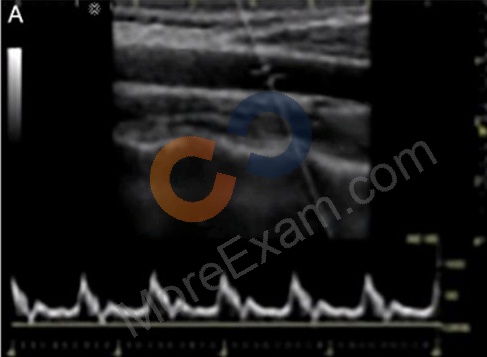
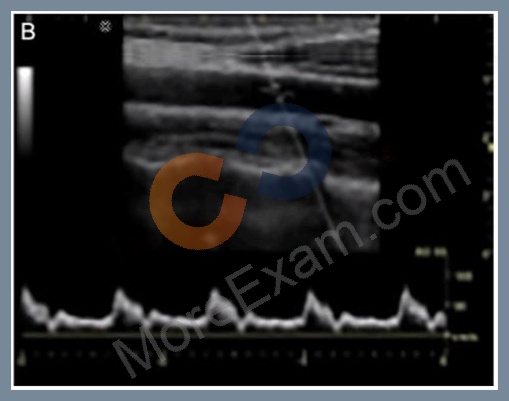
Question2: Which system control adjusts amplification of signals as a function of depth?
Question3: What does damping in a pulsed-wave transducer affect?
Question4: Which factor influences color flow imaging frame rate?
Question6: What is the primary factor that improves lateral resolution?
Question7: Which settings will lead to the highest temporal resolution?
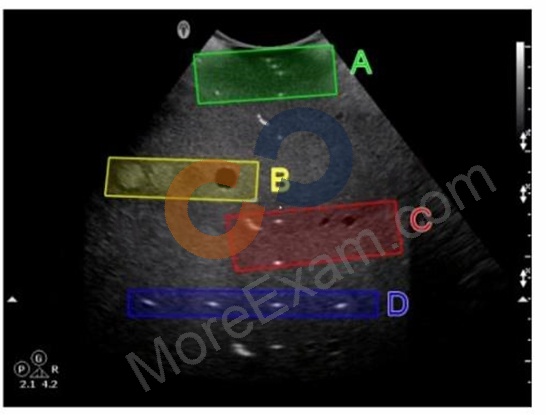
Question9: What happens to the Doppler shift when the angle is changed from 30 to 60 degrees?
Question10: Which technique averages individual frames together to improve the image?
Question11: Which factor improves axial resolution?
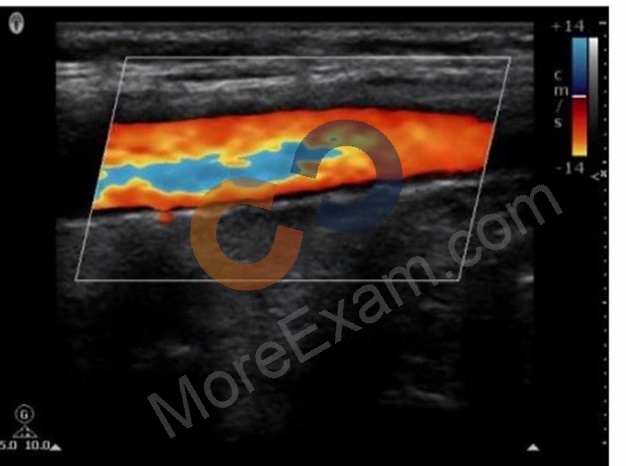
Question13: Which adjustment resulted in the change from image A to image B?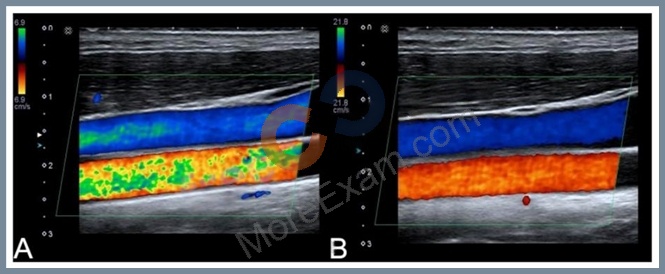
Question14: Which adjustment would reduce the noise in the Doppler waveform in this image?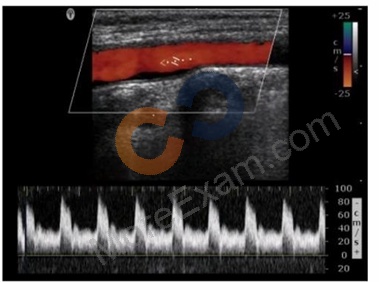
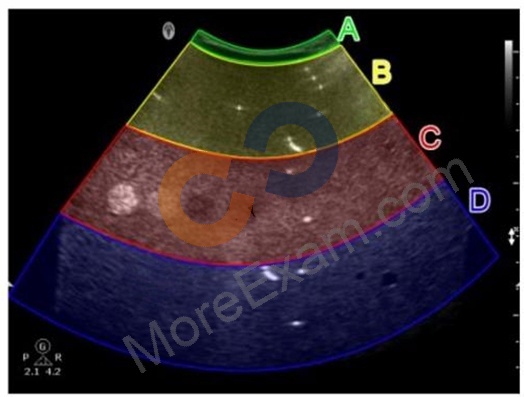
Question16: How is intensity of an ultrasound beam measured?
Question18: Which feature is a characteristic of continuous wave Doppler?
Question19: What is a potential negative consequence of using a high wall filter?
Question20: Which resolution is improved by focusing?
Question21: Which index is related to the likelihood of cavitation?
Question22: Which color Doppler artifact is visualized in this image?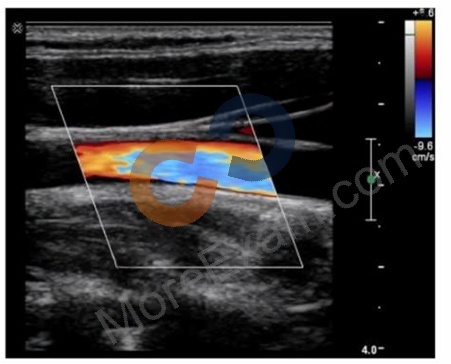
Question23: What improves the temporal resolution of color flow imaging?
Question24: What does this image demonstrate?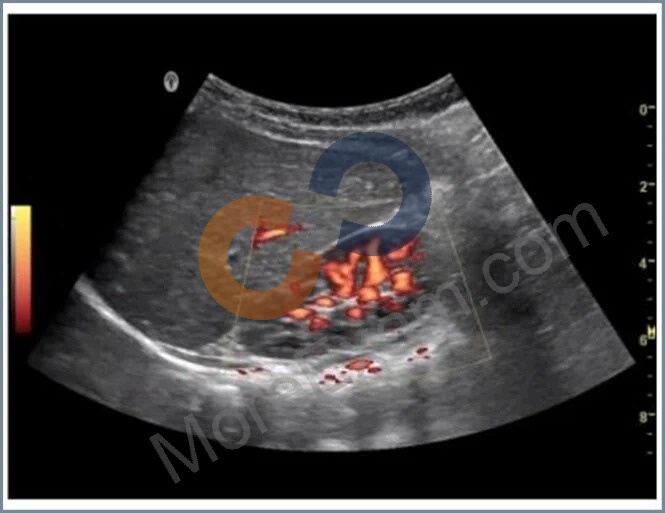
Question25: Which change can be made in order to avoid exceeding the Nyquist limit?
Question26: Which method of sanitizing the transducer would damage piezoelectric crystals?
Question27: What is the relationship between overall gain and image brightness?
Question29: Which factor affects temporal resolution?
Question30: What is the benefit of using a wall filter?
Question31: Which is a method to reduce noise?
Question33: Which color control was adjusted in color bar A to produce color bar B?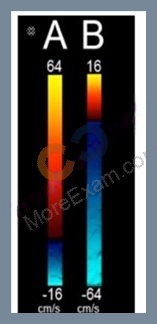
Question34: Which statement characterizes the primary difference between image A and image B?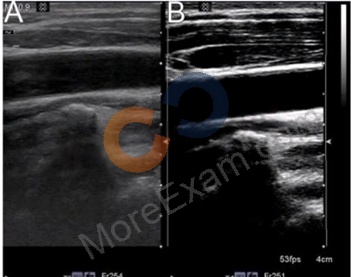
Question35: Which resolution capability is most affected by spatial pulse length?
Question36: What determines the resonant frequency of a pulsed wave transducer?
Question37: Which will affect the gray-scale of a 2-D image?
Question38: What is effected by increasing the color scale?
Question39: In this image, what does the data below the baseline represent?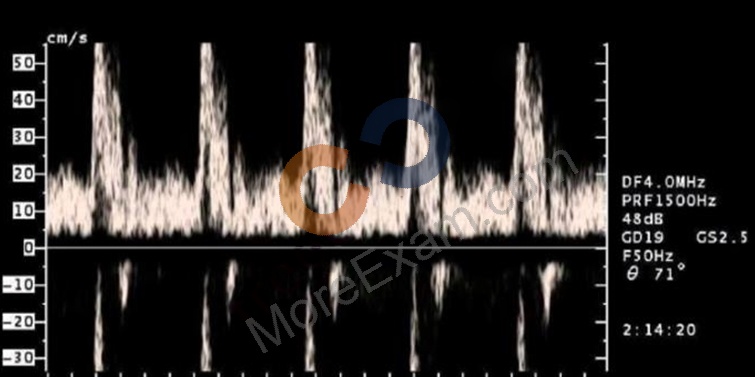
Question42: What is the function of M-mode?
Question43: Which machine setting could cause aliasing to occur?