EMT Practice Test

1. Question Content...


Question List

Question1: What portion of Activity B is on the critical path?

Question2: Select the most appropriate explanation for use of a winter/wet weather seasonal calendar for use in this project?

Question3: Each of the following accurately describes total float in a schedule EXCEPT:

Question4: Using the normal schedule, given Activity 3001 and the relationship with Activity 4001. what is indicated?

Question5: Which of the following risks CANNOT be estimated by BILCO with only a resource-loaded schedule?

Question6: Theoretically construct a summary activity for activities 2001 through 2004. Using the "normal" schedule, what is the cost of the hammock?

Question7: Which of the following are NOT considerations or constraints of the planning process for construction scheduling?

Question8: Determine the correct formula and date for the late start for Activity 9001.
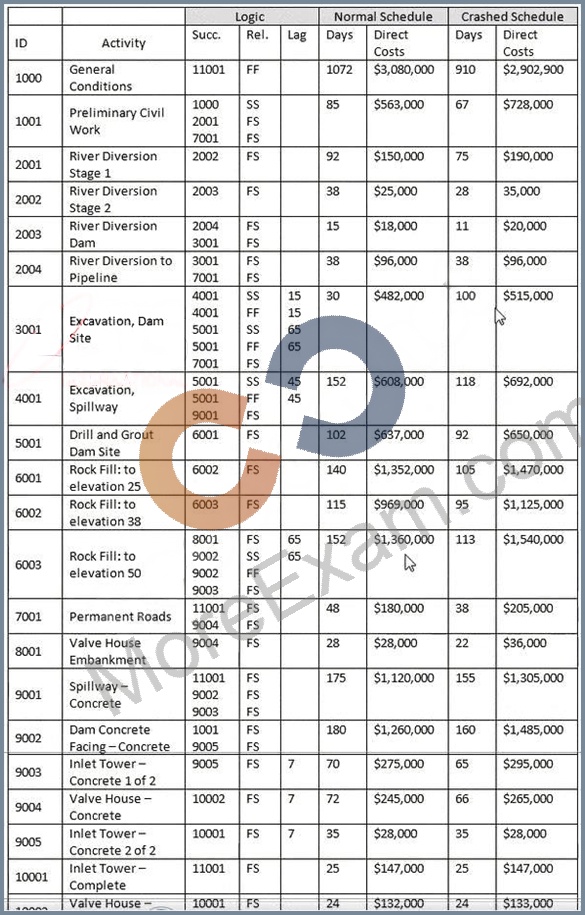
Question9: Using the "normal" schedule, and assuming you are billing on the last day of the month for previous month and for appropriate partial months, how many invoices will you have for this project?

Question10: What is accurate about Activity 7001 in the precedence diagram?

Question11: Determine the correct formula and date for the late finish for Activity 2002.

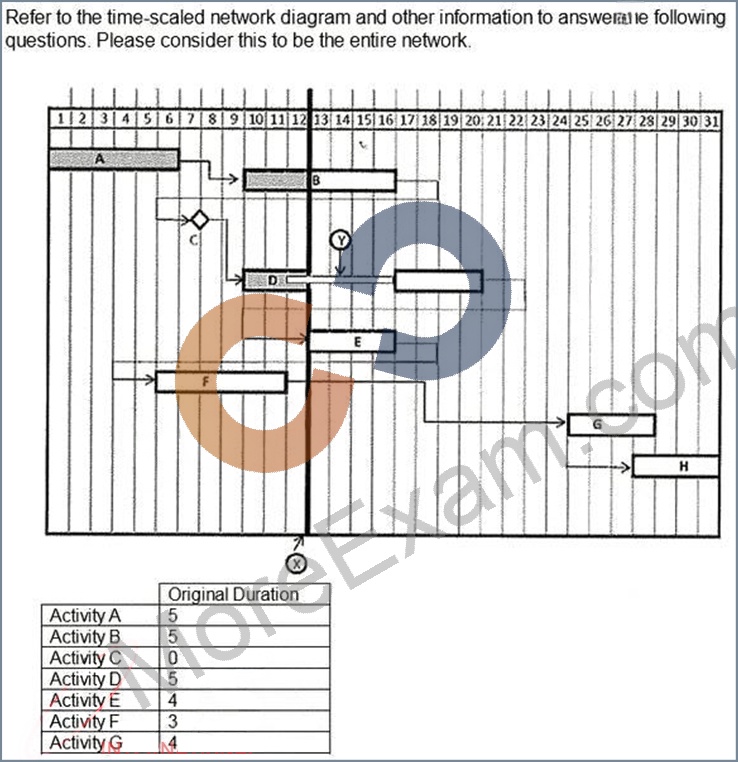
Question12: If Activity A was delayed 5 days from starting, which of the following adjustments will NOT maintain the completion date of Activity C at Day 40?

Question13: Using the "normal" schedule, what is the early finish date of activity 10002 and its total float?

Question14: In analyzing a logical chain of activities in a critical path method (CPM) schedule, what do differing total float values within that chain typically indicate?

Question15: Which of the following will NOT affect the total float calculation of a non-resource leveled schedule?

Question16: Which of the following is NOT a tool or technique used to perform scope planning?

Question17: Which of the following are NOT normally included in the project scope statement, either directly or by reference?

Question18: If after calculating a schedule an activity exhibits negative total float, which of the following is certain? The activity

Question19: Using the "crashed" schedule, if you start Activity 2002 on August 12, 2001, what is the finish date for Activity 2002?

Question20: Budgeted cost of work scheduled is _______________________.

Question21: Determine the driving activity for Activity 10001.

Question22: You are retained by a contractor who asks you to perform a simple as-planned versus as-built analysis (APAB) of a large hydro-electric dam project that took more than five years to complete. Your analysis will form the basis of a change order that requests a time extension. You suggest using a different methodology for quantifying the delay. Which of the following reasons for recommending a different analysis does NOT apply to a simple APAB analysis?

Question23: What method offers the best chance of the schedule being used effectively to implement the project in the field?

Question24: When resource leveling craft labor for a critical path schedule, the scheduler

Question25: How many work days does it take to move the product from testing to sale?
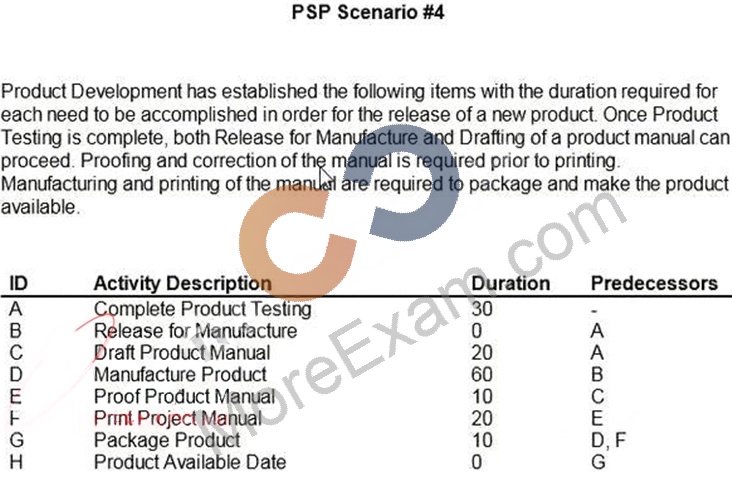
Question26: The addition of which of the following relationships would cause a logic loop?

Question27: If a cost estimate assumes that 240 hours will be expended on a given activity, and the projected crew size expected to perform that activity is 5 personnel working and 8-hour workday, what is the calculated duration for the activity?

Question28: As a change to the network for the current update, activity 6002 is required to begin ten days after the beginning of activity 6001. Which is the simplest logic organization?

Question29: Determine the correct formula and date for the late finish for Activity 2001.

Question30: Which letter of the alphabet best approximates the graphical shape of a project's cumulative cost baseline, or budgeted cost of work scheduled?

Question31: Which of the following will always describe the critical path? The path with

Question32: For which of these delays should an owner grant a time extension?

Question33: Free float is the

Question34: Activity C is a

Question35: Activity 1001 started on the scheduled date but has slipped 10 days. Activity 10002 will slip 35 days. All remaining activities retain their original duration. What is the revised completion date?

Question36: Which of the following is NOT required when initially planning a project?

Question37: An earned value-based project control system can use either of which two budgets as the basis of its calculations?

Question38: Which of the following phases does NOT describe the commonly accepted construction life cycle?

Question39: Assuming that you had only one crane capable of 30 lifts per day, 3 column pours requiring 28 lifts each, plus associated assorted work requiring an additional 150 lifts, what is the minimum planned working duration for this work?

Question40: Considering the information provided for the project, what is the factor that most influences the successful crashing of the schedule?

Question41: What method would be the best way to determine the most likely as-built critical path of a project that is underway, and the schedule of which has been partially progressed?

Question42: At the end of month one, did the delay to the parking structure foundation delay the project?

Question43: Determine the correct formula and date for the late finish for Activity 6002.

Question44: What is a critical path method schedule?

Question45: What is the primary difference between the arrow diagramming method (ADM) and the precedence diagramming method (PDM)?

Question46: Background
Your name is Evan Marshal. You are the corporate scheduler for Happy Insurance Corporation (HIC), a general health insurance company located in Ridgemond, Illinois. HIC is very busy with 49 unique software development projects. The organization structure at HIC gives the project scheduling responsibility to the Project Manager assigned to each project. You are charged with coordination of the project schedules into a Master Schedule and quality control for scheduling on the individual development projects. You report directly to the Director of Information Services (DIS), Desmond Rayburn.
It has come to your attention Project JP-114 has fallen behind schedule and Rita Belateau, the Project Manager, wants to accelerate the project in order to reclaim lost time. Rita is a strong supporter of Total Quality Management and strives for zero failures; therefore she is assessing the need for overtime for resources assigned to an activity that is not projecting a completion prior to the early finish depicted in the current schedule.
You and Rita review the current schedule to identify which activities are on the critical path and which activities have plenty of float. The review reveals several activities have suffered less than planned productivity and have contributed to falling behind. In the process of this review, you and Rita also review the budget for Project JP-114 and notice not only the schedule has fallen behind but the cost to date is more than she had expected. To total budget is $150,000, planned to date is $30,000; expended to date is $37,000.
With nine months remaining until baseline contract completion, Rita needs to bring Project JP-114 back on track; knowing overtime for an extended period of time is not always the right answer, especially with the cost to date already over planned.
In order to truly understand the options available to help remedy the current situation, you and Rita brainstorm on several potential courses of action. All the potential courses of action will require an evaluation of budget impact versus schedule correction.
1. Pull the project team together and ensure everyone understands which activities are on the critical path.
Rita would like to use the existing project team and focus them on these critical path activities, laying out a plan for periodic overtime when needed to crunch through a deliverable. This approach could add approximately 20% to the budget.
2. Outsource various modules of activities to qualified and known consultants. This could drive up the costs and must be evaluated before implemented. Having an outside source working in parallel with the project team could also accelerate the schedule to mitigate some of the delays, as well as keep overtime down to a minimum for the project team. Potentially this could add as much as 40% to the budget, but could also be very productive schedule wise.
3. Mandatory overtime for the project team - entire project goes on a 50-hour work week. If the entire project team works overtime for an extended period of time, the budget could see an additional 60% increase.
4. The project continues as is completes the project late and accepts the penalties imposed. Penalties imposed for late delivery could add as much as 50% to the budget.
Assignment
Draft a proper memorandum to Desmond Raybum, IS Director, explaining in your own words:
a). the current problem and potential impact(s);
b). each course of action, stating advantages and disadvantages as appropriate;
c). your recommendations, properly supported.
Please be sure to include the rationale for your recommendations. Be sure to summarize your thoughts and address (To, From, Date, and Subject/Project Name) and close the memo appropriately. If you are uncomfortable with the courses of action noted, provide your own with appropriate substantiation for your position. Limit your answer to one, full typewritten page (roughly three handwritten pages).
While your email can be a detailed as you like, be sure to write sufficiently to address each element of the assignment, yet not so long that you go beyond the scope of the exercise.
Take time to read the problem and consider what you want Evan to say. Good luck!

Question47: An early start constraint dictates

Question48: When reconstructing a CPM schedule electronically from a hardcopy, which of the following is NOT required to determine the critical path?

Question49: Project schedules help control all of the following EXCEPT for_____________________.

Question50: What activities are concurrent to Activity 2001 in the "normal" schedule?

Question51: These are the activities on the critical path:
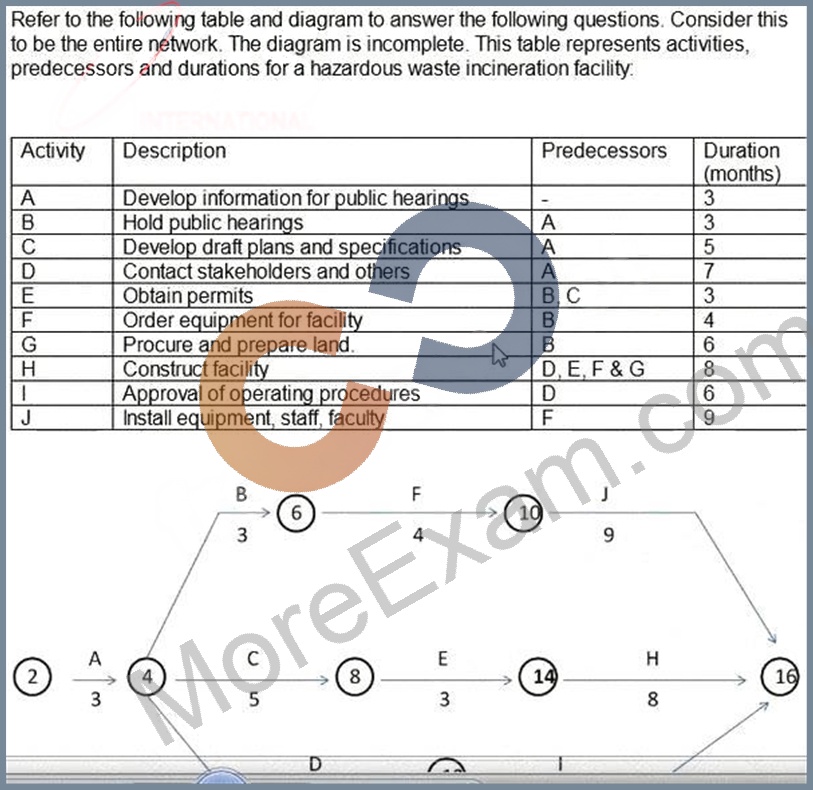
Question52: Who will receive the most benefit from a master schedule of the Spring Highway project?

Question53: Which statement is true?

Question54: By subtracting a measured unit productivity rate during an impacted period from the unit productivity rate during an unimpacted period, the resulting value represents:

Question55: If no time extensions are granted and all actual delays are as described above, what will the total float calculation be at the end of the project?

Question56: Assumptions made during the planning stage should be_____________.

Question57: How much Total Float does drafting the product manual have?

Question58: What is the remaining work duration of Active D?
Question59: Which of the following project planning situations is the most frequent contributor to cost overruns?

Question60: What changes to logic would eliminate Activity B from the critical path?

Question61: Using the "normal" schedule, given Activity 3001 and the relationship with Activity 4001, what is indicated?

Question62: Midway through the project you received an executed change order for this project, adding thirty-three days to the contract for weather delays. In its simplest form, how would your next project update display the changed condition?

Question63: The BEST reason to use multiple calendars is to:

Question64: The sum of all budgets for work scheduled to be accomplished within a given time period is the
____________.

Question65: A driving relationship is _____________________.

Question66: Estimate to complete (ETC) is __________________.

Question67: All the following describe the critical path of a schedule EXCEPT:

Question68: Which of these letters, symbols or words best approximates the graphical shape of a project's cumulative BCWS?

Question69: The work breakdown structure is used to organize

Question70: Identify the late finish to develop plans and specs.

Question71: Using the "normal" schedule, theoretically construct a hammock for activities 2001 through 2004. What is the duration of the hammock?

Question72: Theoretically construct a summary activity for activities 6001 through 6003. Identify the governing predecessor and successor activities for the hammock:

Question73: How could the structural steel drawing delay have been prevented?

Question74: SUBCO is a potential concrete bridge contractor based in a metropolitan area 300 miles away from your project. They have offered to supply manpower and equipment t BILCO at a per diem rate of $3,000 above their direct labor and equipment rates. In doing a cost benefit analysis, which of the following is NOT a consideration?

Question75: During proofing of the product manual, a problem was discovered requiring 15 days additional time to affect a correction. How can the date of availability be maintained?

Question76: Which of the following statements is true?

Question77: If a detailed estimate is NOT available to assist in the formulation of activity durations but unit quantities have been identified, what information can be utilized to estimate work package/activity durations?

Question78: What project cost elements would NOT normally be reflected in the Activity 1000?

Question79: The linear scheduling velocity diagram has the following two-axis:

Question80: Total float is defined as the amount of time an activity can be delayed without impacting

Question81: Is activity 7001 pictured correctly in the precedence diagram?

Question82: Which of the following is NOT input data to the construction planning process?