EMT Practice Test

1. Question Content...


Question List

Question1: What is a common cause of poor power quality?
Question2: A cooling tower delivers 29°C water to a central chilled water plant. The cooling tower is capable of delivering water to the chilled-water plant with a 6°C approach temperature to the ambient wet bulb temperature. Using this information, what type of control strategy would you recommend be added to the cooling tower operation to save additional energy?

Question3: A desk lamp is located inside a windowless office. The office is heated during the winter and cooled during the summer. When the lamp is switched on, how much of the energy consumed by the lamp becomes heat in the office space?

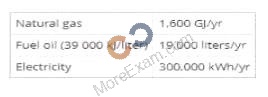
Question4: What is the Energy Use index (EUl) for a 4,000 m2 building that uses the following amountsof energy each year?

Question5: A new energy-efficient boiler costs $60,890 to buy and install. The new energy-efficient boiler will save
$15,400 per year and last for 20 years. What is the internal rate of return (IRR) of the project?

Question6: Which of the following controls can optimize the operation of lighting systems?

Question7: Which is the best application for variable-speed drives?

Question8: A compressed-air distribution system has one section that frequently has low pressure when demand for compressed air is high. How can you resolve the problem without increasing energy consumption?

Question9: The International Performance Measurement and Verification Protocol (IPMVP) has how many categories (method options) to determine the performance of an energy- or water-consuming system?

Question10: What does a manometer measure?

Question11: Which of the following is a closed-loop controller?

Question12: Which heat recovery device listed below can be used to preheat boiler make-up water using the heat energy from skimming blowdown?

Question13: Air is heated from 10°C (dry bulb temperature) and 80% relative humidity to 32°C (dry bulb temperature).
What is the new relative humidity?

Question14: What instrument determines flow rate by measuring pressure differential?

Question15: Which problems can be caused by poor power quality?

Question16: What instrument is NOT used to measure temperature?

Question17: What term describes the difference between the control signal value and the set point?

Question18: Infiltration (inward air leakage) in a building is dependent on several factors. Which of the following is least likely to affect or influence infiltration in a building?

Question19: A cooling tower is delivering water to a chilled-water plant. The cooling tower outlet temperature has a 6°C approach temperature to the ambient air, wet-bulb temperature. The outside air conditions are 20°C dry bulb,
60% relative humidity. Using the psychrometric chart, at what temperature can the cooling tower deliver water to the chilled-water plant?

Question20: Which of the following color temperatures looks more like daylight?

Question21: Using the lumen method, calculate the number of luminaires (fixtures) required to light a room to 200 lux.
Each luminaire has 2 fluorescent lamps, 3,000 lumens per lamp. The room is 20 meters by 30 meters. The total light loss factor (LLF) is 0.70 and the luminaire coefficient of utilization (CU) is 0.80.

Question22: Lighting systems operate with a certain recoverable light loss factor. Control systems with photocell sensor inputs combined with dimming ballasts can be used to regulate dimming levels to maintain a continuous light level in the work space. Which of the following best describes this type of control?

Question23: Which electric rate tariff would best cost justify a thermal energy storage (TES) system?

Question24: Natural gas costs $4.80/GJ. How much does it cost to heat 500 liters of water from 18°C to 50°C using a natural gas water heater with an efficiency of 85%? [The efficiency and fuel price are both based on HHV.
The specific heat of water (C) is 4.2 kJ/kg-°C.]

Question25: Which of the following steam turbines will likely not provide steam output at a useable temperature for industrial processes?

Question26: A 100-kW electrical load has a power factor of 75%. What capacitance, in KVAR, will improve the power factor to 95%?

Question27: An energy-saving project costs $540,000. The project will have maintenance costs of $25,000 per year. The energy savings from the project are $160,000 per year. What is the simple payback of the project?

Question28: If a boiler cycles on and off too frequently, what control can you adjust to reduce the number of times a boiler cycles on and off?

Question29: In a chilled water thermal energy storage system, chilled water is stored at 4°C and used for supply water.
Chilled water return is 14°C. Calculate the storage capacity required to hold 50 GJ of thermal cooling. (The specific heat of water (C) is 4.2 kJ/kg-°C. Assume no system losses.)

Question30: Which of the following statements regarding refrigerants is NOT correct?
5ELECT THE CORRECT ANSWER

Question31: Which of the following International Performance Measurement and Verification Protocol (IPMVP) options would you use to verify annual energy savings in a project that upgraded lighting in a large manufacturing plant?

Question32: Which type of lighting control technique operates in "manual on" and "auto-off mode, and can be used in situations where there is brief occupancy that do not need lights on?

Question33: A controller has a signal output that can range from 4 to 20 mA (milli-amperes). The controller regulates the output temperature from a three-way mixing valve from 5°C to 15°C. What is the control gain?

Question34: What is the purpose of monitoring energy consumption?
SELECT THE CORRECT ANSWER

Question35: Periodic commissioning of a building automation system (BAS) might include which of the following?

Question36: Which of the following statements best describe Demand Control Ventilation (DVC) in Building Automation Systems?

Question37: When should commissioning be included in the design and construction of a facility?

Question38: A refrigerant-to-water heat exchanger can be added to air-conditioning equipment to heat water using the waste heat in the vapor compression refrigerant cycle. Where is this type of heat exchanger located in the refrigerant loop?

Question39: A 1OO-kW packaged engine-generate combined heat and power (CHP) system has the specifications listed below. The CHP equipment operates fully loaded for 8.000 h/yr. What isthe annual fuel cost for the ChP equipment?
CMP equipment specifications: Electrical output 100kw Electrical efficiency: 25% Thermal recovery efficiency: 50*6 Total CMP efficiency: 75% Additional information: Fuel cost: S3.S0/GJ Electricity cost S0.06/kWh Previous water heating efficiency:
8046 Mot water usage: 75,700 liters/day (21 *C temperature rise)
[The question from the previous image, which was about calculating the annual cost of heat loss through a wall, but had a discrepancy between the calculated cost and the provided answer choices]

Question40: How can you tell if steam traps in a steam distribution system may NOT be working correctly?

Question41: In a warehouse, lights are mounted 4 meters above the floor. This provides an average light level of 150 lux.
To increase the light level without installing more lights or higher Wattage lights, you lower the light fixtures with pendants so that the lights are located 3.25 meters above the floor. Calculate the new average light level on the floor.

Question42: A 7 bar (gauge pressure) compressed air system has 5 leaks that are 3 mm in diameter and 3 leaks that are 6 mm in diameter. The compressed-air system is pressurized 8,760 hours per year. Electricity cost is $0.10
/kWh. What is the annual cost of the leaks in the compressed air system?

Question43: If the initial design process includes group relamping, how can this reduce the number of lamps required to illuminate a space?

Question44: Using an interest rate of 15%, an energy project has a net-present value (NPV) of $3,500. Which statement is true about the project's internal rate of return (IRR)?

Question45: Exhaust gases from an industrial furnace flow through a heat-recovery steam generator, which generates medium-pressure steam. This steam is used in a steam turbine to generate shaft power driving a fan. Which type of combined heat and power (CHP) cycle does this process describe?

Question46: A facility replaces a natural gas heating system rated at 10,000 kJ/h and 80% efficiency with an electric heat pump rated at 10,000 kJ/h and a coefficient of performance (COP) of 2.3. Will this project also reduce the annual energy utilization index (EUI) for the facility?

Question47: How does an enthalpy-based economizer control operate?
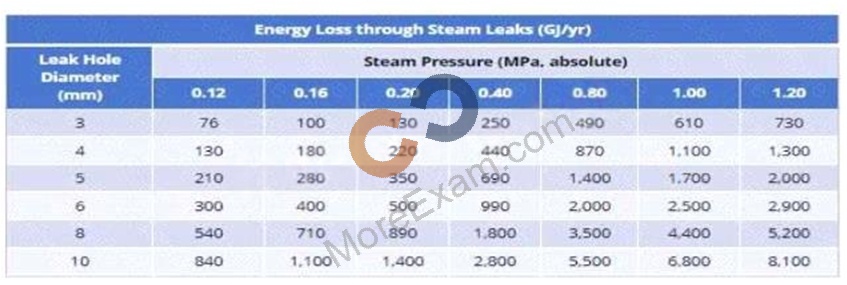
Question48: A steam trap with a 6-mm orifice in an 0.8-MPa steam system has failed open. The steam system is pressurized8.760 hours/yr. The steam cost is $15.00 /GJ. Using thetable below, what is the annualcost of the vented steam through the failed steam trap? ignore any condensate return issues.

[The question from the previous image, which was about calculating the annual cost of heat loss through a wall, but had a discrepancy between the calculated cost and the provided answer choices]

Question49: A 50-Hz alternating current (AC) induction motor has 3 pole pairs (6 poles). What is the synchronous speed of the motor?

Question50: An air-conditioning system at full load is rated at 70-kW (thermal cooling) and has a coefficient of performance (COP) of 4.1. What is the electrical load at full load?

Question51: A facility owner is considering installing a new chiller. The installed project cost will be $300,000. The annual savings from the energy-saving project will be $45,000 for the 20-year life of the chiller. If an energy- service company requires a minimum 20% return on investment (pre-tax), will the energy-service company agree to finance this project?

Question52: Electricity costs SO. 10 per kWh. if an electric water heater has an efficiency of 95*6. what is the equivalent price of natural gas per Gigajoule for a natural gas water heater? The natural gas water heater has an efficiency of 95*t based on lower-heating value.
[Natural gas has an energy content of 36.400 K|/m3 (higher-heating value) and 32-760 K/m3 (lower-heating value).] SELECT THE CORRECT ANSWER

Question53: A concentrating solar thermal system collects 5 GJ/h of thermal heat, which is delivered to a 94% efficient hot water generator. The hot water generator is used to raise the water temperature from 15°C to 65°C. The specific heat of water (Cp) is 4.2 kJ/kg-°C. What flow rate (liter/second) of hot water can be delivered from the hot water generator?

Question54: A gas-fired boiler is operating with 31.9% excess air. A feedwater economizer is used to reduce the stack temperature rise from 310°C to 160°C. Using the natural gas combustion efficiency tables in your workbook, find the energy savings from the economizer as a percentage of historical fuel consumption.

Question55: A compressed air system has a total volume of 247,500 liters. During a 30-minute break in production (air compressor system turned off and no production demand for compressed air), the system pressure drops from
7 bar, gauge (700 kPa, gauge) to 5 bar, gauge (500 kPa, gauge). Calculate the leakage rate in the compressed air system.

Question56: A motor operates with a normal and constant load. The electric current is measured to be 25% of the motor's nameplate rating. What does this mean?

Question57: Why do electric utility companies transmit power at high voltages?
SELECT THE CORRECT ANSWER

Question58: Which of the following statements best describe Demand Control Ventilation (DVC) in Building Automation Systems?

Question59: Using the natural gas combustion efficiency tables in your workbook, find the combustion efficiency (based on higher-heating value) of a natural-gas-fired boiler if the excess air level is measured at 31.9% and the stack temperature rise is 187.8°C.

Question60: What is a common method to reduce the impact of voltage imbalance?

Question61: Which motor parameter is the most difficult to measure with precision?