EMT Practice Test

1. Question Content...


Question List

Question1: Who is responsible for preparing the corrective action plan?

Question2: Sampling procedures used in audits are designed to

Question3: When is it acceptable to grant an extension of the time frame for a corrective action?

Question4: Which of the following is most important for an auditor to convey at an initial audit interview?

Question5: Auditor independence includes freedom from which of the following?
I. Bias
II. Conflict of interest
III. External influences
IV. Previous exposure to the area

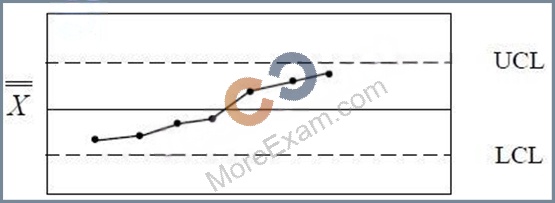
Question6:
The process information shown in the graph above is indicative of a

Question7: During an audit, the best way to determine whether an audited process is consistent with the requirements of the relevant written procedure is by

Question8: Which of the following is most likely to request an audit?

Question9: An auditor finds deficiencies in the order entry, purchasing, product test, and shipping functions of a potential supplier. Which of them should have the highest priority in the audit report?

Question10: During the opening meeting, it is the auditee's responsibility to

Question11: Which of the following conclusions can be made by an auditor who observes that statistical process control (SPC) charts posted near operator workstations are done correctly and are regularly completed throughout the plant?

Question12: Which of the following represents a sound time-management technique?

Question13: Which of the following types of tools or techniques is considered qualitative?

Question14: The confidence level in a sampling plan is defined as the

Question15: The main purpose for conducting an opening meeting for an audit is to

Question16: Communication by telephone is likely to be most effective when it is used for

Question17: Measures of which of the following provide attributes data?

Question18: Which of the following behaviors is LEAST important for an auditor to exhibit?

Question19: To determine whether a finding is a minor, isolated incident or a serious, chronic problem, an auditor should consult with the

Question20: The best way to communicate audit results to upper management would be to

Question21: Which of the following qualifications would contribute most to an auditor being able to function effectively in various industrial or service disciplines?

Question22: During the closing meeting, what is the advantage of having the lead auditor be the only presenter of the audit findings?

Question23: During an audit, the client learns that the auditor has recently completed a quality system audit of a major competitor. The client then questions the auditor about the competitor's audit results. The best action for the auditor to take is to

Question24: The following portion of the test includes several Case Studies. Each Case Study includes introductory information about a specific company or audit situation, followed immediately by a set of questions related to the situation described and various audit-related documents, identified by company name.
All of the audit-related documents for these Case Studies are presented in a separate booklet labeled:
CONFIDENTIAL
Audit Documents
These documents were drawn from actual companies and are designed to be examples of genuine audit materials. Their format and contents have not been altered, and they are intended to represent working documents from everyday situations.
Although the documents for the Case Studies are presented separately, the test will be scored as a whole, on a total of 150 questions. You may go back and check your work on any part of the examination until time is called at the end of the testing period.
Two auditors are conducting an internal audit of the Quality Electronics and Elements Co. (QEE) system procedures. During the first day of the audit, the following observations were made.
An outbound carton with obvious damage was examined by the auditor on the shipping dock.

A shipment of six (6) boxes to Allied Supply was returned because the customer-required certifications

did not accompany the product.
Unsigned product verification documents were found on stored products.

Of three (3) cartons found in the accepted materials station, only two of the cartons had labels

indicating their contents. When the auditor pointed this out, a customer service representative immediately affixed the proper label to the one unlabeled carton.
The auditor also found that "Accepted Material Traveler Cards" were not attached to any of the cartons

in the accepted materials station.
The auditor's finding on products without "Accepted Material Traveler Cards" should be written against which of the following departments?

Question25: Who makes the final determination regarding the distribution of the audit report?

Question26: An auditee is likely to be most threatened by an auditor's use of which of the following interviewing techniques?

Question27: Audits are conducted against a performance standard to ensure which of the following?
I. Meaningful measurements
II. Objectively evaluated performance
III. Perceptive observations

Question28: Quality system audits are directed at evaluating the

Question29: A quality audit observation is defined as

Question30: When a proposed corrective action plan is judged unacceptable, an auditor should do which of the following?

Question31: In quality auditing, a finding is defined as

Question32: Within most organizations, the responsibility for planning and carrying out a programmed series of quality system audits rests with the

Question33: Which of the following audit strategies is a common technique to assess compliance to a specific requirement at all locations where that requirement is applicable?

Question34: The following portion of the test includes several Case Studies. Each Case Study includes introductory information about a specific company or audit situation, followed immediately by a set of questions related to the situation described and various audit-related documents, identified by company name.
All of the audit-related documents for these Case Studies are presented in a separate booklet labeled:
CONFIDENTIAL
Audit Documents
These documents were drawn from actual companies and are designed to be examples of genuine audit materials. Their format and contents have not been altered, and they are intended to represent working documents from everyday situations.
Although the documents for the Case Studies are presented separately, the test will be scored as a whole, on a total of 150 questions. You may go back and check your work on any part of the examination until time is called at the end of the testing period.
Two auditors are conducting an internal audit of the Quality Electronics and Elements Co. (QEE) system procedures. During the first day of the audit, the following observations were made.
An outbound carton with obvious damage was examined by the auditor on the shipping dock.

A shipment of six (6) boxes to Allied Supply was returned because the customer-required certifications

did not accompany the product.
Unsigned product verification documents were found on stored products.

Of three (3) cartons found in the accepted materials station, only two of the cartons had labels

indicating their contents. When the auditor pointed this out, a customer service representative immediately affixed the proper label to the one unlabeled carton.
The auditor also found that "Accepted Material Traveler Cards" were not attached to any of the cartons

in the accepted materials station.
During the second day of the audit, another unlabeled product container was delivered to the accepted materials station. When the auditor noted the lack of label, the auditee immediately filled out a label and affixed it to the container. In this situation, the auditor should do which of the following?

Question35: While performing an internal audit, an auditor notices that an operator on one shift skips part of the documented procedure. In this situation, the auditor should do which of the following?

Question36: Audit team members are responsible for which two of the following?
I. Initiating the audit
II. Remaining within the scope of the audit
III. Compiling and analyzing evidence
IV. Recommending specific corrective actions

Question37: A quality audit contributes to improvement of the quality of a company's products and services by

Question38: The main function of an audit checklist is to

Question39: An auditee responds to a corrective action request by stating that the problem has never occurred before and is "not the norm for our operation." Which of the following is the most appropriate action for the lead auditor?

Question40: During an audit interview, the auditee is not providing needed information about the process for which the auditee has sole responsibility. In an effort to minimize any miscommunication, the auditor should

Question41: Which of the following is the most fundamental role of the audit function?

Question42: After an external audit, the auditee may be asked to evaluate which of the following auditor skills or elements of the audit?

Question43: Which of the following is the best method for determining the retention policy of the audit documents?

Question44: The most important objective in the development of a supplier evaluation system is to reduce

Question45: Managing the quality audit process includes ensuring that which of the following audit functions occur?
I. Preparing and issuing the annual audit schedule
II. Issuing audit reports in a timely manner
III. Identifying appropriate corrective actions
IV. Assessing the effectiveness of the quality audit process

Question46: When an internal audit program is being formulated, the auditees' anxiety about the audit process is most likely to be reduced by which of the following?

Question47: Which of the following would NOT normally be used as a major category in a cause and effect diagram?

Question48: What action should an auditor take if an auditee responds to a procedural noncompliance by stating that the procedure conflicts with a written company policy?

Question49: Recognizing the need for a follow-up audit is the responsibility of the

Question50: Which of the following is a benefit of performing a systems audit of a current supplier?

Question51: During a supplier audit, all of the following documentation can be reviewed EXCEPT

Question52: An auditee who objects to any part of an audit plan should first make those objections known to the

Question53: Which of the following methods can an audit program manager use to establish consistency among auditors?

Question54: Partitioning or segmenting an audit is a useful way to

Question55: Which of the following is NOT an acceptable method of verifying a corrective action?

Question56: Which of the following is the greatest benefit of an internal audit program to an organization?

Question57: Management of an internal audit program should consider all of the following EXCEPT

Question58: The following portion of the test includes several Case Studies. Each Case Study includes introductory information about a specific company or audit situation, followed immediately by a set of questions related to the situation described and various audit-related documents, identified by company name.
All of the audit-related documents for these Case Studies are presented in a separate booklet labeled:
CONFIDENTIAL
Audit Documents
These documents were drawn from actual companies and are designed to be examples of genuine audit materials. Their format and contents have not been altered, and they are intended to represent working documents from everyday situations.
Although the documents for the Case Studies are presented separately, the test will be scored as a whole, on a total of 150 questions. You may go back and check your work on any part of the examination until time is called at the end of the testing period.
Two auditors are conducting an internal audit of the Quality Electronics and Elements Co. (QEE) system procedures. During the first day of the audit, the following observations were made.
An outbound carton with obvious damage was examined by the auditor on the shipping dock.

A shipment of six (6) boxes to Allied Supply was returned because the customer-required certifications

did not accompany the product.
Unsigned product verification documents were found on stored products.

Of three (3) cartons found in the accepted materials station, only two of the cartons had labels

indicating their contents. When the auditor pointed this out, a customer service representative immediately affixed the proper label to the one unlabeled carton.
The auditor also found that "Accepted Material Traveler Cards" were not attached to any of the cartons

in the accepted materials station.
If the audit also revealed that customer-required certifications were not included with a shipment, a finding should be written against which department?

Question59: A root cause of a nonconformance is defined as a problem that

Question60: Quality auditors help companies improve their processes, products, and services by

Question61: For third-party audits, which two of the following factors should be considered by the auditor when agreeing to the amount of time needed to complete corrective action?
I. The resources available to the auditor for determining when follow-up can occur II. The resources available to the auditee to enact the corrective action III. The auditee's experience in project evaluation techniques
IV. The number of findings recorded during the audit

Question62: An auditee's procedures require that all design drawings be dated and signed. During a design review, an auditor notices that several drawings are signed, but not dated. The missing dates are examples of what kind of data?

Question63: When lower-tier documents are compared to higher-tier documents before the fieldwork starts, the comparison is called a

Question64: As the last step before distributing an audit plan, an auditor should have the plan

Question65: Generally, which of the following is the most meaningful way to trace a finished product?

Question66: During the course of a 10-day system audit, when should the auditee be briefed?

Question67: Which of the following factors related to scheduling would most directly affect the performance of an audit?

Question68: Which of the following statistics would best describe the central tendency of a sample of data?

Question69: Auditors can use flowcharts in their work in order to

Question70: Which of the following is an audit reporting technique for prioritizing audit findings?

Question71: Management can best ensure support for the audit function from other departments by

Question72: An auditee has responded to all requests for corrective action in a timely manner. Which of the following is the next step for the auditor?

Question73: An audit schedule is an integral part of which of the following phases of the auditing process?

Question74: An audit trail is necessary in order to

Question75: The type of chart that presents the value of items in descending order is a

Question76: An auditor is performing an audit of a drilling machine that produces 100 pieces a day and that is showing improved quality. Which of the following rules should be used for determining the proper sample size for a fixed level of confidence?

Question77: Which of the following indicates that a quality system is effective?

Question78: The following portion of the test includes several Case Studies. Each Case Study includes introductory information about a specific company or audit situation, followed immediately by a set of questions related to the situation described and various audit-related documents, identified by company name.
All of the audit-related documents for these Case Studies are presented in a separate booklet labeled:
CONFIDENTIAL
Audit Documents
These documents were drawn from actual companies and are designed to be examples of genuine audit materials. Their format and contents have not been altered, and they are intended to represent working documents from everyday situations.
Although the documents for the Case Studies are presented separately, the test will be scored as a whole, on a total of 150 questions. You may go back and check your work on any part of the examination until time is called at the end of the testing period.
Two auditors are conducting an internal audit of the Quality Electronics and Elements Co. (QEE) system procedures. During the first day of the audit, the following observations were made.
An outbound carton with obvious damage was examined by the auditor on the shipping dock.

A shipment of six (6) boxes to Allied Supply was returned because the customer-required certifications

did not accompany the product.
Unsigned product verification documents were found on stored products.

Of three (3) cartons found in the accepted materials station, only two of the cartons had labels

indicating their contents. When the auditor pointed this out, a customer service representative immediately affixed the proper label to the one unlabeled carton.
The auditor also found that "Accepted Material Traveler Cards" were not attached to any of the cartons

in the accepted materials station.
Which department is responsible for determining whether an outbound product has been damaged in handling or storage?

Question79: Which of the following types of data is likely to be most reliable?

Question80: An audit report should contain which of the following?

Question81: Auditors who audit outside their own country should be familiar with

Question82: Typically, which two of the following are more important to an auditor in maintaining his or her auditing competency?
I. Understanding current standards for quality systems
II. Attending audit closing meetings
III. Networking with other auditors and auditing organizations
IV. Learning about changes to existing auditing techniques

Question83: Which of the following is the most useful graphical tool for promoting an understanding of process capability?

Question84: Which of the following is an example of a short-term corrective action?

Question85: When should audit checklists be prepared?

Question86: The fraction of nonconforming products is plotted on which of the following types of control charts?

Question87: If the audit escort for one area is repeatedly late or unavailable, what is the best option open to the auditor?

Question88: An internal audit schedule should be prioritized on the basis of all of the following criteria EXCEPT the

Question89: Which of the following requests by an auditor is likely to obtain the most objective evidence for verification?

Question90: The following portion of the test includes several Case Studies. Each Case Study includes introductory information about a specific company or audit situation, followed immediately by a set of questions related to the situation described and various audit-related documents, identified by company name.
All of the audit-related documents for these Case Studies are presented in a separate booklet labeled:
CONFIDENTIAL
Audit Documents
These documents were drawn from actual companies and are designed to be examples of genuine audit materials. Their format and contents have not been altered, and they are intended to represent working documents from everyday situations.
Although the documents for the Case Studies are presented separately, the test will be scored as a whole, on a total of 150 questions. You may go back and check your work on any part of the examination until time is called at the end of the testing period.
Two auditors are conducting an internal audit of the Quality Electronics and Elements Co. (QEE) system procedures. During the first day of the audit, the following observations were made.
An outbound carton with obvious damage was examined by the auditor on the shipping dock.

A shipment of six (6) boxes to Allied Supply was returned because the customer-required certifications

did not accompany the product.
Unsigned product verification documents were found on stored products.

Of three (3) cartons found in the accepted materials station, only two of the cartons had labels

indicating their contents. When the auditor pointed this out, a customer service representative immediately affixed the proper label to the one unlabeled carton.
The auditor also found that "Accepted Material Traveler Cards" were not attached to any of the cartons

in the accepted materials station.
Who is responsible for evaluating the adequacy of QEE's handling and storage practices?

Question91: "What are your defined responsibilities in the calibration laboratory?" The question above is an example of what type of questioning technique?

Question92: Which of the following best describes a frequency distribution?

Question93: A cause and effect diagram is a useful tool for doing which of the following?

Question94: A root cause analysis can best be described as a process that is used to

Question95: The objective evidence supporting an audit observation must be

Question96: Which of the following authorities initially determines whether a third-party audit should be conducted?

Question97: The auditor has the most independence from the auditee in which of the following types of audits?

Question98: The accuracy of quality audit documentation is especially important in which of the following situations?

Question99: During the closing meeting, the lead auditor should do which of the following?

Question100: Which two of the following conditions must be met in order to infer statistical significance about the results of an audit sample?
I. The population must be homogeneous.
II. The sample size must be greater than 10.
III. The sample must be random.
IV. The sample must be taken from multiple locations.