EMT Practice Test

1. Question Content...


Question List

Question1: The purpose of a failure reporting, analysis and corrective action system(FRACAS) includes which two of the following?
I. Provide a closed loop failure reporting system.
II. Provide initial robust product designs.
III. Provide management with derating methods and principles.
IV. Provide a failure analysis and corrective action vehicle.
Response:

Question2: A system is defined by the following reliability block diagram.

Which of the following block diagrams MOST simply represents the system reliability when Unit C is functioning?

Response:

Question3: Which of the following statistical distributions can be used to compare sample means?
Response:

Question4: Which of the following is TRUE about hypothesis testing?
Response:

Question5: Which of the following are the MOST desirable basic skills required of a reliability engineer assigned to a cross-functional product team?
Response:

Question6: The success of the FMEA is principally dependent on:
I. Good communication between the reliability engineer and the designer.
II. Use of the correct form and definitions.
III. Early determination of the reliability critical items.
Response:

Question7: Which of the following is a primary concern for a reliability engineer who uses publicly available sources for mechanical part-failure rates?
Response:

Question8: If the reliability goal for a 4 - hour mission is 0.9999 for a complex system, what system MTBF is required?
Response:

Question9: When designing experiments, which term describes the situation in which the effects of two factors are not separable?
Response:

Question10: Censoring of data occurs when
Response:

Question11: A failure that leaves the system fully functional is:
Response:

Question12: If the average repair time for a system is 3 hours and the MTBMA is 122 hours, what is the operational availability?
Response:

Question13: The first phase in the operation life history of a population of product units is typically called:
Response:

Question14: A Reliability Engineering Department is conducting a training needs assessment. Which of these techniques are used for a training needs assessment?
I. Personal observations.
II. External customer surveys.
III. Costs analysis.
IV. Work sampling.
V. Interviews.
Response:

Question15: Failure modes and effects analysis involves what activity?
Response:

Question16: Laboratory tests of a new polymer prototype yielded the following proportions of a critical compound:
4.2 ppm, 4.1 ppm, 4.7 ppm, 4.9 ppm, 5.3 ppm
What is the sample standard deviation?
Response:

Question17: Reliability Growth is:
I. Often mathematically modeled with the Duane or AMSSA approaches.
II. The existence of more than one means for accomplishing a given functions.
III. Improvement of a reliability parameter by correcting deficiencies in the design.
Response:

Question18: A key distinction between Taguchi designed experiments and classical designed experiments is that Taguchi designs Response:

Question19: Which mathematical model is characterized by linking exact relationships between variables?
Response:

Question20: A component has a constant failure rate of 0.0005 failures per hour. What is the reliability for 1,000 hours of operation assuming wearout is not a factor?
Response:

Question21: The reliability manager or engineer attend and participate in :
Response:

Question22: Which of the following techniques is NOT used when derating parts to enhance their overall reliability?
Response:

Question23: Which of the following are important elements of the concept of risk?
Ⅰ. Damage
Ⅱ. Frequency
Ⅲ. Schedule
Response:

Question24: When performing trade-offs in evaluating parts for reliability, which of the following is LEAST important?
Response:

Question25: For human factors testing, the reliability engineer should understand and consider which of the following?
I. Sight capabilities.
II. Touch capabilities.
III. Audio capabilities.
IV. Thermal capabilities.
V. Vibration capabilities.
Response:

Question26: What is this system's reliability at 3000 hours?
MTBFs for the components are :
A = 2500 hours B = 3700 hours C = 2000 hours D = 4000 hours.
Response:

Question27: Ideally for a FRACAS to be effective, how many failures should be allowed to pass before corrective action is to be undertaken?
Response:

Question28: Derating a component to 50 percent of its operating value will generally decrease its failure rate by a factor of:
Response:

Question29: In the House of Quality, the principal matrix shows the relationship between:
Response:

Question30: Certain functional tests can be conducted for electronic equipment in the areas of:
I. Endurance testing.
II. Voltage transients
III. Electromagnetic effects.
IV. Wearout determination.
Response:

Question31: As a result of improper machining, a gear-tooth in a vehicle's transmission breaks causing the transmission to lock up and the vehicle to crash, injuring the driver. The failure mode in this case should be identified by the reliability engineer as the Response:

Question32: A sample is split into subgroups. Testing for each subgroup is stopped after the first failure in that subgroup. The times to first failure are plotted and the distribution parameters are estimated.
Which of the following test types BEST describes this situation?
Response:

Question33: Which of the following is best defined as the practice of using parallel components and subsystems?
Response:

Question34: A data collection, analysis, and reporting system should:
I. Permit detailed failure and failure rate analysis for varying environments, time periods, storage conditions, etc.
II. Provide distinction between items that failed and item that were wrongly removed.
III. Report data on successes as well as failures.
Response:

Question35: In an analysis of variance, which of the following distributions is the basis for determining whether the variance estimates are all from the same population?
Response:

Question36: It is reliability's job to see that all the tasks outlined in the reliability program are:
Response:

Question37: Corrective maintenance is performed in order to
Response:

Question38: Which of the following is the BEST approach to recover product reliability from manufacturing?
Response:

Question39: When a bathtub curve is used, one characteristic of the flat center portion of the curve is that during this period Response:

Question40: Which one of the following quantitative methods does NOT apply to the assessment of actual system/component reliability?
Response:

Question41: Specifically, up-time ratio is a measure of:
Response:

Question42: Which of the following is an appropriate use for experimental design?
Response:

Question43: What is the MOST accurate method to verify that the maintainability requirement of a design is being met?
Response:

Question44: Product safety standards do NOT include:
Response:

Question45: All of the following statements concerning statistical inference are true EXCEPT:
Response:

Question46: Internal testing sources of component reliability data are:
Response:

Question47: What type of failure is usually reduced by periodic overhaul and replacement of component parts?
Response:

Question48: Root cause failure analysis is necessary to identify and correct basis problems. Usually a priority of failure mode is established. This classic or traditional approach to improvement results in which of the following?
Response:

Question49: Which answer correctly describes the experimental design on the left?

Response:

Question50: Experimental design plans usually call for testing a number of factors and keeping all other conditions as nearly constant as possible.
Taguchi Methods call for similar techniques, but with a twist. Noise conditions are changes a bit to determine robustness. Where are the noise factors placed?
Response:

Question51: A QFD team's primary goal should be to
Response:

Question52: Which of the following techniques is MOST efficient when two nuisance variables are to be averaged out in an experimental design?
Response:

Question53: If the plating time of a tube increases as the inside diameter decreases, then the correlation coefficient for the insider diameter versus plating time would be:
Response:

Question54: Which of the following is the key component in continuously providing a reliable product?
Response:

Question55: If a company monitors field reliability using both 6 and 12 month MTBF moving average, a comparison of the average will generally show that the 12 month moving averages Response:

Question56: What is the probability of exactly 3 defects given the following?
- Probability of 1 or more defects = 0.75
- Probability of 2 or more defects = 0.41
- Probability of 3 or more defects = 0.17
- Probability of 4 or more defects = 0.05
Response:

Question57: Which of the following action will help eliminate the effects of extraneous factors in a designed experiment?
Response:

Question58: Given mean-time-to-failure of 200 hours for each of two components, what is the probability of system failure if both components operate in parallel for one hour?
Response:

Question59: A fault tree analysis (FTA) is a design analysis technique constructed from a "top event". A basic problem with this technique in comparison to a FMECA would be which of the following?
Response:

Question60: Which of the following is the BEST example of a random variable?
Response:

Question61: Which of the following is NOT true about the Taguchi DOE approach?
I. It includes the concept of loss function in factorial experiments.
II. It assumes losses occur when a process fails to meet a target value.
III. It assumes losses are due to variability within the process.
IV. It assumes that the loss function is a step function relative to the specification limits.
Response:

Question62: For single-failure modes, the probability plotting methods used to derive time-to-failure distribution parameters are applicable only when the data are Response:

Question63: There is a subtle difference between a standard parts program and a standardization program. A standardization program tends to emphasize:
Response:

Question64: A 2 level 5 factor experiment is being conducted to optimize the reliability of an electronic control module. A half replicate of the standard full factorial experiment is proposed. The number of treatment combinations will be Response:

Question65: Probability ratio sequential tests are used for products designed to operate for a long period of time.
This test is primarily based on:
Response:

Question66: An undesired event in a system led to the below fault tree. Which of the following are the cut sets of the fault tree?

Response:

Question67: Which of the following CANNOT be classified as a computer output device?
Response:

Question68: Maintainability considerations are important in the design of:
Response:

Question69: The BEST way to set an overall reliability goal is to:
Response:

Question70: A mission profile is:
I. Time-phased.
II. A summary of events and environments.
III. All activities from initiation to completion of a mission.
Response:

Question71: The House of Quality incorporates a correlation matrix roof. This describes the relationships between which of the following?
Response:

Question72: A design review committee has recommended changes to a proposed design. Whose job is it to investigate and incorporate the ideas that will aid product reliability?
Response:

Question73: From a company's point of view, which of the following costs would be LEAST appropriate for determining the cost of reliability?
Response:

Question74: A substantial fraction of the usual design effort need NOT be devoted to a reliability program.:
Response:

Question75: The reliability of a device comprised of various parts functioning in series is the:
Response:

Question76: Which of the following FTA statements is NOT true?
Response:

Question77: Highly repetitive operations should be assigned to:
Response:

Question78: Reliability prediction is:
Response:

Question79: Which of the following is a basic element in the corrective action process?
Response:

Question80: For equal length missions an increase in the MTBF will yield:
I. An increase in availability.
II. An increase in reliability.
III. A decrease in reliability.
IV. A decrease in availability.
Response:

Question81: All of the following Boolean algebra expression is incorrect EXCEPT?
Response:

Question82: Which answer BEST describes the events and operating conditions an item experiences from mission initiation to completion?
The events may include the research and development phase, product manufacturing, warehousing, and so on, to mission completion.
Response:

Question83: In a software development project, which of the following elements is NOT essential to ensure a reliable product?
Response:

Question84: All of the following are purposes of a production reliability assurance test (PRAT) EXCEPT Response:

Question85: Measures of availability include:
I. Effectiveness.
II. Inherent.
III. Achieved.
IV. Dependability.
V. Capability.
Response:

Question86: Product safety is a concern in today's environment. If a risk assessment is performed near the end of the design stage, consideration should be based on:
I. Hazard probability.
II. Hazard severity.
III. Risk impact.
IV. Cost impact.
Response:

Question87: Random sampling plans are based on which of the following assumption?
Response:

Question88: What is the general use of an R chart?
Response:

Question89: Risk management includes which of the following?
I. Integration of risk evaluation in all design phases.
II. Knowledge and consideration of liability law.
III. Adopting procedures, policies and practices to control risks.
IV. Providing product labels and operator manuals where appropriate.
Response:

Question90: What is this system's reliability at 700 hours?
Component failure data is : - Failure rate of A = 0.0007 failures/hr - Reliability of B = 0.92 - MTTF of C =
1400 hours - Reliability of D = 0.85.

Response:

Question91: In standby parallel systems, imperfect switching means :
I. The switch is not perfect.
II. The secondary unit is on back-up.
III. The reliability of the system is less than with perfect switching.
IV. The secondary unit has the same reliability as the primary unit.
Response:

Question92: An air handling system has a MTBF of 8000 hours, MTBMct of 120 hours, and MMT (mean maintenance action time) of 230 hours. Determine the potential availability.
Response:

Question93: What is the difference between a system whose reliability prediction is MTTF versus one whose reliability prediction is MTBF?
Response:

Question94: Product residual safety risk includes which two of the following?
I. The risk left over after the risk reducing plan is implemented.
II. The risk associated with the selected part.
III. The risk associated with a safety device.
IV. The risk the user introduces when they modify a product.
Response:

Question95: In general, consumer consider reliability and safety to be a
Response:

Question96: Which of the following techniques is MOST beneficial in tracking a process to determine whether corrective action should be taken?
Response:

Question97: The two principal measures of failure during risk assessment are which of the following?
Response:

Question98: What is the MOST important role performed by a failure review board?
Response:

Question99: Time-to-market can be reduced MOST directly through the use of:
Response:

Question100: What is the Z value needed to conduct a two tail test in a statistical inference problem, specifying 90% level of confidence?
Response:

Question101: When a new system is being developed, which of the following will be LEAST effective in speeding up the system reliability growth process?
Response:

Question102: The distribution used to describe the time between failures which occur independently and at a constant rate, is the:
Response:

Question103: Which process has as its principle parts
- Defining the system.
- Establishing the reliability model.
- Assigning failure rates to the equipment involved.
- Computing the reliability for each function and for the system.
Response:

Question104: Which of the following graphs represents a product that is undergoing step-stress testing?

Response:

Question105: Customer feedback and data have been gathered on several new unknown failure modes, what would be an appropriate analysis tool to use on the data?
Response:

Question106: A person takes their car to the repair shop and it stops doing what it was previously doing. This is an example of:
Response:

Question107: When reliability people say they are breaking the monopoly of the designer they mean Response:

Question108: Using complete field-based data, a reliability engineer has analyzed the reliability growth of a repairable system over the last 24 months. The analysis suggests a "no growth" condition, and that finding is reported to management.
Due to a pending multimillion dollar order, management requests that a line be drawn to show growth where none actually exists. The engineer's department manager directs the engineer to comply with management request.
The system is released without improvements and the company receives the multimillion dollar order from an external customer. The customer then requests evidence of the reliability growth. Which of the following actions by the engineer would be MOST appropriat?
Response:

Question109: Censoring of reliability data indicates which of the following?
I. Biased product data is used.
II. Testing has been failure terminated.
III. The data collection is time limited.
IV. Questionable data collection methods are used.
Response:

Question110: A reliability test conducted during the pre-production stage is called
Response:

Question111: The maintenance action rate (MAR) may be mandated by contract. If an extruder is run continuously and experiences 24 maintenance actions (downtown) in one year, what is the MAR?
Response:

Question112: Which of the following is the MOST effective technique for prioritizing critical factors for problem- solving?
Response:

Question113: Maintainability can be improved by:
Response:

Question114: The "least squares" description in regression analysis pertains to:
Response:

Question115: Inherent reliability can be increased by:
Response:

Question116: For continual improvement in product reliability which of the following tests is MOST desirable?
Response:

Question117: Which of the following forms of reliability data will BEST provide valuable information on product usage and reliability?
Response:

Question118: The distribution used to describe the time between failures which occur independently and at a constant rate, is the:
Response:

Question119: The term "failure mode" is defined as the:
Response:

Question120: What is the reliability of the logic diagram to the below?
(Assume statistical independence of all 3 components)

Response:

Question121: System-safety analytical techniques include all EXCEPT:
Response:

Question122: Which of following is NOT elements of risk priority number for FMEA?
Response:

Question123: Which of the following tools are classified as structured root cause analysis tools?
I. 5P.
II. 7D, 8D or 9D problem solving.
III. Management oversight and risk tree analysis (MORT).
IV. Human performance evaluation system (HPE)
Response:

Question124: When a large number of components have been tested for a fixed time with no failure then:
Response:

Question125: All of the following statements are TRUE about confidence interval EXCEPT Response:

Question126: Develop the fault tree analysis for a candy dispensing machine. There are two contributing subsystems, both of them must fail for the system to fail. The electronic release has Pf = 0.04 and the coil spring release has Pf = 0.06. What is the system's probability of failure?

Response:

Question127: A reliability test was terminated after 171 hours based upon a pre-established plan. An estimate of mean-time-to-failure of 57 hours was obtained. The lower 95 percent confidence bound on the true population mean-time-to-failure is:
Response:

Question128: Maintenance times on simple with straightforward repair will fit which of the following distributions?
Response:

Question129: Consider the four normal stress and strength distributions described below. Which component would have the highest reliability?
Response:

Question130: According to the Reliability Analysis Center, which of the following design objectives is NOT supported by reliability and maintainability contributing tasks?
Response:

Question131: If a component has a known constant failure rate of 0.0037 failures per hour ; the reliability of two of these components in a series alignment would be:
Response:

Question132: Design reviews should have sufficient information available to make their meetings worthwhile. Formal controls (specifications, drawing controls, etc.) should begin with the first design review. This approach is referred to as:
Response:

Question133: For the ANOVA Table below, what is the Fcal statistic?
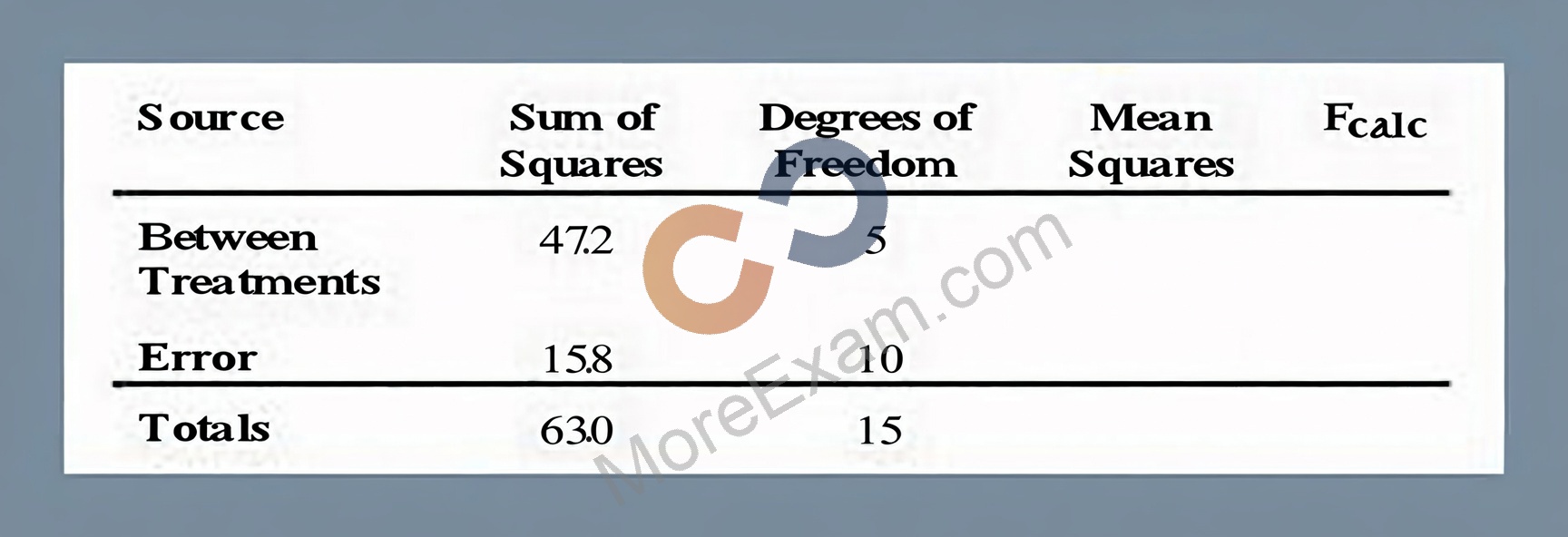
Response:

Question134: Which of the following provides the maximum benefit of parts standardization?
Response:

Question135: A device has a MTBF of 400 hours. Assuming an exponential distribution of time to failure, what is the maximum time of allowable operation if a reliability of .995 is required?
Response:

Question136: When parts are selected for a product in development, which of the following key elements should be considered first?
Response:

Question137: What functions can normally be expected to be assigned to the Reliability Engineering Department of a company that emphasizes product reliability?
I. Maintain a failure reporting system.
II. Establish reliability growth.
III. Oversee use of statistical tools.
IV. Evaluate customer surveys regarding product costs.
V. Establish and maintain a corrective action system.
Response:

Question138: A company is in a multi-products, competitive market. Which of the following is the MOST appropriate strategy to help capture the maximum market share?
Response:

Question139: The department having the authority to sign all deviations pertaining to the design of the product is normally:
Response:

Question140: The means of large samples from a population tend to be normally distributed around the population mean. This statement is TRUE according to which of the following theorems?
Response:

Question141: A component fails on the average of once every 4 years with 75% of the failures observed to occur during stormy weather.
If there are 12 hours of stormy whether to every 240 hours of good weather, what are the failure rates for stormy and good weather respectively?
Response:

Question142: Human factors in product safety planning are assessed for which of the following reasons?
I. To allocate the proper balance between man and machine.
II. To address the limitations of human beings.
III. To determine the user hardware interaction.
Response:

Question143: Top probability of the top event is represented by which of the following expressions?

Response:

Question144: Which of the following is a continuous probability distribution?
Response:

Question145: An exclusive "or" gate produces an output only if:
Response:

Question146: Software reliability planning includes all of the following EXCEPT
Response:
Question147: Data collection for a failure reporting, analysis, and corrective action system is important. The control of input data is BEST determined by:
Response:

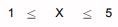
Question148: The function below has a density distribution where X is a continuous random variable. What is the probability that X = 4.0?

Response:

Question149: FMECA is:
Response:

Question150: For the exponential model, the reliability at mean time to failure is about:
Response:

Question151: Maintainability is:
Response:

Question152: A "fail-safe" requirement means:
Response:

Question153: If the probability of a car starting on a sub-zero morning is 0.6, and we have two such cars. What is the probability that at least one of the cars will start on a sub-zero morning?
Response:

Question154: What is meant by reliability assurance?
I. The probability of performing a specified function without failure under given conditions for a specified period of time.
II. The exercise of positive and deliberate measures to provide confidence that a specified reliability will be obtained.
III. The probability that a product or component will be accepted by the customer.
Response:

Question155: A prototype lot of a new design suspension spring underwent testing with these results:
- Total hours accumulated: 12,000
- Number of Failures: 6
- Hours to failure: 202, 387, 461, 590, 723, 864
What is the failure rate?
Response:

Question156: Total system effectiveness can be predicted during the conceptual or development design by considering three main elements of reliability. Which of the four elements does NOT apply?
Response:

Question157: A satellite has two redundant control systems, each has a failure rate (lambda) = 1×10 -6 failures/hour. If one of the systems fails, the failure rate for the remaining system increases to 2×10 -5 failures/hour.
What is the reliability of the redundant control systems at 175,000 hours?
Response:

Question158: The probability of an accident for the head event "H" given below is:

Response:

Question159: The use of plug-in devices improves all of the following EXCEPT:
Response:

Question160: Which of the following is the MOST appropriate reason for selecting accelerated life testing for an expensive product to determine adherence to design requirements?
Response:

Question161: A component has a strength of 8000 psi and a standard deviation of 1200 psi. It needs to withstand a load with a mean value of 5000 psi and a standard deviation of 500 psi. Both strength and load are normally distributed.
What is the probability of failure for the component?
Response:

Question162: If the exponential distribution is assumed, what is the reliability prediction uncertainty?
Response:

Question163: Basic sources of reliability data are:
I. In-plant testing.
II. Field testing.
III. Operation by user.
Response:

Question164: A go/no-go device is tested until it fails. If X is the number of tests to first failure with no wear out present, and the probability of success on each test is .99, then the probability that X is greater than 5 is:
Response:

Question165: According to the definition of reliability, performance, over the expected or intended life, is one criterion. In order to obtain a measurement for reliability, the actual life (t) must be compared to which of the following?
Response:

Question166: Pascal's triangle presents a simple means of determining which of the various terms of the binomial expansion?
Response:

Question167: Which one of the following would NOT be necessary in a corrective action status report?
Response:

Question168: Which of the following BEST describe a critical item in reliability?
Response:

Question169: A certain equipment has a MTBF of m = 300 hours. Assuming an exponential distribution of time to failure, what is the maximum time of allowable operation if a reliability of 0.999 is required?
Response:

Question170: What is meant by "derating"?
I. The technique of using a part, component, or equipment under stress conditions considerably below rated values, to achieve a "reliability margin" in design.
II. The technique of using a part, component, or equipment under normal conditions to achieve a reliable product design.
III. The technique of using a part, component, or equipment below stress conditions to achieve a reliable product design.
Response: