MoreExam
1. Question Content...
EXPLANATION
Answer: X - EXPLANATION Content.
Question1: A 50-year-old patient is admitted for acute coronary syndrome with a past medical history of hyperlipidemia and diabetes. The patient was transferred to the cardiac care unit for intubation because of worsening condition with increased shortness of breath. Physical examination and laboratory results reveal:* BP: 140/90 mm Hg* HR: 90 bpm* RR:27 bpm* O2 Sat: 90% on 2L* Nasal cannula general: moderate distress* Chest: bibasilar rales noted* CV: S1, S2 present, + JVD 11 cm* EXT. bilateral pulses, 2+ pitting edema, warm extremities* BUN: 40 mg/dL* Serum creatinine: 2.1 mg/dL* Brain natriuretic peptide: 1120 pg/mLWhich of the following is the most appropriate first-line intravenous therapy for this patient?
Question2: A 72-year-old patient, weighing 72 kg and measuring 173 cm tall, presents to the emergency department with an acute ischemic stroke. The symptoms have been present for just over an hour. The patient has a history of hypertension and is currently taking lisinopril 10 mg daily.The patient's evaluation reveals no intracerebral hemorrhaging. The current BP is 178/100 mm Hg. It is now 150 minutes from stroke symptom onset.Which of the following should now be administered?
Question3: Prednisone 10 mg orally daily is prescribed for a 68-year-old 60-kg patient with acute temporal arteritis. The pharmacotherapy specialist would recommend which of the following?
Question4: A 42-year-old woman is diagnosed with deep vein thrombosis. Heparin therapy is initiated with5,000 units as a single bolus injection, followed by an initial infusion rate of 1,000 units/h. The aPTT measured 6 hours later is >150 sec. Which of the following would be the most appropriate action at this time?
Question5: A 48 year old man attends a local pharmacy health fair for a blood pressure check. His blodd pressure on two recent occasions has averaged 138/88 mm Hg.According to the American Society of Hypertension, what is this patient's blood pressure classification?
Question6: A 24-year-old woman with bipolar disorder is admitted for arthroscopic surgery. Baseline laboratory studies reveal leukocytosis. Which drug is most likely to elevate WBCs and lead to an erroneous interpretation?
Question7: After 9 days of hospitalization, a 60-year-old 60-kg patient has a temperature of 39.4°C and a WBC count of 20,000 cells/uL. A sputum sample shows numerous WBCs and Gram-negative bacilli. The serum creatinine is 1.0 mg/dL. For this patient, which of the following drugs would be most appropriate for initial parenteral therapy?
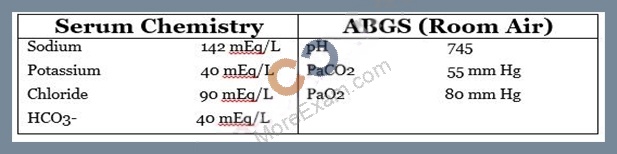
Question8: A patient with a nasogastric output of 8 L daily and respirations of 10 bpm has the following - laboratory values:This clinical information is most consistent with which of the following?
Question9: A 24-year-old Woman complains of dysuria, hesitancy in urination, and frequent urination for the past 2 days. She has no costovertebral tenderness, fever, or history of UTls. Urinalysis data are:* pH: 5.5* WBCS: 15 cells/ul* RBCS:5 Cells/uL* Bacteria: Numerous Gram-negative rods* Negative for protein, glucose, and WBC castsFor this patient, assuming that local resistance rates are low, which of the following would be an empiric cost-effective regimen?
Question10: A 58-year-old patient is admitted to the hospital with a temperature of 38.3°C, cough, and dyspnea. Rales are present at the left base, and chest X-ray reveals a left lower lobe infiltrate.Oxygen saturation is 88% on room air. Which of the following antibiotics is most appropriate?
Question11: A 49-year-old patient has been taking pregabalin for the treatment of fibromyalgia for one year with good relief of symptoms. However, this patient recently lost access to health insurance.Although she experienced excellent relief from pregabalin, she is unable to continue this therapy due to cost.Which of the following would be the best intervention?
Question12: With regard to the privacy rule of the Health Insurance Portability and Accountability Act (HIPAA), which of the following statements is correct with regard to the use or disclosure of Protected Health Information (PHI) in clinical research?
Question13: An obtunded 61-year-old Woman weighing 45 kg with Worsening renal function is admitted to the hospital. She has a recent history of several days of nausea, fatigue, pruritus, and a metallic taste in her mouth. Her medical history includes diabetes, heart failure, and COPD. Admission laboratory values include:SERUM CHEMISTRYSodium: 135 mEq/LPotassium: 5.7 mEq/LChloride: 100 mEq/LHCO3: 15 mEq/LBUN: 96 mg/dLCreatinine: 5.5 mg/dLGlucose: 300 mg/dLCalcium: 7.4 mg/dLSerum ketones: NegativeABGS (Room Air)pH: 72PaCO2: 30 mm HgPaO2: 75 mm HgO2 Sat: 90%Chest X-ray shows a flattened diaphragm. Current medications include furosemide, fluticasone salmeterol, and glipizide. Which acid-base disorder does this patient exhibit?
Question14: In a case-control study of 285 subjects with Alzheimer's dementia and 1,080 control subjects, the number of patients with dyslipidemia was recorded for each group. Among the subjects with dyslipidemia who had taken statins, the odds ratio for developing dementia was 0.29 (95%CI,0.13-0.63). Which of the following statements can accurately be made about the relationship between the taking of statins and the development of dementia in this study?
Question15: From ethical and scientific validity standpoints, in addition to double blinding, which of the following research designs is best for determining a new medication's relative efficacy in treating acute stroke?
Question16: A 58-year-old man presents with symptoms of the common cold (nasal congestion, headaches, and dry Cough).He purchased XYZ Cold formula (acetaminophen, pseudoephedrine, and dextromethorphan), but after reading the cautionary information on the package, he thought he should obtain his pharmacist's advice. He has hypertension and is taking hydrochlorothiazide daily. His office blood pressures range from 127-134/82-88 mm Hg, and he has no other medical problems.Which of the following instructions are applicable to this patient regarding XYZ Cold formula?
Question17: A 67-year-old patient is hospitalized for decompensated heart failure. The serum sodium concentration is 130 mEq/L on admission. Which of the following is the most appropriate approach to managing the patient's hyponatremia?
Question18: An investigator decides to perform a correlation analysis of the relationship between the number of cigarettes smoked per day and age. Results show a positive correlation between the two, with an r value of 0.50 and ap value for the correlation equal to 0.03. What is the most reasonable interpretation of this correlation?
Question19: Interpretation of the findings of a research project should be placed in which section of an abstract?
Question20: Which of the following disease states has been associated with stress-related mucosal bleeding and is an indication for initiation of stress ulcer prophylaxis?
Question21: A pharmacotherapy specialist is contemplating Writing a case report on a suspected penicillin induced neutropenia in a patient who received intravenous penicillin G for treatment of infective endocarditis. The specialist has established a temporal relationship between the period of medication administration and the onset of neutropenia, and has excluded other potential causes of the adverse effect.Which of the following is the most appropriate next step in composing the case report?
Question22: A 25-year-old woman who is HIV-positive and has a CD4+ count of 120 cells/mm begins antiretroviral therapy. The patient's CD4+ count drops to 45 cells/mm3 over the next year. For which of the following opportunistic infections should this patient receive prophylaxis?
Question23: A 22-year-old woman presents to a clinic for her annual pap smear. At this time, she explains that she has engaged in increased unprotected sexual activity over the last few years and is concerned about sexually transmitted diseases, especially human papillomavirus (HPV). She completed the bivalent HPV vaccine series at age 15 and is questioning its duration of effect.Which option is the most appropriate regarding continued efficacy of the vaccine?
Question24: A pharmacotherapy specialist in a managed-care organization is about to review a new drug for the treatment of osteoporosis. The P&T committee will use the results in deciding whether to add the new drug to the formulary. Which of the following information would be most helpful?
Question25: A 13-year-old boy who has asthma, weight 32kg, height 150cm, takes inhaled salmeterol one puff twice daily and inhaled fluticasone 2 puffs twice daily. The patient must stop participation in physical education classes after a few minutes due to shortness of breath. To allow the patient to participate longer, the most effective measure would be to add which of the following?
Question26: Which of the following quality performance measures would be most appropriate to evaluate in relation to anticoagulation management in the outpatient setting?
Question27: After the first intravenous bolus dose of a drug, the peak concentration is 50 mcg/mL, the elimination rate constant is 0.3/h, and the dosage Interval is 6 hours. Assuming a one compartment model and intravenous bolus injection, which of the following will be the peak concentration following the second dose?
Question28: A patient with rheumatoid arthritis has been experiencing increased pain over the last 2-3 weeks. The patient's rheumatoid arthritis has previously been controlled with methotrexate and periodic NSAID and steroid use for acute flares. However, currently this regimen is inadequate.The physician wants to initiate therapy with etanercept.Which of the following infections should be screened for prior to initiating therapy?
Question29: The Joint Commission requires accredited organizations to encourage which groups to report concerns about safety?
Question30: Permission to use a previously published figure or illustration in a manuscript should be initially obtained from which of the following?
Question31: A pharmacotherapy specialist wishes to investigate the impact of thiazolidinedione therapy on Weight gain. The specialist will determine average body weight immediately before participants begin therapy with pioglitazone and again after they complete 12 weeks of treatment. Which of the following statistical methods is most appropriate for analyzing these data?
Question32: A 50-year-old woman experienced acute renal failure after receiving contrast dye for an imaging study. Her estimated creatinine clearance is now 20 mL/min. Her medications include:* Piperacillin/tazobactam 4.5g intravenously every 8 hours* Azithromycin 500 mg intravenously daily* Famotidine 40 mg orally twice daily* Enoxaparin 40 mg subcutaneously daily* Metoprolol succinate 100 mg orally dailyWhich drugs require dose reduction due to acute renal failure?
Question33: A 60-year-old man is admitted to the CCU with an acute anterior wall Ml. Therapy with amiodarone is initiated. The man's concurrent medications include Warfarin, furosemide, and enalapril. Which of the following baseline laboratory land clinical data, in addition to thyroid and liver function tests, should be obtained prior to initiation of amiodarone therapy in this patient?
Question34: A 21-year-old patient with leukemia is admitted to the hospital with a temperature of 38.9°C and a nonproductive cough 8 days after induction chemotherapy completion. Laboratory tests show a WBC count of 1,000 cells/ul (10% segmented neutrophils, 0% bands, and 90% lymphocytes) and a platelet count of 60,000 cells/uL. Chest X-ray reveals a small left lower lobe infiltrate. Blood, urine, and sputum cultures are obtained. What should be the recommendation for initial management?
Question35: In which of the following scenarios should the error be reported to the Institute for Safe Medication Practices?
Question36: Post myocardial infarction, a patient's cardiac profile and serum chemistry results show the following values:Heart rate: 120 bpmBlood pressure: 80/40 mm HgPulmonary capillary Wedge pressure: 6 mm HgRight atrial pressure: 2 mm HgCardiac index: 2.3 L/min/m2Sodium: 136 mEq/LPotassium: 4.2 mEq/LChloride: 98 mEq/LBicarbonate: 22 mEq/LBlood urea nitrogen: 25 mg/dLCreatinine: 1.0 mg/dLGlucose: 110 mg/dLWhich one of the following therapeutic regimens is most appropriate for the initial treatment of this patient?
Question37: A patient with previously well-controlled diabetes is suspected to be nonadherent with medication and diet. During the patient's last visit, the pharmacy student attempt to review education materials. However, the patient said that he forgot his reading glasses and asked if he could read through the information when he got home?Which of the following is the best course of action for the patient at his next visit?
Question38: A hospital requests a policy and procedure document for the monitoring and reporting of significant adverse drug reactions. Which agency requires a policy for the reporting of adverse drug reactions by hospitals?
Question39: When low molecular weight heparin is prescribed, in which of the following patient populations would monitoring anti-factor-Xa levels be reasonable to consider?
Question40: A 40-year-old transplant recipient who is receiving cyclosporine develops seizures requiring anticonvulsant therapy. Because a drug interaction is likely to occur between cyclosporine and phenytoin, the pharmacotherapy specialist suggests that the resident do which of the following?
Question41: A 71-year-old patient presents for a hospital follow-up visit after a recent inpatient stay for an exacerbation of COPD, the fourth such stay in the past year. The patient's home medication regimen includes albuterol/ipratropium by inhaler, theophylline, and extended release guaifenesin. The latest FEV1 value in a one-second test was 40% of the predicted value; o2 Sat was 90%. Which of the following is the most appropriate management strategy for this patient?
Question42: A 50-kg 15-year-old female patient presents to the emergency department 6 hours after ingesting 100 ferrous sulfate tablets, each containing 325 mg. A pregnancy test is negative, and flat plate radiography of the abdomen demonstrates many tablets in the stomach and throughout the small intestine. The patient is intermittently vomiting, with no tablets recovered in the emesis. The patient is otherwise asymptomatic and stable. Which of the following forms of gastrointestinal decontamination should be recommended?
Question43: A patient presents at a physician's office with gait unsteadiness and clumsiness. The patient has a history of type 2 diabetes mellitus, hypertension, and chronic numbness and tingling of the feet and fingertips.Examination reveals mild distal wasting, glove-and-stocking sensory impairment, absent ankle jerks, brisk knee jerks, and bilateral Babinski reflexes. Gait is slightly ataxic.CBC reveals a hemoglobin of 10.1 g/dL, WBC of 4,500 cells/mL, MCV 120 fL, and platelets163,000 cells/ul.Which of the following is the most important laboratory test for assisting in diagnosis?
Question44: A 49-year-old man presents to his physician with a 3-day acute attack of gout in four joints of the right foot. The patient has a history of at least three previous gout attacks; in one, a joint aspirate was positive for urate crystals. His history also includes type 2 diabetes mellitus and two calcium oxalate kidney stones.Laboratory values include creatinine 3.1 mg/dL, uric acid 11.7 mg/dL, and A1C 6.8%. The patient is allergic to aspirin. Vital signs are BP135/82mm Hg and HR 90 bpm and regular.Current medications are glipizide 10 mg daily and enalapril 20 mg daily.Which short-term regimen is most appropriate for treating this patient's gout?
Question45: Upon reviewing a clinical trial submission for publication, it is discovered that the authors have asked a medical Writer to help develop the manuscript after the data have been collected and analyzed by the authors. The medical Writer developed the manuscript, and the authors reviewed and edited the document before submitting it for publication. What is the most appropriate action for the authors to take?
Question46: A 47-year-old patient with cirrhosis, ascites, and acute renal failure presents to the emergency department. A peritoneal tap reveals spontaneous bacterial peritonitis (neutrophils = 789 in the ascitic fluid). Medical history includes ethanol abuse and positivity for HCV antibody. What is the most appropriate drug therapy for this patient?
Question47: A 54-year-old male patient (BSA = 1.8 m2) is being treated for head and neck cancer with the following regimen:* Cisplatin 100 mg/m2 intravenously on day 1* 5-Fluorouracil 1000 mg/m2 intravenously by continuous infusion on days 1 through 5* Ondansetron 16 mg intravenouslyWhich of the following is the appropriate administration instruction for ondansetron?
Question48: A 60-year-old man with heart failure states that he becomes "a bit short of breath" after climbing a flight of stairs. His ejection fraction is 40%. Current medications include lisinopril 5 mg daily, metoprolol XL 100 mg daily, aspirin 81 mg daily, furosemide 40 mg daily, and digoxin250 mcg daily. All vital signs and laboratory values are stable and within normal limits. Which of the following recommendations would be most appropriate at this time?
Question49: A pharmacotherapy specialist is interpreting a published paper describing a randomized controlled, double-bling study that was conducted to evaluate the effects of antihistamines on the failure rate of treatment of otitis media in children. In the study, 250 children received antihistamines and 264 did not. All children received appropriate antibiotic therapy. Treatment failures occurred in four (1.6%) of the children who received antihistamines and in 13 (4.9%) of those who did not. The difference is statistically significant (p<0.05, chi-square). Which of the following statements about these result is appropriate?
Question50: Using a new assay, the following readings for Drug X concentration in a blood sample are obtained: 45 ng/mL, 43 ng/mL, 45 ng/mL, 44 ng/mL, 45 ng/mL, and 45 ng/mL. The true concentration of the drug was reported as 65 ng/mL using the gold-standard assay.On the basis of these data, the new assay should be characterized in which of the following categories?
Question51: A patient with a COPD exacerbation is treated with prednisone 40 mg daily for one week with improvement. To discontinue the prednisone, the most appropriate procedure would be which of the following?
Question52: A pharmacotherapy specialist is conducting a pharmacokinetic study of a drug. The pharmacokinetic profile of this drug is best described by a one-compartment model with a mean elimination rate constant of 0.173/h. The standard curve for the assay to be used covers the range of 5-40mcg/mL. Samples are collected shortly after single intravenous bolus drug administration, and at 4 and 8 hours after dosing. Preliminary analysis shows that the 4-hour sample concentration is 25 mcg/mL. In this situation, which of the following statements is correct?
Question53: A 46-year-old man comes into the clinic complaining of facial swelling and difficulty breathing.Upon examination, it is determined that the patient has facial edema most likely associated with enalapril use. The patient was transferred to the hospital for treatment of the facial edema. It is most appropriate to report this reaction to the:
Question54: A study shows that the participants who received 6 months of a new oral anticoagulant after a venous thromboembolism were randomized to continue with the new oral anticoagulant (n =612) or to placebo (n = 611) for 18 months. Thromboembolism recurred in 12 subjects in the new oral anticoagulant group and 71 subjects in the placebo group (hazard ratio 0.17; 95% CI, 0.09-0.30; p < 0.001).Which of the following statements regarding these results is correct?
Question55: A 47-year-old patient with end-stage renal disease undergoing hemodialysis has an HCT of 23% and exhibits anginal symptoms. Upon further Workup, no evidence of occult bleeding is found.In addition to antianginal therapy, which of the following is the most appropriate initial treatment for this patient's anemia?
Question56: A clinical trial is being designed to evaluate the efficacy of an intermediate-acting niacin preparation in a population with regard to amelioration of coronary artery disease risk.Bioethical considerations would restrict recruitment of subjects with poorly controlled diabetes mellitus, recent gastroduodenal ulcer disease, or hyperuricemia. Which principle would consider these patients to be ineligible for enrollment?
Question57: A 38-year-old man with stage II testicular cancer has received a 5-day course of Cisplatin and etoposide, followed by daily Filgrastim. On day 14, he reports duki aching bone pain. Which of the following is the most likely cause of this complaint?
Question58: A 50-year-old patient presents to the physician complaining of anxiety, insomnia, a depressed mood, and decreased energy level. Paroxetine therapy is initiated. Which symptom will be the last to respond?
Question59: A patient presents to the emergency department with an acute Ischemic stroke. The symptoms have been present for just over an hour.Which test would be most appropriate to help determine the patient's eligibility to receive t-PA?
Question60: A 55 year old woman being treated for hypothyroidism with levothyroxine 125 mcg daily is currently euthyroid. She now has menopausal symptoms and is receiving conjugated estrogens.What effect is this most likely to have on her thyroid function tests?
Question61: In a clinical trial, when would "intention to treat" analysis be most appropriate?