MoreExam
1. Question Content...
EXPLANATION
Answer: X - EXPLANATION Content.
Question1: Providers of debt finance often insist on covenants being entered into when providing debt finance for companies.Agreement and adherence to the specific covenants is often a condition of the loan provided by the lender.Which THREE of the following statements are true in respect of covenants?
Question2: Using the CAPM, the expected return for a company is 11%. The market return is 8% and the risk free rate is2%.What does the beta factor used in this calculation indicate about the risk of the company?
Question3: Company B is an all equity financed company with a cost of equity of 10%.It is considering issuing bonds in order to achieve a gearing level of 20% debt and 80% equity.These bonds will pay a coupon rate of 5% and have an interest yield of 6%.Company B pays corporate tax at the rate of 25%.According to Modigliani and Miller's theory of capital structure with tax, what will be Company B's new cost of equity?A)B)C)D)
Question4: Listed company R is in the process of making a cash offer for the equity of unlisted company S.Company R has a market capitalisation of $200 million and a price/earnings ratio of 10.Company S has a market capitalisation of $50 million and earnings of $7 million.Company R intends to offer $60 million and expects to be able to realise synergistic benefits of $20 million by combining the two businesses. This estimate excludes the estimated $8 million cost of integrating the two businesses.Which of the following figures need to be used when calculating the value of the combined entity in $ millions?
Question5: A company financed by equity and debt can be valued by discounting:
Question6: A company is considering the issue of a convertible bond compared to a straight bond issue (non- convertible bond).Director A is concerned that issuing a convertible bond will upset the shareholders for the following reasons:* it will dilute their control* the interest payments will be higher therefore reducing liquidity* it will increase the gearing ratio therefore increasing financial risk Director B disagrees, and is preparing a board paper to promote the issue of the convertible bond rather than a non-convertible.Advise the Director B which THREE of the following statements should be included in his board paper to promote the issue of the convertible bond?
Question7: Company C is a listed company. It is currently considering the acquisition of Company D.The original founder of Company C currently owns 52% of the shares.Alternative forms of consideration for Company D being considered are as follows:* Cash payment, financed by new borrowing* issue of new shares in Company CWhich of the following is an advantage of a cash offer over a share-for exchange from the viewpoint of the original founder of Company C?
Question8: A manufacturing company is based in Country L whose currency is the L$.One of the company's products is exported to Country M, a rapidly growing economy, whose currency is the M$.In the most recent financial year:* 100,000 units of the product were sold to customers in country M* The unit selling price was M$12The spot rate today is L$1 = M$5The company has an objective of growth in total sales value in L$ of 10% a year.If the L$ strengthens by 5% next year against the M$, what volume of sales of this product is needed next year to achieve the objective?
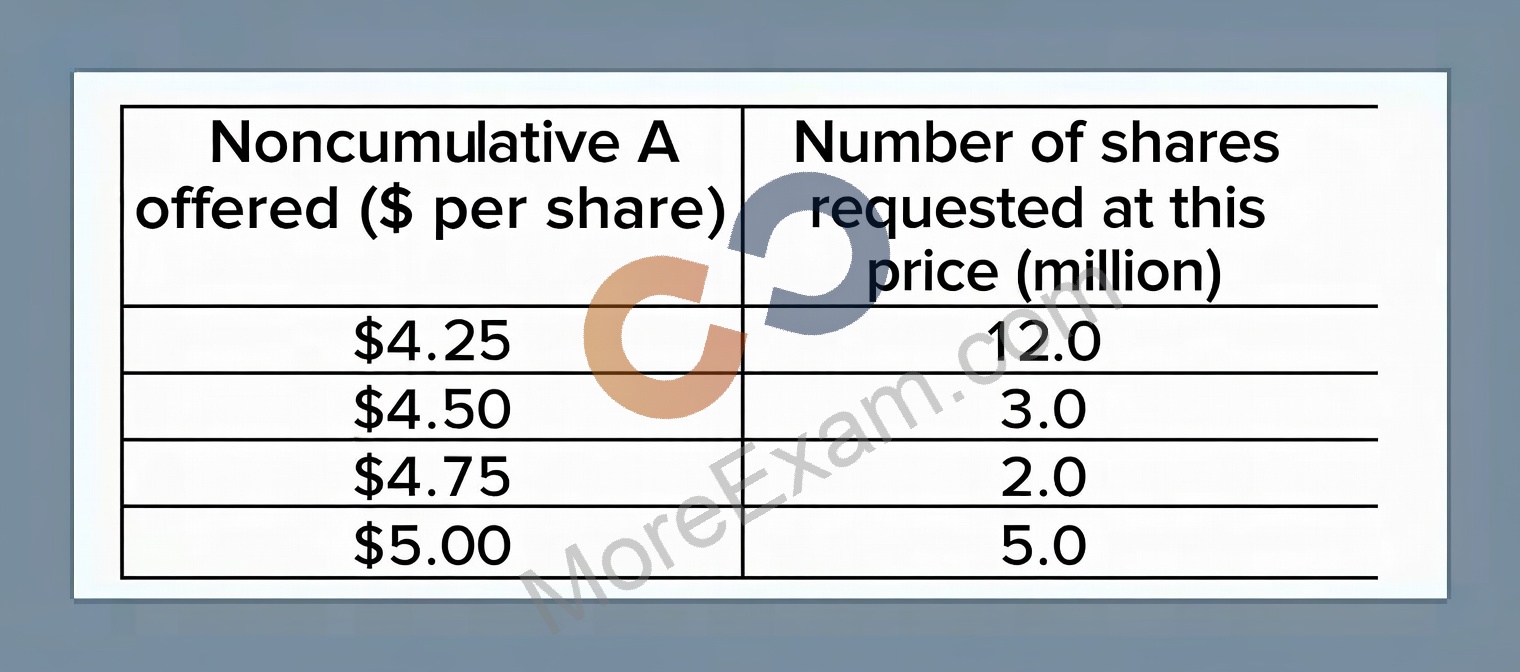
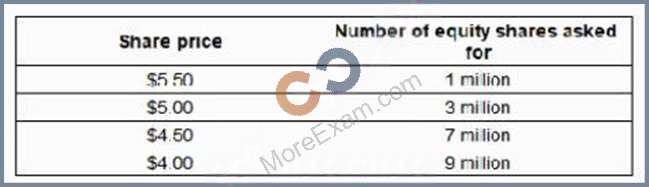
Question9: Company C invests heavily in Research and Development an need to raise $45 million to finance future projects. It has decided to use equity finance raised by a tender offer, The following tender offers have been received from potential investors:Company C wishes to select an offer price that will project shareholders from a significant dilution of control but still raise the required amount of finance.What offer price should Company C's select?
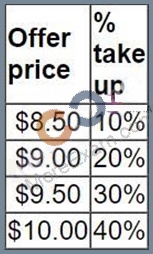
Question10: A listed company is planning a share repurchase.Research into different offer prices has given the following data with regards acceptance by the shareholders at different prices:What price should be offered to shareholders if the retained earnings of the company are to remain unchanged?
Question11: A large, listed company is planning a major project that should greatly improve its share price in the long term.These plans require a significant capital cost that the company plans to finance by debt.All of the debt options being considered are for the same duration of time.Which of the following sources of debt finance is likely to be the most expensive for the company over the full term of the debt?
Question12: A company is funded by:* $40 million of debt (market value)* $60 million of equity (market value)The company plans to:* Issue a bond and use the funds raised to buy back shares at their current market value.* Structure the deal so that the market value of debt becomes equal to the market value of equity.According to Modigliani and Miller's theory with tax and assuming a corporate income tax rate of 20%, this plan would:
Question13: Which THREE of the following long term changes are most likely to increase the credit rating of a company?
Question14: A listed company in the retail sector has accumulated excess cash.In recent years, it has experienced uncertainly with forecasting the required level of cash for capital expenditure due to unpredictable economic cycles.Its excess cash is on deposit earning negligible returns.The Board of Directors is considering the company's dividend policy, and the need to retain cash in the company.Which THREE of the following are advantages of retaining excess cash in the company?
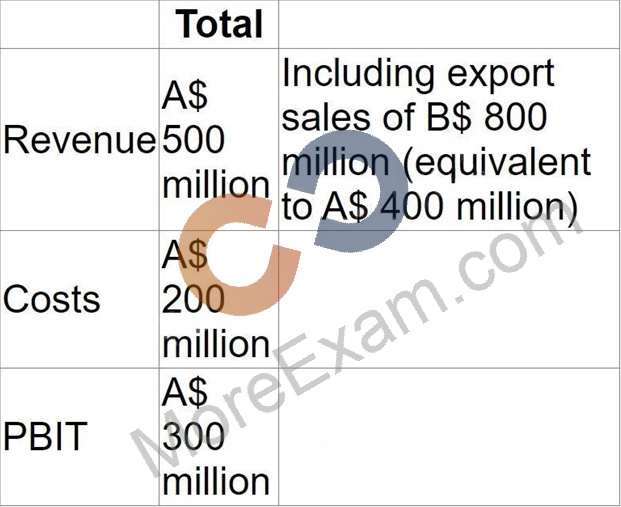
Question15: A company aims to increase profit before interest and tax (PBIT) each year.The company reports in A$ but has significant export sales priced in B$.All other transactions are priced in A$.In 20X1, the company reported:In 20X2, the only changes expected are:* An increase in export prices of 10%, but no change to units sold.* A rise in the value of the B$ to A$/B$ 2.500 (that is, A$ 1 = B$ 2.5) Is it likely that the company would still meet its objective to grow PBIT between 20X1 and 20X2?
Question16: Company A is proposing a rights issue to finance a new investment. Its current debt to equity ratio is 10%.Which TWO of the following statements are true?
Question17: Which of the following statements are true with regard to interest rate swaps?Select ALL that apply.
Question18: Company J plans to acquire Company K, an unlisted company whose equity is to be valued using a P/E ratio approach.A listed company has been identified which is very similar to Company K and which can be used as a proxy.However, the growth prospects of Company K are higher than those of the proxy.The Directors of Company J are aware that certain adjustments will be necessary to the proxy company's P/E ratio in order to obtain a more reliable valuation.The following adjustments have been agreed:* 20% due to Company K being unlisted.* 15% to allow for the growth rate difference.The total adjustment to the proxy p/e ratio is:
Question19: Which THREE of the following are considered in detail in IFRS 7 Financial Instruments: Disclosures?
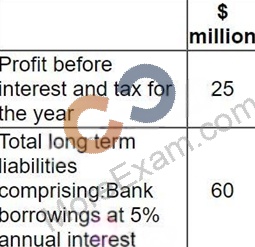
Question20: At the last financial year end, 31 December 20X1, a company reported:The corporate income tax rate is 30% and the bank borrowings are subject to an interest cover covenant of 4 times.The results are presently comfortably within the interest cover covenant as they show interest cover of 8.3 times. The company plans to invest in a new product line which is not expected to affect profit in the first year but will require additional borrowings of $20 million at an annual interest rate of 10%.What is the likely impact on the existing interest cover covenant?
Question21: Which of the following explains an aim of integrated reporting in accordance with The International <IR> Framework as issued by the International Integrated Reporting Council?
Question22: A company has announced a rights issue of 1 new share for every 4 existing shares.Relevant data:* The current market price per share is $10.00.* Rights are to be issued at a 20% discount to the current price.* The rate of return on the new funds raised is expected to be 10%.* The rate of return on existing funds is 5%.What is the yield-adjusted theoretical ex-rights price?Give your answer to two decimal places.
Question23: Two listed companies in the same industry are joining together through a merger.What are the likely outcomes that will occur after the merger has happened?Select ALL that apply.
Question24: A major energy company, GDE, generates and distributes electricity in country A.The government of country A is concerned about rising inflation and has imposed price controls on GDE, limiting the price it can charge per unit of electricity sold to both domestic and commercial customers. It is likely that price controls will continue for the foreseeable future.The introduction of price controls is likely to reduce the profit for the current year from $3 billion to $1 billion.The company has:* Distributable reserves of $2 billion.* Surplus cash at the start of the year of $1 billion.* Plans to pay a total dividend of $1.5 billion in respect of the current year, representing a small annual increase as in previous years. However, no dividends have yet been announced.Which THREE of the following responses would be MOST appropriate for GDE following the imposition of price controls?
Question25: A company has convertible bonds in issue.The following debt is apply (31 December 20X0):* Conversion ratio- 20 shares for each $130 bond.* Current share price - $4 50* Expected annual growth in share price - 5%Advise the bond Holder at which date the convers on would be worthwhile?
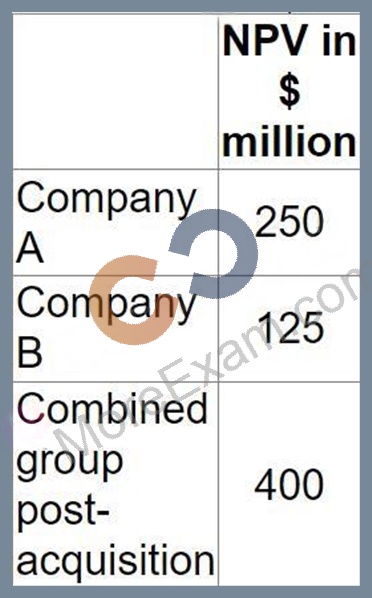
Question26: Company A is planning to acquire Company B by means of a cash offer. The directors of Company B are prepared to recommend acceptance if a bid price can be agreed. Estimates of the net present value (NPV) of future cash flows for the two companies and the combined group post acquisition have been prepared by Company A's accountant. There are as follows:What is the maximum price that Company A should offer for the shares in Company B?Give your answer to the nearest $ million
Question27: A company has:* $7 million market value of equity* $5 million market value of debt* WACC of 9.375%* Corporate income tax rate of 15%According to Modigliani and Miller's theory of capital structure with tax, what is the ungeared cost of equity?
Question28: Which THREE of the following are benefits of integrated reporting?
Question29: A listed company has suffered a period of falling revenues and profit margins. It has been obliged to issue a profit warning to the market and its share price has fallen sharply. The company relies heavily on debt finance and is discussing with its banks possible refinancing options to assist with a restructuring programme.Which THREE of the following are likely to be of MOST interest to the company's banks when they review the refinancing requests?
Question30: A company's current earnings before interest and taxation are $5 million.These are expected to remain constant for the forseeable future.The company has 10 million shares in issue which currently trade at $3.60.It also has a $10 million long term floating rate loan.The current interest rate on this loan is 5%.The company pays tax at 20%.The company expects interest rates to increase next year to 6% and it's Price/Earnings (P/E) ratio to move to9.5 times by the end of next year.What percentage reduction in the share price will occur by the end of next year if the interest rate increase and the P/E movement both occur?
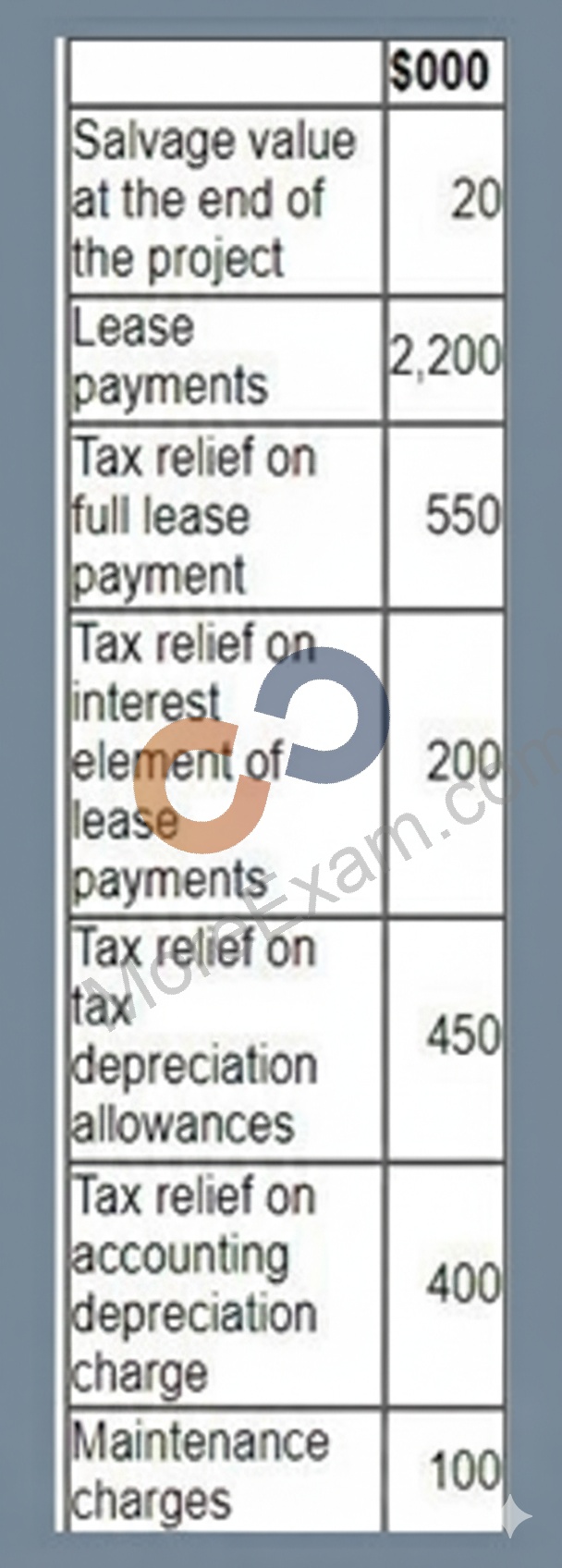
Question31: A project requires an initial outlay of $2 million which can be financed with either a bank loan or finance lease.The company will be responsible for annual maintenance under either option.The tax regime is:* Tax depreciation allowances can be claimed on purchased assets.* If leased using a finance lease, tax relief can be claimed on the interest element of the lease payments and also on the accounting depreciation charge.The trainee management accountant has begun evaluating the lease versus buy decision and has produced the following data. He is not confident that all this information is relevant to this decision.Using only the relevant data, which of the following is correct?
Question32: Company A plans to acquire Company B, an unlisted company which has been in business for 3 years.It has incurred losses in its first 3 years but is expected to become highly profitable in the near future.No listed companies in the country operate the same business field as Company B, a unique new high- risk business process.The future success of the process and hence the future growth rate in earnings and dividends is difficult to determine.Company A is assessing the validity of using the dividend growth method to value Company B.Which THREE of the following are weaknesses of using the dividend growth model to value an unlisted company such as Company B?
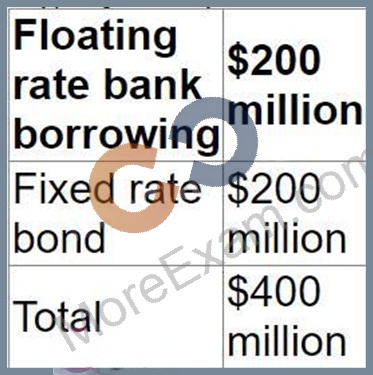
Question33: A company is in the process of issuing a 10 year $100 million bond and is considering using an interest rate swap to change the interest profile on some or all of the $100 million new finance.The company has a target fixed versus floating rate debt profile of 1:1. Before issuing the bond its debt profile was as follows:Which of the following is the most appropriate interest rate swap structure for the company?
Question34: A company s about to announce a new project that has a positive NPV.If the market is semi-strong form efficient, which of the following statements is most Likely to be true?The value of the company will.
Question35: A UK based company is considering investing GBP1 ,000,000 in a project it the USA. It is anticipated that the project will yield net cash inflows of USD580.000 each year for the next three years. These surplus cash flows will be remitted to the UK at the end of each year.Currently GBP1.00 is worth USD1.30.The expected inflation rates in the two countries ever the next four years are 2% in the UK and 4% in the USA.Applying the purchasing power parity theory, which of the following represents the expected remittance at the end of year three, in GBP whole the nearest whole GBP)?
Question36: Company P is a pharmaceutical company listed on an alternative investment market.The company is developing a new drug which it hopes to market in approximately six years' time.Company P is owned and managed by a group of doctors who wish to retain control of the company. The company operates from leased laboratories with minimal fixed assets.Its value comes from the quality of its research staff and their research.The company currently has one approved drug which generates sufficient cashflow to cover day to day operations but not sufficient for major new research and development.Company P wish to raise debt finance to develop the new drug.Recommend which of the following types of debt finance would be most appropriate for Company P to help finance the development of this new drug.
Question37: An entity prepares financial statements to 31 December each year. The following data applies:1 December 20X0* The entity purchased some inventory for $400,000.* In order to protect the inventory against adverse changes in fair value the entity entered into a futures contract to sell the inventory for a fixed price on 31 January 20X1.* The entity designated this contract as a fair value hedge of the value of the inventory.31 December 20X0* The inventory had a fair value of $480,000 and the futures contract had a fair value of $75,000 (a financial liability).What will be the impact on the statement of profit or loss and other comprehensive income for the year ended31 December 20X0 in respect of the change in the value of the inventory and the futures contract?
Question38: A company currently has a 6.25% fixed rate loan but it wishes to change the interest style of the loan to variable by using an interest rate swap directly with the bank.The bank has quoted the following swap rate:* 5.50% - 5.55% in exchange for LIBORLIBOR is currently 5%.If the company enters into the swap and LIBOR remains at 5%, what will the company's interest cost be?
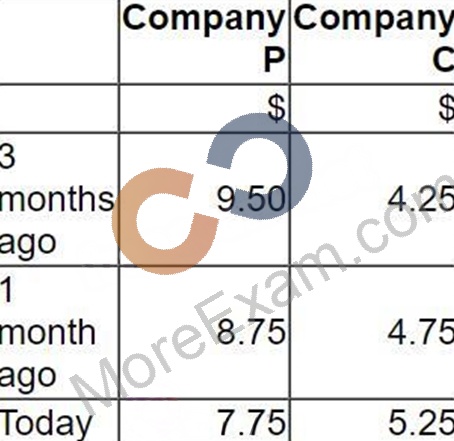
Question39: Company C has received an unwelcome takeover bid from Company P.Company P is approximately twice the size of Company C based on market capitalisation.Although the two companies have some common business interests, the main aim of the bid is diversification for Company P.The offer from Company P is a share exchange of 2 shares in Company P for 3 shares in Company C.There is a cash alternative of $5.50 for each Company C share.Company C has substantial cash balances which the directors were planning to use to fund an acquisition.These plans have not been announced to the market.The following share price information is relevant. All prices are in $.Which of the following would be the most appropriate action by Company C's directors following receipt of this hostile bid?
Question40: On 31 October 20X3:* A company expected to agree a foreign currency transaction in January 20X4 for settlement on 31 March20X4.* The company hedged the currency risk using a forward contract at nil cost for settlement on 31 March20X4.* The transaction was correctly treated as a cash flow hedge in accordance with IAS 39 Financial Instruments: Recognition and Measurement.On 31 December 20X3, the financial year end, the fair value of the forward contract was $10,000 (asset).How should the increase in the fair value of the forward contract be treated within the financial statements for the year ended 31 December 20X3?
Question41: Which TIIRCC of the following are most likely be primary objectives for a newly established, unincorporated entity in the service sector?
Question42: A company needs to raise $40 million to finance a project. It has decided on a right issue at a discount of 20% to its current market share price.There are currently 20 million shares in issue with a nominal value of $1 and a market price of $10.00 per share.
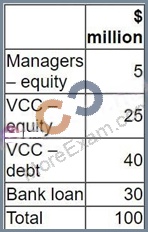
Question43: A company intends to sell one of its business units, Company R by a management buyout (MBO).A selling price of $100 million has been agreed.The managers are discussing with a bank and a venture capital company (VCC) the following financing proposal:The VCC requires a minimum return on its equity investment in the MBO of 30% a year on a compound basis over 5 years.What is the minimum TOTAL equity value of Company R in 5 years time in order to meet the VCC's required return?Give your answer to one decimal place.
Question44: Which TIIRCC of the following are most likely to reduce the long term credit rating co a company?
Question45: If a company's bonds are currently yielding 8% in the marketplace, why would the entity's cost of debt be lower than this?
Question46: Company H is considering the valuation of an unlisted company which it hopes to acquire.It has obtained the target company's financial statements.Company H has been advised that the book value of net assets as shown in the financial statements of the target company does not provide a reliable indicator of their true value.Advise the Board of Directors which of the following THREE statements are disadvantages of the net asset basis of valuation?
Question47: A company's latest accounts show profit after tax of $20.0 million, after deducting interest of $5.0 million. The company expects earnings to grow at 5% per annum indefinitely.The company has estimated its cost of equity at 12%, which is included in the company WACC of 10%.Assuming that profit after tax is equivalent to cash flows, what is the value of the equity capital?Give your answer to the nearest $ million.
Question48: A company enters into a floating rate borrowing with interest due every 12 months over the five year life of the borrowing.At the same time, the company arranges an interest rate swap to swap the interest profile on the borrowing from floating to fixed rate.These transactions are designated as a hedge for hedge accounting purposes under IAS 39 Financial Instruments: Recognition and Measurement.Assuming the hedge is considered to be effective, how would the swap be accounted for 12 months later?
Question49: A company is planning a share repurchase programme with the following details:* Repurchased shares will be immediately cancelled.* The shares will be purchased at a premium to the market share price.The current market share price is greater than the nominal value of the shares.Which of the following statements about the impact of the share repurchase programme on the company's financial statements is correct?
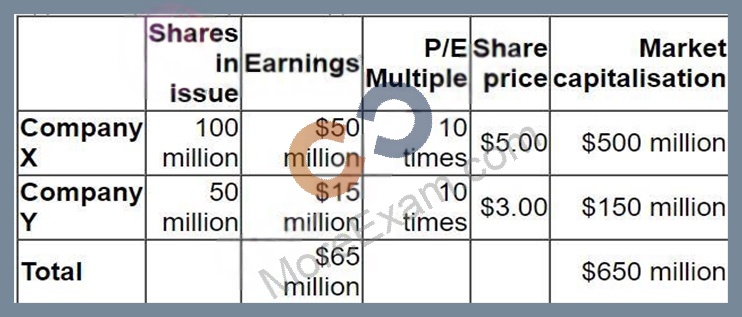
Question50: Company X plans to acquire Company Y.Pre-acquisition information:Post-acquisition information:Total combined earnings are expected to increase by 10%Total combined P/E multiple will remain at 10 timesWhich of the following share-for-share exchanges will result in an increase of 10% in Company X's share price post-acquisition?
Question51: Company A is a listed company that produces pottery goods which it sells throughout Europe. The pottery is then delivered to a network of self employed artists who are contracted to paint the pottery in their own homes.Finished goods are distributed by network of sales agents.The directors of Company A are now considering acquiring one or more smaller companies by means of vertical integration to improve profit margins.Advise the Board of Company A which of the following acquisitions is most likely to achieve the stated aim of vertical integration?
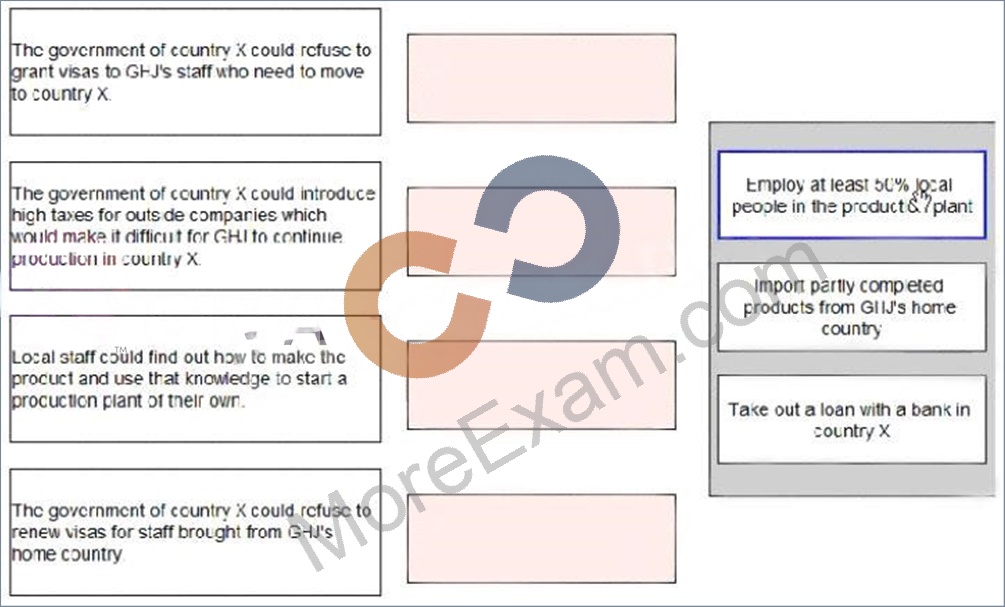
Question52: CI IJ has decided to move its production plant to overseas country X.This would make the product cheaper to produce. The technology used to make the product is very advanced and some of the skilled staff would have to move to country X.The Production Director has identified that there are some political risks in moving to county X.For each of the political risks of moving to country X shown below, select the correct method for reducing the risk.
Question53: A company has:* $6 million market value of equity* $4 million market value of debt* WACC of 11.04%* Corporate income tax rate of 20%According to Modigliani and Miller's theory of capital structure with tax, what is the ungeared cost of equity?
Question54: Company A, a listed company, plans to acquire Company T, which is also listed.Additional information is:* Company A has 150 million shares in issue, with market price currently at $7.00 per share.* Company T has 120 million shares in issue,. with market price currently at $6.00 each share.* Synergies valued at $50 million are expected to arise from the acquisition.* The terms of the offer will be 2 shares in A for 3 shares in T.Assuming the offer is accepted and the synergies are realised, what should the post-acquisition price of each of Company A's shares be?Give your answer to two decimal places.
Question55: A company has in a 5% corporate bond in issue on which there are two loan covenants.* Interest cover must not fall below 3 times* Retained earnings for the year must not fall below $3.5 millionThe Company has 200 million shares in issue.The most recent dividend per share was $0.04.The Company intends increasing dividends by 10% next year.Financial projections for next year are as follows:Advise the Board of Directors which of the following will be the status of compliance with the loan covenants next year?
Question56: A venture capitalist has made an equity investment in a private company and is evaluating possible methods by which it can exit the investment over the next 3 years. The private company shareholders comprise the four original founders and the venture capitalist.Advise the venture capitalist which THREE of the following methods will enable it to exit its equity investment?
Question57: A company has just received a hostile bid. Which of the following response strategies could be considered?
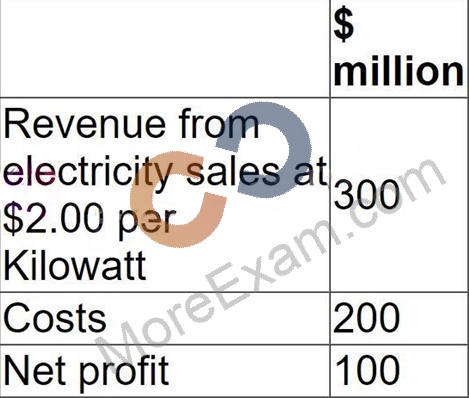
Question58: A company generates and distributes electricity and gas to households and businesses.Forecast results for the next financial year are as follows:The Industry Regulator has announced a new price cap of $1.50 per Kilowatt.The company expects this to cause consumption to rise by 10% but costs would remained unaltered.The price cap is expected to cause the company's net profit to fall to:
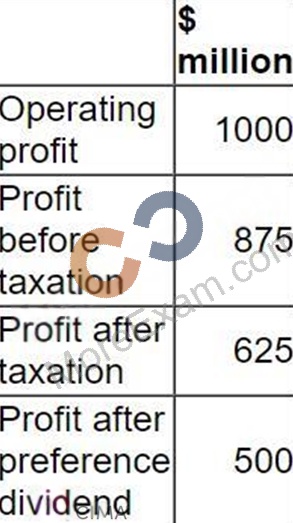
Question59: Extracts from a company's profit forecast for the next financial year as follows:Since preparing the forecast, the company has decided to return surplus cash to shareholders by a share repurchase arrangement.The share repurchase would result in the company purchasing 20% of the 1,250 million ordinary shares currently in issue and canceling them.Assuming the share repurchase went ahead, the impact on the company's forecast earnings per share will be an increase of:
Question60: A Venture Capital Fund currently holds a significant shareholding in a large private company as a result of funding a recent management buyout. It plans to exit this investment in 5 years time at a significant profit.Which THREE of the following exit mechanisms are most likely to be preferred by the Venture Capital Fund?
Question61: On 1 January 20X1, a company had:* Cost of equity of 10 0%.* Cost of debt of 5.0%* Debt of $100Mmilion* 100 million $1 shares trading at $4.00 each.On 1 February 20X1:* The company's share police fell to $3.00.* Debt and the cost of debt remained unchangedThe company does not pay tax.Under Modigliani and Miller's theory without lax. what is the best estimate of the movement in the cost of equity as a result of the fall in ne share price?
Question62: H Company has a fixed rate load at 10.0%, but wishes to swap to variable. It can borrow at LIBOR 8%.The bank is currently quoting swap rates of 3.1% (bid) and 3.5% (ask).What net rate will H Company pay if it enters into the swap?
Question63: Company T has 1,000 million shares in issue with a current share price of $10 each.Company V has 300 million shares in issue with a current share price of $5 each.Company T is considering acquiring Company V.Total synergy gains of $100 million have been estimated.The purchase of Company V's shares would be by cash at a 10% premium above the current share price.In seeking approval for the acquisition, the likely reaction from T's shareholders will be:
Question64: A company is currently all-equity financed with a cost of equity of 8%.It plans to raise debt with a pre-tax cost of 4% in order to buy back equity shares.After the buy-back, the debt-to-equity ratio at market values will be 1 to 2.The corporate income tax rate is 30%.Which of the following represents the company's cost of equity after the buy-back according to Modigliani and Miller's Theory of Capital Structure with taxes?
Question65: Which THREE of the following are the most likely exit routes that apply to a venture capitalist?
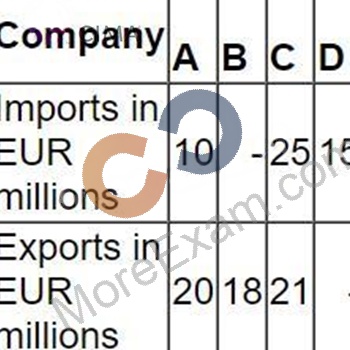
Question66: Companies A, B, C and D:* are based in a country that uses the K$ as its currency.* have an objective to grow operating profit year on year.* have the same total levels of revenue and cost.* trade with companies or individuals in the eurozone. All import and export trade with companies or individuals in the eurozone is priced in EUR.Typical import/export trade for each company in a year are as follows:Which company's growth objective is most sensitive to a movement in the EUR/K$ exchange rate?
Question67: A large, quoted company that is all-equity financed is planning to acquire a smaller unquoted company that is also all-equity financed.The acquiring company's directors are using the dividend valuation model to value the target company before making an offer.Relevant data for the target company:* Dividends paid in the last financial year $2 million* Book value of net assets $15 million* Shares in issue 1 millionThe acquiring company's cost of capital is 10%.Its directors believe they can improve the target company's performance in the long term.They estimate there will be no growth in the first year of the acquisition but from year 2 onwards there will be a 4% growth each year in perpetuity.What is the maximum price the acquiring company should offer for each of the shares in the target company?
Question68: A company has a covenant on its 5% long-term bond, stipulating that its retained earnings must not fall below$2 million.The company has 100 million shares in issue.Its most recent dividend was $0.045 per share. It has committed to grow the dividend per share by 4% each year.The nominal value of the bond is $60 million. It is currently trading at 80% of its nominal value.Next year's earnings before interest and taxation are projected to be $11.25 million.The rate of corporate tax is 20%.If the company increases the dividend by 4%, advise the Board of Directors if the level of retained earnings will comply with the covenant?
Question69: A company plans to raise $12 million to finance an expansion project using a rights issue.Relevant data:* Shares will be offered at a 20% discount to the present market price of $15.00 per share.* There are currently 2 million shares in issue.* The project is forecast to yield a positive NPV of $6 million.What is the yield-adjusted Theoretical Ex-Rights Price following the announcement of the rights issue?
Question70: The directors of a financial services company need to calculate a valuation of their company's equity in preparation for an upcoming initial Public Offering (IPO) of shares. At a recent board meeting they discussed the various methods of business valuation.The Chief Executive suggested using a Price-earing (P./E) method of valuation, but the finance Director argued that a valuation based on forecast cash flows to equity would be more appropriate.Which THREE of the following are advantages of valuation based on forecast cash flows to equity, compared to a valuating using a price earnings methods?
Question71: Company C has received an unwelcome takeover bid from Company P.Company P is approximately twice the size of Company C based on market capitalisation.Although the two companies have some common business interests, the main aim of the bid is diversification for Company P.The offer from Company P is a share exchange of 2 shares in Company P for 3 shares in Company C.There is a cash alternative of $5.50 for each Company C share.Company C has substantial cash balances which the directors were planning to use to fund an acquisition.These plans have not been announced to the market.The following share price information is relevant. All prices are in $.Which of the following would be the most appropriate action by Company C's directors following receipt of this hostile bid?
Question72: A listed company is considering either a one-off special divided or a share repurchase scheme to reduce its surplus cash level.Identify TWO advantages that a one-off special payment has over a share repurchase scheme.
Question73: A company has 8% convertible bonds in issue. The bonds are convertible in 3 years time at a ratio of 20 ordinary shares per $100 nominal value bond.Each share:* has a current market value of $5.60* is expected to grow at 5% each yearWhat is the expected conversion value of each $100 nominal value bond in 3 years' time?
Question74: RST wishes to raise at least $40 million of new equity by issuing up to 10 million new equity shares at a minimum price of $3.00 under an offer for sale by tender. It receives the following tender offers:What is the maximum amount that RST can raise by this share issue?(Give your answer to the nearest $ million).
Question75: Company AB was established 6 years ago by two individuals who each own 50% of the shares.Each individual heads a separate division within the company, which now has annual turnover of GBP10 million and employs 40 people.Some of the employees are very highly paid as they are important contributors to the company's profitability.The owners of the company wish to realise the full value of their investment within the next 12 months.Which TWO of the following options are most likely to be acceptable exit strategies to the two owners of the company?
Question76: An unlisted company operates in a niche market, exploring the west coast of Africa for new oiI reservoirs.The oil exploration program has been successful in recent years and t now has a substantial amount of oil reserves with a high level of certainty of being recoverable Under financial reporting regulations, oil still in the ground is not recognised as an asset unit is extracted.The expense of the exploration program has used up all the company's available cash resources.The company has denied to list or a stock market and raise finds through an initial public offering to finance its drilling program.Which of the following valuation methods in the appropriate to use in calculating an initial listing price for this company?
Question77: The Board of Directors of a listed company wish to estimate a reasonable valuation of the entire share capital of the company in the event of a takeover bid.The company's current profit before taxation is $4.0 million.The rate of corporate tax is 25%.The average P/E multiple of listed companies in the same industry is 8 times current earnings.The P/E multiple of recent takeovers in the same industry have ranged from 9 times to 10 times current earnings.The average P/E multiple of the top 100 companies on the stock market is 15 times current earnings.Advise the Board of Directors which of the following is a reasonable estimate of a range of values of the entire share capital in the event of a bid being made for the whole company?
Question78: Modigliani and Miller are the main proponents of the view that the dividend policy is irrelevant to the value of a company's shares.They argue that a company that continually reinvests its entire earnings would generate the same shareholder wealth if it engaged in a policy of high dividends and financed its expansion with funds obtained from rights issues.Which THREE of the following statements are assumptions that are required in order to support this proposition?
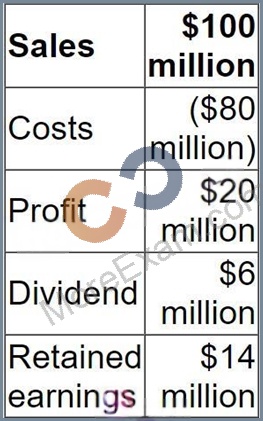
Question79: A company's main objective is to achieve an average growth in dividends of 10% a year.In the most recent financial year:Sales are expected to grow at 8% a year over the next 5 years.Costs are expected to grow at 5% a year over the next 5 years.What is the minimum dividend payout ratio in 5 years' time that would allow the company to achieve its objective?
Question80: Which THREE of the following statements are correct?
Question81: A company is considering either exporting its product directly to customers in a foreign country or establishing a manufacturing subsidiary in that country.The corporate tax rate in the company's own country is 20% and 25% tax depreciation allowances are available.Which THREE of the following would be considered advantages of establishing the subsidiary in the foreign country?
Question82: Company A is identical in all operating and risk characteristics to Company B, but their capital structures differ.Company B is all-equity financed. Its cost of equity is 17%.Company A has a gearing ratio (debt:equity) of 1:2. Its pre-tax cost of debt is 7%.Company A and Company B both pay corporate income tax at 30%.What is the cost of equity for Company A?
Question83: A company plans to acquire new machinery.It has two financing options; buy outright using a bank loan, or a finance lease.Which of the following is an advantage of a finance lease compared with a bank loan?
Question84: Company X is an established, unquoted company which provides IT advisory services.The company's results and cashflows are growing steadily and it has few direct competitors due to the very specialised nature of it's business. Dividends are predictable and paid annually.Company P is looking to buy 30% of company X's equity shares.Which TWO of the following methods are likely to be considered most suitable valuation methods for valuing company P's investment in Company X?
Question85: Z wishes to borrow at a floating rate and has been told that it can use swaps to reduce the effective interest rate it pays. Z can borrow floating at Libor ' 1, and fixed at 10%.Which of the following companies would be the most appropriate for Z to enter into a swap with?
Question86: A new company was set up two years ago using the personal financial resources of the founders.These funds were used to acquire suitable premises.The company has entered into a long-term lease on the premises which are not yet fully fitted out.The founders are considering requesting loan finance from the company's bank to fund the purchase of custom-made advanced technology equipment.No other companies are using this type of equipment.The company expects to continue to be profitable for the forseeable future.It re-invests some of its surplus cash in on-going essential research and development.Which THREE of the following features are likely to be considered negatives by the bank when assessing the company's credit-worthiness?
Question87: Which THREE of the following remain unchanged over the life of a 10 year fixed rate bond?
Question88: A company has a financial objective of maintaining a gearing ratio of between 30% and 40%, where gearing is defined as debt/equity at market values.The company has been affected by a recent economic downturn leading to a shortage of liquidity and a fall in the share price during 20X1.On 31 December 20X1 the company was funded by:* Share capital of 4 million $1 shares trading at $4.0 per share.* Debt of $7 million floating rate borrowings.The directors plan to raise $2 million additional borrowings in order to improve liquidity.They expect this to reassure investors about the company's liquidity position and result in a rise in the share price to $4.2 per share.Is the planned increase in borrowings expected to help the company meet its gearing objective?