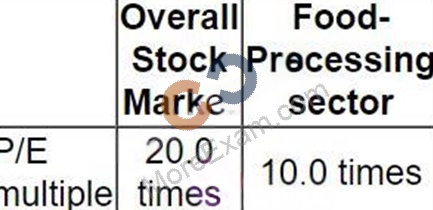
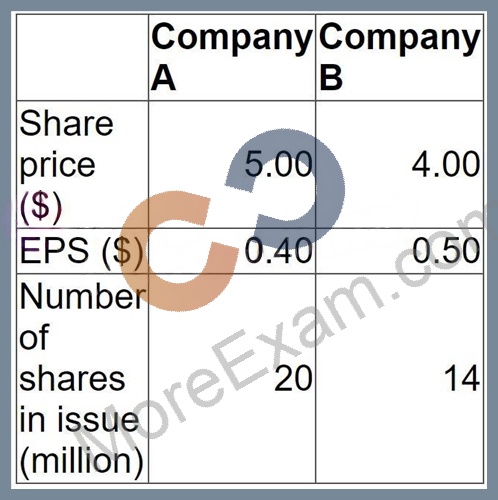
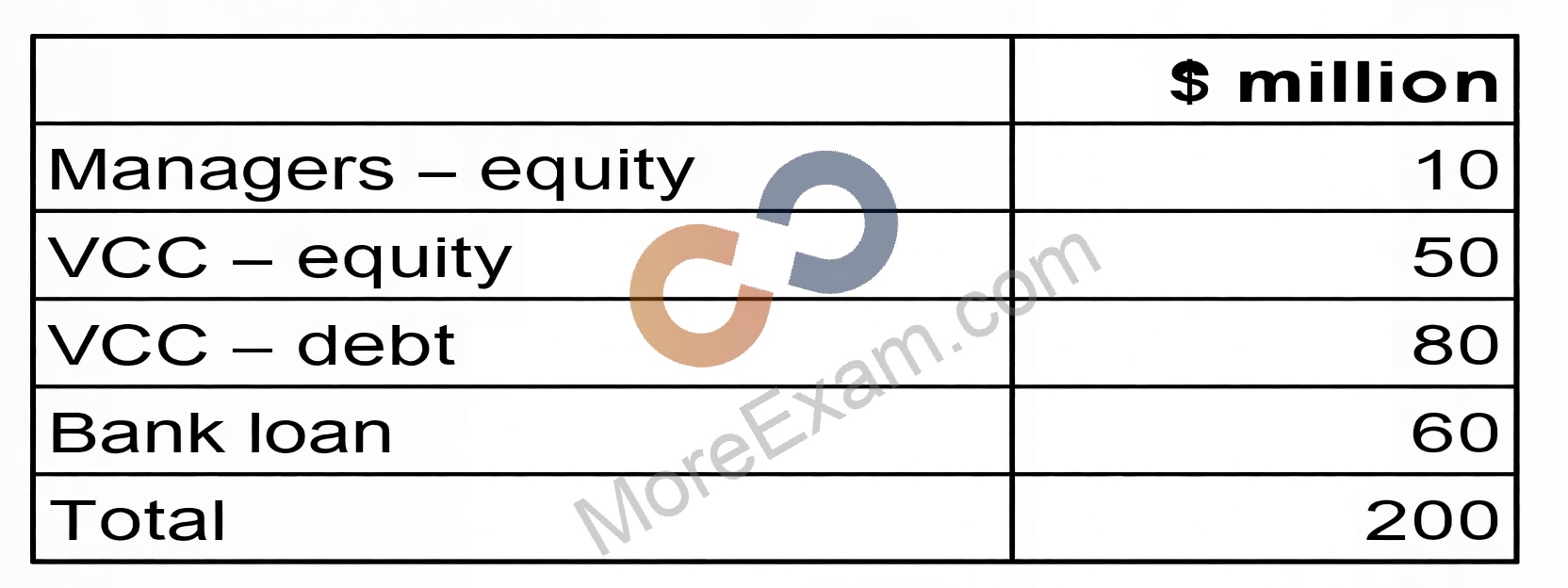
EMT Practice Test

1. Question Content...


Question List
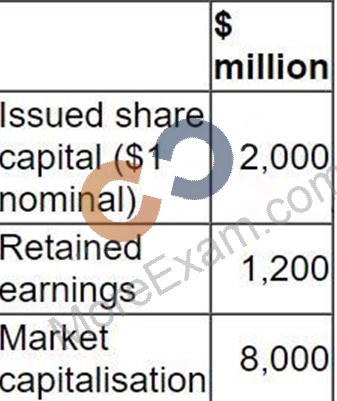
Question1: A company is planning a share repurchase programme with the following details:
* Repurchased shares will be immediately cancelled.
* The shares will be purchased at a premium to the market share price.
The current market share price is greater than the nominal value of the shares.
Which of the following statements about the impact of the share repurchase programme on the company's financial statements is correct?

Question2: A company proposes to value itself based on the net present value of estimated future cash flows.
Relevant data:
* The cash flow for the next three years is expected to be £100 million each year
* The cash flow after year 3 will grow at 2% to perpetuity
* The cost of capital is 12%
The value of the company to the nearest $ million is:

Question3: A company has a cash surplus which it wishes to distribute to shareholders by a share repurchase rather than paying a special dividend.
Which THREE of the following statements are correct?

Question4: A listed company is financed by debt and equity.
If it increases the proportion of debt in its capital structure it would be in danger of breaching a debt covenant imposed by one of its lenders.
The following data is relevant:

The company now requires $800 million additional funding for a major expansion programme.
Which of the following is the most appropriate as a source of finance for this expansion programme?

Question5: Select the category of risk for each of the descriptions below:
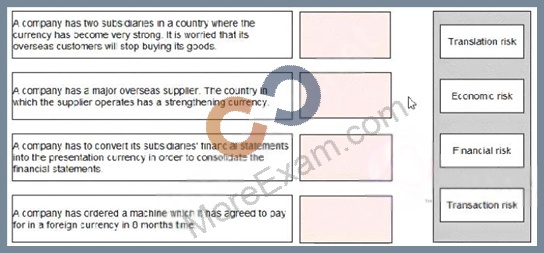
Question6: A is a listed company. Its shares trade on a stock market exhibiting semi-strong form efficiency.
Which of the following is most likely to increase the wealth of A's shareholders?

Question7: A venture capitalist invests in a company by means of buying:
* 9 million shares for $2 a share and
* 8% bonds with a nominal value of $2 million, repayable at par in 3 years' time.
The venture capitalist expects a return on the equity portion of the investment of at least 20% a year on a compound basis over the first 3 years of the investment.
The company has 10 million shares in issue.
What is the minimum total equity value for the company in 3 years' time required to satisify the venture capitalist's expected return?
Give your answer to the nearest $ million.

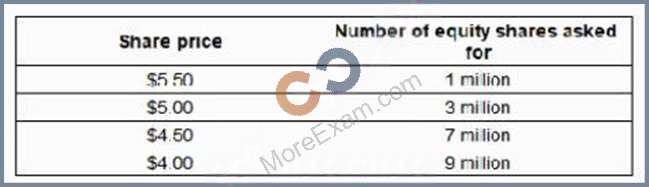
Question8: RST wishes to raise at least $40 million of new equity by issuing up to 10 million new equity shares at a minimum price of $3.00 under an offer for sale by tender. It receives the following tender offers:

What is the maximum amount that RST can raise by this share issue?
(Give your answer to the nearest $ million).

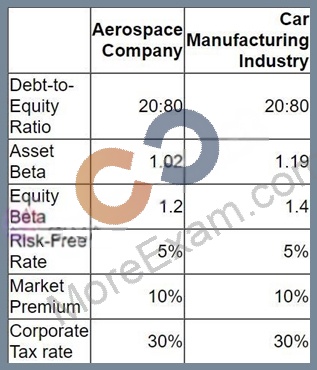
Question9: An aerospace company is planning to diversify into car manufacturing.
Relevant data:

What is the the cost of equity to be used in the WACC for the project appraisal?
Give your answer in percentage, as a whole number.

Question10: A venture capitalist is most likely to take which THREE of the following exit routes?
Question11: A company's gearing (measured as debt/(debt + equity)) is currently 60% and it is investigating whether an optimal gearing structure exists within the industry.
It has analysed the capital structure of similar companies in the industry and it would appear that there is evidence supporting the traditional theory of capital structure.
Companies with the lowest WACC in the industry have gearing of around 45% to 50%.
Which of the following actions would result in the company achieving a more optimal capital structure?

Question12: A company is deciding whether to offer a scrip dividend or a cash dividend to its shareholders.
Although the company has excellent long-term growth prospects, it is experiencing short-term profit and cash flow problems.
Which of the following statements is most likely to be a reason for choosing the scrip dividend?

Question13: A private company was formed five years ago and is currently owned and managed by its five founders. The founders, who each own the same number of shares have generally co-operated effectively but there have also been a number of areas where they have disagreed The company has grown significantly over this period by re-investing its earnings into new investments which have produced excellent returns The founders are now considering an Initial Public Offering by listing 70% of the shares on the local stock exchange Which THREE of the following statements about the advantages of a listing are valid?

Question14: Company T is a listed company in the retail sector.
Its current profit before interest and taxation is $5 million.
This level of profit is forecast to be maintainable in future.
Company T has a 10% corporate bond in issue with a nominal value of $10 million.
This currently trades at 90% of its nominal value.
Corporate tax is paid at 20%.
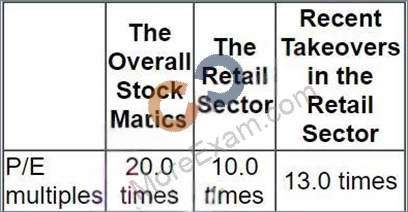
The following information is available:

Which of the following is a reasonable expectation of the equity value in the event of an attempted takeover?

Question15: Company W has received an unwelcome takeover bid from Company B. The offer is a share exchange of 3 shares in Company B for 5 shares in Company Wora cash alternative of $5.70 for each Company W share.
Company B is approximately twice the size of Company W based on market capitalisation. Although the two companies have some common business interested the main aim of the bid is diversification for Company B.
Company W has substantial cash balances which the directors were planning to use to fund an acquisition.
These plans have not been announced to the market.
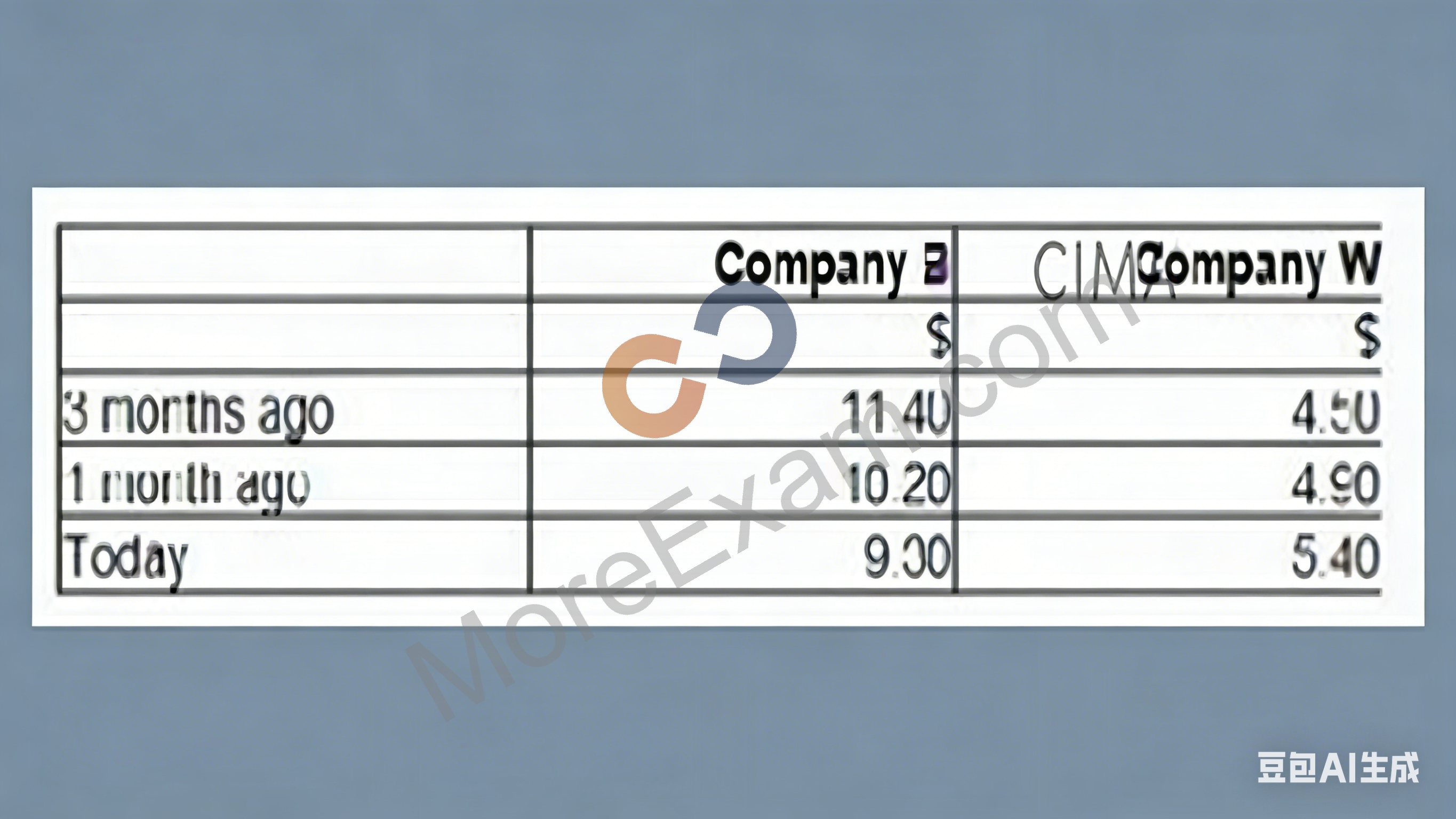
The following share price information is relevant.

Which of the following would be the most appropriate action by Company W's directors following receipt of this hostile bid?

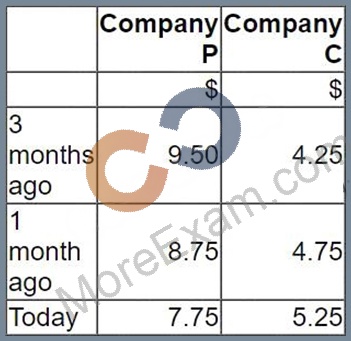
Question16: A national airline has made an offer to acquire a smaller airline in the same country.
Which of the following would be of most concern to the competition authorities?

Question17: A company has:
* 10 million $1 ordinary shares in issue
* A current share price of $5.00 a share
* A WACC of 15%
The company holds $10 million in cash. No interest is earned on this cash.
It will invest this in a project with an expected NPV of $4 million.
In a semi-strong efficient stock market, which of the following is the most likely share price immediately after the announcement of the new investment?

Question18: The Board of Directors of a listed company have decided that it needs to increase its equity capital to ensure it is in a more stable financial position.
The shareholder profile is a mix of institutional and individual small shareholders.
The board is considering either:
* A scrip dividend
* A zero dividend
Which THREE of the following would be considered disadvantages of a scrip dividend compared to a zero dividend?

Question19: A company's dividend policy is to pay out 50% of its earnings.
Its most recent earnings per share was $0.50, and it has just paid a dividend per share of $0.25.
Currently, dividends are forecast to grow at 2% each year in perpetuity and the cost of equity is 10.5%.
In order to grow its earnings and dividends, the company is considering undertaking a new investment funded entirely by debt finance. If the investment is undertaken:
* Its cost of equity will immediately increase to 12% due to the increased finance risk.
* Its earnings and dividends will immediately commence growing at 4% each year in perpetuity.
Which of the following is the expected percentage change in the share price if the new investment is undertaken?

Question20: A company wishes to raise new finance using a rights issue to invest in a new project offering an IRR of 10% The following data applies:
* There are currently 1 million shares in issue at a current market value of $4 each.
* The terms of the rights issue will be $3.50 for 1 new share for 5 existing shares.
* The company's WACC is currently 8%.
What is the yield-adjusted theoretical ex-rights price (TERP)?
Give your answer to 2 decimal places.

Question21: Listed Company A has prepared a valuation of an unlisted company. Company B. to achieve vertical integration Company A is intending to acquire a controlling interest in the equity of Company B and therefore wants to value only the equity of Company B.
The assistant accountant of Company A has prepared the following valuation of Company B's equity using the dividend valuation model (DVM):
Where:
* S2 million is Company B's most recent dividend
* 5% is Company B's average dividend growth rate over the last 5 years
* 10% is a cost of equity calculated using the capital asset pricing model (CAPM), based on the industry average beta factor

Which THREE of the following are valid criticisms of the valuation of Company B's equity prepared by the assistant accountant?

Question22: KKL is a listed sports clothing company with three separate business units. KKL is seeking to sell TT', one of these business units TTP cwns a new. brand of trail running shoes that have Droved hugely popular with lone distance runners.
The management team of TTP are frustrated by the constraints imposes b/ KKL in managing tie brand and developing. the bus ness and they believe that TTF has huge growth potential.
The management team of TTP have approached KKL with a proposal to purchase 1~P through a management layout (MDO). KKL has accepted this proposal as TTP has not proved to be a good fit' with the rest of the business and has agreed on the selling price.
Which THREE of the following factors a-e mast Likely to affect the success of the MBO?

Question23: A profitable company wishes to dispose of a loss-making division that generated negative free cashflow in the last financial year.
The division requires significant new investment to return it to profitability.
Which of the following valuation approaches is likely to be the most useful to the company when negotiating the sales price?

Question24: Listed company R is in the process of making a cash offer for the equity of unlisted company S.
Company R has a market capitalisation of $200 million and a price/earnings ratio of 10.
Company S has a market capitalisation of $50 million and earnings of $7 million.
Company R intends to offer $60 million and expects to be able to realise synergistic benefits of $20 million by combining the two businesses. This estimate excludes the estimated $8 million cost of integrating the two businesses.
Which of the following figures need to be used when calculating the value of the combined entity in $ millions?

Question25: A private company manufactures goods for export, the goods are priced in foreign currency B$.
The company is partly owned by members of the founding family and partly by a venture capitalist who is helping to grow the business rapidly in preparation for a planned listing in three years' time.
The company therefore has significant long term exposure to the B$.
This exposure is hedged up to 24 months into the future based on highly probable forecast future revenue streams.
The company does not apply hedge accounting and this has led to high volatility in reported earnings.
Which of the following best explains why external consultants have recently advised the company to apply hedge accounting?

Question26: A listed company is planning a share repurchase.
The following data applies:
* There are 10 million shares in issue
* The share repurchase will involve buying back 20% of the shares at a price of $0.75
* The company is holding $2 million cash
* Earnings for the current year ended are $2 million
The Directors are concerned about the impact that this repurchase programme will have on the company's cash balance and current year earnings per share (EPS) ratio.
Advise the directors which of the following statements is correct?

Question27: Which of the following statements about IFRS 7 Financial Instruments: Disclosures is true?

Question28: On 31 October 20X3:
* A company expected to agree a foreign currency transaction in January 20X4 for settlement on 31 March
20X4.
* The company hedged the currency risk using a forward contract at nil cost for settlement on 31 March
20X4.
* The transaction was correctly treated as a cash flow hedge in accordance with IAS 39 Financial Instruments: Recognition and Measurement.
On 31 December 20X3, the financial year end, the fair value of the forward contract was $10,000 (asset).
How should the increase in the fair value of the forward contract be treated within the financial statements for the year ended 31 December 20X3?

Question29: M is an accountant who wishes to take out a forward rate agreement as a hedging instrument but the company treasurer has advised that a short-term interest rate future would be a better option.
Which of the following is true of a short-term interest rate

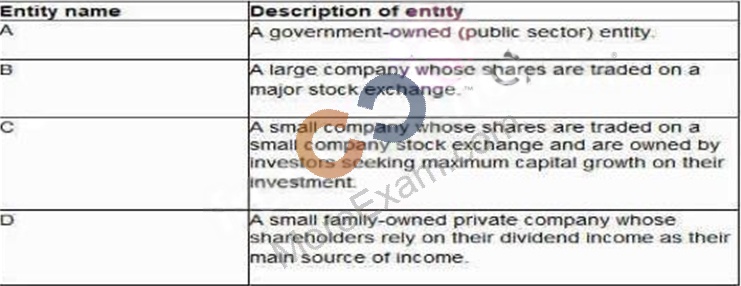
Question30: The directors of the following four entities have been discussing dividend policy:

Which of these four entities is most likely to have a residual dividend policy?

Question31: Company M is a listed company in a highly technical service industry.
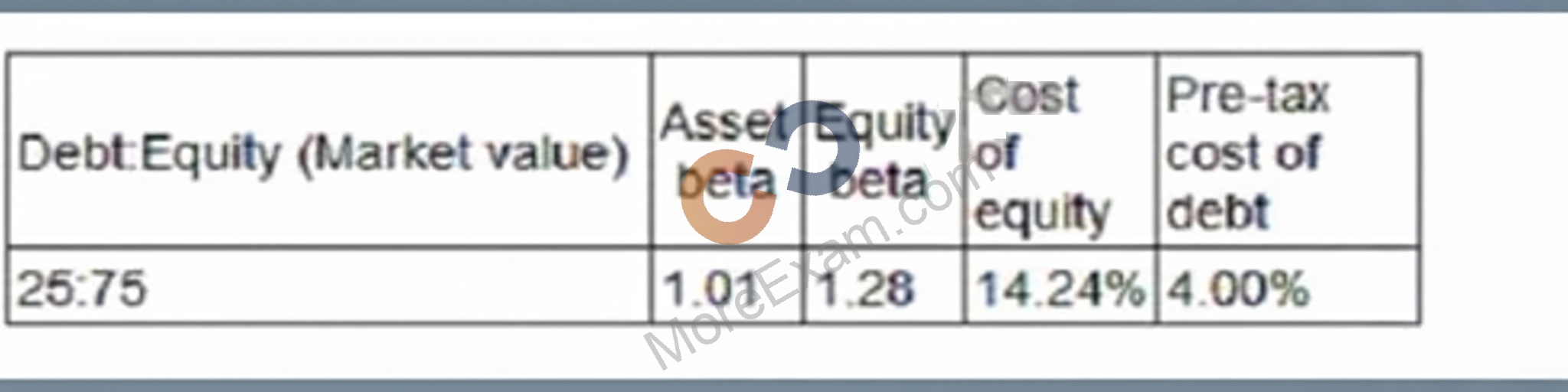
The directors are considering making a cash offer for the shares in Company Q, an unquoted company in the same industry.
Relevant data about Company Q:
* The company has seen consistent growth in earnings each year since it was founded 10 years ago.
* It has relatively few non-current assets.
* Many of the employees are leading experts in their field. A recent exercise suggested that the value of the company's human capital exceeded the value of its tangible assets.
The directors and major shareholders of Company Q have indicated willingness to sell the company.
Before negotiations become too advanced, the directors of Company M are considering the benefits to their company that would follow the acquisition.
Which THREE of the following are the most likely benefits of the acquisition to Company M's shareholders?

Question32: A large, listed company in the food and household goods industry needs to raise $50 million for a period of up to 6 months.
It has an excellent credit rating and there is almost no risk of the company defaulting on the borrowings. The company already has a commercial paper programme in place and has a good relationship with its bank.
Which of the following is likely to be the most cost effective method of borrowing the money?

Question33: Company ABC's management has noticed that Company BCD has quickly built up a 20% stake by buying shares in Company ABC and are concerned that this is the start of a hostile bid.
This build-up of shares triggers the poison pill provision which automatically converts the rights to buy future preference shares previously issued to existing shareholders in Company ABC to full ordinary shares What is the most likely impact of the triggering of a poison pill strategy at this stage in the bidding process?

Question34: Company T has 1,000 million shares in issue with a current share price of $10 each.
Company V has 300 million shares in issue with a current share price of $5 each.
Company T is considering acquiring Company V.
Total synergy gains of $100 million have been estimated.
The purchase of Company V's shares would be by cash at a 10% premium above the current share price.
In seeking approval for the acquisition, the likely reaction from T's shareholders will be:

Question35: Which of the following would be a reason for a company to adopt a low dividend pay-out policy?

Question36: HHH Company has a fixed rate loan at 10.0%, but wishes to swap to variable. It can borrow at the risk-free rate +8%. The bank is currently quoting swap rates of 3.1% (bid) and 3.5% (ask). What net rate will HHH Company pay if it enters into the swap?

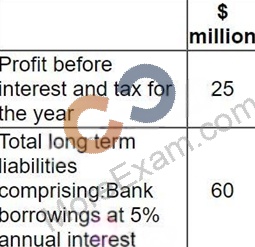
Question37: At the last financial year end, 31 December 20X1, a company reported:

The corporate income tax rate is 30% and the bank borrowings are subject to an interest cover covenant of 4 times.
The results are presently comfortably within the interest cover covenant as they show interest cover of 8.3 times. The company plans to invest in a new product line which is not expected to affect profit in the first year but will require additional borrowings of $20 million at an annual interest rate of 10%.
What is the likely impact on the existing interest cover covenant?

Question38: Company W is a manufacturing company with three divisions, all of which are making profits:
* Division A which manufactures cars
* Division B which manufactures trucks
* Division C which manufactures agricultural machinery
Company W is facing severe competitive pressure in all of its markets, and is currently operating with a high level of gearing Company W's latest forecasts suggest that it needs to raise cash to avoid breaching loan covenants on its existing debt finance in 6 months' time In a recent strategy review. Divisions A and B were identified as being the core divisions of Company W The management of Division C is known to be interested in the possibility of a management buy-out.
Company Z is known to be interested in making a takeover bid for Company W's truck manufacturing division A rival to Company W has recently successfully demerged its business, this was well received by the Financial markets Which of the following exit strategies will be most suitable for company W?

Question39: A company plans to raise $12 million to finance an expansion project using a rights issue.
Relevant data:
* Shares will be offered at a 20% discount to the present market price of $15.00 per share.
* There are currently 2 million shares in issue.
* The project is forecast to yield a positive NPV of $6 million.
What is the yield-adjusted Theoretical Ex-Rights Price following the announcement of the rights issue?

Question40: A company plans to acquire new machinery.
It has two financing options; buy outright using a bank loan, or a finance lease.
Which of the following is an advantage of a finance lease compared with a bank loan?

Question41: A company based in Country D, whose currency is the D$, has an objective of maintaining an operating profit margin of at least 10% each year.
Relevant data:
* The company makes sales to Country E whose currency is the E$. It also makes sales to Country F whose currency is the F$.
* All purchases are from Country G whose currency is the G$.
* The settlement of all transactions is in the currency of the customer or supplier.
Which of the following changes would be most likely to help the company achieve its objective?

Question42: Company C is a listed company. It is currently considering the acquisition of Company D. The original founder of Company C currently owns 52% of the shares.
Alternative forms of consideration for Company D being considered are as follows:
* Cash payment, financed by new borrowing
* issue of new shares in Company C
Which of the following is an advantage of a cash offer over a share-for exchange from the viewpoint of the original founder of Company C?

Question43: B has a S3 million loan outstanding on which the interested rate is reset every 6 months for the following 6 month and the interested is payable at the end of that 6 month period. The next 6 monthly reset period starts in
3 months and the treasurer of B thinks interested rates are likely to raise between and then.
Current 6-month rates are 6.4% and the treasurer can get a rate of 6.9% for a 6-month forward rate agreement (FRA) starting in 3 months time. By transacting an TRA the treasurer can lock in a rate today of 6.9%.
If interested rates are 7.5% in 3 months' time, what will the net amount payable be?
Give your answer to the nearest thousand dollars.

Question44: An unlisted software development business is to be sold by its founders to a private equity house following the initial development of the software. The business has not yet made a profit but significant profits are expected for the next three years with only negligible profits thereafter. The business owns the freehold of the property from which it operates. However, it is the industry norm to lease property.
Which THREE of the following are limitations to the validity of using the Calculated Intangible Value (CIV) method for this business?

Question45: Which TIIRCC of the following are most likely to reduce the long term credit rating co a company?

Question46: SUP is a large supermarket chain. It produces many 'own brand' goods in Country S where the parent company is located. These goods are sold in SUP's supermarkets in Country S as well as being sold at a 'transfer price' to SUP companies located in foreign countries for sale in the SUP supermarkets located in that country.
Which of the following factors is the most important for SUP from a lax planning and compliance viewpoint when setting prices for the 'own brand' goods sold to other group companies'?

Question47: The International Integrated Reporting Council (IIRC) was formed in August 2010 and brings together a cross-section of representatives from a wide variety of business sectors.
The primary purpose of the IIRC's framework is to help enable an organsation to communicate how it:

Question48: A consultancy company is dependent for profits and growth on the high value individuals it employs.
The company has relatively few tangible assets.
Select the most appropriate reason for the net asset valuation method being considered unsuitable for such a company.

Question49: The long-term prospects for inflation in the UK and the USA are 1% and 4% per annum respectively.
The GBP/USD spot rate is currently GBP/USD1.40
Using purchasing power parity theory, what GBP/USD spot rate would you expect to see in six months' time?

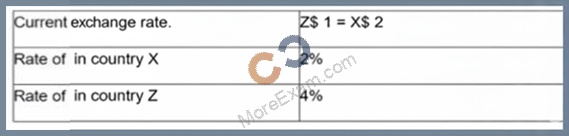
Question50: A company is based in Country Y whose functional currency is Y$. It has an investment in Country Z whose functional currency is Z$.
This year the company expects to generate Z$ 10 million profit after tax.
Tax Regime:
* Corporate income tax rate in country Y is 50%
* Corporate income tax rate in country Z is 20%
* Full double tax relief is available
Assume an exchange rate of Y$ 1 = Z$ 5.
What is the expected profit after tax in Y$ if the Z$ profit is remitted to Country Y?

Question51: A listed company in a high growth industry, where innovation is a key driver of success has always operated a residual dividend policy, resulting in volatility in dividends due to periodic significant investments in research and development.
The company has recently come under pressure from some investors to change its dividend policy so that shareholders receive a consistent growing dividend. In addition, they suggested that the company should use more debt finance.
If the suggested change is made to the financial policies, which THREE of the following statements are true?

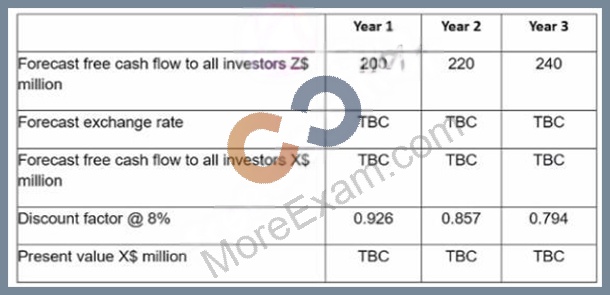
Question52: Company XXY operates in country X with the X$ as its currency. It is looking to acquire company ZZY which operates in country Z with the Z$ as its currency.
The assistant accountant at Company XXY has started to prepare an initial valuation of Company ZZY's equity for the first 3 years, however their valuation is incomplete. TBC' in the table below indicates that her calculations have yet to be completed.

The following information is relevant:

What is the correct figure (to the nearest million S) to include in year 3 as the present value in X$ million?

Question53: Company A has made an offer to take over all the shares in Company B on the following terms:
* For every 20 shares currently held, Company B's shareholders will receive $100 bond with a coupon rate of 3%
* The bond will be repaid in 10 years' time at its par value of $100.
* The current yield on 10 year bonds of similar risk is 6%.
What is the effective offer price per share being made to Company B's shareholders?

Question54: Which of the following best explains why the interest rate parity model is highly effective in practice?

Question55: A company has 6 million shares in issue. Each share has a market value of $4.00.
$9 million is to be raised using a rights issue.
Two directors disagree on the discount to be offered when the new shares are issued.
* Director A proposes a discount of 25%
* Director B proposes a discount of 30%
Which THREE of the following statements are most likely to be correct?

Question56: Company A plans to acquire Company B, an unlisted company which has been in business for 3 years.
It has incurred losses in its first 3 years but is expected to become highly profitable in the near future.
No listed companies in the country operate the same business field as Company B, a unique new high-risk business process.
The future success of the process and hence the future growth rate in earnings and dividends is difficult to determine.
Company A is assessing the validity of using the dividend growth method to value Company B.
Which THREE of the following are weaknesses of using the dividend growth model to value an unlisted company such as Company HHG?

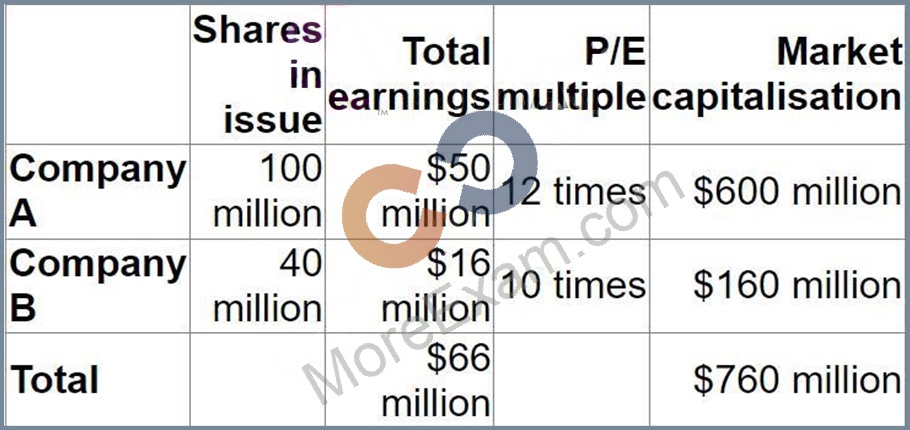
Question57: Company A plans to acquire Company B in a 1-for-1 share exchange.
Pre-acquisition information is as follows:

Post-acquisition information is as follows:
* Annual earnings are expected to increase by $4 million.
* The P/E multiple of the combined company is expected to be 12 times.
If the acquisition proceeds, what is the expected percentage increase in the post acquisition share price of Company A?

Question58: Company YZZ has made a bid for the entire share capital of Company ZYY
Company YZZ is offering the shareholders in Company ZYY the option of either a share exchange or a cash alternative Which THREE of the following would be considered disadvantages of accepting the cash consideration for the shareholders of Company ZYY?

Question59: Which THREE of the following statements are disadvantages of the net asset basis of valuation?

Question60: Company A operates in country A with the AS as its functional currency. Company A expects to receive BS500.000 in 6 months' time from a customer in Country B which uses the B$.
Company A intends to hedge the currency risk using a money market hedge The following information is relevant:

What is the AS value of the BS expected receipt in 6 months' time under a money market hedge?

Question61: A company has accumulated a significant amount of excess cash which is not required for investment for the foreseeable future.
It is currently on deposit, earning negligible returns.
The Board of Directors is considering returning this excess cash to shareholders using a share repurchase programme.
The majority of shareholders are individuals with small shareholdings.
Which THREE of the following are advantages of the company undertaking a share repurchase programme?

Question62: A company is considering either exporting its product directly to customers in a foreign country or establishing a manufacturing subsidiary in that country.
The corporate tax rate in the company's own country is 20% and 25% tax depreciation allowances are available.
Which THREE of the following would be considered advantages of establishing the subsidiary in the foreign country?

Question63: A company is funded by:
* $40 million of debt (market value)
* $60 million of equity (market value)
The company plans to:
* Issue a bond and use the funds raised to buy back shares at their current market value.
* Structure the deal so that the market value of debt becomes equal to the market value of equity.
According to Modigliani and Miller's theory with tax and assuming a corporate income tax rate of 20%, this plan would:

Question64: Company A is a large well-established listed entertainment company and Company B is a small unlisted company specializing in providing online media streaming.
Company A has a gearing ratio of 60% (using book values) and interest cover of 2.
Company A is considering making an offer for Company B, either a cash offer financial by raising additional debt finance or a share-for-share exchange.
Which of the following is most likely to occur if Company A offers a share-for exchange rather than offering cash finance by raising debt?

Question65: Which of the following explains an aim of integrated reporting in accordance with The International <IR> Framework as issued by the International Integrated Reporting Council?

Question66: A new company was set up two years ago using the personal financial resources of the founders.
These funds were used to acquire suitable premises.
The company has entered into a long-term lease on the premises which are not yet fully fitted out.
The founders are considering requesting loan finance from the company's bank to fund the purchase of custom-made advanced technology equipment.
No other companies are using this type of equipment.
The company expects to continue to be profitable for the forseeable future.
It re-invests some of its surplus cash in on-going essential research and development.
Which THREE of the following features are likely to be considered negatives by the bank when assessing the company's credit-worthiness?

Question67: Company RRR is a well-established, unlisted, road freight company.
In recent years RRR has come under pressure to improve its customer service and has had some success in doing this However, the cost of improved service levels has resulted in it making small losses in its latest financial year. This is the first time RRR has not been profitable.
RRR uses a 'residual' dividend policy and has paid dividends twice in the last 10 years.
Which of the following methods would be most appropriate for valuing RRR?

Question68: A company's statement of financial position includes non-current assets which are leased, the tax regime follows the accounting treatment.
Which cash flows should be discounted when evaluating the cost of lease finance?

Question69: The financial assistant of a geared company has prepared the following calculation of the company's equity value:


Useful information;
* Tax rate - 20%
* Cost of equity = 12%
* Weighted average cost of capital (WACC)= 10%
" Debt finance of the company comprises a $6 million 7% undated bond trading at par Valuation workings.
Which of the following errors has been made by the financial assistant?

Question70: The directors of a unlisted manufacturing company have prepared a valuation of their company using the price-earning method.
Their calculation is:
Value if the company's equity = $6 million x 10 =$60 million where.
* $6 million is the company's reported profit before interested and tax in the most recent accounting period and
* 10 is the average price-earnings ratio for all listed companies
Which THREE of the following are weakness of this valuation?

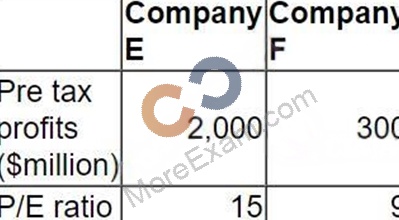
Question71: Company E is a listed company. Its directors are valuing a smaller listed company, Company F, as a possible acquisition.
The two companies operate in the same markets and have the same business risk.
Relevant data on the two companies is as follows:

Both companies are wholly equity financed and both pay corporate tax at 30%.
The directors of Company E believe they can "bootstrap" Company F's earnings to improve performance.
Calculate the maximum price that Company E should offer to Company F's shareholders to acquire the company.
Give your answer to the nearest $million.

Question72: A company's annual dividend has grown steadily at an annual rate of 3% for many years. It has a cost of equity of 11%. The share price is presently $64.38.
The company is about to announce its latest dividend, which is expected to be $5.00 per share.
The Board of Directors is considering an attractive investment opportunity that would have to be funded by reducing the dividend to $4.50 per share. The board expects the project to enable future dividends to grow by
5% every year and the cost of equity to remain unchanged.
Calculate the change in share price, assuming that the directors announce their intention to proceed with this investment opportunity.
Give your answer to 2 decimal places.

Question73: A large, listed company is planning a major project that should greatly improve its share price in the long term.
These plans require a significant capital cost that the company plans to finance by debt.
All of the debt options being considered are for the same duration of time.
Which of the following sources of debt finance is likely to be the most expensive for the company over the full term of the debt?

Question74: A listed company is planning a share repurchase.
The following data applies:
* There are 10 million shares in issue
* The share repurchase will involve buying back 20% of the shares at a price of $0.75
* The company is holding $2 million cash
* Earnings for the current year ended are $2 million
The Directors are concerned about the impact that this repurchase programme will have on the company's cash balance and current year earnings per share (EPS) ratio.
Advise the directors which of the following statements is correct?

Question75: A company's directors plan to increase gearing to come in line with the industry average of 40%. They need to know what the effect will be on the company's WACC.
According to traditional theory of gearing the WACC is most likely to:

Question76: A company is wholly equity funded. It has the following relevant data:
* Dividend just paid $4 million
* Dividend growth rate is constant at 5%
* The risk free rate is 4%
* The market premium is 7%
* The company's equity beta factor is 1.2
Calculate the value of the company using the Dividend Growth Model.
Give your answer in $ million to 2 decimal places.
$ ? million

Question77: A large, listed company in the food and household goods industry needs to raise $50 million for a period of up to 6 months.
It has an excellent credit rating and there is almost no risk of the company defaulting on the borrowings. The company already has a commercial paper programme in place and has a good relationship with its bank.
Which of the following is likely to be the most cost effective method of borrowing the money?

Question78: A company is planning to issue a 5 year $100 million bond at a fixed rate of 6%.
It is also considering whether or not to enter into a 10 year $100 million swap to receive 5% fixed and pay Libor + 1% once a year.
The company predicts that Libor will be 4% over the life of the 5 years.
What is the impact of the swap on the company's annual interest cost assuming that the Libor prediction is correct?

Question79: VVV has a floating rate loan that it wishes to replace with a fixed rate. The cost of the existing loan is the risk-free rate + 3%. VW would have to pay a fixed rate of 7% on a fixed rate loan VVVs bank has found a potential counterparty for a swap arrangement.
The counterparty wishes to raise a variable rate loan It would pay the risk-free rate +1 % on a variable rate loan and 8% on a fixed rate.
The bank will require 10% of the savings from the swap and WV and the counterparty will share the remaining saving equally.
Calculate VWs effective rate of interest from this swap arrangement.

Question80: Company HJK is planning to bid for listed company BNM
Financial data for BNM for the financial year ended 31 December 20X1:

HJK is not forecasting any growth in these figures for the foreseeable future Profit and cost data above should be assumed to be equivalent to cash flow data when answenng this question Which THREE of the following approaches would be most appropriate for HJK to use to value the equity of BNM?

Question81: A company is currently all-equity financed.
The directors are planning to raise long term debt to finance a new project.
The debt:equity ratio after the bond issue would be 30:60 based on estimated market values.
According to Modigliani and Miller's Theory of Capital Structure without tax, the company's cost of equity would:

Question82: A company enters into a floating rate borrowing with interest due every 12 months over the five year life of the borrowing.
At the same time, the company arranges an interest rate swap to swap the interest profile on the borrowing from floating to fixed rate.
These transactions are designated as a hedge for hedge accounting purposes under IAS 39 Financial Instruments: Recognition and Measurement.
Assuming the hedge is considered to be effective, how would the swap be accounted for 12 months later?

Question83: Company WWW is considering making a takeover bid for Company KKA Company KKA's current share price is $5.00 Company WWW is considering either
" A cash payment of $5.75 for each share in Company KKA
" A 5 year corporate bond with a market value of $90 in exchange for 15 shares in Company KKA Calculate the highest percentage premium which Company KKA shareholders will receive.

Question84: Company A operates in country A and uses currency AS. It is looking to acquire Company B which operates in country B and uses currency B$. The following information is relevant:

The assistant accountant at Company A has prepared the following valuation of company B's equity, however there are some errors in his calculations.

Value of Company B's equity = 14.16 + 16.03 + 17.67 = AS47.86 million
Company B has BS5 million of debt finance.
Which of the following THREE statements are true?

Question85: A major energy company, GDE, generates and distributes electricity in country A. The government of country A is concerned about rising inflation and has imposed price controls on GDE, limiting the price it can charge per unit of electricity sold to both domestic and commercial customers. It is likely that price controls will continue for the foreseeable future.
The introduction of price controls is likely to reduce the profit for the current year from $3 billion to $1 billion.
The company has:
* Distributable reserves of $2 billion.
* Surplus cash at the start of the year of $1 billion.
* Plans to pay a total dividend of $1.5 billion in respect of the current year, representing a small annual increase as in previous years. However, no dividends have yet been announced.
Which THREE of the following responses would be MOST appropriate for GDE following the imposition of price controls?

Question86: A company has two divisions.
A is the manufacturing division and supplies only to B, the retail division.
The Board of Directors has been approached by another company to acquire Division B as part of their retail expansion programme.
Division A will continue to supply to Division B as a retail customer as well as source and supply to other retail customers.
Which is the main risk faced by the company based on the above proposal?

Question87: TTT pic is a listed company. The following information is relevant:

TTT pic's board is considering issuing new 6% irredeemable debt to re-purchase equity. This is expected to change TTT pic's debt to equity mix to 40: 60 by market value. The corporate tax rate is 20%.
What will be TTT pic's WACC following this change in capital structure?

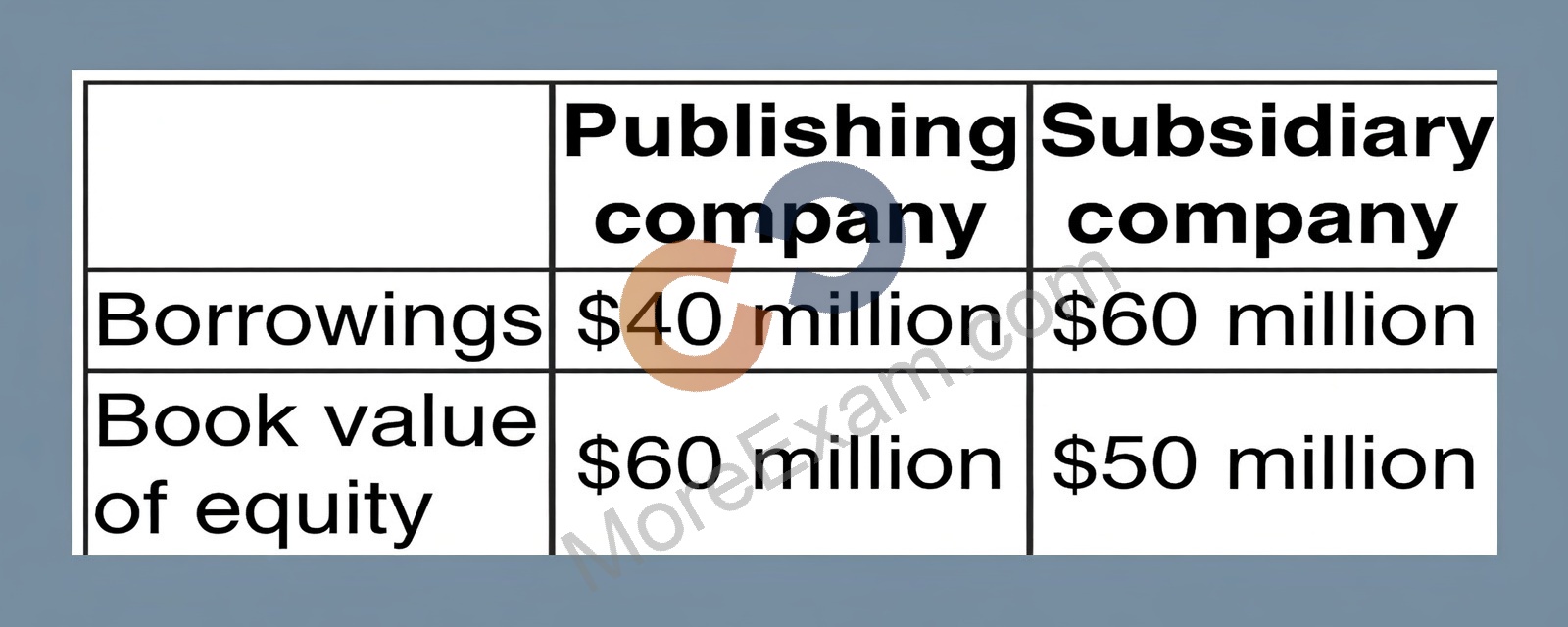
Question88: A listed publishing company owns a subsidiary company whose business activity is training.
It wishes to dispose of the subsidiary company.
The following information is available:

The board of the publishing company believe that the value of the subsidiary company, and hence the value of the equity invested in it, can be determined by calculating the present value of the subsidiary's free cashflows.
Which of the following is the most appropriate discount rate to use when determining the enterprise value of the company?

Question89: Which THREE of the following are considered in detail in IFRS 7 Financial Instruments: Disclosures?

Question90: A national rail operating company has made an offer to acquire a smaller competitor.
Which of the following pieces of information would be of most concern to the competition authorities?

Question91: Company M is a geared company whose equity has a market value of $1,500 million and debt has a market value of S300 million. The company plans to issue $200 million of new shares and use the funds raised to pay off some of the debt Company M currently has a cost of equity of 13% and a WACC of 10% It pays corporate tax at the rate of 30% Company B, an ungeared company operating in the same business sector as Company M, has a cost of equity of 12% Assume Modigliani and Miller's theory of capital structure with tax applies Which calculation below shows the correct approach to calculating the new WACC following the planned changes in capital structure?

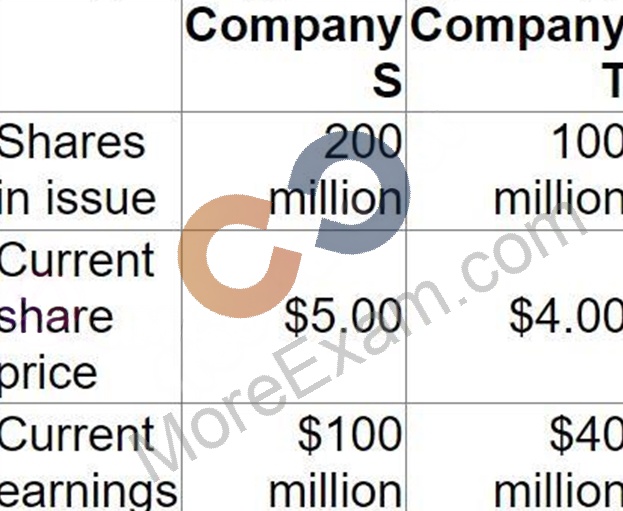
Question92: Company S is planning to acquire Company T.
The shareholders in Company T will receive new shares in Company S in an all-share consideration.
Relevant information:

The shareholders in Company T want sufficient shares to receive a 25% premium on the pre-acquisition value of their shares, based on the pre-acquisition share price.
Which of the following share-for-share offers will achieve the desired result?

Question93: Company ACC. an ungeared car manufacturer has launched a takeover bid of Company BDD. a key competitor operating in the same industry Company BDD has high gearing Company ACC has a large surplus cash balance and believes that the acquisition is an opportunity to enhance shareholder wealth through the realisation of synergistic benefits. Which THREE of the following would most likely be synergistic benefits to Company ACC of purchasing Company BDD9 I

Question94: Which THREE of the following are the most likely exit routes that apply to a venture capitalist?

Question95: An unlisted company wishes to obtain an estimated value for its shares in anticipation of a private sale of a large parcel of shares.
Relevant data for the unlisted company:
* It has a residual dividend policy.
* It has earnings that are highly sensitive to underlying economic conditions.
* It is a small business in a large industry where there are listed companies but there are none with a similar capital structure.
The company intends to base valuations on the cost of equity of a proxy company after adjusting for any differences in capital structure where appropriate.
Which of the following methods is likely to give the most accurate equity value for this unlisted company?

Question96: A company is deciding whether to offer a scrip dividend or a cash dividend to its shareholders.
Although the company has excellent long-term growth prospects, it is experiencing short-term profit and cash flow problems.
Which of the following statements is most likely to be a reason for choosing the scrip dividend?

Question97: Company Z wishes to borrow $50 million for 10 years at a fixed rate of interest.
Two alternative approaches are being considered:
A: Issue a 10 year bond at a fixed rate of 6%, or B: Borrow from the bank at Libor +2.5% for a 10 year period and simultaneously enter into a 10 year interest rate swap.
Current 10 year swap rates against Libor are 4.0% - 4.2%.
What is the difference in the net interest cost between the two alternative approaches?

Question98: A company is considering the issue of a convertible bond compared to a straight bond issue (non- convertible bond).
Director A is concerned that issuing a convertible bond will upset the shareholders for the following reasons:
* it will dilute their control
* the interest payments will be higher therefore reducing liquidity
* it will increase the gearing ratio therefore increasing financial risk Director B disagrees, and is preparing a board paper to promote the issue of the convertible bond rather than a non-convertible.
Advise the Director B which THREE of the following statements should be included in his board paper to promote the issue of the convertible bond?

Question99: Company R is a major food retailer. It wishes to acquire Company S, a food manufacturer.
Company S currently supplies many stores owned by Company R with food products that it manufactures.
Company S is of similar size to Company R but has a lower credit rating.
Which of the following is most likely to be a synergistic benefit to R on purchasing S?

Question100: The Treasurer of Z intends to use interest rate options to set an interest rate cap on Z's borrowings.
Which of the following statement is correct?

Question101: XYZ is a multi-national group with subsidiary AA in Country A and subsidiary BB in Country B. The capital structures of AA and BB are set up to take advantage of the lower tax rate in Country A Thin capitalisation rules in Country B will limit the ability for either AA or BB to claim tax relief on:

Question102: XCV can borrow at either 9.5% fixed or the risk-free rate plus 1.3%.
XCV wishes to borrow at a variable rate and thinks that a swap may enable it to do so cheaply BNM can borrow the same principal sum as XCV It can borrow at 10 5% fixed or the risk-free rate plus 2 1 % BNM wishes to raise fixed rate debt XCV and BNM have agreed to use an interest rate swap They will share any savings equally Calculate the effective swap rate that will be paid by XCV.
Give your answer to one decimal place.

Question103: A company plans to raise S15 million to finance an expansion project using a rights issue Relevant data
* Shares will be offered at a 20% discount to the present market price of S12 50 per share
* There are currently 3 million shares in issue
* The project is forecast to yield a positive NPV of $9 million
What is the yield-adjusted Theoretical Ex-Rights Price following the announcement of the rights issue?

Question104: Company J plans to acquire Company K, an unlisted company whose equity is to be valued using a P/E ratio approach.
A listed company has been identified which is very similar to Company K and which can be used as a proxy.
However, the growth prospects of Company K are higher than those of the proxy.
The Directors of Company J are aware that certain adjustments will be necessary to the proxy company's P/E ratio in order to obtain a more reliable valuation.
The following adjustments have been agreed:
* 20% due to Company K being unlisted.
* 15% to allow for the growth rate difference.
The total adjustment to the proxy p/e ratio is:

Question105: X exports goods to customers in a number of small countries Asia. At present, X invoices customers in X's home currency.
The Sales Director has proposed that X should begin to invoice in the customers currency, and the Treasurers considering the implications of the proposal.
Which TWO of the following statement are correct?

Question106: Company M is a listed company in a highly technical service industry.
The directors are considering making a cash offer for the shares in Company Q, an unquoted company in the same industry.
Relevant data about Company Q:
* The company has seen consistent growth in earnings each year since it was founded 10 years ago.
* It has relatively few non-current assets.
* Many of the employees are leading experts in their field. A recent exercise suggested that the value of the company's human capital exceeded the value of its tangible assets.
The directors and major shareholders of Company Q have indicated willingness to sell the company.
Before negotiations become too advanced, the directors of Company M are considering the benefits to their company that would follow the acquisition.
Which THREE of the following are the most likely benefits of the acquisition to Company M's shareholders?

Question107: A company plans to raise $12 million to finance an expansion project using a rights issue.
Relevant data:
* Shares will be offered at a 20% discount to the present market price of $15.00 per share.
* There are currently 2 million shares in issue.
* The project is forecast to yield a positive NPV of $6 million.
What is the yield-adjusted Theoretical Ex-Rights Price following the announcement of the rights issue?

Question108: A company's gearing (measured as debt/(debt + equity)) is currently 60% and it is investigating whether an optimal gearing structure exists within the industry.
It has analysed the capital structure of similar companies in the industry and it would appear that there is evidence supporting the traditional theory of capital structure.
Companies with the lowest WACC in the industry have gearing of around 45% to 50%.
Which of the following actions would result in the company achieving a more optimal capital structure?

Question109: The directors of a multinational group have decided to sell off a loss-making subsidiary and are considering the following methods of divestment:
1. Trade sale to an external buyer
2. A management buyout (MBO)
The MBO team and the external buyer have both offered the same price to the parent company for the subsidiary.
Which of the following is an advantage to the parent company of opting for a MBO compared to a trade sale as the preferred method of divestment?

Question110: A company has in a 5% corporate bond in issue on which there are two loan covenants.
* Interest cover must not fall below 3 times
* Retained earnings for the year must not fall below $3.5 million
The Company has 200 million shares in issue.
The most recent dividend per share was $0.04.
The Company intends increasing dividends by 10% next year.
Financial projections for next year are as follows:
Advise the Board of Directors which of the following will be the status of compliance with the loan covenants next year?

Question111: The following information relates to Company ZZA's current capital structure:

Company ZZA is considering a change in the capital structure that will increase gearing to 35:65 (Debt Equity).
The risk-free rate is 4% and the return on the market portfolio is expected to be 12%.
The rate of corporate tax is 25%
Using the Capital Asset Pricing Model, calculate the cost of equity resulting from the proposed change to the capital structure.

Question112: An unlisted company is attempting to value its equity using the dividend valuation model.
Relevant information is as follows:
* A dividend of $500,000 has just been paid.
* Dividend growth of 8% is expected for the foreseeable future.
* Earnings growth of 6% is expected for the foreseeable future.
* The cost of equity of a proxy listed company is 15%.
* The risk premium required due to the company being unlisted is 3%.
The calculation that has been performed is as follows:
Equity value = $540,000 / (0.18 - 0.08) = $5,400,000
What is the fault with the calculation that has been performed?

Question113: Company X is an established, unquoted company which provides IT advisory services.
The company's results and cashflows are growing steadily and it has few direct competitors due to the very specialised nature of it's business. Dividends are predictable and paid annually.
Company P is looking to buy 30% of company X's equity shares.
Which TWO of the following methods are likely to be considered most suitable valuation methods for valuing company P's investment in Company X?

Question114: Company C has received an unwelcome takeover bid from Company P.
Company P is approximately twice the size of Company C based on market capitalisation.
Although the two companies have some common business interests, the main aim of the bid is diversification for Company P.
The offer from Company P is a share exchange of 2 shares in Company P for 3 shares in Company C.
There is a cash alternative of $5.50 for each Company C share.
Company C has substantial cash balances which the directors were planning to use to fund an acquisition.
These plans have not been announced to the market.
The following share price information is relevant. All prices are in $.

Which of the following would be the most appropriate action by Company C's directors following receipt of this hostile bid?

Question115: The Senior Management Team of ABC, an owner-managed, capital intensive start-up engineering business, is considering the options for its dividend policy. It has so far been a successful business and is expanding quickly Once in place, the Senior Management Team anticipates that its current investment plans will yield returns for many years to come The first agenda item at every meeting currently concerns arranging and funding new equipment and premises.
Which of the following dividend policies is likely to be the most suitable?

Question116: Company A, a listed company, plans to acquire Company T, which is also listed.
Additional information is:
* Company A has 150 million shares in issue, with market price currently at $7.00 per share.
* Company T has 120 million shares in issue,. with market price currently at $6.00 each share.
* Synergies valued at $50 million are expected to arise from the acquisition.
* The terms of the offer will be 2 shares in A for 3 shares in T.
Assuming the offer is accepted and the synergies are realised, what should the post-acquisition price of each of Company A's shares be?
Give your answer to two decimal places.

Question117: Company A, a listed company, plans to acquire Company T, which is also listed.
Additional information is:
* Company A has 100 million shares in issue, with market price currently at $8.00 per share.
* Company T has 90 million shares in issue,. with market price currently at $5.00 each share.
* Synergies valued at $60 million are expected to arise from the acquisition.
* The terms of the offer will be 2 shares in A for 3 shares in B.
Assuming the offer is accepted and the synergies are realised, what should the post-acquisition price of each of Company A's shares be?
Give your answer to two decimal places.

Question118: On 31 October 20X3:
* A company expected to agree a foreign currency transaction in January 20X4 for settlement on 31 March
20X4.
* The company hedged the currency risk using a forward contract at nil cost for settlement on 31 March
20X4.
* The transaction was correctly treated as a cash flow hedge in accordance with IAS 39 Financial Instruments: Recognition and Measurement.
On 31 December 20X3, the financial year end, the fair value of the forward contract was $10,000 (asset).
How should the increase in the fair value of the forward contract be treated within the financial statements for the year ended 31 December 20X3?

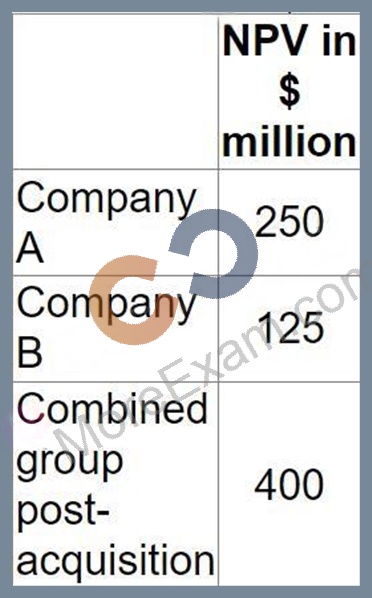
Question119: Company A is planning to acquire Company B by means of a cash offer. The directors of Company B are prepared to recommend acceptance if a bid price can be agreed. Estimates of the net present value (NPV) of future cash flows for the two companies and the combined group post acquisition have been prepared by Company A's accountant. There are as follows:

What is the maximum price that Company A should offer for the shares in Company B?
Give your answer to the nearest $ million

Question120: Company P is a pharmaceutical company listed on an alternative investment market.
The company is developing a new drug which it hopes to market in approximately six years' time.
Company P is owned and managed by a group of doctors who wish to retain control of the company. The company operates from leased laboratories with minimal fixed assets.
Its value comes from the quality of its research staff and their research.
The company currently has one approved drug which generates sufficient cashflow to cover day to day operations but not sufficient for major new research and development.
Company P wish to raise debt finance to develop the new drug.
Recommend which of the following types of debt finance would be most appropriate for Company P to help finance the development of this new drug.

Question121: Delta and Kappa both wish to borrow $50m.
Delta can borrow at a fixed rate of 12% or at a floating rate of the risk-free rate +3% Kappa can borrow at 15% fixed or the risk-free rate +4%.
Delta wishes a variable rate loan and Kappa a fixed rate loan The bank for the two companies suggests a swap arrangement The two companies agree to a swap arrangement, sharing savings equally What is the effective swap rate for each company?

Question122: A company is preparing an integrated report according to the International <IR> Framework as issued by the International Integrated Reporting Council.
Which THREE of the following should be included in the report?

Question123: Under traditional theory, an increase in a company's WACC would cause the value of the company to:

Question124: An unlisted company operates in a niche market, exploring the west coast of Africa for new oiI reservoirs.
The oil exploration program has been successful in recent years and t now has a substantial amount of oil reserves with a high level of certainty of being recoverable Under financial reporting regulations, oil still in the ground is not recognised as an asset unit is extracted.
The expense of the exploration program has used up all the company's available cash resources.
The company has denied to list or a stock market and raise finds through an initial public offering to finance its drilling program.
Which of the following valuation methods in the appropriate to use in calculating an initial listing price for this company?

Question125: An entity prepares financial statements to 30 June.
During the year ended 30 June 20X2 the following events occurred:
1 July 20X1
* The entitiy borrowed $100 million at a variable rate of interest.
* In order to protect itself against the variability of its interest cashflows, the entity entered into a pay-fixed-receive-variable interest swap with annual settlements. The fair value of the swap on this date was zero.
30 June 20X2
* The entity received a net settlement of $2 million under the swap. After this net settlement, the fair value of the swap was $5 million - a financial asset.
The entity decides to use hedge accounting for this arrangement and has designated it as a cash flow hedge.
The swap is a perfect hedge of the variability of the cash interest payments.
Which of the following describes the treatment of the settlement and the change in the fair value of the swap in the statement of profit or loss and other comprehensive income for the year ended 30 June 20X2?

Question126: Company ABE is an unlisted company that has been trading for 10 years. During this period, it has seen substantial growth in revenue and earnings. For the company to continue its growth it needs to raise new finance The directors are considering an initial public offering (IPO).
The following information is relevant to Company ABE:

A listed company of similar size and in the same industry as Company ABE had earnings per share in the last financial year of $1 80 Its shares are currently trading at a price / earnings ratio of 12.
The directors of Company ABE have asked for advice on what price they might expect if the company is listed on the stock exchange by means of an IPO.
Using the information provided what is an estimated issue price for each share in Company ABE?

Give your answer to 2 decimal places.

Question127: STU has relatively few tangible assets and is dependent for profits and growth on the high-value individuals it employs. Which of the following statements best explains why the net asset valuator method's considered unstable for TU?

Question128: A large, quoted company that is all-equity financed is planning to acquire a smaller unquoted company that is also all-equity financed.
The acquiring company's directors are using the dividend valuation model to value the target company before making an offer.
Relevant data for the target company:
* Dividends paid in the last financial year $2 million
* Book value of net assets $15 million
* Shares in issue 1 million
The acquiring company's cost of capital is 10%.
Its directors believe they can improve the target company's performance in the long term.
They estimate there will be no growth in the first year of the acquisition but from year 2 onwards there will be a 4% growth each year in perpetuity.
What is the maximum price the acquiring company should offer for each of the shares in the target company?

Question129: A company generates and distributes electricity and gas to households and businesses.
Forecast results for the next financial year are as follows:

The Industry Regulator has announced a new price cap of $2.00 per Kilowatt.
The company expects this to cause consumption to rise by 15% but costs would remained unaltered.
The price cap is expected to cause the company's net profit to fall to:

Question130: BBA is a wholly owned subsidiary of AAB BBA operates in country B where the currency is the B$.
The following is an extract from BBA's financial statements at 31 December 20X1:

The following Information is relevant:
" The bonds were trading at $110 per $100 on 31 December 20X1. "Operating profit of BBA for the year ended 31 December 20X1 was S15 million
* The P/E ratio is 8
* Corporate income tax rate is 20%.
The tax authorities m country B Implemented thin capitalisation rules based on the level of gearing of the subsidiary, calculated as book value o( debt lo book value of equity The cut-off point for gearing used by the tax authorities for a company to be thinly capitalised is 75%.
Which of the following statements is correct as at 31 December 20X1?

Question131: The Board of Directors of Company T is considering a rights issue to fund a new investment opportunity which has a zero NPV.
The Board of Directors wishes to explain to shareholders what the theoretical impact on their wealth will be as a result of different possible actions during the rights issue.
Which THREE of the following statements in respect of theoretical shareholder wealth are true?

Question132: It is now 1 January 20X0.
Company V, a private equity company, is considering the acquisition of 40% of the equity of Company A for a total amount of $15 million.
Company A has been established to develop a new type of engine which will be launched at the end of 20X1.
Company A is forecasting that the new engine will result in free cash flows to equity of $2m in its first year of operation and that this will rise by 8% per year for the foreseeable future.
The new engine is the only commercial activity that Company A is involved in.
Company V intends to sell its stake in Company A when the new engine is launched.
Company A has a cost of equity of 12%.
Assuming that Company V receives an amount that reflects the present value of their shares in company A.
what is the estimated annual rate of return to Company V from this investment? (To the nearest %)

Question133: Company A is planning to acquire Company B.
Company A's managers think they can improve the performance of Company B to the extent that its own P/E ratio should be applied to Company B's earnings.
Relevant Data:

What is the expected synergy if the acquisition goes ahead?
Give your answer to the nearest $ million.

Question134: An unlisted software development company has recently reported disappointing results. This was partly due to weak economic conditions but also because of its poor competitive position. The company has a number of exciting development opportunities which would enable it to achieve significant future growth. The company's growth potential has been hindered by its inability to secure sufficient new finance.
To enable the company raise new finance the Directors are considering working forwards an IPO in 10 years and accepting finance from a venture capitalist in order support in the intervening period.
The directors are keen to retain a controlling stake in the company and full representation on the board. They therefore require venture capitalists to provide funds as a mix of debt and equity and not soley equity finance.
Which THREE of the following are most likely to disrupt the directors' plans to use venture capital finance?

Question135: Listed company R is in the process of making a cash offer for the equity of unlisted company S.
Company R has a market capitalisation of $200 million and a price/earnings ratio of 10.
Company S has a market capitalisation of $50 million and earnings of $7 million.
Company R intends to offer $60 million and expects to be able to realise synergistic benefits of $20 million by combining the two businesses. This estimate excludes the estimated $8 million cost of integrating the two businesses.
Which of the following figures need to be used when calculating the value of the combined entity in $ millions?

Question136: Company Y plans to diversify into an activity where Company X has an equity beta of 1.6, a debt beta of zero and gearing of 50% (debt/debt plus equity).
The risk-free rate of return is 5% and the market portfolio is expected to return 10%.
The rate of corporate income tax is 30%.
What would be the risk-adjusted cost of equity if Company Y has 60% equity and 40% debt?

Question137: WX, an advertising agency, has just completed the all-cash acquisition of a competitor, YZ. This was seen by the market as a positive strategic move byWX.
Which THREE of the following will WX's shareholders expect the company's directors to prioritise following the acquisition?

Question138: Which TWO of the following situations offer arbitrage opportunities?

Question139: PPA owns $500,000 of shares in Company ABB.
Company ABB has a daily volatility of 2% of its share price Calculate the 12-day value at risk that shows the most PPA can expect to lose during a 12-day period (PPA wishes to be 90% certain that the actual loss in any month will be less than your predicted figure)
Give your answer to the nearest thousand dollars.

Question140: Company B is an all equity financed company with a cost of equity of 10%.
It is considering issuing bonds in order to achieve a gearing level of 20% debt and 80% equity.
These bonds will pay a coupon rate of 5% and have an interest yield of 6%.
Company B pays corporate tax at the rate of 25%.
According to Modigliani and Miller's theory of capital structure with tax, what will be Company B's new cost of equity?

Question141: A Venture Capital Fund currently holds a significant shareholding in a large private company as a result of funding a recent management buyout. It plans to exit this investment in 5 years time at a significant profit.
Which THREE of the following exit mechanisms are most likely to be preferred by the Venture Capital Fund?

Question142: A manufacturing company based in Country R. where the currency is the R$, has an objective of maintaining an operating profit margin of at least 10% each year Relevant data:
* The company makes sales to Country S whose currency is the SS It also makes sales to Country T whose currency is the T$ " All purchases are from Country U whose currency is the US.
* The settlement of an transactions is in the currency of the customer or supplier Which of the following changes would be most likely to help the company achieve its objective?

Question143: A listed company has suffered a period of falling revenues and profit margins. It has been obliged to issue a profit warning to the market and its share price has fallen sharply. The company relies heavily on debt finance and is discussing with its banks possible refinancing options to assist with a restructuring programme.
Which THREE of the following are likely to be of MOST interest to the company's banks when they review the refinancing requests?

Question144: Company ABD and Company BCD operate in the same industry and each has a significant market share.
The directors of Company ABD have heard rumours in the market that Company BCD is planning to bid to takeover Company ABD. They do not believe the takeover would be in the best interests of the shareholders and are therefore keen to prevent the bid from going ahead.
Which THREE of the following defense strategies could be used by the directors of Company ABD at this point in time?

Question145: A company raised fixed rate bank finance together with an interest rate swap for the same term and same principal value to pay floating receive fixed rate interest on an annual basis.
Which THREE of the following statements are correct?

Question146: PTT has a number of subsidiary companies around the world, including FTT based in Europe and CTT based in Indonesia CTT purchases all of us raw materials from FTT CTT processes these materials and the resulting products are exported to several different countries CTT pays FTT in the Indonesian currency.
Indonesia's inflation is higher than that of FTTs home country
Which of the following statements are correct?
Select ALL that apply

Question147: Company AEE has a 10 year 6% corporate bond in issue which has a nominal value of $400 million, which is currently trading at 95%. The bond is secured on the company's property The Board of Directors has calculated the equity value of Company AEE as follows;

Which THREE of the following are errors in the valuation?

Question148: Company U has made a bid for the entire share capital of Company B.
Company U is offering the shareholders in Company B the option of either a share exchange or a cash alternative.
Advise the shareholders in Company B which THREE of the following would be considered disadvantages of accepting the cash consideration?

Question149: Company A is proposing a rights issue to finance a new investment. Its current debt to equity ratio is 10%.
Which TWO of the following statements are true?

Question150: Company M plans to bid for Company J. Company M has 20 million shares in issue and a current share price of $10.00 before publicly announcing the planned takeover. Company J has 10 million shares in issue and a current share price of $4.00.
The directors of Company M are considering an all-share bid of 1 Company M shares for 2 Company J shares.
Synergies worth $20m are expected from the acquisition.
What is the likely change in wealth for Company M's shareholders (in total) if the bid is accepted?
Give your answer to the nearest $ million.
$ ? million

Question151: The shares of a company in a high technology industry have been listed on a stock exchange for 10 years.
During this period, it has paid no dividends but invested all retained earnings in growth. The company is now entering a period of relatively stable growth and the directors are considering beginning to pay dividends They are reviewing the following suggestions made by members of the board:
* Pay cash dividends linked to growth in earnings
* Use a residual theory approach to establish cash dividends
* Issue scrip dividends (shares instead of cash)
* Continue to pay no dividends as dividends are irrelevant to the value of the company Which THREE of the following are correct statements for the directors to take into consideration when making a decision about future dividend policy?

Question152: A company based in Country D, whose currency is the D$, has an objective of maintaining an operating profit margin of at least 10% each year.
Relevant data:
* The company makes sales to Country E whose currency is the E$. It also makes sales to Country F whose currency is the F$.
* All purchases are from Country G whose currency is the G$.
* The settlement of all transactions is in the currency of the customer or supplier.
Which of the following changes would be most likely to help the company achieve its objective?

Question153: The Board of Directors of a small listed company engaged in exploration are currently considering the future dividend policy of the company. Exploration is considered a high-risk business and consequently the company has a low level of debt finance.
Forecasts indicate a period of profit fluctuation in the next few years as the company is planning to embark on a major capital investment project. Debt finance is unlikely to be available due to the project's high business risk.
Which THREE of the following are practical considerations when determining the company's dividend/retention policy?

Question154: A listed entertainment and media company produces and distributes films globally. The company invests heavily in intellectual property in order to create the scope for future film projects. The company has five separate distribution companies, each managed as a separate business unit The company is seeking to sell one of its business units in a management buy-out (MBO) to enable it to raise finance for proposed new investments The business unit managers have been in discussions with a bank and venture capitalists regarding the financing for the MBO The venture capitalists are only prepared to invest a mixture of debt and equity and have suggested the following:

The venture capitalists have stated that they expect a minimum return on their equity investment of 3Q°/o a year on a compound basis over the first 5 years of the MBO No dividends will be paid during this period.
Advise the MBO team of the total amount due to the venture capitalist over the 5-year period to satisfy their total minimum return?

Question155: A company is currently all-equity financed with a cost of equity of 8%.
It plans to raise debt with a pre-tax cost of 4% in order to buy back equity shares.
After the buy-back, the debt-to-equity ratio at market values will be 1 to 2.
The corporate income tax rate is 30%.
Which of the following represents the company's cost of equity after the buy-back according to Modigliani and Miller's Theory of Capital Structure with taxes?

Question156: A company is considering hedging the interest rate risk on a 3-year floating rate borrowing linked to the
12-month risk-free rate.
If the 12-month risk-free rate for the next three years is 2%, 3% and 4%, which of the following alternatives would result in the lowest average finance cost for the company over the three years?

Question157: A company based in Country A with the A$ as its functional currency requires A$500 million 20-year debt finance to finance a long-term investment The company has a high credit rating, but has not previously issued corporate bonds which are listed on the stock exchange Which THREE of the following are advantages of issuing 20 year bonds compared with simply borrowing for a 20 year period?

Question158: PPP's home currency is the PS. An overseas customer is due to make a payment of A$5,000,000 to PPP in 3 months. The present spot rate is 1PS = 5A$. P can obtain an interest rate of 4% per year on P$ deposits and 6% per year on AS deposits.
Forecast the value of the customer's payment to PPP, in PS, when the payment is made in 3 months' time.
Give your answer to the nearest thousand PS.

Question159: PYP is a listed courier company. It is looking to raise new finance to fit each of its delivery vans with new equipment to allow improved parcel tracking for customers The senior management team of PYP have decided on a 10-year secured bond to finance this investment- Which TWO of the following variables are most likely to decrease the yield to maturity of the bond?

Question160: Company A plans to acquire Company B.
Both firms operate as wholesalers in the fashion industry, supplying a wide range of ladies' clothing shops.
Company A sources mainly from the UK, Company B imports most of its supplies from low-income overseas countries.
Significant synergies are expected in management costs and warehousing, and in economies of bulk purchasing.
Which of the following is likely to be the single most important issue facing Company A in post-merger integration?

Question161: Which THREE of the following long term changes are most likely to increase the credit rating of a company?

Question162: Company A plans to diversify by a cash acquisition of Company B an unlisted company in another country (Country B) which operates in a different industrial sector Company A already manufactures its product in Country B and has a loan denominated in Country B's currency Company A regularly suffers foreign exchange losses due to volatility in the exchange rate between the two countries' currencies in recent years.
Which THREE of the following appear to be be valid justifications of this diversification decision?

Question163: A company is owned by its five directors who want to sell the business.
Current profit after tax is $750,000.
The directors are currently paid minimal salaries, taking most of their incomes as dividends.
After the company is sold, directors' salaries will need to be increased by $50,000 each year in total.
A suitable Price/Earnings (P/E) ratio is 7, and the rate of corporate tax is 20%.
What is the value of the company using a P/E valuation?

Question164: Which THREE of the following statements about stock market listings are correct?
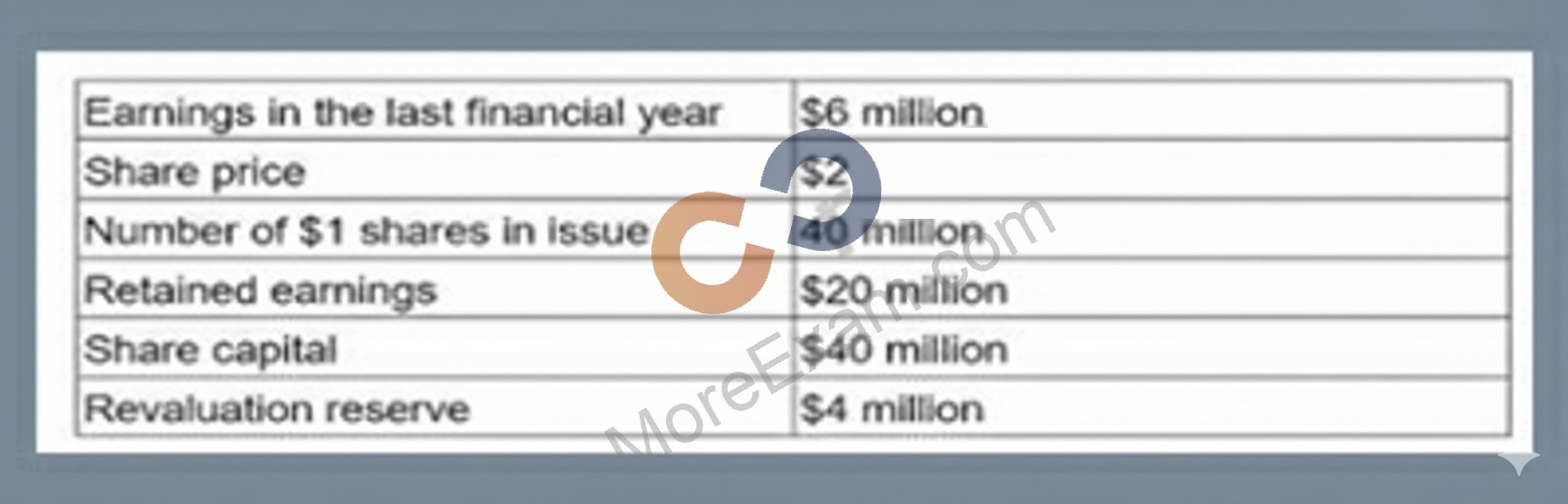
Question165: A company is based in Country Y whose functional currency is Y$. It has an investment in Country Z whose functional currency is Z$.
This year the company expects to generate Z$ 10 million profit after tax.
Tax Regime:
* Corporate income tax rate in country Y is 50%
* Corporate income tax rate in country Z is 20%
* Full double tax relief is available
Assume an exchange rate of Y$ 1 = Z$ 5.
What is the expected profit after tax in Y$ if the Z$ profit is remitted to Country Y?

Question166: A company s about to announce a new project that has a positive NPV.
If the market is semi-strong form efficient, which of the following statements is most Likely to be true?
The value of the company will.

Question167: On 1 January 20X1, a company had:
* Cost of equity of 10 0%.
* Cost of debt of 5.0%
* Debt of $100Mmilion
* 100 million $1 shares trading at $4.00 each.
On 1 February 20X1:
* The company's share police fell to $3.00.
* Debt and the cost of debt remained unchanged
The company does not pay tax.
Under Modigliani and Miller's theory without lax. what is the best estimate of the movement in the cost of equity as a result of the fall in ne share price?

Question168: A company has:
* A price/earnings (P/E) ratio of 10.
* Earnings of $10 million.
* A market equity value of $100 million.
The directors forecast that the company's P/E ratio will fall to 8 and earnings fall to $9 million.
Which of the following calculations gives the best estimate of new company equity value in $ million following such a change?

Question169: An unlisted company has the following data:

A listed company in the same industry has a P/E of 11.
The value of the unlisted company based on the P/E of this listed company is:

Give your answer to the nearest whole number.

Question170: Company P is a large unlisted food-processing company.
Its current profit before interest and taxation is $4 million, which it expects to be maintainable in the future.
It has a $10 million long-term loan on which it pays interest of 10%.
Corporate tax is paid at the rate of 20%.
The following information on P/E multiples is available:

Which of the following is the best indication of the equity value of Company P?

Question171: A company's current earnings before interest and taxation are $5 million.
These are expected to remain constant for the forseeable future.
The company has 10 million shares in issue which currently trade at $3.60.
It also has a $10 million long term floating rate loan.
The current interest rate on this loan is 5%.
The company pays tax at 20%.
The company expects interest rates to increase next year to 6% and it's Price/Earnings (P/E) ratio to move to
9.5 times by the end of next year.
What percentage reduction in the share price will occur by the end of next year if the interest rate increase and the P/E movement both occur?

Question172: Company A is planning to acquire Company B at a price of $ 65 million by means of a cash bid.
Company A is confident that the merged entity can achieve the same price earnings ratio as that of Company A.

What does Company A expect the value of the merged entity to be post acquisition?

Question173: Company Z has identified four potential acquisition targets: companies A, B, C and D.
Company Z has a current equity market value of $590 million.
The price it would have to pay for the equity of each company is as follows:

Only one of the target companies can be acquired and the consideration will be paid in cash.
The following estimations of the new combined value of Company Z have been prepared for each acquisition before deduction of the cash consideration:

Ignoring any premium paid on acquisition, which acquisition should the directors pursue?

Question174: A company has convertible bonds in issue.
The following debt is apply (31 December 20X0):
* Conversion ratio- 20 shares for each $130 bond.
* Current share price - $4 50
* Expected annual growth in share price - 5%
Advise the bond Holder at which date the convers on would be worthwhile?

Question175: Clinic A provides free healthcare to all members of the community, funded by the central Government.
Clinic B provides healthcare which has to be paid for by the individual patients. It is a listed company, owned by a large number of shareholders.
In comparing the above two organisations and their objectives, which THREE of the following statements are correct?

Question176: A company intends to sell one of its business units. Company W, by a management buyout (MBO). A selling price of S200 million has been agreed.
The managers are discussing with a bank and a venture capital company (VCC) the following financing proposal.

The VCC requires a minimum return on its equity investment In the MBO of 35% a year on a compound basis over 5 years.
What is the minimum total equity value of Company W in 5 years time in order to meet the VCC's required return?
Give your answer to one decimal place.

Question177: Company A is unlisted and all-equity financed. It is trying to estimate its cost of equity.
The following information relates to another company, Company B, which operates in the same industry as Company A and has similar business risk:
Equity beta = 1.6
Debt:equity ratio 40:60
The rate of corporate income tax is 20%.
The expected premium on the market portfolio is 7% and the risk-free rate is 5%.
What is the estimated cost of equity for Company A?
Give your answer to one decimal place.