EMT Practice Test

1. Question Content...


Question List

Question1: Which four procurement cycle stages happen after the award of the contract?

Question2: Explain how a lack of understanding of a global supplier's culture and ethical behavior could cost buying organization money.

Question3: Describe four factors that could damage reputation within the supply chair

Question4: What effect is technology having on jobs within an organization with which you are familiar with?

Question5: Which Incoterm applies here?
The supplier is responsible for delivering the goods directly onto the vessel that will transport them to their named destination and must also cover the cost of this. The supplier bears all risks until the goods are delivered to the buyer at their named place.

Question6: What is the method of monitoring suppliers?

Question7: What is commissioning?
Question8: Which Incoterm applies here?
The supplier is responsible for delivering the goods to the buyer's premises include arranging any custom clearances that applies, bearing all risk up until this point.

Question9: What Incoterm applies here?
The goods are considered 'delivered' at the point of release from the supplier's premises or another name place. The supplier is not responsible for loading or transporting the goods and does not have to arrange export clearance - this must be arranged by the buyer. The risk is on the buyer from this point.
a) EXW - Ex Works
b) FCA - Free Career
c) CPT - Carriage Paid To
d) CIP - Carriage and Insurance Paid to

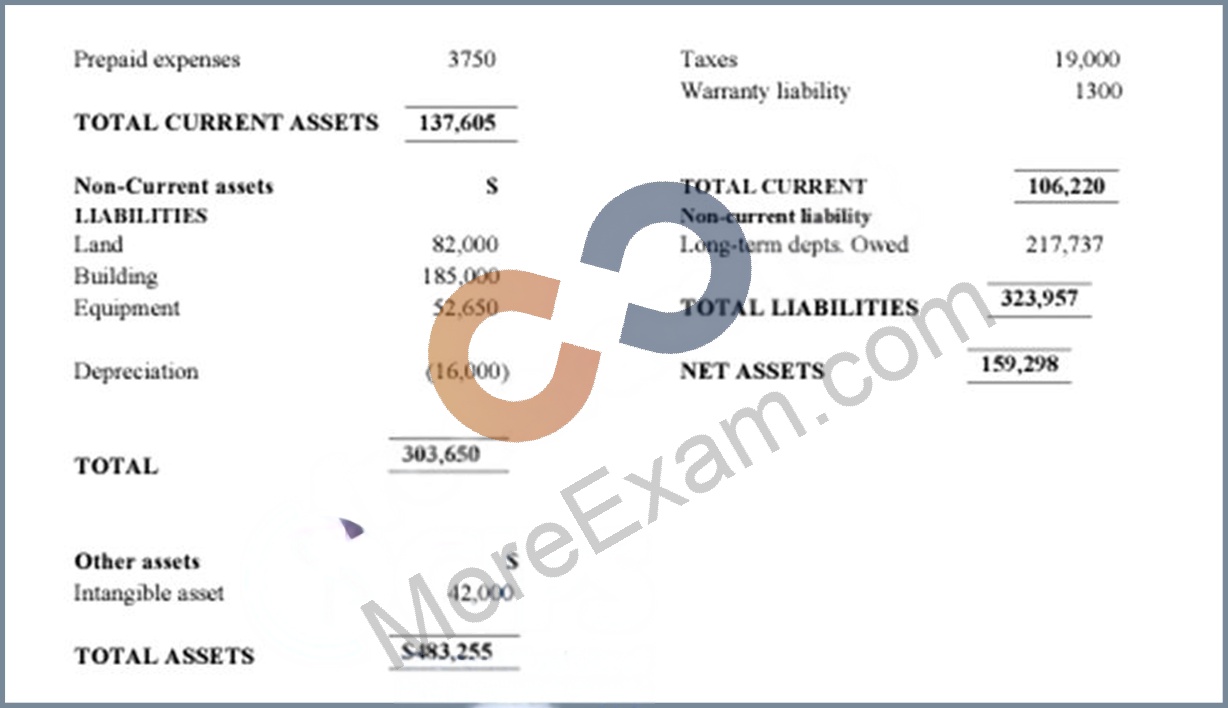
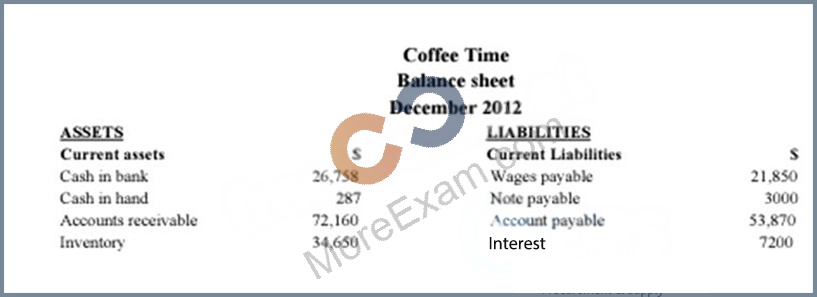
Question10: Use the balance sheet below to work out the correct ratio for coffee Time and explain whether the company appears to have enough assets to cover it liability.

Question11: Which Incoterm applies here?
The supplier is responsible for delivering the goods directly onto the vessel that will transport them to their named destination. As soon as the goods are on the vessel, the risk transfers to the buyer

Question12: What potential costs could an organization face if it fails to conduct Due diligence effectively?

Question13: Describe three benefits of working cross-functionally

Question14: What is a cross function team?

Question15: Describe one qualitative and one quantitative measures of social impact for an organization with which you are familiar.

Question16: What does the acronym SMART stand for?

Question17: What information should be included on a purchase requisition?

Question18: When should whole life asset management be applied?

Question19: What are the ILO and ETI?

Question20: Describe one implied term and one expressed term from a contract with which you are familiar.

Question21: What are five recognized types of modern slavery?

Question22: What is contract performance review and continuous improvement?

Question23: Create two KPIs and two SLAs for a contract with which you are familiar.

Question24: Which Incoterm applies here?
The supplier is responsible for delivering the goods to a carrier or to an intermediate agreed place and should ensure that the goods have at least minimal insurance cover until this point. Again, the buyer is responsible for ensuring these goods reach their named destination from here.

Question25: Think of a supply chain with which you are familiar and distinguish between the primary, second-ary and tertiary sector organization within it.

Question26: The supplier is responsible for delivering the goods to a named port or destination (such as an air-port or warehouse), as well as unloading them from the terminal from this point, risk passes to the buyer.

Question27: What is business case?

Question28: What are the four methods that can be used to try to resolve dispute?

Question29: Looking at stage 8 of the procurement and supply cycle, what does TCA mean?

Question30: Explain why it is deemed better to use Sea freight rather than air

Question31: What are the five stages in Tuckman's team Development model?

Question32: Why is it important to have adequate procedures in place within an organization in relation to bribery?

Question33: Why do some specifications need to adapt?

Question34: Which type of power is most likely to be used in corruption?

Question35: Explain the difference between bonded and forced labor.