EMT Practice Test

1. Question Content...


Question List

Question1: You are tasked with describing the various frames used in 802.11 communications.
What frame is used for spectrum management, fast BSS transition and some other actions taken within a BSA?

Question2: Using a portable analyzer you perform a packet capture next to a client STA and you can see that the STA is associated to a BSS. You observe the STA sending packets to the AP and the AP sending packets to the STA. Less the 2% of all packets are retransmissions. You move to capture packets by the AP and, while the retry rate is still very low, you now only see unidirectional traffic from the AP to the client. How do you explain this behavior?

Question3: What is the function of the PHY Preamble?

Question4: What is used to respond with an uplink transmission to an MU-RTS trigger frame in the 802.11ax PHY?

Question5: Which common feature of a Spectrum Analyzer would be the best to help you locate a non-
802.11 interference source?

Question6: As the WLAN engineer in your organization, you must troubleshoot performance problems related to co- channel interference (CCI).
What is a good measurement of CCI impact in addition to the number of APs seen on a channel?

Question7: Which statement accurately describes IEEE 802.11 Power Save operation in a Basic Service Set that does not support the QoS facility?

Question8: You are using a Wireless Aggregator utility to combine multiple packet captures.
One capture exists for each of channels 1, 6 and 11.
What kind of troubleshooting are you likely performing with such a tool?

Question9: Given: The Frame Check Sequence (FCS) is a 32 CRC used for error detection. The CRC is calculated over what?

Question10: 802.11k Neighbor Requests and Neighbor Reports are sent in what type of Management Frames?

Question11: What is an AIFS?

Question12: Which one of the following statements is not true concerning DTIMs?

Question13: You are performing a multiple adapter channel aggregation capture to troubleshoot a VoIP roaming problem and would like to measure the roaming time from the last VoIP packet sent on the old AP's channel to the first VoIP packet sent on the new AP's channel. Which timing column in the packet view would measure this for you?

Question14: Where, in a protocol analyzer, would you find an indication that a frame was transmitted as part of an AMPDU?

Question15: You are troubleshooting a client that is experiencing slow WLAN performance. As part of the troubleshooting activity, you start a packet capture on your laptop close to the client device. While analyzing the packets, you suspect that you have not captured all packets transmitted by the client. By analyzing the trace file, how can you confirm if you have missing packets?

Question16: When an originator QoS STA initiates a BlockAck agreement with a recipient QoS STA, what is the first frame sent by the originator?

Question17: The To DS bit is set to 0 and the From DS is set to 1.
What best describes this 802.11 frame?

Question18: An HT STA does not receive an ACK for a first-attempt data frame that it transmitted. Assuming this STA is not using BlockAcks in this case, what happens to the HT STA's EDCA contention window?

Question19: Given a protocol analyzer can decrypt WPA2-PSK data packets providing the PSK and SSID are configured in the analyzer software.
When performing packet capture (in a non-FT environment) which frames are required in order for PSK frame decryption to be possible?

Question20: While at a government-operated facility, you are attempting to troubleshoot a WLAN performance problem using a wireless protocol analyzer. When you start capturing frames, you see a proprietary layer 2 protocol running over the ERP network as shown in this screenshot. The facility's WLAN administrator confirms that this protocol is proprietary and used for both data encryption and compression.

How will this information affect the steps you take to troubleshoot performance problems on this WLAN?

Question21: What is the default 802.11 authentication method for a STA when using Pre-RSNA?

Question22: The PLCP sublayer provides framing by adding a header to create what type of data unit?

Question23: Given the screenshot shown, Choose the statement that accurately describes what is being seen by this protocol analyzer.

Question24: You are creating a baseline configuration for a pool of 100 laptops related to Wi-Fi.
The laptops have dual- band 802.11ac adapters. They are configured for aggressive roaming.
What additional setting might you configure to ensure they access the WLAN on the channels with the least interference assuming the enterprise WLAN is well-designed?

Question25: You are considering disabling the data rates of 1, 2, 5.5 and 11 in the 2.4 GHz band.
What advantage might this provide to the networks operating in this band?

Question26: A PHY Header is added to the PSDU at which sub-layer?

Question27: In a Spectrum Analyzer the Swept Spectrogram plot displays what information?

Question28: What Interframe space would be expected between a CTS and a Data frame?
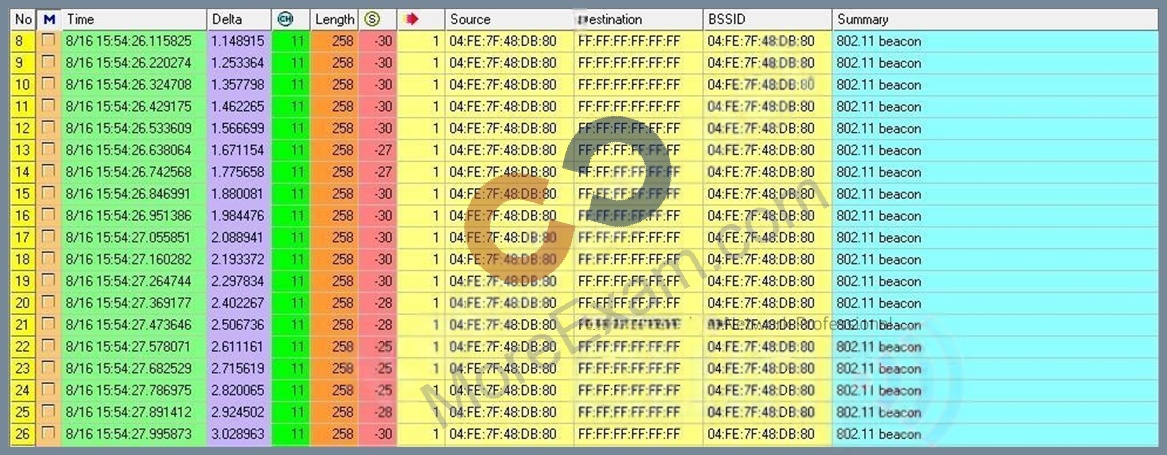
Question29: In the analyzer trace shown, the TBTT is nominally 102.5 milliseconds.

Why does the Beacon transmission interval vary?

Question30: Finish the statement. It is possible to distinguish between _______and ______20 MHz transmissions when looking at an FFT plot.

Question31: As a WLAN consultant, you have been asked to troubleshoot a problem with a single wireless client station (Station-Z). Your customer informs you that other wireless client stations are not having problems with wireless connectivity, and that Station-Z is configured in the same manner as all other wireless client stations on the network. Station-Z is showing an unusually high retransmission count in its client utility statistics. Using a wireless protocol analyzer, where and how should you begin troubleshooting this problem? (Choose 2)

Question32: A manager at a retail outlet has complained that an incident occurred allowing a STA to launch an attack against another STA connected to their public Wi-Fi hotspot. He has asked you to troubleshoot the situation and verify that all possible measured are being taken to prevent this.
What configuration should you check in the AP?

Question33: Why is a high CRC error rate in L2 protocol analysis software NOT always a valid indicator of network performance? (Choose 3)

Question34: The data rate for a data frame is 150 Mbps in 5 GHz.
What rate is used to transmit the PHY header information?

Question35: A manufacturing facility has installed a new automation system which incorporates an 802.11 wireless network. The automation system is controlled from tablet computers connected via the WLAN. However, the automation system has not gone live due to problem with the tablets connecting to the WLAN. The WLAN vendor has been onsite to perform a survey and confirmed good primary and secondary coverage across the facility. As a CWAP you are called in to perform Spectrum Analysis to identify any interference sources. From the spectrum analysis, you did not identify any interference sources but were able to correctly identify the issue. Which of the following issues did you identify from the spectrum analysis?

Question36: Which one of the following is required for Wi-Fi integration in laptop-based Spectrum Analyzer software?

Question37: You suspect an interfere may exist in a BSS that is experiencing sporadic problems. You want to identify and locate the device. The actual device identify is not known.
What tool should be used for this purpose?

Question38: Which one of the following is not an 802.11 Management frame?

Question39: ABC Company's WLAN administrator is getting complaints from one user that his WLAN throughput is sluggish compared to other users in his area. The administrator takes his diagnostics laptop, which has a wireless protocol analyzer installed, to the area where the complaining user works. The administrator uses the PING utility to test connectivity from the complaining user's wireless client station to another wireless client station across the closest access point, while capturing the wireless frames.
The administrator sees what is displayed in this screenshot.

From this screenshot, which statements can you conclude to be TRUE that are related to the complaining user's throughput problem? (Choose 2)

Question40: Given: Adjacent Channel Interference (ACI) can cause frame corruption and poor performance in WLANs. You are using a protocol analyzer in the attempt to detect ACI.
What should you look for in such a scenario?

Question41: How does a VoIP Phone, using WMM Power Save, request data frames buffered at the AP?

Question42: How many frames make up the Group Key Handshake excluding any Ack frames that may be required?

Question43: You are responsible for troubleshooting and analysis of the WLAN in your organization that supports more than 700 client STAs. Forty APs are deployed and they are all dual-band APs and are controller-based. You must troubleshoot the wired side in some scenarios using a protocol analyzer. Which one of the following problems would warrant wired-side analysis in most situations?

Question44: Given: The graphic is taken from a spectrum analyzer.

What types of RF transmitters are illustrated?

Question45: What is the function of the PHY layer?

Question46: Given: The exhibit shows a small network environment with dual-band APs.

What is true of the network shown in this spectrum analyzer trace?

Question47: Which one of the best following is an advantage of using display filters instead of capture-time filters?

Question48: When would you expect to see a Reassociation Request frame?

Question49: What is the difference between a Data frame and a QoS-Data frame?

Question50: You're the WLAN administrator for a large retailer based at the HQ in New York. The London- based office has been complaining about WLAN disconnections around lunch time each day. You suspect this might be interference from the staff microwave, how might you test your theory from the New York office?

Question51: Which one of the following portions of information is communicated in the PHY Header?

Question52: ABC International has installed a new smart ZigBee controlled lighting system. However, the network team is concerned that this new system will interface with the existing WLAN and has asked you to investigate the impact of the two systems operating simultaneously in the 2.4 GHz band. When performing Spectrum Analysis, which question could you answer by looking at the FFT plot?

Question53: Which statement is true regarding the Association Identifier (AID) used in IEEE 802.11 WLANs?

Question54: Protocol analyzers may present field values in either binary, decimal or hexadecimal. What precedes a hexadecimal value to indicate it is hexadecimal?

Question55: What element was added to the general frame of 802.11 with the 802.11e amendment and the
802.11- 2007 rollup?

Question56: In what scenario is Open Authentication without encryption not allowed based on the 802.11 standard?

Question57: What is the purpose of a PHY preamble?

Question58: How is the length of an AIFS is calculated?

Question59: You want to simplify viewing frames of a particular type in Wireshark.
What is used to specify frames for colorization?

Question60: Which one of the following is not a valid reason for an AP to fail a STAs association?

Question61: You are attempting to determine timing information within a packet capture of a WLAN protocol analyzer.
What time is used to display the time the packet was captured based on the system clock in the computer?

Question62: You have installed a new 802.11ac WLAN configured with 80 MHz channels. Users in one area are complaining about poor performance. This area is currently served by a single AP. You take a spectrum analysis capture in the poor performing area. While examining the waterfall plot you notice the airtime utilization is higher on the first 20 MHz of the 80 MHz channel when compared to the rest of the channel. What do you conclude?

Question63: When using Wireshark for protocol analysis, what filter will allow you to see only beacon frames?

Question64: Which one of the following is an advantage of using display filters that is not an advantage of capture-time filters?

Question65: According to 802.11-2007, in what frame type(s) might you find the PMK Count and PMKID List fields?

Question66: In which element of a Beacon frame would you look to identify the current HT protection mode in which an AP is operating?

Question67: Which statements regarding an IEEE 802.11 Channel Switch Announcement frame are true?
(Choose 2)

Question68: When performing protocol analysis, you capture an 802.11ac data frame on channel 52, transmitted at MSC 8.
At what data rate was the PHY Preamble transmitted?

Question69: You are performing 802.3 network analysis. For what are the DA and SA fields used in the frame header?

Question70: How long, in microseconds, is the required Slot Time that is announced by an AP in an HT BSS when HR/DSSS, ERP-OFDM, and HT-OFDM client stations are associated to the AP?

Question71: Given: Your network consists of HT and ERP access points, and you are implementing VoWiFi with support for U-APSD.
When an ERP handset operating in WMM Power Save mode with a ReceiveDTIMs parameter of TRUE receives a Beacon containing a DTIM indicating queued broadcast traffic, what task is the handset required to perform?

Question72: An RST frame should be acknowledged by which frame?
Question73: You are troubleshooting problems with DHCP in relation to lightweight APs. They vendor class identifier (VCI) is not specified in the DHCP server. When you contact vendor support, they inform you that it is not necessary.
When is this information true?

Question74: What is the function of the PMD sub-layer?

Question75: How many frames are exchanged for 802.11 authentication in the 6 GHz band when WPA3- Enterprise is not used, and a passphrase is used instead?

Question76: You require 802.11ac capture solution.
You want to capture using native operating system tools if possible.
What operating system has built-in ability to capture 802.11ac frames assuming it is running on the appropriate laptop hardware?

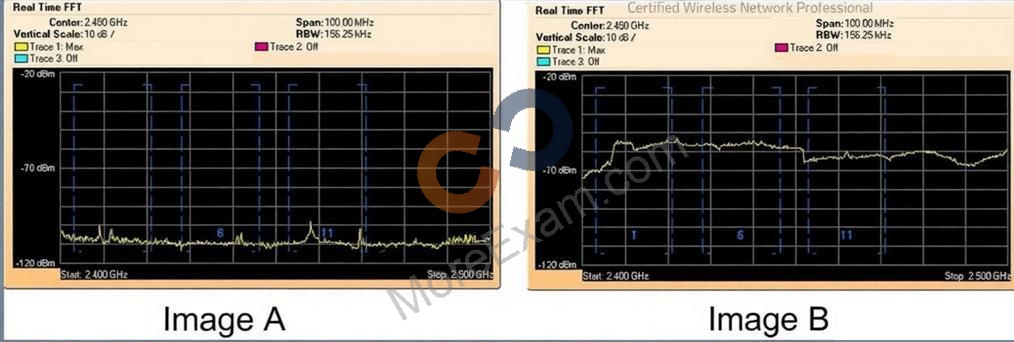
Question77: Given: ABC Company recorded the 2.4 GHz band with a spectrum analyzer prior to installing their ERP WLAN. Image-A is how the band appeared prior to the WLAN installation. Image-B is how the band appears now, and all channels on their WLAN have ceased to function.

What is the best explanation as to why their WLAN is no longer functioning properly?

Question78: Given: Shown are frames captured from an IEEE 802.1X/LEAP authentication.
This WLAN is a Robust Security Network (RSN) using the CCMP cipher suite.

Using the information given in the screenshot, calculate how long it takes for only the frames that are part of the 4-Way handshake to complete.

Question79: You have been recently hired as the wireless network administrator for an organization spread across seven locations. They have deployed more than 100 APs, but they have not been managed in either an automated or manual process for more than 18 months.
Given this length of time, what is one of the first things you should evaluate from a support perspective?