EMT Practice Test

1. Question Content...


Question List

Question1: What is the expected difference between two source address persistence profiles if profile A has a mask of 255.255.255.0 and profile B has a mask of 255.255.0.0?

Question2: Which of the following protocol protections is not provided by the Protocol Security Manager?

Question3: Use a proprietary syntax language. Must contain at least one event declaration. Must contain at least one conditional statement. Must contain at least one pool assignment statement. What must be sent to the license server to generate a new license?

Question4: Which of the following statements best describes the ARX architecture?

Question5: A virtual server is listening at 10.10.1.100:any and has the following iRule associated with it:
when CLIENT_ACCEPTED { if {[TCP::local_port] equals 21 } { pool
ftppool } elseif {[TCP::local_port] equals 23 } { pool telnetpool }
If a user connects to 10.10.1.100 and port 22, which pool will receive the request.

Question6: A pool is using Global Availability as its load balancing method (Alternate:
Round Robin; Fallback: Return to DNS). The last five resolutions have been C, D, C, D, C . Given the current conditions shown in the table, which address will be used for the next resolution?

Question7: The layer 3 security feature _______ Cookies that protects against SYN floods, DoS, and DDoS attacks.
(Fill in)

Question8: What is the expected difference between two source address persistence profiles if profile A has a mask of 255.255.255.0 and profile B has a mask of 255.255.0.0?

Question9: Which statement is true concerning iRule context?

Question10: Which persistence method will always recognize a client when the client returns to the same virtual server?

Question11: ARX will detect any modification to a file on the second tier because all clients are being _______ by the ARX to get to the storage.

Question12: The ARX saves customers time, money and frustration through a stub-based system that makes a slight modification to each file in order to more efficiently sort and store end user data.

Question13: When using a redundant pair of LTMs, it is most advantageous to use them in an Active/Active scenario because this provides additional load balancing capabilities.

Question14: What is the purpose of provisioning?

Question15: Why does deploying LTM into an existing network immediately improve security?

Question16: Which statement is true concerning SNATs using SNAT pools and SNATs using automap?

Question17: In order to improve GTM performance, administrators should use multiple complex monitors to ensure resources are functioning properly:

Question18: Which of the following is not a feature of a standalone BIG-IP ASM System?

Question19: Why would an administrator capture monitor traffic between a BIG-IP and servers?
Question20: A site has six members in a pool. All of the servers have been designed, built, and configured with the same applications. It is known that each client's interactions vary significantly and can affect the performance of the servers. If traffic should be sent to all members on a regular basis, which loadbalancing mode is most effective if the goal is to maintain a relatively even load across all servers.

Question21: The APM Dashboard enables administrators to monitor which two of these metrics? (Choose two.)

Question22: A monitor has been defined using the HTTP monitor template. The send and receive strings were customized, but all other settings were left at their defaults. Which resources can the monitor be assigned to?

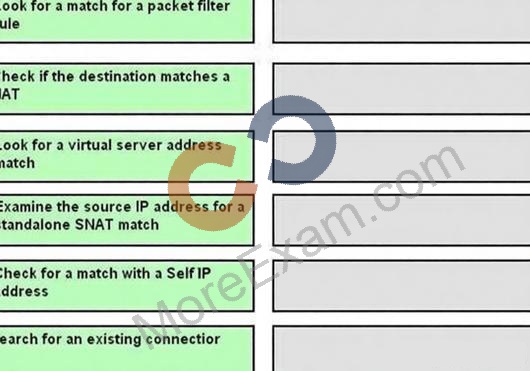
Question23: Drag and Drop Question
Place the following items in the order that the BIG-IP device uses when processing a packet.

Question24: Which of the following methods are used by the BIG-IP ASM System to protect against SQL injections?

Question25: When configuring the BIG-IP ASM System in redundant pairs, which of the following are synchronized? (Choose 2)

Question26: Information leakage is a major obstacle to achieving PCI DSS compliance.

Question27: If a customer has an application that uses a customized protocol, what LTM feature can help optimize the traffic from the application?

Question28: Generally speaking, should the monitor templates be used as production monitors or should they be customized prior to use?

Question29: Assume a virtual server has a ServerSSL profile. What SSL certificates are required on the BIG-IP?

Question30: Which two of the following statements about how TMOS typically manages traffic between a client and server are accurate? (Choose two.)

Question31: Assume a virtual server is configured with a ClientSSL profile. What would the result be if the virtual server's destination port were not 443.

Question32: Select the key reasons F5 is able to handle DNS DDoS attacks so effectively? Select two.

Question33: FastCache will NOT work with compressed objects.

Question34: ASM provides antivirus protection by:

Question35: What is the expected difference between two source address persistence profiles if profile A has a mask of 255.255.255.0 and profile B has a mask of 255.255.0.0?

Question36: Which of the following storage type combinations are configurable in an ASM logging profile?

Question37: When configuring a Virtual Server to use an iRule with an HTTP_REQUEST event, which lists required steps in a proper order to create all necessary objects.

Question38: Assume a client's traffic is being processed only by a NAT; no SNAT or virtual server processing takes place. Also assume that the NAT definition specifies a NAT address and an origin address while all other settings are left at their defaults. If a client were to initiate traffic to the NAT address, what changes, if any, would take place when the BIG-IP processes such packets?

Question39: If your customer has a policy requirement that cannot be handled in the Visual Policy Editor, what would you use to supplement the Visual Policy Editor?

Question40: In order to improve GTM performance, administrators should use multiple complex monitors to ensure resources are functioning properly:

Question41: Which is NOT an ASM protection method for cross site scripting?

Question42: Without creating a user defined region, what is the most specific group a topology record can identify?

Question43: The current status of a given pool member is nknown. Which condition could explain that state.
The current status of a given pool member is .nknown. Which condition could explain that state.

Question44: LTM runs on________F5's proprietary product platform. (Fill in the correct answer)

Question45: A BIG-IP has a virtual server at 150.150.10.10:80 with SNAT automap configured. This BIG-IP also has a SNAT at 150.150.10.11 set for a source address range of 200.200.1.0 /
255.255.255.0. All other settings are at their default states. If a client with the IP address
200.200.1.1 sends a request to the virtual server, what is the source IP address when the associated packet is sent to the pool member.

Question46: When probing LDNSs, which protocol is used by default?

Question47: What is the expected difference between two source address persistence profiles if profile A has a mask of 255.255.255.0 and profile B has a mask of 255.255.0.0?

Question48: Logging profiles are assigned to?

Question49: How many events can be referenced in a given iRule?

Question50: LTM runs on______F5's proprietary product platform. (Fill in the correct answer)

Question51: How is traffic flow through transparent virtual servers different from typical virtual servers?

Question52: Which two of the following statements are accurate descriptions of the ARX index? (Choose two.)

Question53: Which method of protection is not provided by the Rapid Deployment policy template?

Question54: Which of the following is correct regarding User-defined Attack signatures?

Question55: A site needs to terminate client HTTPS traffic at the BIG-IP and forward that traffic unencrypted.
Which two are profile types that must be associated with such a virtual server. (Choose two.)

Question56: Assume a BIG-IP has no NATs or SNATs configured. Which two scenarios are possible when client traffic arrives on a BIG-IP that is NOT destined to a self-IP? (Choose two.)

Question57: The F5 Visual Policy Editor (VPE) is unique to the F5 BIG-IP APM module; no other access management tool has this capability. Select the features that the VPE provides. Select two.

Question58: What is the purpose of Zonerunner?
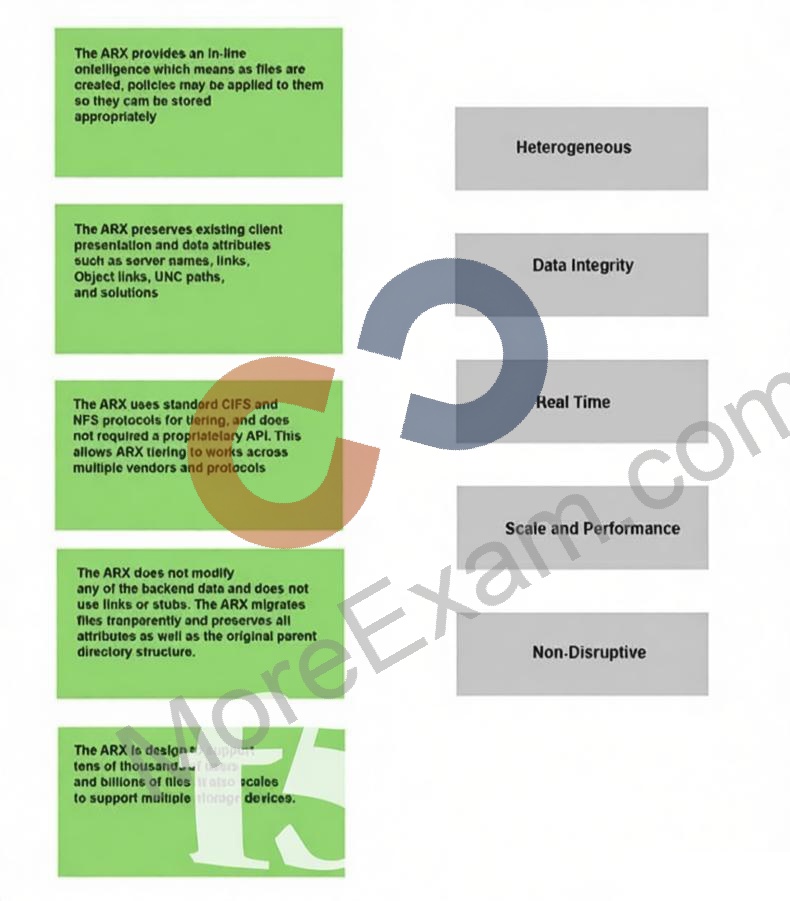
Question59: Drag and Drop Question
Match the five elements of the intelligent file virtualization with the appropriate ARX feature:

Question60: Why does the F5 Application Delivery Firewall solution mitigate SSL attacks more effectively than any other firewalls?

Question61: What does the insert XForwarded option in an HTTP profile do?

Question62: A site is load balancing to a pool of web servers. Which statement is true concerning BIG-IP's ability to verify whether the web servers are functioning properly or not.

Question63: To share device information with F5 technical support, a customer must either verbally share the information over the phone or copy and send the information in an Email.

Question64: What are two advantages of the Quality of Service (QoS) load balancing method? (Choose two.)

Question65: Customers can purchase LTM as a stand-alone product, or layer it with additional software modules to increase the functionality of the BIG-IP device.

Question66: Which HTTP response code ranges indicate an error condition? (Choose 2)

Question67: Which of the following business benefits does storage tiering offer to customers?

Question68: Which is a potential result when a trunk is configured on a BIG-IP?

Question69: An administrator is planning on solving latency issues by placing the backup data center in a neighboring city to the primary data center. Why isn't this effective solution?

Question70: What is the expected difference between two source address persistence profiles if profile A has a mask of 255.255.255.0 and profile B has a mask of 255.255.0.0?

Question71: Which of the following statements are correct regarding Attack signatures? (Choose 2)

Question72: Which of the following is NOT included on the F5 DevCentral site?

Question73: Sensitive parameter is a feature used to hide sensitive information from being displayed in which of the following?

Question74: Brute force protection will:

Question75: Which of the following is NOT a logging option within an APM access control entry?

Question76: Which of the following can be accomplished using iRules?

Question77: Which tool is used on BIG-IP systems to capture data packets?

Question78: A, steaming profile will do which of the following?

Question79: A site would like to ensure that a given web server's default page is being served correctly prior to sending it client traffic. They assigned the A site would like to ensure that a given web server's default page is being served correctly prior to sending it client traffic. They.e assigned the default HTTP monitor to the pool. What would the member status be if it sent an unexpected response to the GET request. default HTTP monitor to the pool. What would the member. status be if it sent an unexpected response to the GET request.

Question80: There are many user roles configurable on the BIG-IP ASM System. Which of the following user roles have access to make changes to ASM policies? (Choose 3)

Question81: Assume a virtual server is configured with a ClientSSL profile. What would the result be if the virtual server's destination port were not 443.

Question82: What is NOT a benefit of using a SNAT?

Question83: Which statement is true concerning cookie persistence.

Question84: Which programming language is the basis for F5 iRules?

Question85: A site wishes to perform source address translation on packets arriving from the Internet for clients using some pools but not others. The determination is not based on the client's IP address, but on the pool they are load balanced to. What could best accomplish this goal.

Question86: A virtual server is listening at 10.10.1.100:80 and has the following iRule associated with it:
when HTTP_REQUEST { if {[HTTP::uri] ends_with "txt" } { pool pool1 } elseif {[HTTP::uri] ends_with "php" } { pool pool2 } If a user connects to http://10.10.1.100/foo.html, which pool will receive the request.

Question87: Which statement is true concerning the default communication between a redundant pair of BIG- IP devices.

Question88: Where is persistence mirroring configured?

Question89: Which of the following is a client-side action in the Visual Policy Editor that prevents external access and deletes any files created during a secure access session?

Question90: Assume a virtual server is configured with a ClientSSL profile. What would the result be if the virtual server's destination port were not 443.

Question91: What is the advantage of specifying three load balancing methods when load balancing within pools?

Question92: Assume a virtual server has a ServerSSL profile. What SSL certificates are required on the pool members.

Question93: Given the configuration shown below, if a connection request arrived on the BIG-IP with a source address of 200.10.10.10:1050 and a destination of 150.10.10.75:80, what would the source IP address of the associated packet be when it arrived on the choosen member of the web_pool self
150.10.10.1 { netmask 255.255.255.0 unit I floating enable vlan external allow tcp https } self
10.10.1.1 { netmask 255.255.255.0 unit I floating enable vlan internal allow default } pool web_pool { member 10.10.1.11:80 member 10.10.1.12:80 member 10.10.1.13:80 }snatpool client_pool { member 10.10.1.100 member 150.10.10.15 }virtual VS_web { destination
150.10.10.10:80 ip protocol tcp snat automap pool web_pool }virtual VS_network{ destination
150.10.1 0.0:any mask 255.255.255.0 snatpool client_pool ip protocol tcp pool web_pool } virtual VS_network { destination 150.10.1 0.0:any mask 255.255.255.0 snatpool client_pool ip protocol tcp pool web_pool } virtual VS_network { destination 150.10.10.0:any mask 255.255.255.0 snatpool client_pool ip protocol tcp pool web_pool }

Question94: Which of the following is a language used for content provided by a web server to a web client?

Question95: All members of a pool must share the same service port?

Question96: Assuming that systems are synchronized, which action could take place if the failover cable is connected correctly and working properly, but the systems cannot communicate over the network due to external network problems.

Question97: A virtual server is listening at 10.10.1.100:any and has the following iRule associated with it:
when CLIENT_ACCEPTED { if {[TCP::local_port] equals 80 } { pool pool1 } elseif
{[TCP::local_port] equals 443 } { pool pool2 } If a user connects to 10.10.1.100 and port 22, which pool will receive the request.

Question98: Which statement is true regarding OneConnect processing?

Question99: Where is persistence mirroring configured?

Question100: Which of the following violations cannot be learned by Traffic Learning?

Question101: With standard DNS, assuming no DNS request failures, which process describes the normal resolution process on a "first time" DNS request?

Question102: ASM offers the most extensive, effective, and simplest to configure CSRF protection in the WAF market.

Question103: When upgrading a BIG-IP redundant pair, what happens when one system has been updated but the other has not.

Question104: Where is connection mirroring configured?

Question105: What is the expected difference between two source address persistence profiles if profile A has a mask of 255.255.255.0 and profile B has a mask of 255.255.0.0?

Question106: What is the purpose of provisioning?

Question107: Where do you configure GTM client persistence?

Question108: Network Security personnel are entirely responsible for web application security.

Question109: Which of the following TMOS feature enables BIG-IP to scale performance based to the available CPU cores?

Question110: Which of the following is not a configurable parameter data type?

Question111: Mobile device browsers typically display Web pages more slowly than PC browsers.

Question112: When configuring monitors for individual pool members, which three options can be selected?
(Choose three.)

Question113: A user's access to resources can change based on the computer they connect from.

Question114: To make complex access policies easier to manage, an administrator can create a policy containing several policy actions, and then add instances of it within the policy using the
________. (Fill in)

Question115: Which statement is true about the synchronization process, as performed by the Configuration Utility or by typing b config sync all.

Question116: How is MAC masquerading configured.

Question117: Which statement is true concerning iRule context?

Question118: Which two statements are true about SNATs? (Choose two.)

Question119: Which two of the following statements are accurate descriptions of the ARX index? (Choose two.)

Question120: The BIG-IP determines the lowest connection speed between the client and the server and then uses that for both connections.

Question121: Using IP Geolocation, an organization can always direct a client request from France to a data enter in Dublin.

Question122: APM provides access control lists at which two OSI layers? (Choose two.)

Question123: If the config tool is complete, which two access methods are available by default for GTM administration and configuration? (Choose two.)

Question124: Select the best word or phrase to complete the following sentence. Using the _______ feature in GTM, F5's Application Delivery Firewall solution can handle a significantly higher number of queries than traditional DNS servers.

Question125: When a pool is created and saved to file, where is the default file and location for the pool configuration? When a pool is created and saved to file, where is the default file and location for the pool configuration?

Question126: As a full TCP proxy, LTM acts as the termination point for both requests from the client and responses from the server.

Question127: A virtual server at 10.10.1.100:80 has the rule listed below applied. when HTTP_REQUEST { if
{[HTTP::uri] ends_with "htm" } { pool pool1 } elseif {[HTTP::uri] ends_with "xt" } { pool pool2 } If a user connects to http://10.10.1.100/foo.txt which pool will receive the request.

Question128: Which two statements are true concerning the default communication between a redundant pair of BIG-IP systems? (Choose two.)

Question129: Which of the following is not a method of protection for user-input parameters?

Question130: Which two must be included in a WidelP definition for the WidelP to resolve a DNS query?
(Choose two.)

Question131: Although not all modules run on all platforms, each F5 hardware platform can run LTM plus at least one additional software module.

Question132: A BIG-IP has a virtual server at 150.150.10.10:80 with SNAT automap configured. This BIG-IP also has a SNAT at 150.150.10.11 set for a source address range of 200.200.1.0 /
255.255.255.0. All other settings are at their default states. If a client with the IP address
200.200.1.1 sends a request to the virtual server, what is the source IP address when the associated packet is sent to the pool member.

Question133: Which file contains the list of events for which the GTM System will send traps to an SNMP manager?

Question134: GTM solves which three of these standard DNS limitations? (Choose three.)

Question135: Which item is NOT a function of ASM?

Question136: What is the expected difference between two source address persistence profiles if profile A has a mask of 255.255.255.0 and profile B has a mask of 255.255.0.0?

Question137: Which statement is true concerning SNATs using automap?

Question138: The current status of a given pool is ffline.(red). Which condition could explain that state. Assume the descriptions below include all monitorsThe current status of a given pool is .ffline.(red). Which condition could explain that state. Assume the descriptions below include all monitors assigned for each scenario.

Question139: What is the expected difference between two source address persistence profiles if profile A has a mask of 255.255.255.0 and profile B has a mask of 255.255.0.0?

Question140: Which are immediate results of entering the following command:
b pool PoolA . { lb method predictive member 10.10.1 .1:80 member 10.10.1.2:80 }

Question141: What is the expected difference between two source address persistence profiles if profile A has a mask of 255.255.255.0 and profile B has a mask of 255.255.0.0?

Question142: What does the BIG-IP_add script do?

Question143: What is the expected difference between two source address persistence profiles if profile A has a mask of 255.255.255.0 and profile B has a mask of 255.255.0.0?

Question144: What feature of the F5 Exchange solution helps administrators to streamline implementation for added security and granular control?

Question145: Using IP Geolocation, an organization can always direct a client request from France to a datacenter in Dublin.

Question146: What is the expected difference between two source address persistence profiles if profile A has a mask of 255.255.255.0 and profile B has a mask of 255.255.0.0?

Question147: Which of the following user roles have access to make changes to security policies? (Choose 2)

Question148: When an optimized TCP connection exists between LTM and the pool member, LTM can accept server responses faster than the client. What is the name of this feature?

Question149: Listeners that correspond to nonfloating self lP addresses are stored in which configuration file?

Question150: A site needs a virtual server that will use an iRule to parse HTTPS traffic based on HTTP header values. Which two profile types must be associated with such a virtual server. (Choose two.)

Question151: An F5 customer must install WebAccelerator on top of LTM:

Question152: A BIG-IP has a virtual server at 150.150.10.10:80 with SNAT automap configured. This BIG-IP also has a SNAT at 150.150.10.11 set for a source address range of 200.200.1.0 /
255.255.255.0. All other settings are at their default states. If a client with the IP address
200.200.1.1 sends a request to the virtual server, what is the source IP address when the associated packet is sent to the pool member.

Question153: Which must be sent to the license server to generate a new license.

Question154: What occurs when a save-config command is issued?

Question155: Adding more RAM to a GTM device drastically improves query performance.

Question156: Which statement is correct if a TOP-based monitor is assigned to an LTM System and an HTTP-based monitor is assigned to one of that LTM System's Virtual Servers?

Question157: What is the primary benefit of associating Servers with Data Centers?
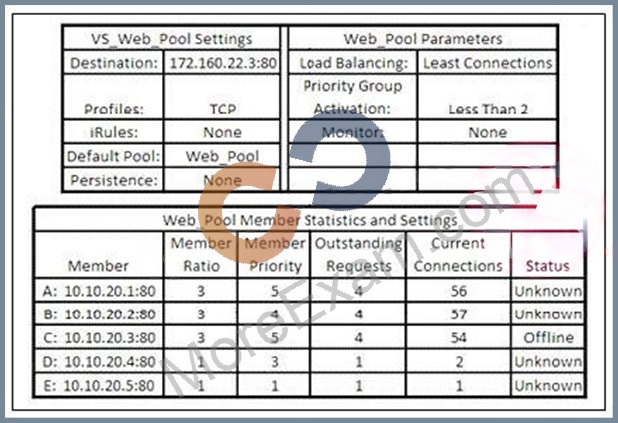
Question158: The incoming client IP address is 205.12.45.52. The last five connections have been sent to members C, D, A, B, B.
The incoming client. IP address is 205.12.45.52. The last five connections have been sent to members C, D, A, B, B.
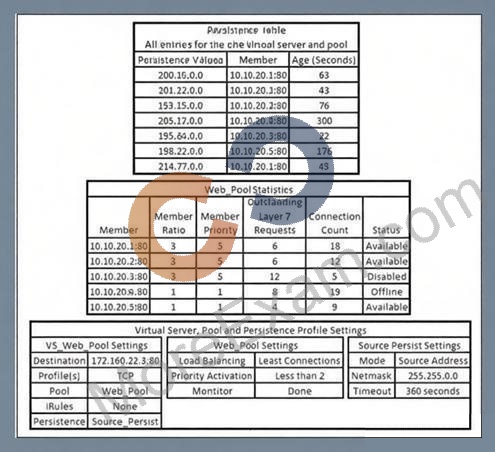
Given the virtual server and pool definitions and the statistics shown in the graphic, which member will be used for the next connection.

Question159: The drawback to having BIG-IP act as a full application proxy is the decrease in application performance.

Question160: The Flow Login feature prevents which web vulnerability from occurring?

Question161: How do you support non intelligent DNS resolution in an environment with GTM Systems and standard DNS servers? (Choose two.)

Question162: If a client's browser does not accept cookies, what occurs when the client connects to a virtual server using cookie persistence.

Question163: The BIG-IP ASM System sets two types of cookies to enforce elements in the security policy. The two types are main and frame cookies. What is the purpose of the frame cookie? (Choose 2)

Question164: If the GTM System receives a packet destined for one of its Listener addresses the GTM will process the request _____

Question165: A _______ object maps a FQDN to virtual servers. (Fill in)

Question166: Which two statements are true concerning capabilities of current BIG-IP platforms? (Choose two.)

Question167: Assume a virtual server is configured with a ClientSSL profile. What would the result be if the virtual server's destination port were not 443.

Question168: A virtual server is defined per the charts. The last five client connections were to members C, D, A, B, B . Given the conditions shown in the above graphic, if a client with IP address 205.12.45.52 opens a connection to the virtual server, which member will be used for the connection.

Question169: Which of the following is correct regarding static parameters?

Question170: Even though F5 is an application delivery controller, it can also effectively mitigate attacks directed at the network layer.

Question171: An age-based policy is set up on the ARX that retains only data modified in the last 3 months on tier 1 storage and moves the rest of the data to secondary storage. What happens when the end user tries to access data that has not been touched in 6 months?

Question172: Which of the following statements are incorrect regarding protection of web services? (Choose 2)

Question173: Which WOM feature replaces a long byte pattern, such as "100000111000110101", with a shorter reference to the pattern?

Question174: In the next few years, 75% of new storage capacity will shift to unstructured data (also known as file data). Which two of the following are examples of unstructured data? (Choose two.)

Question175: Which two of the following statements are accurate descriptions of the ARX index? (Choose two.)

Question176: The default staging-tightening period for attack signatures and wildcard entities is?

Question177: Drag and Drop Question
Match the security-related term with the correct definition.
1. OWASP Top 10
2. Secure Socket Layer (SSL)
3. Bot
4. Certificate
5. Content scrubbing

Question178: Flow login allows for more granular protection of login and logout URLs within web applications.
Which of the following are components of flow login? (Choose 3)

Question179: Which is the result when multiple monitors are assigned to a pool member?
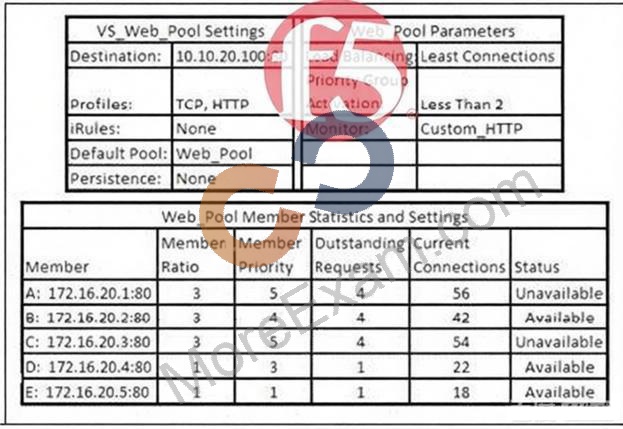
Question180: A virtual server is defined per the charts. The last five client connections were to members C, D, A, B, B . Given the conditions shown in the above graphic, if a client with IP address 205.12.45.52 opens a connection to the virtual server, which member will be used for the connection.

Question181: A site has six members in a pool. Three of the servers are new and have more memory and a faster processor than the others. Assuming all other factors are equal and traffic should be sent to all members, which two loadbalancing methods are most appropriate. (Choose two.)

Question182: On a BIG-IP ASM 3600, in standalone mode, which of the following pool configurations is valid?

Question183: Under what condition must an appliance license be reactivated.

Question184: Which three statements are true about SNATs? (Choose three.)

Question185: The SNMP monitor can collect data based on which three metrics? (Choose three.)

Question186: What is the expected difference between two source address persistence profiles if profile A has a mask of 255.255.255.0 and profile B has a mask of 255.255.0.0?

Question187: Which of the following are default settings when using the Policy Builder to build a security policy based on the QA lab deployment scenario? (Choose 2)

Question188: GTM can load balance to LTM in addition to non-BIG-IP hosts.

Question189: How is persistence configured.
Question190: The following request is sent to the BIG-IP ASM System:
GET http://www.example.local/financials/week1.xls?display=yes&user=john&logon=true Which of the following components in this requests line represent the query string?

Question191: iQuery is a proprietary protocol that distributes metrics gathered from which three sources?
(Choose three.)

Question192: A GTM System performs a name resolution that is not a Wide-IP. The name is in a domain for which the GTM System is authoritative. Where does the information come from?

Question193: A security audit has determined that your web application is vulnerable to a crosssite scripting attack. Which of the following measures are appropriate when building a security policy? (Choose
2)

Question194: An LTM has the 3 virtual servers, 2 SNATs, four self IP addresses defined, and the networks shown in the exhibit. Selected options for each object are shown below. Settings not shown are at their defaults. Assume port exhaustion has not been reached.
VirtualServerl
Destination: 10.10.2.102:80 netmask 255.255.255.255
Pool: Pool with 3 members in the 172.16/16 network
SNAT Automap configured
VirtualServer2
Destination: 10.10.2.102:* netmask 255.255.255.255
Pool: Pool with 3 members in the 192.168/16 network
VirtualServer3
Destination: 10.10.2.0:80 netmask 255.255.255.0
Type: IP Forwarding
SNAT1 Source IP: 10.10.0.0 netmask 255.255.0.0
SNAT Address: SNAT Pool with 2 members 172.16.20.50 and 192.168.10.50
SNAT2 Source IP: All Addresses
SNATAddress: 10.10.2.102 Floating Self IPs 192.168.1.1; 172.16.1.1;
10.10.2.1; 10.10.1.1
A connection attempt is made with a source IP and port of 10.10.100.50:2222 and a destination IP and port of 10.10.2.10:80. When the request is processed, what will be the source and destination IP addresses?

Question195: Which three statements describe a characteristic of profiles. (Choose three.)

Question196: What is the expected difference between two source address persistence profiles if profile A has a mask of 255.255.255.0 and profile B has a mask of 255.255.0.0?

Question197: Which facility logs messages concerning GTM System parameters?

Question198: When building a policy based on live traffic using the automated policy builder, which of the following elements will not be taken into account when analyzing the traffic?

Question199: A customer says his business wouldn't benefit from buying ARX because it already has block based storage virtualization in place. Is he right? Why or why not?

Question200: Which statement is true concerning packet filters?
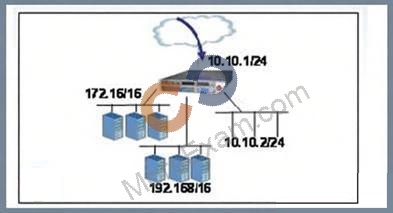
Question201: An LTM has the 3 virtual servers, a SNAT, four self IP addresses defined and the networks shown in the exhibit. Selected options for each object are shown below. Settings not shown are at their defaults.
VirtualServerl
Destination: 10.10.2.102:80 netmask 255.255.255.255
Pool: Pool with 3 members in the 172.16/16 network
VirtualServer2
Destination: 10.10.2.102:* netmask 255.255.255.255
Pool: Pool with 3 members in the 192.168/16 network
VirtualServer3
Destination: 10.10.2.0:80 netmask 255.255.255.0
Type: IP Forwarding
SNAT1
Source IP: All Addresses
SNATAddress: SNAT Pool with 2 members 172.16.20.50 and 192.168.10.50
Self IPs 192.168.1.1;
172.16.1.1; 10.10.2.1; 10.10.1.1
A connection attempt is made with a source IP and port of 10.20.100.50:2222 and a destination IP and port of 10.10.2.10:80.
When the request is processed, what will be the destination IP address?

Question202: Which of the following are methods BIG-IP ASM utilizes to mitigate web scraping vulnerabilities?
(Choose 2)

Question203: Which cookie persistence method requires the fewest configuration changes on the web servers to be implemented correctly?

Question204: Assuming there are open connections through an active system's NAT and a failover occurs, by default, what happens to those connections.

Question205: Similar to LTM monitors, GTM monitors use both an Interval and a Timeout value.

Question206: Which statement about root DNS servers is true?