EMT Practice Test

1. Question Content...


Question List

Question1: The owner of a web application asks the 8IG-IP Administrator to change the port that the BIG-IP device sends traffic to. This change must be made for each member in the server pool named app_pool for their Virtual Server named app_vs. In which area of the BIG-IP Configuration Utility should the BIG-P Administrator make this change?

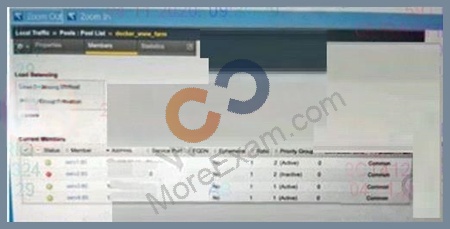
Question2: Refer to the exhibit.


During maintenance, the BIG-IP Administrator manually disables a pool member as shown.
What is the result?

Question3: Which cookie persistence method requires the fewest configuration changes on the web servers to be implemented correctly?

Question4: Users report that traffic is negatively affected every time a BIG-IP device fails over. The traffic becomes stabilized after a few minutes.
What should the BIG-IP Administrator do to reduce the impact of future failovers?

Question5: A BIG-IP Administrator must determine if a Virtual Address is configured to fail over to the standby member of a device group in which area of the Configuration Utility can this be confirmed?

Question6: A BIG-IP Administrator needs to check the memory utilization on a BIG-IP system. Which two methods can the UIG IP Administrator use? (Choose two.)

Question7: Which two statements are true about SNATs? (Choose two.)
Question8: A BIG-IP Administrator finds the following log entry after a report of user issues connecting to a virtual server:
01010201: 2: Inet port exhaustion on 10.70.110.112 to 192.28.123.250:80 (proto 6) How should the BIG-IP Administrator modify the SNAT pool that is associated with the virtual server?

Question9: Assume a virtual server has a ServerSSL profile. What SSL certificates are required on the BIG-IP?

Question10: Assume a virtual server is configured with a ClientSSL profile. What would the result be if the virtual server's destination port were not 443?

Question11: A BIG-IP Administrator makes a configuration change to a Virtual Server on the Standby device of an HA pair. The HA pair is currently configured with Auto-Sync Enabled. What effect will the change have on the HA pair configuration?

Question12: DNS queries from two internal DNS servers are being load balanced to external DNS Servers via a Virtual Server on a BIG-P device. The DNS queries originate from 192.168.101.100 and 192.168.101.200 and target 192.168.21.50 All DNS queries destined for the external DNS Servers fail Which property change should the BIG-IP Administrator make in the Virtual Server to resolve this issue?

Question13: A Standard Virtual Server for a web application is configured with Automap for the Source Address Translation option. The original source address of the client must be known by the backend servers. What should the BIG-IP Administrator configure to meet this requirement?

Question14: The BIG-IP Administrator creates a custom iRule that fails to work as expected. Which F5 online resource should the administrator use to help resolve this issue?

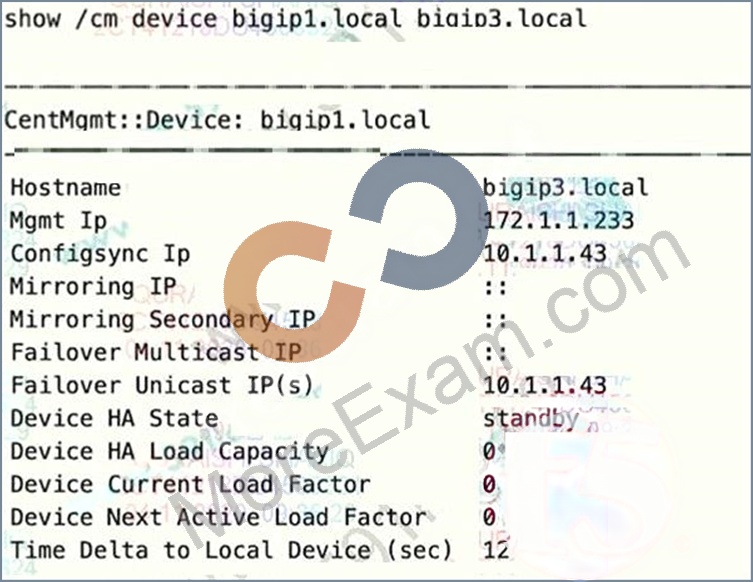
Question15: Refer of the exhibit.

The 816-IP Administrator runs the command shown and observes a device trust issue between BIG-IP devices in a device group. The issue prevents config sync on device bigip3.local.
What is preventing the config sync?

Question16: Which two can be a part of a pool's definition? (Choose two.)

Question17: Which is an advantage of terminating SSL communication at the BIGIP rather than the ultimate web server?

Question18: A standard virtual server is defined with a pool and a SNAT using automap. All other settings for the virtual server are at defaults. When client traffic is processed by the BIG-IP, what will occur to the IP addresses?

Question19: A BIG-IP system has the following configuration:
* SNAT is set to Auto Map
* There are two VLANs internal and external
* Default route is pointed to the gateway on external VLAN
* Self P for internal VLAN is 1921.1.2
* Self IP for external VLAN is 192.1.2.2
* Floating IP addresses for internal VLAN is 192.1.1.1
* Floating IP addresses for external VLAN is 192.1.2.1
* The Virtual Server IP address is 192.1.1.100
Which IP address does the BIG-IP system use first when traffic reaches the servers on the internal VLAN?

Question20: Given that VLAN failsafe is enabled on the external VLAN and the network that the active BIG-IP's external VLAN is connected to has failed, which statement is always true about the results?

Question21: A BIG-IP Administrator is setting up a new BIG-IP device. The network administrator reports that the interface has an incompatible media speed. The BIG-IP Administrator needs to change this setting manually.
From which location should the BIG-IP Administrator perform this task?

Question22: One of the two members of a device group has been decommissioned. The BIG-IP Administrator tries to delete the device group, but is unsuccessful.
Prior to removing the device group, which action should be performed?

Question23: A BIG-IP Administrator creates a new VLAN on BIG-IP Cluster Member A and attaches an Interface to it. Although the Auto Config Sync is in place, the new VLAN does NOT show up on Cluster Member B.
What should the BIG-IP Administrator do to ensure the new VLAN is configured on each Cluster Member?

Question24: Which must be sent to the license server to generate a new license?

Question25: Which two methods can be used to determine which BIG-IP is currently active? (Choose two.)

Question26: A BIG-IP Administrator needs to restore a UCS file to an F5 device using the Configuration Utility. Which section of the Configuration Utility should the BIG-IP Administrator access to perform this task?

Question27: Assume the bigd daemon fails on the active system. Which three are possible results? (Choose three.)

Question28: Refer to the exhibit.

How many nodes are represented on the network map shown?

Question29: What is required for a virtual server to support clients whose traffic arrives on the internal VLAN and pool members whose traffic arrives on the external VLAN?

Question30: Administrative user accounts have been defined on the remote LDAP server and are unable to log in to the BIG-IP device.
Which log file should the BIG-IP Administrator check to find the related messages?

Question31: Refer to the exhibit

A connection is being established to IP 1.1.1.1 on port 8080.
Which virtual server will handle the connection?

Question32: A BIG-IP Administrator need to ensure that a pool member and down by the monitor the BIG-IP system sends existing connections to another be pool member.
Which should the BIG-IP Administrator perform to meet this goal?

Question33: The interface 1.1 of the BIG-IP device has been connected to a link dedicated to traffic on VLAN 120. What should the BIG-IP Administrator do to receive traffic from the VLAN?

Question34: Which statement accurately describes the difference between two loadbalancing modes specified as "member" and "node"?

Question35: A BIG-IP Administrator receives an RMA replacement for a failed F5 device. The BIG-IP Administrator tries to restore a UCS taken from the previous device, but the restore fails. The following error appears inthe/var/log/itm.
mcpd [****J: ******;0; License is not operational (expired or digital signature does not match contents.) What should the BIG-IP Administrator do to avoid this error?

Question36: All pool members are online. All other virtual server settings are at default What might after the load balancing behavior?

Question37: A BIG-IP Administrator makes a configuration change to the BIG-IP device. Which file logs the message regarding the configuration change?

Question38: Which statement is true concerning SNATs using automap?

Question39: A BIG-IP Administrator is configuring an SSH Pool with five members.
Which Health Monitor should be applied to ensure that available pool members are monitored accordingly?

Question40: A BIG-IP has a virtual server at 150.150.10.10:80 with SNAT automap configured. This BIG-IP also has a SNAT at 150.150.10.11 set for a source address range of 200.200.1.0 / 255.255.255.0. All other settings are at their default states. If a client with the IP address 200.200.1.1 sends a request to the virtual server, what is the source IP address when the associated packet is sent to the pool member?

Question41: Which Virtual Server type prevents the use of a default pool?

Question42: What is the purpose of provisioning?

Question43: A virtual server is listening at 10.10.1.100:80 and has the following iRule associated with it:
when HTTP_REQUEST { if { [HTTP::header UserAgent] contains "MSIE" }
{ pool MSIE_pool }
else { pool Mozilla_pool }
If a user connects to http://10.10.1.100/foo.html and their browser does not specify a UserAgent, which pool will receive the request?

Question44: Which statement is true concerning the default communication between a redundant pair of BIG-IP devices?

Question45: A BIG-IP Administrator wants to add a new Self IP to the BIG-IP device. Which item should be assigned to the new Self IP being configured?

Question46: Refer to the exhibit.

Why is the virtual server responsive to incoming connections?

Question47: A 8IG-IP Administrator configures a node with a standard icmp Health Monitor. The Node shows as DOWN although the Backend Server is configured to answer ICMP requests. Which step should the administrator take next to find the root cause of this issue?

Question48: A BIG-IP Administrator uses a device group to share the workload and needs to perform service on a BIG-IP device currently active for a traffic group. The administrator needs to enable the traffic group to run on another BIG-IP device in the device group. What should the administrator do to meet the requirement?

Question49: The BIG-IP appliance fails to boot. The BIG-IP Administrator needs to run the End User Diagnostics (EUD) utility to collect data to send to F5 Support.
Where can the BIG-IP Administrator access this utility?

Question50: A BIG-IP Administrator needs to have a BIG-IP linked to two upstream switches for resilience of the external network. The network engineer who is going to configure the switch instructs the BIG-IP Administrator to configure interface binding with LACP. Which configuration should the administrator use?

Question51: A site would like to ensure that a given web server's default page is being served correctly prior to sending it client traffic. They assigned the default HTTP monitor to the pool. What would the member status be if it sent an unexpected response to the GET request.?

Question52: What should the BIG-IP Administrator do to apply and activate a hotfix to a BIG-IP device that is currently running version 11.0.0 on active partition HD1.1?

Question53: Some users who connect to a busy Virtual Server have connections reset by the BIG-IP system. Pool member resources are NOT a factor in this behavior. What is a possible cause for this behavior?

Question54: A site is load balancing to a pool of web servers. Which statement is true concerning BIG IP's ability to verify whether the web servers are functioning properly or not?

Question55: A BIG-IP device is configured with both an internal external and two Corporate VLANs. The virtual server has SNAT enabled and is set to listen on all VLANs Auto Last Hop is disabled. The Corporate users are on
10.0.0.0./24 and 172.16.0.0/12. The BIG-IP has a Self-IP on the 1.0.0.0.0./24 subnet.
Internet users are able to access the virtual server. Only some of the Corporate users are able to connect to the virtual server A BIG-IP Administrator performs a tcpdump on the BIG-IP and verifies that traffic is arriving from users in 10.0.0.0/24.
What should the BIG-IP Administrator do to correct this behaviour?

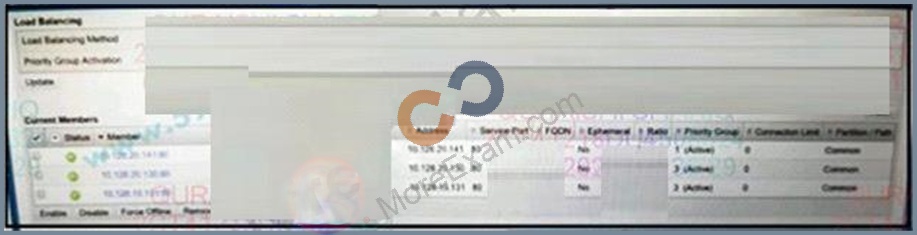
Question56: Refer to the exhibit.

An LTM device has a virtual server mapped to www.f5.com. Users report that when they connect to
/resources/201.1.2h.l_l.com they are unable to receive content.
What is the likely cause of the issue?

Question57: A site needs to terminate client HTTPS traffic at the BIG-IP and forward that traffic unencrypted. Which two are profile types that must be associated with such a virtual server? (Choose two.)

Question58: Refer to the exhibit.

Which Pool Members are receiving traffic?

Question59: A user wants to use the iHealth Upgrade Advisor to determine any issues with upgrading TMOS from 13.0 to 13.1.
Where can the user generate the QKView to upload to iHealth?

Question60: Assume a client's traffic is being processed only by a NAT; no SNAT or virtual server processing takes place. Also assume that the NAT definition specifies a NAT address and an origin address while all other settings are left at their defaults. If the origin server were to initiate traffic via the BIG-IP, What changes, if any, would take place when the BIG-IP processes such packets?

Question61: A BIG-IP Administrator is receiving intermittent reports from users that SSL connections to the BIG-IP device are failing. Upon checking the log files, the BIG-IP Administrator notices the following error message:
ere tmm<instance>[<pid>]: 01260008:3: SSL transaction (TPS) rate limit reached After reviewing statistics, the BIG-IP Administrator notices there are a maximum of 1200 client-side SSL TPS and a maximum of 800 server-side SSL TPS.
What is the minimum SSL license limit capacity the BIG-IP Administrator should upgrade to handle this peak?

Question62: A BIG-IP Administrator plans to resolve a non-critical issue with a BIG-IP device in 2 weeks. What Severity level should be assigned to this type of F5 support ticket?

Question63: How is MAC masquerading configured?

Question64: The current status of a given pool is offline (red). Which condition could explain that state? Assume the descriptions below include all monitors assigned for each scenario.

Question65: A site has assigned the ICMP monitor to all nodes and a custom monitor, based on the HTTP template, to a pool of web servers. The HTTP based monitor is working in all cases. The ICMP monitor is failing for 2 of the pool member 5 nodes.
All other settings are default. What is the status of the monitor is working in all cases?

Question66: Which IP address will the client address be changed to when SNAT automap is specified within a Virtual Server configuration?

Question67: Where is connection mirroring configured?

Question68: Assuming that systems are synchronized, which action could take place if the fail over cable is connected correctly and working properly, but the systems cannot communicate over the network due to external network problems?

Question69: A BIG-IP Administrator is unable to connect to the management interface via HTTPS. What is a possible reason for this issue?

Question70: A BIG-IP Administrator configures remote authentication and needs to make sure that users can still login even when the remote authentication server is unavailable.
Which action should the BIG-IP Administrators in the remote authentication configuration to meet this requirement?

Question71: Refer to the exhibit.

How are new connections load balanced?

Question72: A pool of four servers has been partially upgraded for two new servers with more memory and CPU capacity. The BIG-IP Administrator must change the load balance method to consider more connections for the two new servers. Which load balancing method considers pool member CPU and memory load?

Question73: A VLAN has the following objects configured:
Self-IP 10.10.10.100 with port lockdown set to Allow default
Virtual server 10.10.10.100:443 with UDP profile enabled
Virtual server 10.10.10.0/24 port forwarding virtual server
Global destination NAT forwarding 10.10.10.100 to internal server 172.168.10.100 Which object will process this request when https://10.10.10.100 is entered into a browser?

Question74: A local user account (Users) on the BIG-IP device is assigned the User Manager role. Userl attempts to modify the properties of another account (User2), but the action fails. The BIG-IP Administrator can successfully modify the User2 account.
Assuming the principle of least privilege, what is the correct way to allow User 1 to modify User2 properties?

Question75: What is the purpose of floating self-IP addresses?

Question76: A BIG-IP device has only LTM and ASM modules provisioned. Both have nominal provisioning level. The BI6-IP Administrator wants to dedicate more resources to the LTM module. The ASM module must remain enabled. Which tmsh command should the BIG-IP Administrator execute to obtain the desired result?

Question77: A BIG-IP Administrator opens a case with F5 Support. The support engineer requests the BIG-IP appliance chassis serial number.
Which TMSH command will provide this information?

Question78: What is the purpose of MAC masquerading?

Question79: Which parameters are set to the same value when a pair of BIG-IP devices are synchronized?

Question80: A BIG-IP Administrator needs to purchase new licenses for a BIG-IP appliance.
The administrator needs to know if a module is licensed and the memory requirement for that module.
Where should the administrator view this information in the System menu?

Question81: A BIG-IP Administrator needs to make sure that the automatic update check feature works properly.
What must the administrator configure on the BIG-IP system?

Question82: A BIG-IP Administrator sees the following error message in /var/log/ltm diskmonitor: *******; Disk partition shared has less than 30$ free Which section of the Configuration Utility should the BIG-IP Administrator access to investigate this error message?

Question83: The BIG-IP Administrator needs to perform a BIG-IP device upgrade to the latest version of TMOS. Where can the administrator obtain F5 documentation on upgrade requirements?

Question84: Which three properties can be assigned to nodes? (Choose three.)

Question85: Refer to the exhibit.

The BIG-IP Administrator has modified an iRule on one device of an HA pair. The BIG-IP Administrator notices there is NO traffic on the BIG-IP device in which they are logged into.
What should the BIG-IP Administrator do to verify if the iRule works correctly?

Question86: A site needs a virtual server that will use an iRule to parse HTTPS traffic based on HTTP header values. Which two profile types must be associated with such a virtual server? (Choose two.)

Question87: When network failover is enabled, which of the following is true?

Question88: A BIG-IP Administrator remotely connects to the appliance via out-of-band management using https://mybigip mycompany net. The management portal has been working all week. When the administrator attempts to login today, the connection times out. Which two aspects should the administrator verify? (Choose two)