Question1: A new web application is hosted at www.example.net, but some clients are still pointing to the legacy web application at www.example.com.
Which iRule will allow clients referencing www.example.com to access the new application?
Question2: An LTM Specialist notices the following error on the stdout console:
mcpd[2395]: 01070608:0: License is not operational(expired or digital signature does not match contents) Which command should be executed to verify the LTM device license?
Question3: A BIG-IP device sends out the following SNMP trap:
big-ipo.f5.com - bigipExternalLinkChange Link: 1.0 is DOWN
Where in the BIG-IP Configuration utility should the BIG-IP Administrator verify the current status of Link
1.0?
Question4: What is a benefit provided by F5 Enterprise Manager?
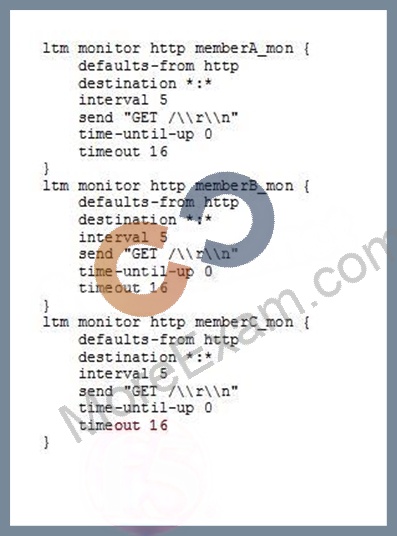
Question5: Consider the monitor configuration displayed below.

What is the status of a pool member that responds with ''200 OK''?
Question6: Refer of the exhibit.
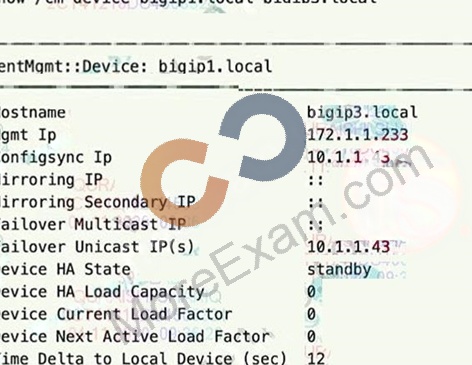
The 816-IP Administrator runs the command shown and observes a device trust issue between BIG-IP devices in a device group. The issue prevents config sync on device bigip3.local.
What is preventing the config sync?
Question7: What is the status of a pool member when manual resume is enabled and a health check first fails and then passes?
Question8: An LTM Specialist plans to enable connection mirroring for a virtualserver in an HA environment.
What must the LTM Specialist consider before implementing the configuration change?
Question9: -- Exhibit -
-- Exhibit --
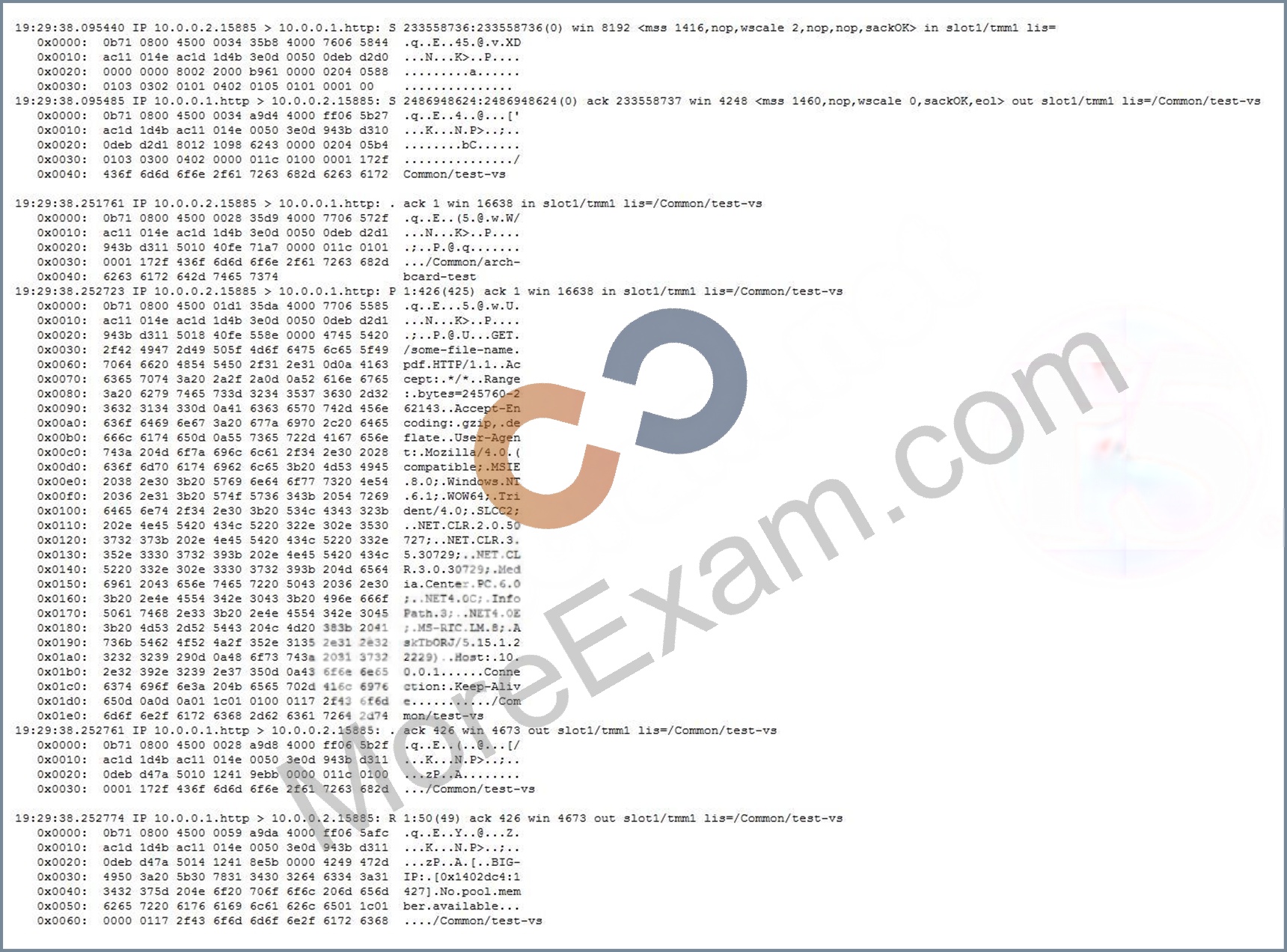
Refer to the exhibit.
A user is unable to access an HTTP application via a virtual server.
What is the cause of the failure?
Question10: An LTM Specialist has just manually failed the active LTM device over to the standby LTM device. The LTM Specialist notices the newly active LTM device is NOT currently receiving traffic. The LTM Specialist verifies the newly active device is responding to ARP but still no traffic is hitting the virtual servers. The LTM Specialist also notices that the virtual servers eventually start responding.
What should be added to the configuration to resolve the problem?
Question11: -- Exhibit -
-- Exhibit --
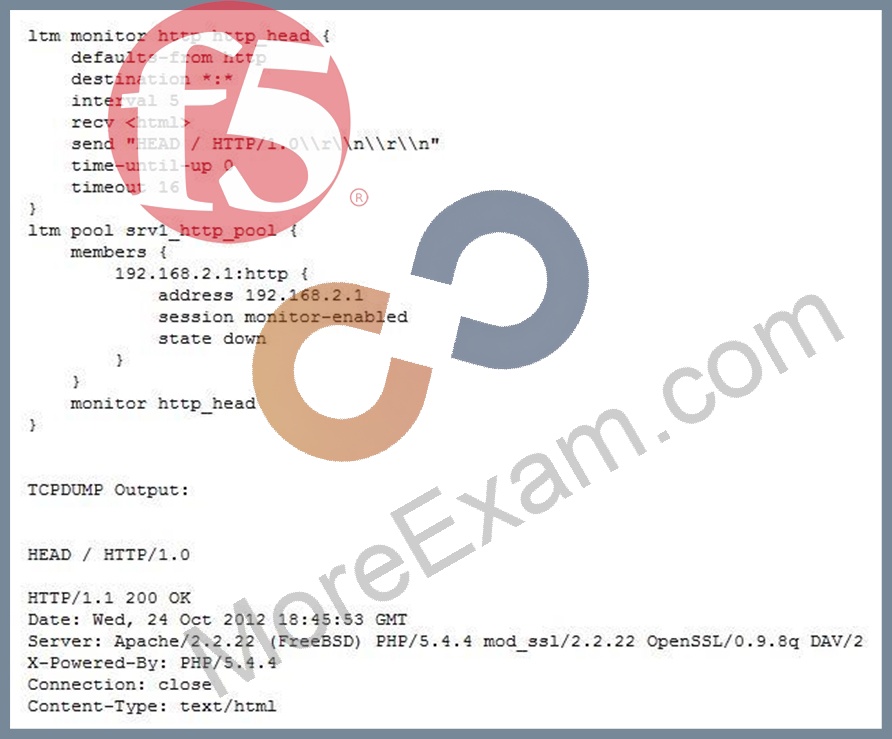
Refer to the exhibit.
An LTM Specialist is troubleshooting a new HTTP monitor on a pool. The pool member is functioning correctly when accessed directly through a browser. However, the monitor is marking the member as down.
The LTM Specialist captures the monitor traffic via tcpdump.
What is the issue?
Question12: A BIG-IP Administrator opens a case with F5 Support. The support engineer requests the BIG-IP appliance chassis serial number.
Which TMSH command will provide this information?
Question13: -- Exhibit -

-- Exhibit --
Refer to the exhibit.
An LTM Specialist is troubleshooting a virtual server. Both the virtual server and the pool are showing blue squares for their statuses, and new clients report receiving "The connection was reset" through their browsers.
Connections directly to the pool member are successful.
What is the issue?
Question14: A BIG-IP Administrator uses a device group to share the workload and needs to perform service on a BIG-IP device currently active for a traffic group. The administrator needs to enable the traffic group to run on another BIG-IP device in the device group. What should the administrator do to meet the requirement?
Question15: A BIG-IP Administrator is checking the BIG-IP device for known vulnerabilities. What should the 8IG-IP Administrator upload to BIG-IP iHealth for further analysis?
Question16: An LTM device is configure with the wildcard virtual servers displayed below.
A client connection is made to 172.24.31.14:443.
Question17: -- Exhibit -
-- Exhibit --
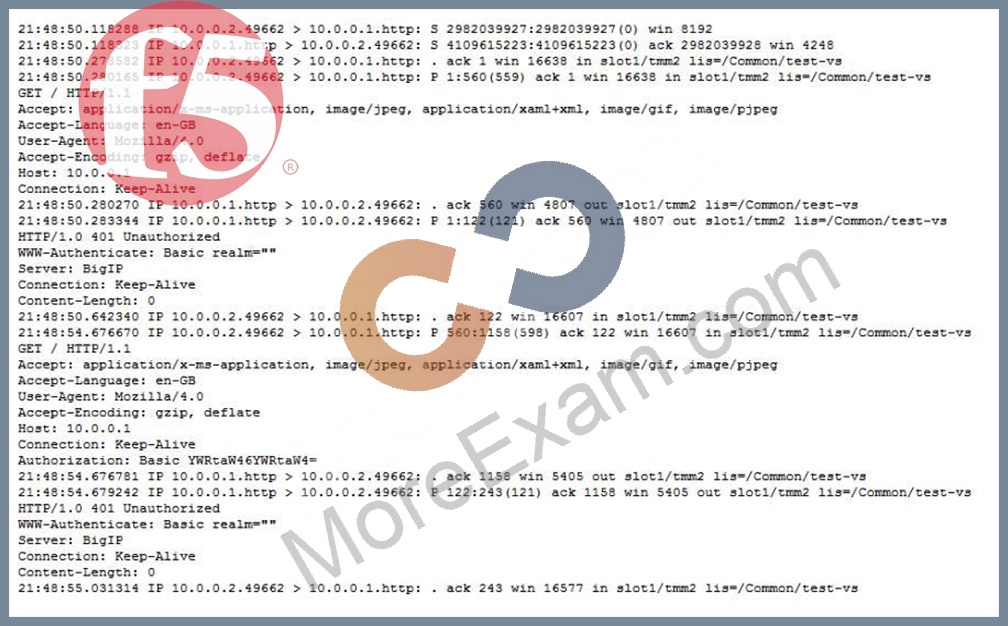
Refer to the exhibit.
A user is unable to access an application.
What is the root cause of the problem?
Question18: An LTM Specialist has installed a hotfix that updated the SCCP firmware package.
Which command will ensure that the host subsystem and SCCP reboot?
Question19: Refer to the exhibit.

A BIG-IP Administrator creates a new Virtual Server. The end user is unable to access the page. During troubleshooting, the administrator learns that the connection between the BIG-IP system and server is NOT set up correctly.
What should the administrator do to solve this issue?
Question20: An LTM Specialist is troubleshooting an HTTP monitor. The pool member is accessible directly through a browser, but the HTTP monitor is marking the pool member as down.
GET / HTTP/1.1
HTTP/1.1 400 Bad Request
DatE. Tue, 23 Oct 2012 21:39:07 GTM
Server: Apache/2.2.22 (FreeBSD) PHP/5.4.4
mod_ssl/2.2.22 OpenSSL/0.9.8q DAV/2
Content-LengtH. 226
Connection: close
Content-TypE. text/html; charset=iso-8859-1
Which issue is the pool member having?
Question21: An LTM Specialist loads a UCS file generated on a different LTM device and receives the following error message:
"mcpd[2395]: 01070608:0: License is not operational (expired or digital signature does not match contents)" Which command should the LTM Specialist use to prevent the error?
Question22: An LTM Specialist defines a receive string in the HTTP monitor and then assigns it to the HTTP pool. The monitor has an interval of 5 seconds and a timeout of 16 seconds.
If the receive string is NOT seen in the the HTTP payload after 20 seconds, how does the LTM device mark the monitor status?
Question23: An LTM Specialist must perform a hot fix installation from the command line.
What is the correct procedure to ensure that the installation is successful?
Question24: TWO LTM devices are in the same Device Group and configured for Ac live/Standby Failover. The LTM Specialist observes that the HA Active and Standby device constantly changes state. All network links use the default route domain A dedicated fiber ink is used for the HA connection with a latency of 250 ms but no packet loss.
What is causing the change in failover state to occur?
Question25: Refer to the exhibit.

An organization is reporting slow performance accessing their Intranet website, hosted in a public cloud. All employees use a single Proxy Server with the public IP of 104.219.110.168 to connect to the Internet. What should the BIG-IP Administrator of the Intranet website do to fix this issue?
Question26: -- Exhibit -

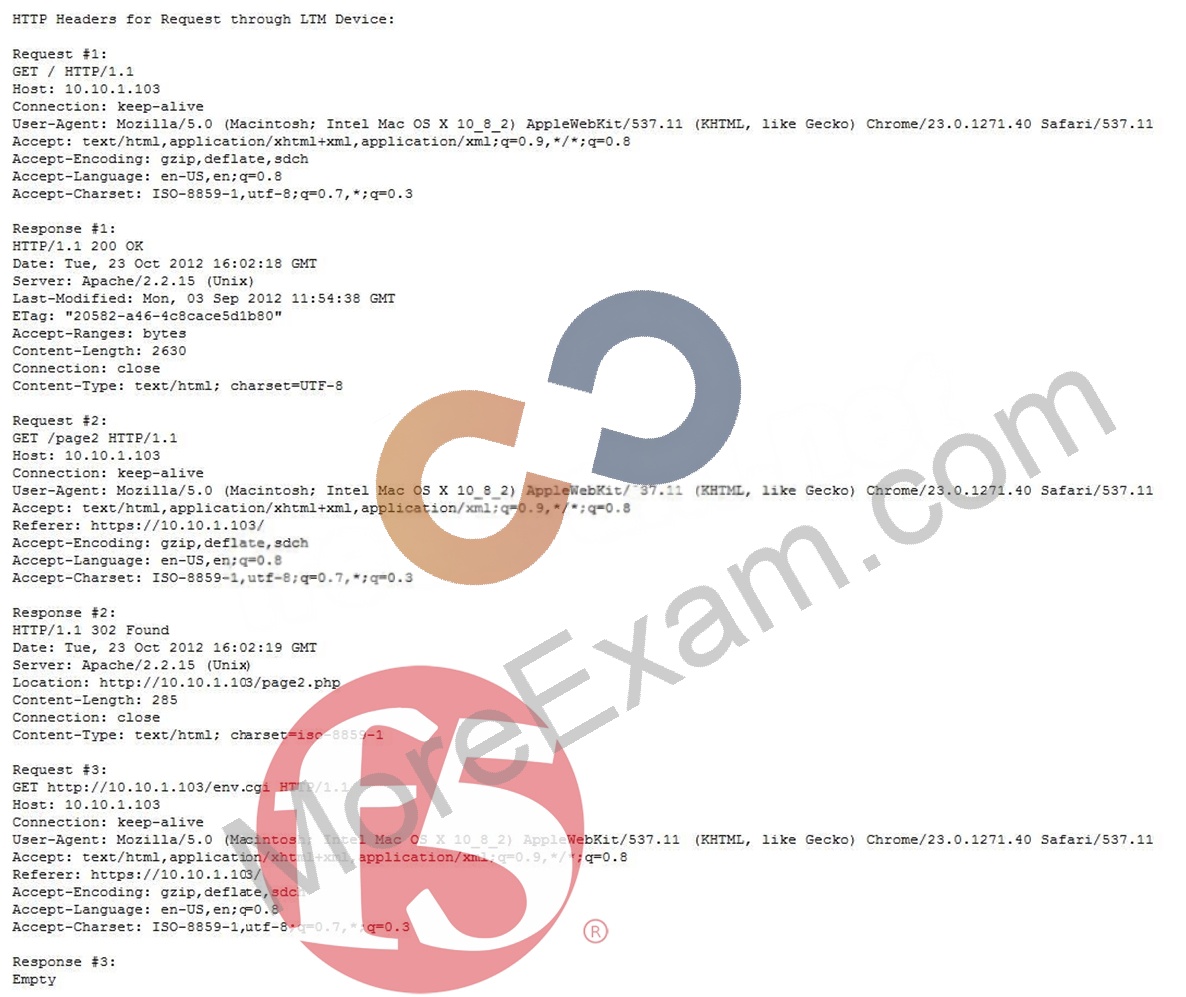
-- Exhibit --
Refer to the exhibits.
A customer requests to offload SSL for an internal website. The front page of the website loads correctly; however, selecting links on the page fails.
How should the LTM Specialist fix the issue?
Question27: An TLM Specialist has an Exchange that must use the LTM device to route traffic to the internet.
Which SNAT/NAT configure allows the Exchange server's traffic access the internet through the LTM device?
Question28: 
A BIG-IP Administrator notices that one of the servers that runs an application is NOT receiving any traffic.
The BIG-IP Administrator examines the configuration status of the application and observes the displayed monitor configuration and affected Pool Member status. What is the possible cause of this issue?
Question29: A 8IG-IP Administrator configures a node with a standard icmp Health Monitor. The Node shows as DOWN although the Backend Server is configured to answer ICMP requests. Which step should the administrator take next to find the root cause of this issue?
Question30: The LTM Specialist is in the process of creating a USB boot drive for the purpose of restoring the BIG-IP software to an LTM device. A separate LTM device has been selected for the purpose of creating the USB boot drive. The BIG-IP software ISO has already been uploaded and mounted on the separate LTM device.
Which command should the LTM Specialist use to trigger the LTM device to install the BIG-IP software to the USB boot drive?
Question31: An LTM Specialist configures an HTTP monitor as follows:
ltm monitor http stats_http_monitor {
defaults-from http
destination *:*
interval 5
recv "Health check: OK"
send "GET /stats/stats.html HTTP/1.1\\r\\nHost: www.example.com\\r\\nAccept-EncodinG. gzip, deflate\\r\\nConnection: close\\r\\n\\r\\n" time-until-up 0 timeout 16
}
The monitor is marking all nodes as down. A trace of the HTTP conversation shows the following:
GET /stats/stats.html HTTP/1.1
Host: www.example.com
Accept-EncodinG. gzip, deflate
Connection: close
HTTP/1.1 401 Authorization Required
DatE. Tue, 23 Oct 2012 19:38:56 GMT
Server: Apache/2.2.15 (Unix)
WWW-AuthenticatE. Basic realm="Please enter your credentials"
Content-LengtH. 480
Connection: close
Content-TypE. text/html; charset=iso-8859-1
Which action will resolve the problem?
Question32: Which iRule will reject any connection originating from a 10.0.0.0/8 network?
Question33: Refer to the exhibit.
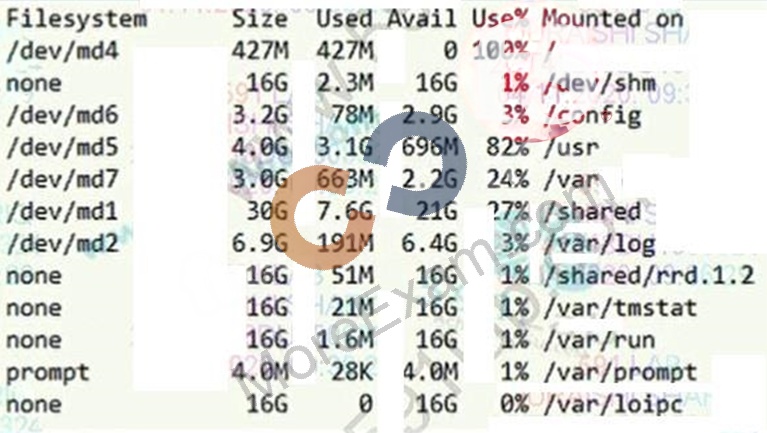
The BIG-IP Administrator is investigating disk utilization on the BIG-IP device.
What should the BIG-IP Administrator check next?
Question34: -- Exhibit -

-- Exhibit --
Refer to the exhibit.
An LTM Specialist has created a virtual server to balance connections to a pool of application servers and offload SSL decryption. Clients connect to the application at https://www.example.com/. The virtual server is configured with a clientssl profile but no serverssl profile. The application servers are listening on ports 80 and
443. Users are unable to connect to the application through the virtual server but are able to connect directly to the application server.
What is the root cause of the error?
Question35: -- Exhibit -

-- Exhibit --
Refer to the exhibit.
An LTM Specialist configures a virtual server to load balance to a pool of FTP servers. File transfers are failing. The virtual server is configured as follows:
ltm virtual ftp_vs {
destination 10.10.1.103:ftp
ip-protocol tcp
mask 255.255.255.255
pool ftp_pool
profiles {
tcp { }
}
vlans-disabled
}
Which change will resolve the problem?
Question36: An LTM Specialist configures a new HTTP virtual server on an LTM device external VLAN. The web servers are connected to the LTM device internal VLAN. Clients trying to connect to the virtual server are unable to establish a connection. A packet capture shows an HTTP response from a web server to the client and then a reset from the client to the web server.
From which two locations could the packet capture have been collected? (Choose two.)
Question37: The following decoded TCPDump capture shows the trace of a failing health monitor.
00:00:13.245104 IP 10.29.29.60.51947 > 10.0.0.12.http: P 1:59(58) ack 1 win 46 <nop,nop,timestamp
2494782300 238063789> out slot1/tmm3 lis=
0x0000: 4500 006e 3b19 4000 4006 ce0c 0a1d 1d3c E..n;.@.@......<
0x0010: 0a00 000c caeb 0050 8be5 aca3 dd65 e3e1 .......P.....e..
0x0020: 8018 002e 1b41 0000 0101 080a 94b3 5b5c .....A........[\
0x0030: 0e30 90ad 4745 5420 2f74 6573 745f 7061 .0..GET./test_pa
0x0040: 6765 2e68 746d 6c20 4854 5450 312e 310d ge.html.HTTP1.1.
0x0050: 0a48 6f73 743a 200d 0a43 6f6e 6e65 6374 .Host:...Connect
0x0060: 696f 6e3a 2043 6c6f 7365 0d0a 0d0a 0105 ion:.Close......
0x0070: 0100 0003 00 .....
00:00:13.245284 IP 10.0.0.12.http > 10.29.29.60.51947: . ack 59 win 362 <nop,nop,timestamp 238063789
2494782300> in slot1/tmm3 lis=
0x0000 0ffd 0800 4500 00c9 6f68 4000 8006 755d [email protected]]
0x0010 0a29 0015 0a29 0103 0050 e0d6 4929 90eb .)...)...P..I)..
0x0020 6f12 d83c 8019 fab3 9b31 0000 0101 080a o..<.....1......
0x0030 0068 4e10 5240 6150 4854 5450 2f31 2e31 .hN.R@aPHTTP/1.1
0x0040 2034 3030 2042 6164 2052 6571 7565 7374 .400.Bad.Request
0x0050 0d0a 436f 6e74 656e 742d 5479 7065 3a20 ..Content-Type:.
0x0060 7465 7874 2f68 746d 6c0d 0a44 6174 653a text/html..Date:
0x0070 2054 6875 2c20 3231 204a 616e 2032 3031 .Mon,.01.Jan.201
0x0080 3020 3138 3a35 383a 3537 2047 4d54 0d0a 2.00:00:01.GMT..
0x0090 436f 6e6e 6563 7469 6f6e 3a20 636c 6f73 Connection:.clos
0x00a0 650d 0a43 6f6e 7465 6e74 2d4c 656e 6774 e..Content-Lengt
0x00b0 683a 2032 300d 0a0d 0a3c 6831 3e42 6164 h:.20....<h1>Bad
0x00c0 2052 6571 7565 7374 3c2f 6831 3e .Request</h1>
The health monitor is sending the string shown in the capture; however, the server response is NOT as expected. The correct response should be an HTML page including the string 'SERVER IS UP'.
What is the issue?
Question38: An application owner claims an LTM device is delaying delivery of an HTTP application. The LTM device has two VLANs, an internal and an external. The application servers reside on the internal VLAN. The virtual server and clients reside on the external VLAN.
With appropriate filters applied, which solution is most efficient for obtaining packet captures in order to investigate the claim of delayed delivery?
Question39: An application is being load balanced through the LTM device using the configuration displayed below.
The network has been re-engineered to NAT all client connection. As a result, allclient connections are hitting the same pool member.
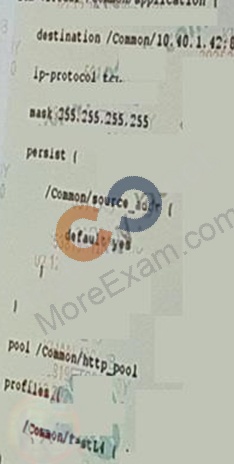

Which changes should the LTM Specialist make in order to restore load balancing functionality wile maintaining session persistence?
Question40: An LTM Specialist must create a new virtual server for HTTP access. The LTM Specialist creates a forwarding virtual server to reach the resource.
What is a potential result of this action?
Question41: An LTM is configure an application that isseparated into several subdomains across multiple virtual servers.
Many of these subdomains require encryption and could be accessed by anyone on the internet. The configuration must NOT result in SSL warnings to end users.
How should the LTM Specialist configure the SSL profiles for these virtual servers?
Question42: An LTM Specialist is configuring a client profile to offload processing a new application Company policy requires that clients can resume session for up to 30 minutes, but must renegotiate a new session after that.
Which setting should the LTM Specialist change to satisfy this requirement?
Question43: Refer to the exhibit.
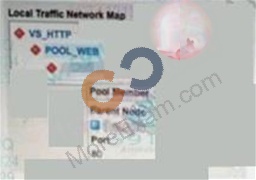
Why is the virtual server responsive to incoming connections?
Question44: An ITM Specialist has the configuration shown:

The LTM Specialist needs to create a new virtual server in part B.
Which virtual address(es) should be used for the new virtual server?
Question45: An LTM device has been configured to log the reasons for generating TCP RST packets.
The following log entry occurs:
"01230140:3: RST sent from 192.168.1.100:80 to 192.168.1.124:39272, [0x112d82a:1721] {peer} TCP RST from remote system." Which condition will trigger this log entry?
Question46: Refer to the exhibit.
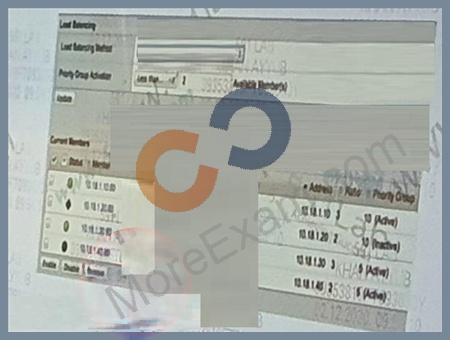
The pool shown isconfigured with four pool members in a variety of states. The application is receiving a large number of request. The LTM Specialist needs to make changes to make sure that all members receive the same levels of traffic.
Which changes need to be made?
Question47: -- Exhibit -
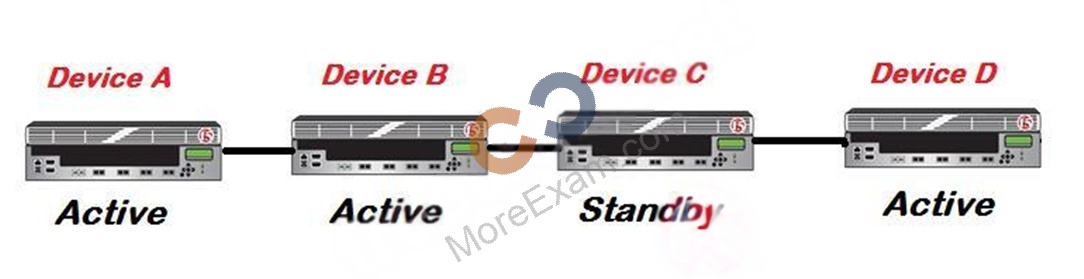
-- Exhibit --
Refer to the exhibit.
An LTM Specialist is upgrading the LTM devices.
Which device should be upgraded first?
Question48: -- Exhibit -

-- Exhibit --
Refer to the exhibit.
An LTM Specialist sets up AVR alerts and notifications for a specific virtual server if the server latency exceeds 50ms. The LTM Specialist simulates a fault so that the server latency is consistently exceeding the
50ms threshold; however, no alerts are being received.
Which configuration should the LTM Specialist modify to achieve the expected results?
Question49: Refer to the exhibit
The network team creates a new VLAN on the switches. The BIG-IP Administrator needs to create a configuration on the BIG-IP device. The BIG-IP Administrator creates a new VLAN and Self IP, but the servers on the new VLAN are NOT reachable from the BIG-IP device.
Which action should the BIG-IP Administrators to resolve this issue?
Question50: The BIG-IP Administrator configures an HTTP monitor with a specific receive string. The status is marked
'down'.
Which tool should the administrator use to identify the problem?
Question51: A BIG-IP Administrator wants to add the ASM Module to an HA pair of BIG-IP devices. The BIG-IP Administrator has already installed a new Add-On License on both devices in the HA pair. What should the BIG-IP Administrator do next to use the module?
Question52: A 8IG-IP Administrator configures a Virtual Server to load balance traffic between 50 webservers for an ecommerce website Traffic is being load balanced using the Least Connections (node) method.
The webserver administrators report that customers are losing the contents from their shopping carts and are unable to complete their orders.
What should the BIG-IP Administrator do to resolve the issue?
Question53: A BIG-IP Administrator uses a device group to share the workload and needs to perform service on a BIG-IP device currently active for a traffic group. The administrator needs to enable the traffic group to run on another BIG-IP device in the device group. What should the administrator do to meet the requirement?
Question54: -- Exhibit -
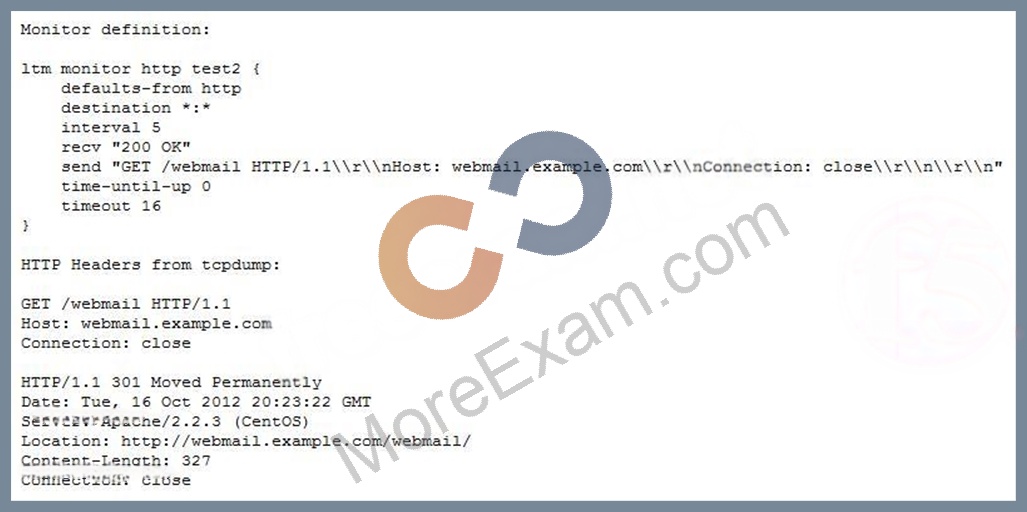
-- Exhibit --
Refer to the exhibit.
An HTTP monitor always marks the nodes in the pool as down. The monitor's definition and the HTTP headers from the monitor request and response are provided.
What is the issue?
Question55: During a maintenance window, an EUD test was executed and the output displayed on the screen. The BIG-IP Administrator did NOT save the screen output. The BIG-IP device is currently handling business critical traffic. The BIG-IP Administrator needs to minimize impact. What should the BIG-IP Administrator do to provide the EUD results to F5 Support?
Question56: Refer to the exhibit.

A BIG-IP Administrator needs to configure health monitors for a newly configured server pool named Pool_B.
Which health monitor settings will ensure that all pool members will be accurately marked as available or unavailable?
Question57: A user is having issues with connectivity to an HTTPS virtual server. The virtual server is on the LTM device's external vlan, and the pools associated with the virtual server are on the internal vlan. An LTM Specialist does a tcpdump on the external interface and notices that the host header is incomplete.
In which location should the LTM Specialist put a traffic analyzer to gather the most pertinent data?
Question58: A virtual server is using a TCP profile based on thetop-wan-optimized profile for a streaming application Users report videos are loading slowly.
Which setting should be modified in the TCP profile to optimize the application?
Question59: Refer to the exhibit.
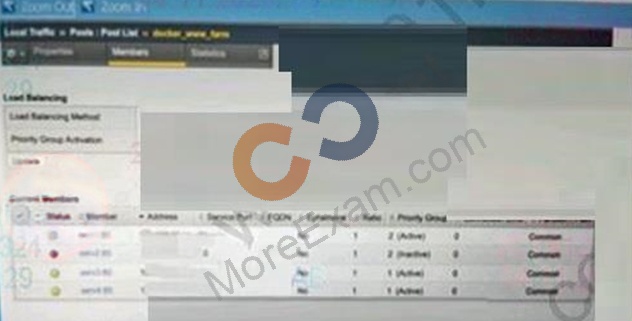
Which Pool Members are receiving traffic?
Question60: A design requires the LTM device to become HA standby when the one of the two physical interface on the External trunk is down the Externaltrunk is an interface on the External VLAN Which TMOS command enables this behavior?
Question61: A BIG-IP Administrator is configuring a pool with members who have differing capabilities. Connections to pool members must be load balanced appropriately.
Which load balancing method should the BIG-IP Administrator use?
Question62: The owner of a web application asks the 8IG-IP Administrator to change the port that the BIG-IP device sends traffic to. This change must be made for each member in the server pool named app_pool for their Virtual Server named app_vs. In which area of the BIG-IP Configuration Utility should the BIG-P Administrator make this change?
Question63: A new DNS virtual server has been configured. Testing reveals that DNS server has failed to accept DNS over TCP. The configuration of the virtual server is as follows:

Which action should be taken to correct this issue?
Question64: An LTM Specialist receives a request to monitor the network path through a member, but NOT the member itself.
Which monitor option should the LTM Specialist enable or configure?
Question65: TWO BIG-IP appliances need to be configured to load balance multiple firewall in a firewall sandwich, Which health monitor setting should be used to verify that the firewalls are able to forward traffic?
Question66: -- Exhibit -
-- Exhibit --
Refer to the exhibit.
An LTM Specialist is troubleshooting an HTTP monitor that is marking a pool member as down. Connecting to the pool member directly through a browser shows the application is up and functioning correctly.
How should the send string be modified to correct this issue?
Question67: A BIG-IP Administrator wants to add a new Self IP to the BIG-IP device. Which item should be assigned to the new Self IP being configured?
Question68: Two LTM devices must be manually configured to restrict in the same Device Group.
What is the correct order of steps to meet this requirement?
Question69: A Web Server Administrator uses a manual process to display a page when the service is down.
Which feature on the LTM device should be used to automate the service down page? :
Question70: An application is expected to maintain more than 100,000concurrent TCP connections to a single pool member.
What is an appropriate SNAT configuration in this situation?
Question71: An LTM Administrator receives an email from the NOC stating that the switch connected to the backend server was shut down for maintenance. The BIG-IP device handles only UDP traffic. The BIG IP device did not fail over to a DR location when no pool members were available.
When theLTM Administrator checks the pool, it confirms that the monitor is still marking UP the pool member.
A tcpdump of the traffic shows the following output:
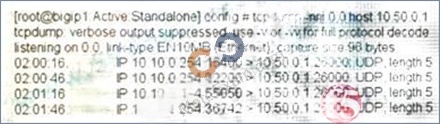
A list of the monitor configuration shows the following:
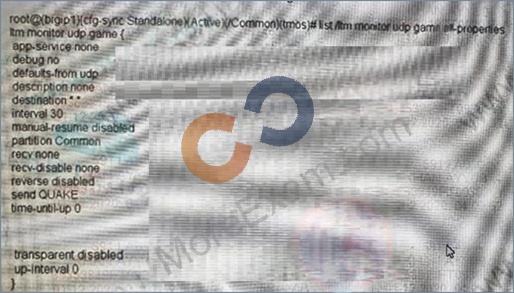
Which two modifications to the LTMconfiguration will mark this pool member down, when the switch is down? (Choose two.)
Question72: -- Exhibit -
-- Exhibit --
Refer to the exhibit.
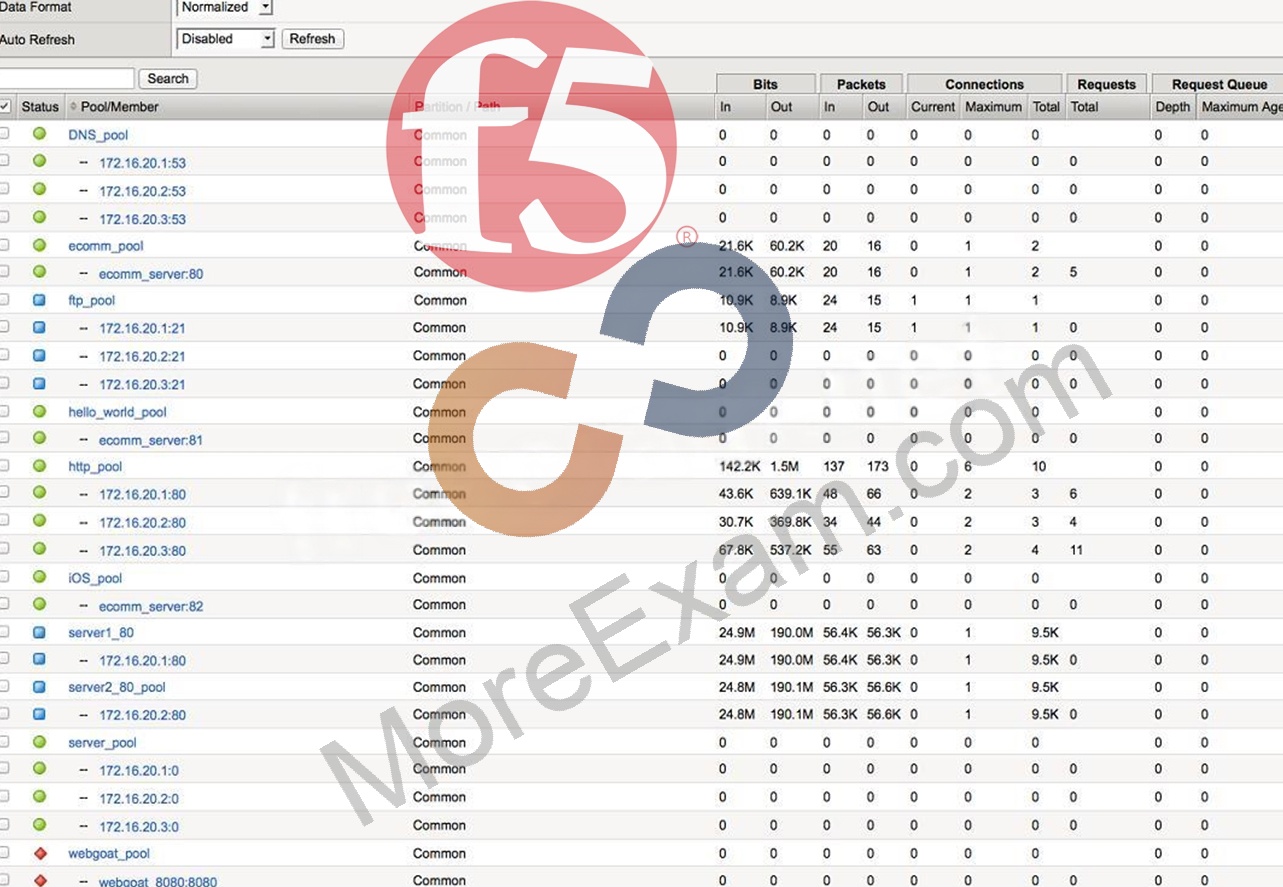
Which pool can be removed without affecting client traffic?
Question73: A BIG-IP Administrator finds the following log entry after a report of user issues connecting to a virtual server:
01010201: 2: Inet port exhaustion on 10.70.110.112 to 192.28.123.250:80 (proto 6) How should the BIG-IP Administrator modify the SNAT pool that is associated with the virtual server?
Question74: Which file should be modified to create custom SNMP alerts?
Question75: -- Exhibit -
-- Exhibit --
Refer to the exhibit.
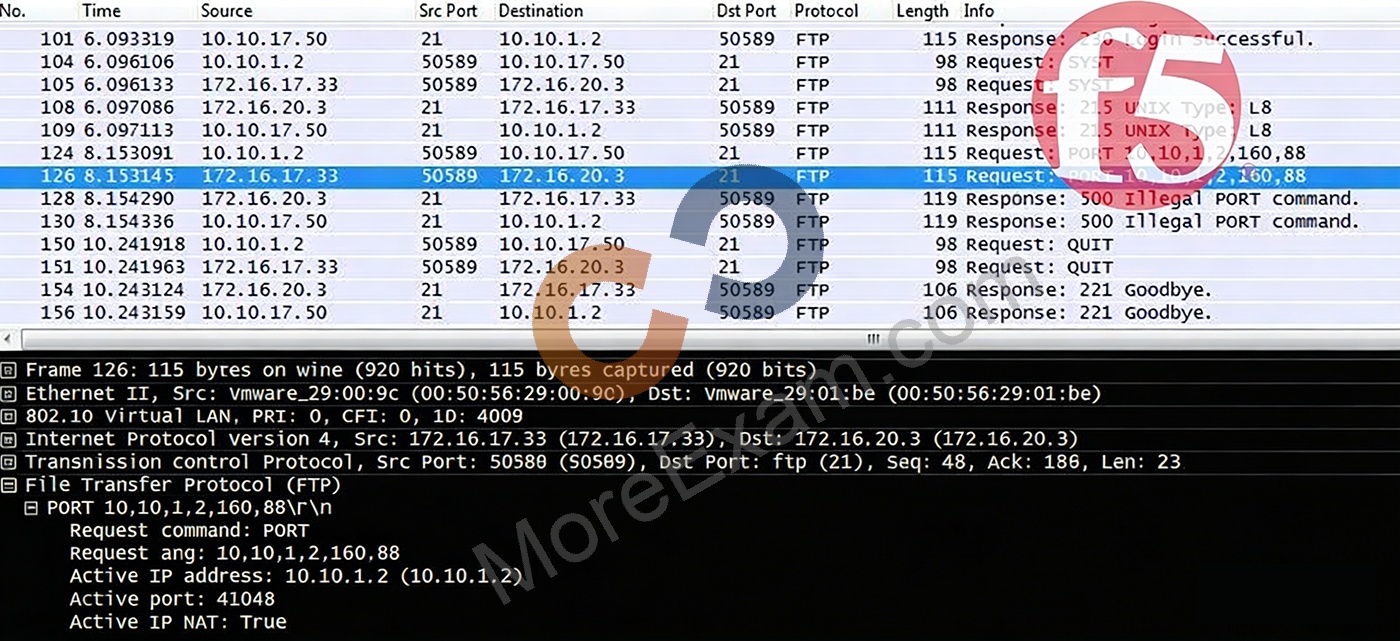
An LTM Specialist is investigating reports that users are unable to perform some commands through an FTP virtual server. The users are receiving the FTP error "500 Illegal PORT command." The virtual server is configured to SNAT using automap. The LTM Specialist performs a capture on the server side of the LTM device.
Why is the server returning this error?
Question76: An LTM Specialist needs to rewrite text within an HTML response from a web server. A client is sending the HTTP request below:
GET / HTTP/1.1
Host: www.f5.com
User-Agent: Mozilla/5.0 (Windows NT 6.1; WOW64; rv:16.0) Gecko/20100101 Firefox/16.0 Accept: text/html,application/xhtml+xml,application/xml;q=0.9,*/*;q=0.8 Accept-LanguagE. en-US,en;q=0.5 Accept-EncodinG. gzip, deflate Cache-Control: no-cache Connection: keep-alive CookiE. somecookie=1 Although a stream profile has been added to the virtual server, the content within the HTTP response is NOT being matched, and therefore NOT modified.
Which HTTP header should the LTM Specialist remove from the request to ensure the content can be matched and modified?
Question77: An F5 LTM Specialist needs to perform an LTM device configuration backup prior to RMA swap.
Which command should be executed on the command line interface to create a backup?
Question78: Traffic to a pool of SFTP servers that share storage must be balanced by an LTM device.
What are therequired profile and persistence settings for a standard virtual server?
Question79: A virtual server with SNAT automap enabled selects pool member 10.20.0.10.443 for the server-side flow.
The client side flow source IP is 192.168.0.10 .

Which source IP should be expected inthe server-side connection?
Question80: AN LTM Specialist needs to determine the delay between anLTM device and the internal web server for a specific client.
Which two AVR reporting options should the LTM Specialist enable to measure the delay? (Choose two.)
Question81: -- Exhibit -
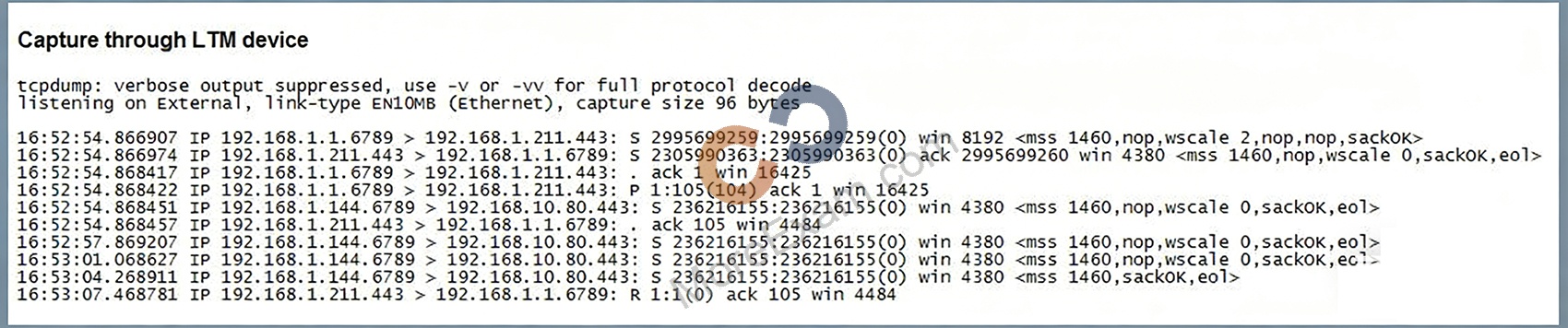




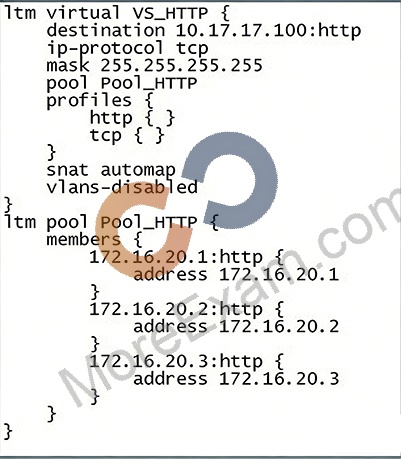
-- Exhibit --
Refer to the exhibits.
An LTM Specialist is troubleshooting an application configured on an LTM device on a one-armed configuration. The application is NOT working through the LTM device but does work when accessed directly via the application servers. The virtual server 192.168.1.211:443 is configured to SNAT using the address
192.168.1.144 and references a pool with the member 192.168.10.80:443. No Client or Server SSL profiles are associated. The LTM Specialist has collected two traffic captures to help determine the issue.
What is the problem with the configuration on the LTM device?
Question82: The picture belongs to static content, you can configure static content cache in FS to meet this demand An LTM Specialist must configure session persistence for a highly available, highly utilized web-based application.
* The following requirements are provided:
* http proxy setup for security
persistence information available to the HA peer in case of failover
The LTM Specialist needs to minimize additional burden on the LTM device to the greatest extent possible.
Which persistence profile should be used?
Question83: An LTMSpecialist is the administrator of an HA pair that contains two BIG IP units and one floating traffic group (TG1). A new project requires the creation of 30 virtual servers. The Specialist decides to create a new floating traffic group (TG2) to handle this requirement. Objects for this project created by the BIG-IP Managers must appears in the correct traffic group.
Which configuration should the LTM Specialist use to meet the requirement?
Question84: What should an LTM Specialist configure on an LTM device to send AVR notification emails?
Question85: A virtual server configuration for traffic destined to a server is as shown:
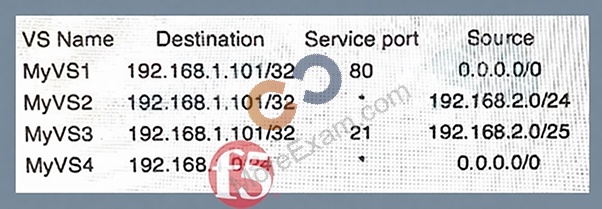
FTP traffic is destined to the 192.168.1.101 server from the source of192.168.2.129.
Based on precedence, which virtual server accepts this traffic?
Question86: -- Exhibit -

-- Exhibit --
Refer to the exhibit.
An LTM Specialist configures a virtual server that balances HTTP connections to a pool of three application servers. Approximately one out of every three connections to the virtual server fails.
Which two actions will resolve the problem? (Choose two.)
Question87: The end users of a web application need to verify that their browsers received the complete message-body from the web server.
Which HTTP header will accomplish this?
Question88: An LTM Specialist needs to provide access to a 8BG-IP to device for a company's support person access to the BIG IP device, but are NOT allowed to change any settings All support the support remote access to the BIG-IP device, but are NOTallowed to change ant settings. All support have accounts in the company's Active Directory Which method is appropriate to provide access for the support personnel to the BIG-JP device?
Question89: Refer to the exhibit.
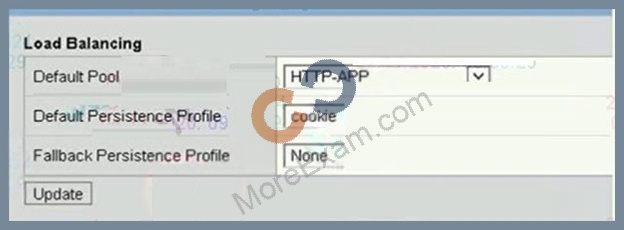
Due to a change in application requirements, a BIG-IP Administrator needs to modify the configuration of a Virtual Server to include a Fallback Persistence Profile.
Which persistence profile type should the BIG-IP Administrator use for this purpose?
Question90: A BIG-IP Administrator finds the following log entry:
tnm tmm[7141]: 011e0002:4: sweeperjjpdate: aggressive mode activated.
Which action should the BIG-IP Administrator to mitigate this memory issue?
Question91: A development team needs to apply a software fix and troubleshoot one of its servers. The BIG-IP Administrator needs to immediately remove all connections from the BIG-IP system to the back end server.
The BIG-IP Administrator checks the Virtual Server configuration and finds that a persistence profile is assigned to it. What should the 8IG-IP Administrator do to meet this requirement?
Question92: -- Exhibit -

-- Exhibit --
Refer to the exhibit.
An LTM Specialist is performing an HTTP trace on the client side of the LTM device and notices there are many undesired headers being sent by the server in the response. The LTM Specialist wants to remove all response headers except "Set-Cookie" and "Location." How should the LTM Specialist modify the HTTP profile to remove undesired headers from the HTTP response?
Question93: Remote users who access the LTM device are authenticated via Radius. The default remote user role is Guest Some users need LTM device with the Administrator role. The F5 Radius attributes are configure on the Radius server.
Which configuration item needs to be created?
Question94: An application is making heavy use of a large, high-quality JPEG image file. An LTM Specialist needs to enhance page load times without increasing server load.
Which profile should be applied to the virtual server to perform this task?
Question95: A new BIG-IP VE is deployed with default settings. The BIG-IP Administrator completes the setup utility in the Configuration Utility. The internal self IP address fails to respond to a ping request. What is a possible cause of this issue?
Question96: A BIG-IP Administrator adds new Pool Members into an existing, highly utilized pool. Soon after, there are reports that the application is failing to load for some users. What pool level setting should the BIG-IP Administrator check?
Question97: -- Exhibit -
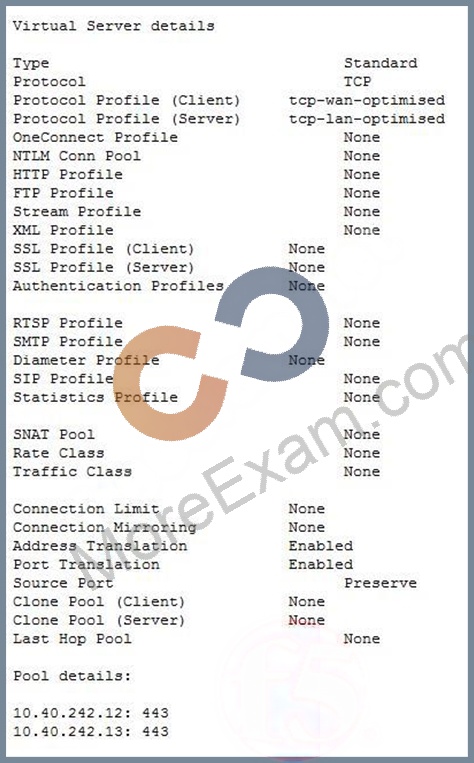
-- Exhibit --
Refer to the exhibit.
An LTM device is used to load balance web content over a secure channel.
The developers of the web content have done a trace using an HTTP profiler application. They believe that allowing the LTM device to compress traffic to the client will improve performance. The client can utilize GZIP or deflate compression algorithms.
An LTM Specialist must implement the compression.
The LTM Specialist has completed the following actions:
1. Create the relevant profile.
2. Apply the relevant profile to the virtual server (VS).
After applying the relevant profile, the LTM device is failing to compress the traffic. Instead, the traffic is being served with an error.
What is the problem?
Question98: New Syslog servers have been deployed in an organization. The BIG-IP Administrator must reconfigure the BIG-IP system to send log messages to these servers.
In which location in the Configuration Utility can the BIG-IP Administrator make the needed configuration changes to accomplish this?
Question99: Exhibit.

- The ITM devices LTM 1 and LTM2 are configured in Device Group X (Sync-Failover)
- LTM3 and LTM4 are configured in Device Group Y (Sync-Only)
- An LTM specialist configures Device Group Z (Sync-Only) to keep several profiles in (sync-Only) to keep several profiles in sync across all devices.
- Device GROUP X has four Traffic Groups A.B.C and D configured.
- Device Group Y has four Traffic Groups E, F, G, and H configured
- Auto Fallback IS NOT Enabled.
- Each Device group is healthy and able to pass traffic for any traffic groupassigned to that Device Group.
The data center that contains LTM2 and LTM4 loses power. After 10 minutes; power is restored and all devices are up and healthy.
What is the state of each Traffic Group on each ITM device after power is restored?
A)

B)

C)

D)

Question100: An LTM deviceneeds to be configured a virtual server. The application requires SSL encryption from the client to the server and an X-Forwarded-For added by the LTM device.
Which virtual server type should the LTM Specialist use?
Question101: -- Exhibit -

-- Exhibit --
Refer to the exhibit.
A client attempts to connect from a Google Chrome browser to a virtual server on a BIG-IP LTM. The virtual server is SSL Offloaded. When the client connects, the client receives an SSL error. After trying Mozilla Firefox and Internet Explorer browsers, the client still receives the same errors.
The LTM Specialist does an ssldump on the virtual server and receives the results as per the exhibit.
What is the problem?
Question102: Which procedure should an LTM Specialist follow to move a configuration from a 1500 to a 1600 hardware platform during an upgrade?
Question103: A new web application is being deployed Mutual SSL authentication must be used to authenticate clients.
Which of the following two tasks must be completed to meet therequirements? (Choose two)
Question104: An application is configured on an LTM device:
Virtual server: 10.0.0.1:80 (VLAN vlan301)
SNAT IP: 10.0.0.1
Pool members: 10.0.1.1:8080, 10.0.1.2:8080, 10.0.1.3:8080 (VLAN vlan302) Which packet capture should the LTM Specialist perform on the LTM device command line interface to capture only client traffic specifically for this virtual server?
Question105: An HA pair of LTM devices that load balance multiple HTTPS applications utilizes highly customized RAM Cache and compression profiles on each virtual server. The LTM Specialist who is administering the HA pair regularly observes entines in the log similar to the following:
tmm tmm I708S1 011e0002.4. sweeper_update: aggressive mode activated (117504/138240 pages) No DoS attacks arc occurring. No user problems have been reported. Which step should the LTM Specialist take to help mitigate the issue?
Question106: AN LTM Specialist is using an external monitor evaluate the hard drive usage of a node. The monitor has marked the node down because it exceeded the specific threshold. The disk usage on the server has been corrected below the threshold, however, the node remains offline.
Which feature is causing this problem?
Question107: Users are unable to reach an application. The BIG-IP Administrator checks the Configuration Utility and observes that the Virtual Server has a red diamond in front of the status. What is causing this issue?
Question108: An LTM Specialist needs to add a pool that will load balanceMYSOL services. It has four members, each with differing hardware platforms. All pool members are already assigned to another pool for load balancing FTP traffic.
Which load balancing method is most effective when the LTM Specialist sets up the pool?
Question109: A BIGJP Administrator needs to load a UCS file but must exclude the license file. How should the administrator perform this task?
Question110: -- Exhibit -

-- Exhibit --
Refer to the exhibit.
The virtual server is listening on port 443.
What is the solution to the problem?
Question111: An LTM Specialist toconfigure a backend server to be disabled it takes longer than 30 seconds to respond to a request.
Which values should the LTM Specialist enter for interval and timeout?
Question112: An LTM Specialistis configuring a new virtual server on an LTM device and assigning a SNAT pool that is already is use another virtual server. Both virtual servers use the same pool members to load balance traffic. A maximum of 35,000 users needs to be able to access each virtual server ta any time. The network architecture does NOT allow the backend servers to use the LTM device as a default gateway.
What is the minimum number of SNAT addresses required in the SNAT pool to meet the needs of the virtual servers?