EMT Practice Test

1. Question Content...


Question List

Question1: A virtual server is experiencing intermittent port exhaustion. What should be done to fix this issue?

Question2: What is the recommended procedure for upgrading a major TMOS release on a BIG-IP platform?

Question3: An LTM is configure an application that isseparated into several subdomains across multiple virtual servers.
Many of these subdomains require encryption and could be accessed by anyone on the internet. The configuration must NOT result in SSL warnings to end users.
How should the LTM Specialist configure the SSL profiles for these virtual servers?

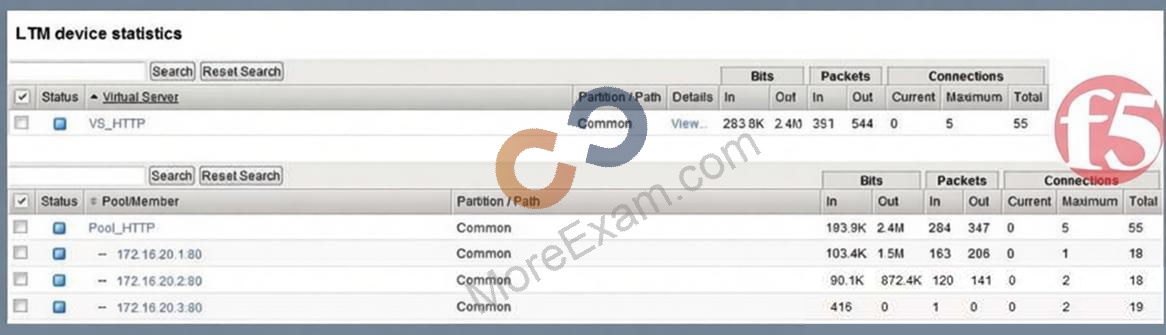
Question4: -- Exhibit -

-- Exhibit --
Refer to the exhibit.
Which step should an LTM Specialist take to utilize AVR?

Question5: A custom TCP application using a single server is being migrated to the LTM device. A server is being added to the pool. The application is known to violate the TCP protocol RFC. Theapplication currently works without error from a user perspective.
Which virtual server type is appropriate in this situation?

Question6: A BIG-IP Administrator remotely connects to the appliance via out-of-band management using
https://mybigip mycompany net. The management portal has been working all week. When the administrator attempts to login today, the connection times out. Which two aspects should the administrator verify? (Choose two)

Question7: An LTM Specialist configures a new HTTP virtual server on an LTM device external VLAN. The web servers are connected to the LTM device internal VLAN. Clients trying to connect to the virtual server are unable to establish a connection. A packet capture shows an HTTP response from a web server to the client and then a reset from the client to the web server.
From which two locations could the packet capture have been collected? (Choose two.)

Question8: The owner of a web application asks the 8IG-IP Administrator to change the port that the BIG-IP device sends traffic to. This change must be made for each member in the server pool named app_pool for their Virtual Server named app_vs. In which area of the BIG-IP Configuration Utility should the BIG-P Administrator make this change?

Question9: -- Exhibit -

-- Exhibit --
Refer to the exhibit.
An LTM Specialist is troubleshooting an issue with a new virtual server. When connecting through the virtual server, clients receive the message "The connection was reset" in the browser. Connections directly to the pool member show the application is functioning correctly.
What is the issue?

Question10: Interface 1.2 on a BIG-IP VE has a status of UNINITIALIZED. What is the reason for this status?

Question11: Refer to the exhibit.

How long will the persistence record remain in the table?
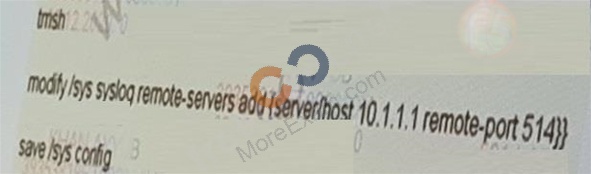
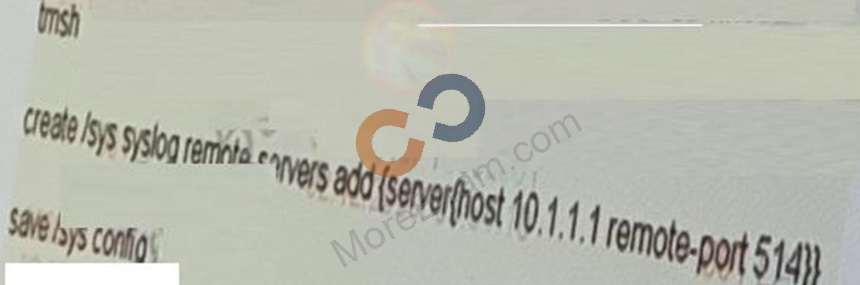
Question12: The network team has recently added a new syslog server with IP address 10.1.1.1.
Which command adds the new syslog entry on the F5 LTM device?
A)

B)

C)

D)

Question13: An application is making heavy use of a large, high-quality JPEG image file. An LTM Specialist needs to enhance page load times without increasing server load.
Which profile should be applied to the virtual server to perform this task?

Question14: Refer to the exhibit.

Which TMSH command generated this output?

Question15: A BIG-IP Administrator is configuring a pool with members who have differing capabilities. Connections to pool members must be load balanced appropriately.
Which load balancing method should the BIG-IP Administrator use?

Question16: An LTM Specialist notices the following error on the stdout console:
mcpd[2395]: 01070608:0: License is not operational(expired or digital signature does not match contents) Which command should be executed to verify the LTM device license?

Question17: An LTM device pool has suddenly been marked down by a monitor. The pool consists of members
10.0.1.1:443 and 10.0.1.2:443 and are verified to be listening. The affected virtual server is 10.0.0.1:80.
Which two tools should the LTM Specialist use to troubleshoot the associated HTTPS pool monitor via the command line interface? (Choose two.)

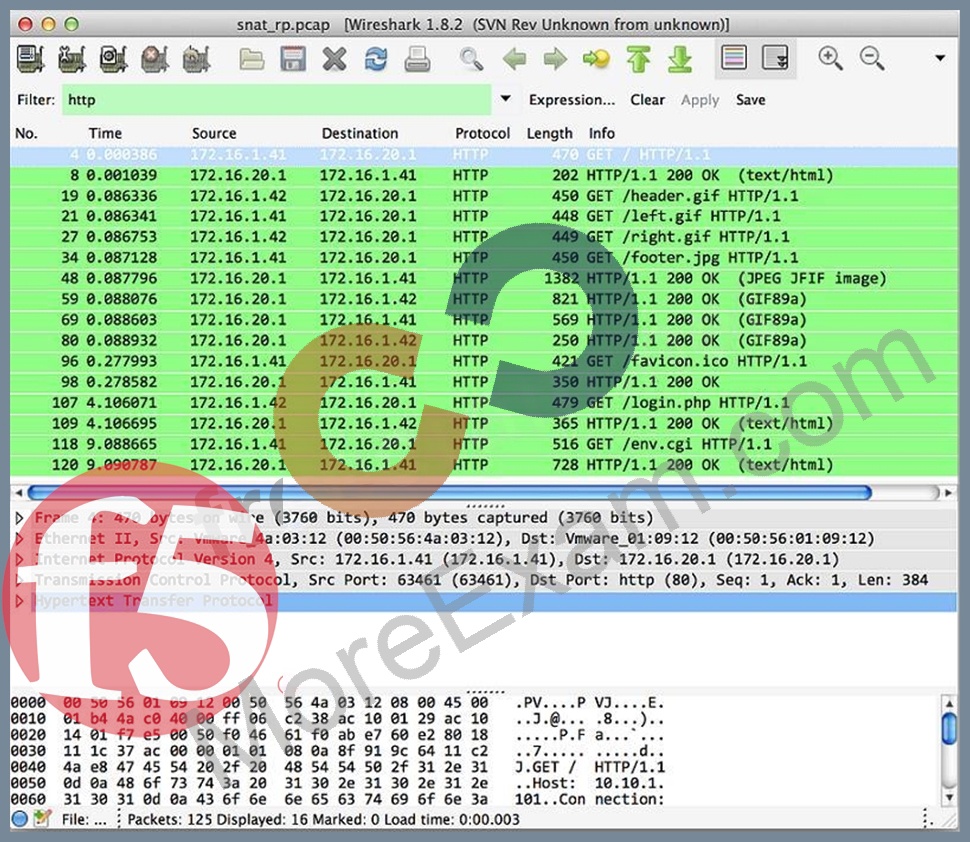
Question18: -- Exhibit -

-- Exhibit --
Refer to the exhibit.
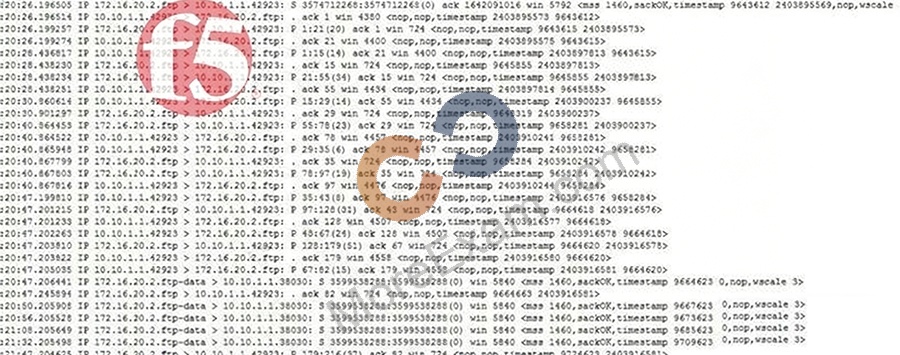
An LTM Specialist is investigating reports that users are unable to perform some commands through an FTP virtual server. The users are receiving the FTP error "500 Illegal PORT command." The virtual server is configured to SNAT using automap. The LTM Specialist performs a capture on the server side of the LTM device.
Why is the server returning this error?

Question19: An application is expected to maintain more than 100,000concurrent TCP connections to a single pool member.
What is an appropriate SNAT configuration in this situation?

Question20: Refer to the exhibit.

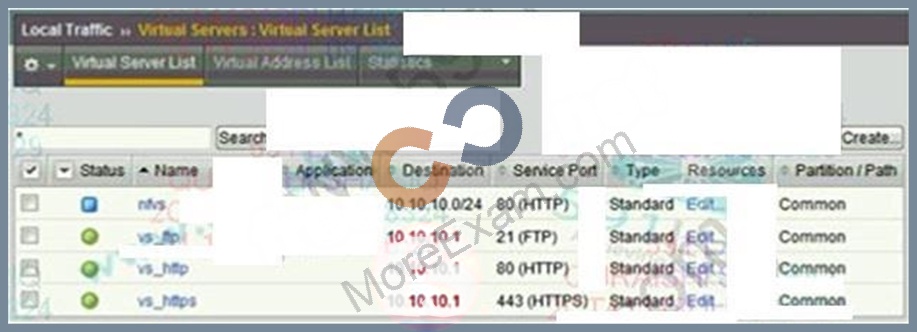
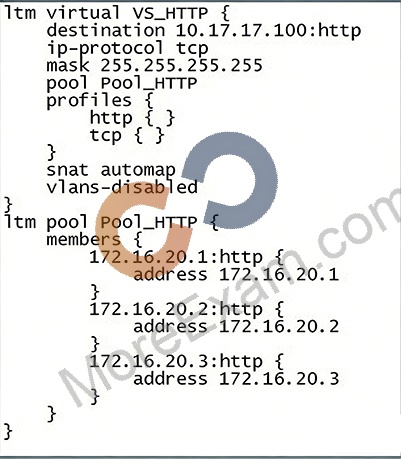
A BIG-IP Administrator configures the Virtual Server to pass HTTP traffic. Users report that they are unable to access the application What should the administrator do to resolve this issue?

Question21: A custom HTTP monitor is failing to a pool member 10.10.3.75:8080 that serves up www.example.com.
A ping works to the pool member address.
The SEND string that the monitor is using is: GET/HTTP/l.l/r/n/Host.www.example.com/r/n/Connection Close/r/n/r/n Which CLI tool syntax will show that the web server returns the correct HTTP response?

Question22: An IT administrator wants to log which server is being load balanced to by a user with IP address 10.10.10.25.
Which iRule should the LTM Specialist use to fulfill the request?

Question23: An LTM device is monitoring three pool members. One pool member is being marked down.
What should the LTM Specialist enable to prevent the server from being flooded with connections once its monitor determines it is up?

Question24: An LTM Specialist connects to an LTM device via the serial console cable and receives unreadable output.
The LTM Specialist is using the appropriate cable and connecting it to the correct serial port.
Which command should the LTM Specialist run through ssh to verify that the baud rate settings for the serial port are correct on the LTM device?

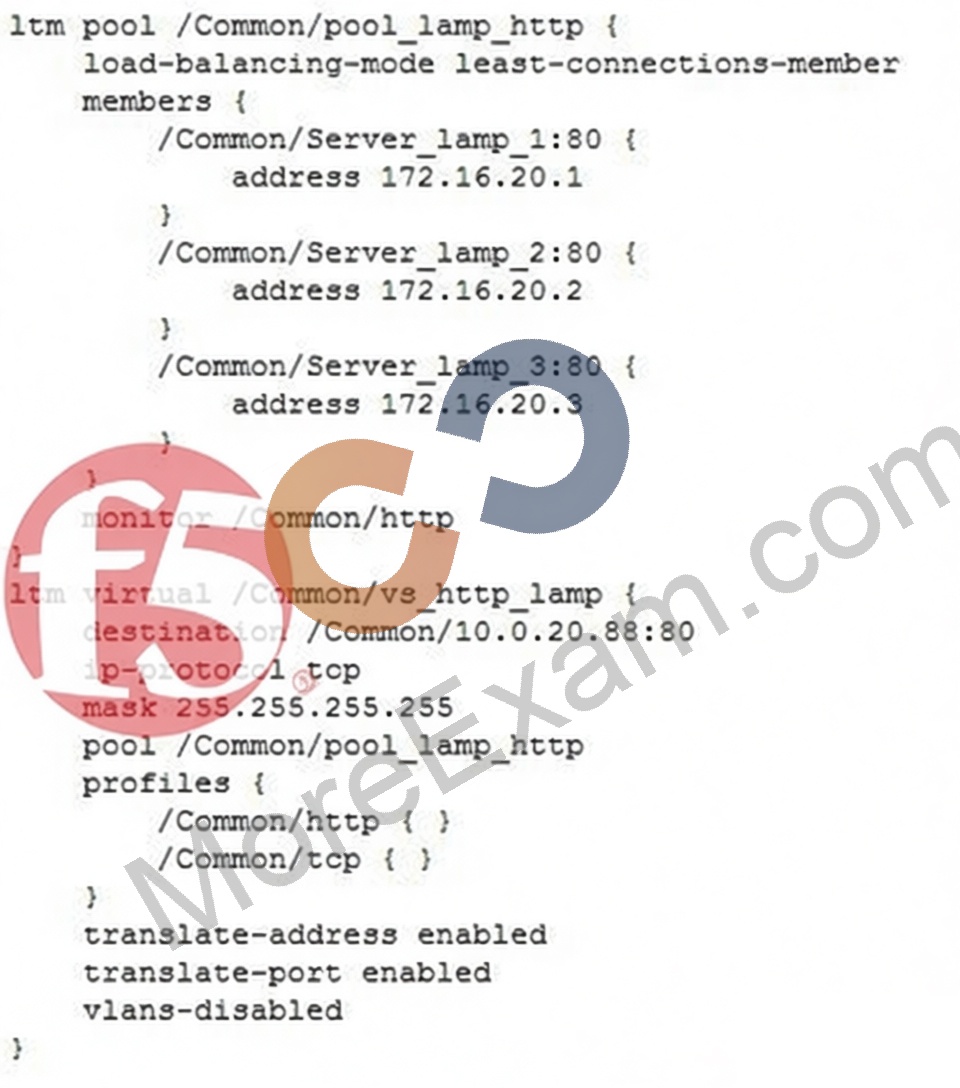
Question25: There are three servers in the pool: 172.16.20.1, 172.16.20.2, and 172.16.20.3, with the virtual IP address
10.0.20.88.
A user CANNOT connect to an HTTP application. To understand the problem and find a solution, the LTM Specialist runs two concurrent traces on the LTM device, with the following results:
Trace on client side:
tcpdump: verbose output suppressed, use -v or -vv for full protocol decode listening on 0.0, link-type EN10MB (Ethernet), capture size 96 bytes
22:22:07.423759 IP 172.16.20.100.53875 > 10.0.20.88.80: S 998346084:998346084(0) win 5840 <mss
1460,sackOK,timestamp 67942058 0,nop,wscale 4>
22:22:07.424056 IP 10.0.20.88.80 > 172.16.20.100.53875: S 4671780:4671780(0) ack 998346085 win 4380
<mss 1460,nop,wscale 0,nop,nop,timestamp 2392362490 67942058,sackOK,eol>
22:22:07.424776 IP 172.16.20.100.53875 > 10.0.20.88.80: . ack 1 win 365 <nop,nop,timestamp 67942058
2392362490>
22:22:07.424790 IP 172.16.20.100.53875 > 10.0.20.88.80: P 1:149(148) ack 1 win 365 <nop,nop,timestamp
67942058 2392362490>
22:22:07.424891 IP 10.0.20.88.80 > 172.16.20.100.53875: . ack 149 win 4528 <nop,nop,timestamp
2392362491 67942058>
22:22:12.024850 IP 10.0.20.88.80 > 172.16.20.100.53875: R 1:1(0) ack 149 win 4528
6 packets captured
6 packets received by filter
0 packets dropped by kernel
Trace on server side:
tcpdump: verbose output suppressed, use -v or -vv for full protocol decode listening on internal, link-type EN10MB (Ethernet), capture size 96 bytes
22:22:07.424881 IP 172.16.20.100.53875 > 172.16.20.2.80: S 51116678:51116678(0) win 4380 <mss
1460,nop,wscale 0,nop,nop,timestamp 2392362491 0,sackOK,eol>
22:22:08.424893 IP 172.16.20.100.53875 > 172.16.20.2.80: S 51116678:51116678(0) win 4380 <mss
1460,nop,wscale 0,nop,nop,timestamp 2392363491 0,sackOK,eol>
22:22:09.625082 IP 172.16.20.100.53875 > 172.16.20.2.80: S 51116678:51116678(0) win 4380 <mss
1460,nop,wscale 0,nop,nop,timestamp 2392364691 0,sackOK,eol>
22:22:10.825194 IP 172.16.20.100.53875 > 172.16.20.2.80: S 51116678:51116678(0) win 4380 <mss
1460,sackOK,eol>
4 packets captured
4 packets received by filter
0 packets dropped by kernel
What should the LTM Specialist do to solve the problem?

Question26: Users are unable to reach an application. The BIG-IP Administrator checks the Configuration Utility and observes that the Virtual Server has a red diamond in front of the status. What is causing this issue?

Question27: The LTM device is configured for RADIUS authentication. Remote logins are failing and the LTM Specialist must verify the RADIUS configuration.
How should the LTM Specialist check the RADIUS server and shared secret configured on the LTM device?

Question28: A high-availability (HA) pair configuration uses only the hardwire serial cable connection to determine device state. A power outage occurs to the PDU powering the active unit. The standby unit takes over the active role as expected.
How is the peer unit able to determine the active unit is unavailable?

Question29: A VCMP guest has the following characteristics:
* Resources allocated for CPU memory, network interfaces, and disk space
* Virtual disk created
* The guest is NOT running
The guest isNOT running in which state is the VCMP guest

Question30: Internet clients connecting to a virtual server to download a file are experiencing about 150 ms of latency and no packet loss.
Which built-in client-side TCP profile provides the highest throughput?

Question31: Given:
Filesystem Size Used Avail Use% Mounted on
/dev/md11 248M 248M 0 100% /
/dev/md13 3.0G 76M 2.8G 3% /config
/dev/md12 1.7G 1.1G 476M 71% /usr
/dev/md14 3.0G 214M 2.6G 8% /var
/dev/md0 30G 2.2G 26G 8% /shared
/dev/md1 6.9G 288M 6.3G 5% /var/log
none 3.9G 452K 3.9G 1% /dev/shm
none 3.9G 19M 3.9G 1% /var/tmstat
none 3.9G 1.2M 3.9G 1% /var/run
prompt 4.0M 12K 4.0M 1% /var/prompt
/dev/md15 12G 8.3G 3.1G 74% /var/lib/mysql
Which command is used to produce this output?

Question32: An LTM Specialist needs to create two virtual servers.
The application has links for both HTTP and HTTPS version of application. The client must be persistence to a pool member, no matter which virtual server isaccessed.
What must be selected in the Source Address Affinity persistence profile?

Question33: -- Exhibit -

-- Exhibit --
Refer to the exhibit.
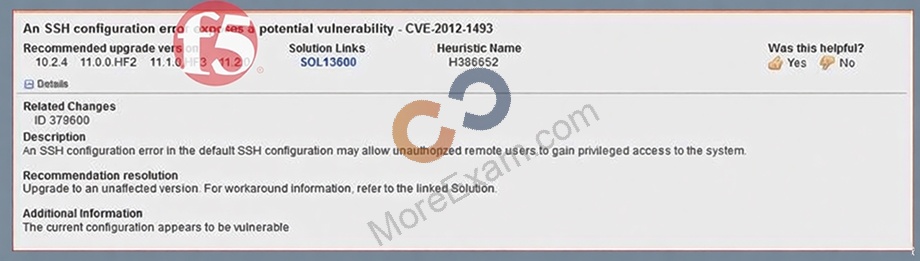
An LTM Specialist is working on an LTM 11.0.0 installation and has identified a security vulnerability as shown in the exhibit. The LTM Specialist is tasked with applying the latest available hotfix to resolve the problem.
Which procedure resolves the problem?

Question34: A BIG-IP Administrator is working with a BIG-IP device and discovers that one of the Interfaces on a Trunk is DOWN.
What is the reason for this Interface status?

Question35: An LTM device provides load balancing to a web application? The LTM device has two dual-core processors and a licensed SSL Transactions Per Second (TPS) limit of 500 CMP is enabled.
TLS connections are used between client systems and virtual servers on the LTM device, as well as from the LTM device to servers used as part of LTM pool.
TLS enabled virtual servers utilize certificates based on 2048-bit keys During a peak period. 2560 new TLStransactions per second are attempted to the web application via the LTM device.
What will happen in this scenario?

Question36: -- Exhibit -

-- Exhibit --
Refer to the exhibit.
A user is unable to access an application.
What is the root cause of the problem?

Question37: Which command line interface command will check if the BIG-IP platform contains a packet velocity ASIC (PVA)?

Question38: -- Exhibit -

-- Exhibit --
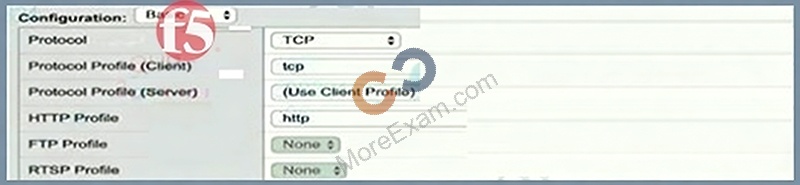
Refer to the exhibit.
An LTM Specialist is troubleshooting an issue with an application configured on an LTM device. The application works properly when accessed directly via the servers; however, it does not work when accessed via the LTM device. The virtual server, 192.168.1.211:443, is configured to SNAT using the address
192.168.1.144 and references a pool with the member 192.168.10.80:443. The virtual server has no Client or Server SSL profiles associated.
Which configuration change will allow the application to function through the virtual server?

Question39: Refer to the exhibit.

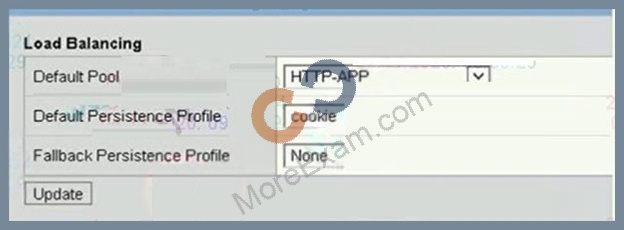
Due to a change in application requirements, a BIG-IP Administrator needs to modify the configuration of a Virtual Server to include a Fallback Persistence Profile.
Which persistence profile type should the BIG-IP Administrator use for this purpose?

Question40: An LTM device is serving an FTP virtual server that has three pool members. The FTP pool members are monitored via TCP port 21. Customers are reporting that they are able to log in, but are sometimes unable to upload files to the server.
Which monitor should the LTM Specialist configure to verify that the servers can handle file uploads?

Question41: An LTM Specialist needs to create a pool with a set of monitor that checks both the pool members and corresponding application service ports. The pool members have services on port 80. The application service is on port 8009.
The LTM device should load balance traffic to the pool member when the pool member and corresponding application service pass monitor.
Which monitor and parameter set meets this requirement?

Question42: An F5 LTM Specialist needs to perform an LTM device configuration backup prior to RMA swap.
Which command should be executed on the command line interface to create a backup?

Question43: Which iRule will instruct the client's browser to avoid caching HTML server responses?

Question44: A BIG-IP Administrator needs to modify a virtual server that web offload web traffic compression tasks from the target server.
Which two profiles must the BIG-IP Administrator apply to a virtual server to enable compression? (Choose two)

Question45: A BIG-IP Administrator wants to add the ASM Module to an HA pair of BIG-IP devices. The BIG-IP Administrator has already installed a new Add-On License on both devices in the HA pair. What should the BIG-IP Administrator do next to use the module?

Question46: An LTM Specialist is troubleshooting an HTTP monitor. The pool member is accessible directly through a browser, but the HTTP monitor is marking the pool member as down.
GET / HTTP/1.1
HTTP/1.1 400 Bad Request
DatE. Tue, 23 Oct 2012 21:39:07 GTM
Server: Apache/2.2.22 (FreeBSD) PHP/5.4.4
mod_ssl/2.2.22 OpenSSL/0.9.8q DAV/2
Content-LengtH. 226
Connection: close
Content-TypE. text/html; charset=iso-8859-1
How should the LTM Specialist resolve this issue?

Question47: set payload {CACHE :: payload}
}
Which two profiles should be used on the virtual server? (Choose two.)

Question48: An LTM device is configure with the wildcard virtual servers displayed below.
A client connection is made to 172.24.31.14:443.

Question49: An LTM device has been configured to log the reasons for generating TCP RST packets.
The following log entry occurs:
"01230140:3: RST sent from 192.168.1.100:80 to 192.168.1.124:39272, [0x112d82a:1721] {peer} TCP RST from remote system." Which condition will trigger this log entry?

Question50: On the VCMP system, a BIG-IP host administrator imports a new ISO image into the host's /shared/images folder. The new ISO images that reside on the vCMP host are available for installation on the guest. How should the BIG-IP Administrator install one image from within the guest?

Question51: A pool with a default connection limit is configured to use Round Robin as the load balancing method. An LTM Specialist needs to ensure that the LTM device selects a serverwith the fewest number of connections when new clients connect. Another pool is using the same set of backend servers.
Which load balancing-method should the pool be changed to?

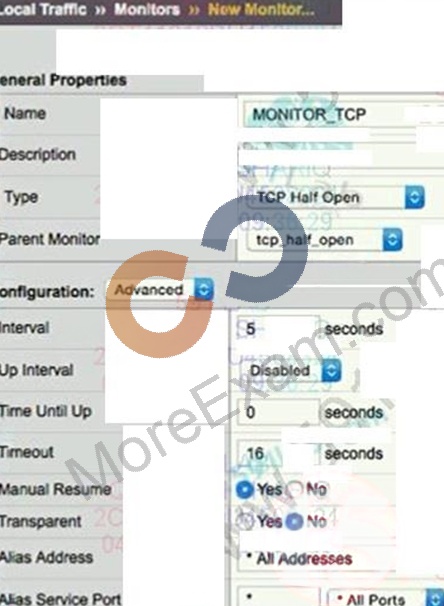
Question52: -- Exhibit -

-- Exhibit --
Refer to the exhibit.
An LTM Specialist is troubleshooting a virtual server. Both the virtual server and the pool are showing blue squares for their statuses, and new clients report receiving "The connection was reset" through their browsers.
Connections directly to the pool member are successful.
What is the issue?

Question53: An LTM Specialist needs to rewrite text within an HTML response from a web server. A client is sending the HTTP request below:
GET / HTTP/1.1
Host: www.f5.com
User-Agent: Mozilla/5.0 (Windows NT 6.1; WOW64; rv:16.0) Gecko/20100101 Firefox/16.0 Accept: text/html,application/xhtml+xml,application/xml;q=0.9,*/*;q=0.8 Accept-LanguagE. en-US,en;q=0.5 Accept-EncodinG. gzip, deflate Cache-Control: no-cache Connection: keep-alive CookiE. somecookie=1 Although a stream profile has been added to the virtual server, the content within the HTTP response is NOT being matched, and therefore NOT modified.
Which HTTP header should the LTM Specialist remove from the request to ensure the content can be matched and modified?

Question54: A BIG-IP Administrator runs the initial configuration wizard and learns that the NTP servers were invalid. In which area of the Configuration Utility should the BIG-IP Administrator update the list of configured NTP servers?

Question55: -- Exhibit -

-- Exhibit --
Refer to the exhibit.
A pair of LTM devices is configured for HA.
What happens if the pool member server with IP address 10.0.0.4 becomes totally unresponsive to the active LTM device, but is still responsive to the standby LTM device?

Question56: A BIG-IP Administrator finds the following log entry:
tnm tmm[7141]: 011e0002:4: sweeperjjpdate: aggressive mode activated.
Which action should the BIG-IP Administrator to mitigate this memory issue?

Question57: The BIG-IP Administrator disable all pool members in a pool Users are still able to reach the pool members.
What is allowing users to continue to reach the disabled poo! members?

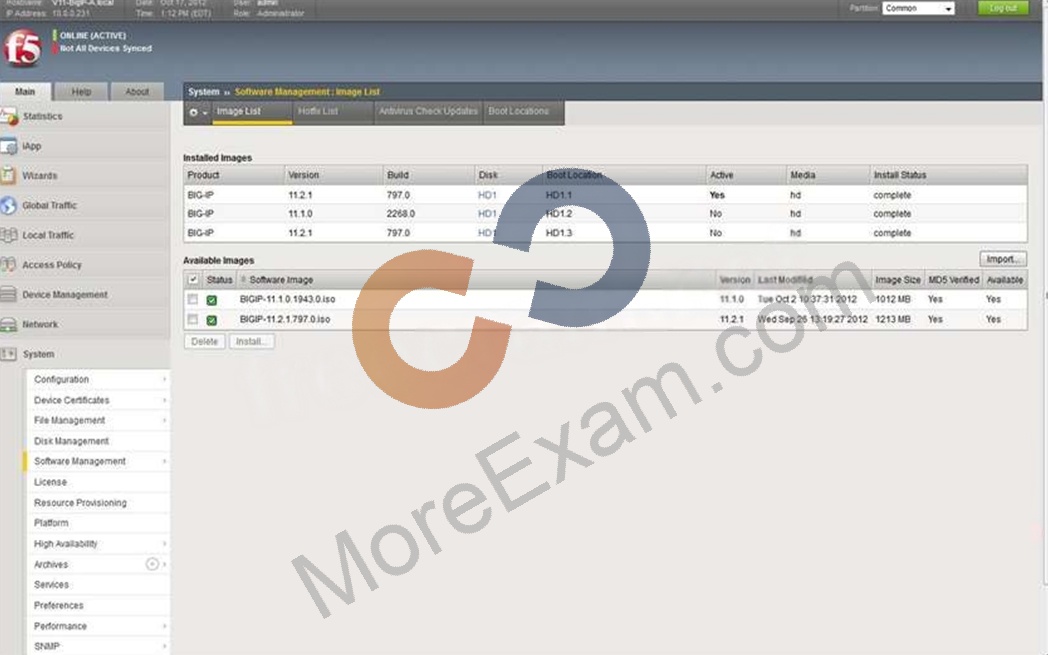
Question58: -- Exhibit -

-- Exhibit --
Refer to the exhibit.
Which step should an LTM Specialist take next to finish upgrading to HD1.3?

Question59: A design requires the LTM device to become HA standby when the one of the two physical interface on the External trunk is down the Externaltrunk is an interface on the External VLAN Which TMOS command enables this behavior?

Question60: -- Exhibit -


-- Exhibit --
Refer to the exhibits.
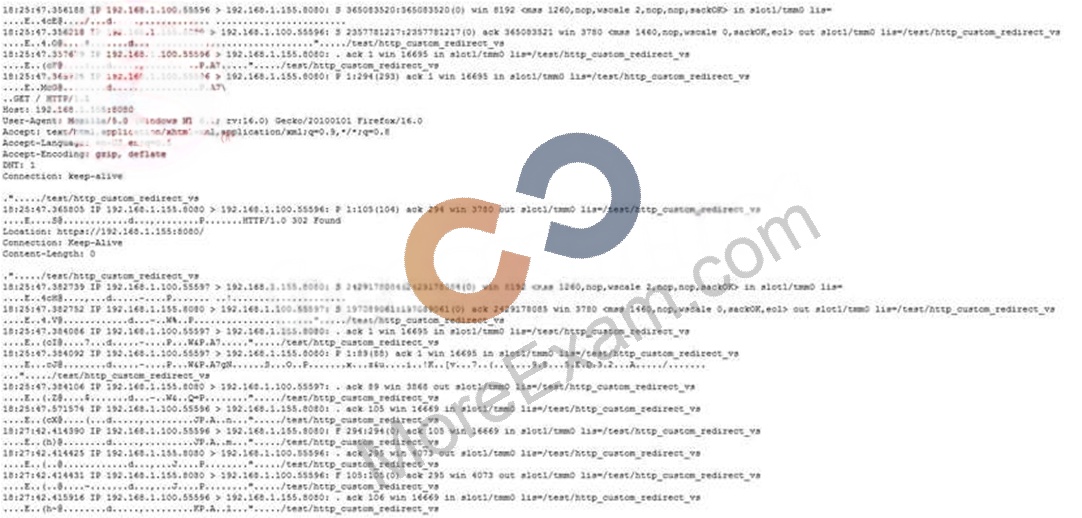
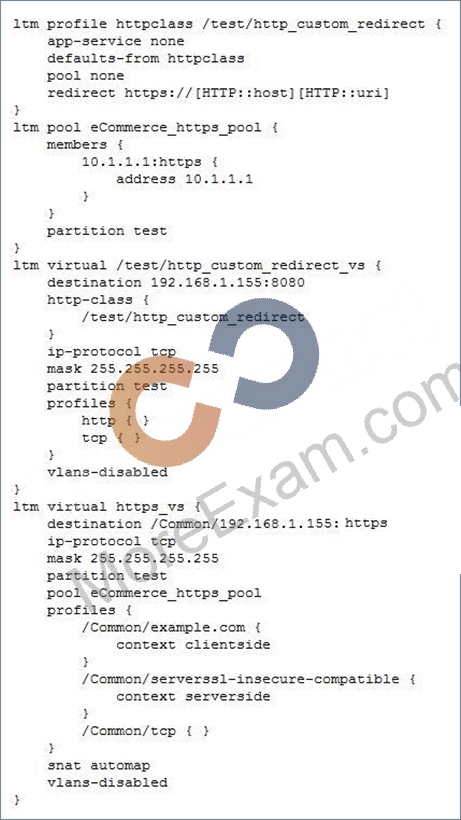
An LTM Specialist is reconfiguring a virtual server to redirect all clients to HTTPS. Testing reveals that the redirect is functioning incorrectly. As part of the troubleshooting process, the LTM Specialist performs a packet capture.
What is the issue?

Question61: A BIG-IP Administrator uses a device group to share the workload and needs to perform service on a BIG-IP device currently active for a traffic group. The administrator needs to enable the traffic group to run on another BIG-IP device in the device group. What should the administrator do to meet the requirement?

Question62: Which three HTTP headers allow an application server to determine the client's language compatibility, browser, operating system type, and compression compatibility? (Choose three.)

Question63: How should a BIG-IP Administrator control the amount of traffic that a newly enabled pool member receives.

Question64: A BIG-IP Administrator makes a configuration change to a Virtual Server on the Standby device of an HA pair. The HA pair is currently configured with Auto-Sync Enabled. What effect will the change have on the HA pair configuration?

Question65: -- Exhibit -

-- Exhibit --
Refer to the exhibit.
Which profile could be removed or changed on this virtual server to reduce CPU load on the LTM device without increasing server side bandwidth usage?

Question66: A BIG-IP Administrator makes a configuration change to the BIG-IP device. Which file logs the message regarding the configuration change?

Question67: An LTM Specialist needs to apply SNAT using currently used SNAT pool to a new virtual server.
What needs to be completed before applying that configuration change?

Question68: Refer to the exhibit.


A BIG-IP Administrator creates a new Virtual Server to load balance SSH traffic. Users are unable to log on to the servers.
What should the BIG-IP Administrator do to resolve the issue?

Question69: A customer needs to intercept all of the redirects its application is sending to clients. When a redirect is matched, the customer needs to log a message including the client IP address.
Which iRule should be used?

Question70: What is the correct command to reset an LTM device to its default settings?
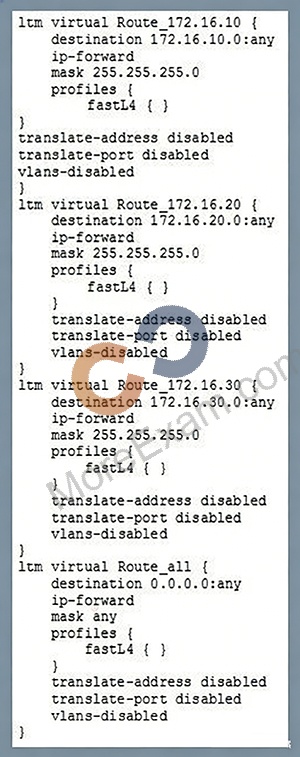
Question71: -- Exhibit -


-- Exhibit --
Refer to the exhibits.
An LTM device has been configured for load balancing a number of different application servers.
Configuration changes need to be made to the LTM device to allow administrative management of the servers in 172.16.10/24, 172.16.20/24, and 172.16.30/24 networks. The servers require outbound access to numerous destinations for operations.
Which solution has the simplest configuration changes while maintaining functionality and basic security?

Question72: -- Exhibit -

-- Exhibit --
Refer to the exhibit.
A user is unable to access a secure application via a virtual server.
What is the cause of the issue?

Question73: To increase available bandwidth of an existing Trunk, the BIG-IP Administrator is adding additional interfaces.
Which command should the BIG-IP Administrator run from within bosh shell?

Question74: Which iRule statement demotes a virtual server from CMP?

Question75: An LTM device is deployed in a one-armed topology. The virtual server, clients, and web servers are connected on the LTM device internal VLAN. A client tries to connect to the virtual server and is unable to establish a connection. A packet capture from the LTM device internal VLAN shows that the HTTP request is being forwarded to the web server.
From which two additional locations should protocol analyzer data be collected? (Choose two.)

Question76: Refer to the exhibit.

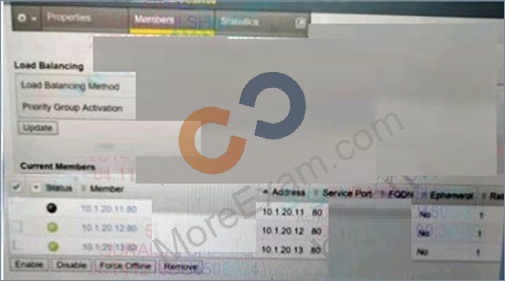
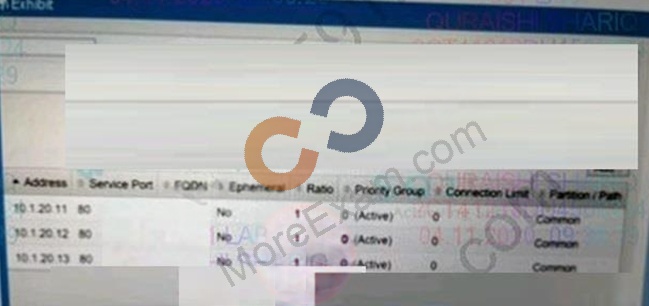
Which two pool members are eligible to receive new connections? (Choose two)

Question77: An LTM Specialist has a single HTTPS virtual server doing SSL termination. No server SSL profile is defined. The pool members are on the internal VLAN answering on HTTP port 80. Users with certain browsers are experiencing issues.
Which two locations are most appropriate to gather packets needed to determine the SSL issue? (Choose two.)

Question78: Refer to the exhibit.

According to the shown Configuration Utility stings What is the setting of the User Directory configuration under the Authentication submenu?

Question79: -- Exhibit -


-- Exhibit --
Refer to the exhibits.
Which two servers are missing two frequently used URLs? (Choose two.)

Question80: -- Exhibit -

-- Exhibit --
Refer to the exhibit.
The decoded TCPDump capture is a trace of a failing health monitor. The health monitor is sending the string shown in the capture; however, the server response is NOT as expected. The receive string is set to 'SERVER IS UP'.
What is the solution?

Question81: An LTM Specialist upgrades the switchinginfrastructure and the backend servers on the LAN segments.
The LTM Specialist notices a 20% memory usage increase on the BIG-IP device while handling the same number of concurrent connections.
A comparison of statistics pre-upgrade and post-upgrade showsa significant reduction on the following:
-RTT between the BIG-IP device and the backend servers
-Packet drops in the switch
Time to First Byte (TTFB)
The LTM Specialist is concerned with the scalability of the number of concurrent connections with the newmemory usage.
Which setting should be changed to reduce the memory usage on the BIG-IP device?

Question82: A 816-IP Administrator recently deployed an application Users are experiencing slow performance with the application on some remote networks.
Which two modifications can the BIG-IP Administrator make to address this issue? (Choose two)

Question83: An LTM device is load balancing SIP traffic. An LTM Specialist notices that sometimes the SIP request is being load balanced to the same server as the initial connection.
Which setting in the UDP profile will make the LTM device more evenly distribute the SIP traffic?

Question84: Refer to the exhibit.


During maintenance, the BIG-IP Administrator manually disables a pool member as shown.
What is the result?

Question85: What should the BIG-IP Administrator do to apply and activate a hotfix to a BIG-IP device that is currently running version 11.0.0 on active partition HD1.1?

Question86: The picture belongs to static content, you can configure static content cache in FS to meet this demand An LTM Specialist must configure session persistence for a highly available, highly utilized web-based application.
* The following requirements are provided:
* http proxy setup for security
persistence information available to the HA peer in case of failover
The LTM Specialist needs to minimize additional burden on the LTM device to the greatest extent possible.
Which persistence profile should be used?

Question87: Which command should an LTM Specialist use on the command line interface to show the health of RAID array hard drives?

Question88: -- Exhibit -

-- Exhibit --
Refer to the exhibit.
An LTM Specialist is investigating intermittent page load issues being reported by users.
What should the LTM Specialist do to resolve the issue?

Question89: A web application requires knowledge of the client's true IP address for logging and analysis purposes.
Instances of the application that can decode X-Forwarded-For HTTP headers reside in pool_a, while pool_b instances assume the source IP is the true address of the client.
Which iRule provides the proper functionality?

Question90: Which iRule will reject any connection originating from a 10.0.0.0/8 network?

Question91: A BIG-IP Administrator plans to upgrade a BIG-IP device to the latest TMOS version.
Which two tools could the administrator leverage to verify known issues for the target versions?
(Choose two.)

Question92: Where does a LTM Specialist view all of the objects that are part of a deployed iApp?

Question93: An LTM HTTP pool has an associated monitor that sends a string equal to 'GET /test.html'.
Which two configurations could an LTM Specialist implement to allow server administrators to disable their pool member servers without logging into the LTM device? (Choose two.)

Question94: A virtual server with SNAT automap enabled selects pool member 10.20.0.10.443 for the server-side flow.
The client side flow source IP is 192.168.0.10 .

Which source IP should be expected inthe server-side connection?

Question95: A BIG-IP Administrator is creating a new Trunk on the BIG-IP device. What objects should be added to the new Trunk being created?

Question96: -- Exhibit -

-- Exhibit --
Refer to the exhibit.
An LTM Specialist has a virtual server set up on the LTM device as per the exhibit. The LTM Specialist receives reports of intermittent issues. Some clients are connecting fine while others are failing to connect.
The LTM Specialist does a tcpdump on the relevant interfaces, with the following results extracted:
What is causing the intermittent issues?

Question97: An application is being load balanced through the LTM device using the configuration displayed below.
The network has been re-engineered to NAT all client connection. As a result, allclient connections are hitting the same pool member.


Which changes should the LTM Specialist make in order to restore load balancing functionality wile maintaining session persistence?

Question98: Which method is recommended for creating a new user from the CLI?
Question99: A LTM device needs to load balance active and passive FTP traffic while using only a single virtual server.
Which virtual server type should an LTM Specialist configure on the LTM device?

Question100: A virtual server is configured to offload SSL from a pool of backend servers. When users connect to the virtual server, they successfully establish an SSL connection but no content is displayed. A packet trace performed on the server shows that the server receives and responds to the request. What should a BIG-IP Administrator do to resolve the problem?

Question101: -- Exhibit -

-- Exhibit --
Refer to the exhibit.
An LTM Specialist has uploaded a qkview to F5 iHealth.
Within the GUI, what is the correct procedure to comply with the recommendation shown in the exhibit?

Question102: A web application requires the client to provide the destination server and service identification.
Which HTTP header will supply this information?

Question103: An LTM Specialist is running the following packet capture on an LTM device:
ssldump -Aed -ni vlan301 'port 443'
Which two SSL record message details will the ssldump utility display by default? (Choose two.)

Question104: Given the iRule:
when HTTP_REQUEST {
if {([HTTP::username] ne "") and ([HTTP::password] ne "") } {
log local0. "client ip [IP::remote_addr] credentials provided [HTTP::username] [HTTP::password]"} else { pool old_application_pool
}
}
The associated virtual server has a default pool named new_application_pool.
Which functionality does the iRule provide?

Question105: Refer to the exhibit. The BIG-IP Administrator needs to avoid overloading any of the Pool Members with connections, when they become active.
What should the BIG-IP Administrator configure to meet this requirement?

Question106: A BIG-IP Administrator contacts F5 Support, which identifies a suspected hardware failure. Which information should the BIG-IP Administrator provide to F5 Support?

Question107: An LTM Specialist needs to add a pool that will load balanceMYSOL services. It has four members, each with differing hardware platforms. All pool members are already assigned to another pool for load balancing FTP traffic.
Which load balancing method is most effective when the LTM Specialist sets up the pool?

Question108: An LTM Specialist has just captured trace /var/tmp/trace.cap for site www.example.com while listening on virtual address 10.0.0.1:443 configured on partition ApplicationA. The data payload being captured is SSL encrypted.
Which command should the LTM Specialist execute to decrypt the data payload?

Question109: Refer to the exhibit


The network team creates a new VLAN on the switches. The BIG-IP Administrator needs to create a configuration on the BIG-IP device. The BIG-IP Administrator creates a new VLAN and Self IP, but the servers on the new VLAN are NOT reachable from the BIG-IP device.
Which action should the BIG-IP Administrators to resolve this issue?

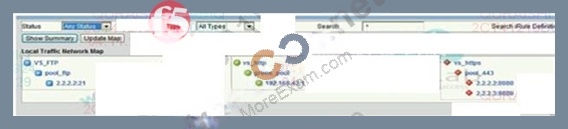
Question110: Refer to the exhibit.

How many nodes are represented on the network map shown?

Question111: A client (10.10.1.30) connecting to an HTTPS virtual server (10.10.1.100) with a clientssl profile is getting an SSL error.
Which options will trace this issue?

Question112: An LTM Specialist configured a virtual server to load balance a custom application. The application works when it is tested from within the firewall but it fails when tested externally. The pool member address is
192.168.200.10:80. A capture from an external client shows:
GET /index.jsp HTTP/1.1
Host: 207.206.201.100
User-Agent: Mozilla/5.0 (Windows NT 6.1; WOW64; rv:15.0) Gecko/20100101 Firefox/15.0.1 Accept: text/html,application/xhtml+xml,application/xml;q=0.9,*/*;q=0.8 Connection: keep-alive HTTP/1.1 302 Found DatE. Wed, 17 Oct 2012 23:09:55 GMT Server: Apache/2.2.15 (CentOS) Location:
http://192.168.200.10/user/home.jsp
Content-LengtH. 304
Connection: close
What is the solution to this issue?

Question113: A virtual server is using a TCP profile based on thetop-wan-optimized profile for a streaming application Users report videos are loading slowly.
Which setting should be modified in the TCP profile to optimize the application?

Question114: An LTM Specialist loads a UCS file generated on a different LTM device and receives the following error message:
"mcpd[2395]: 01070608:0: License is not operational (expired or digital signature does not match contents)" Which command should the LTM Specialist use to prevent the error?

Question115: A BIG-IP Administrator configures a Virtual Server. Users report that they always receive a TCP RST packet to the BIG-IP system when attempting to connect to it. What is the possible reason for this issue?

Question116: A BIG-IP Administrator opens a case with F5 Support. The support engineer requests the BIG-IP appliance chassis serial number.
Which TMSH command will provide this information?

Question117: Exhibit.

- The ITM devices LTM 1 and LTM2 are configured in Device Group X (Sync-Failover)
- LTM3 and LTM4 are configured in Device Group Y (Sync-Only)
- An LTM specialist configures Device Group Z (Sync-Only) to keep several profiles in (sync-Only) to keep several profiles in sync across all devices.
- Device GROUP X has four Traffic Groups A.B.C and D configured.
- Device Group Y has four Traffic Groups E, F, G, and H configured
- Auto Fallback IS NOT Enabled.
- Each Device group is healthy and able to pass traffic for any traffic groupassigned to that Device Group.
The data center that contains LTM2 and LTM4 loses power. After 10 minutes; power is restored and all devices are up and healthy.
What is the state of each Traffic Group on each ITM device after power is restored?
A)

B)

C)

D)

Question118: An LTM Specialist is troubleshooting virtual server 10.0.0.1:443 residing on VLAN vlan301. The web application is accessed via www.example.com. The LTM Specialist wants to save a packet capture with complete decrypted payload for external analysis.
Which command should the LTM Specialist execute on the LTM device command line interface?

Question119: An LTM Specialist needs to configure asetup for antivirus scanning of HTTP traffic with an internet Contact adaption Protocol (ICAP) server.
Which two server type should be used? (Choose two.)

Question120: A Web Server Administrator uses a manual process to display a page when the service is down.
Which feature on the LTM device should be used to automate the service down page? :

Question121: -- Exhibit -

-- Exhibit --
Refer to the exhibits.
An LTM Specialist configures a virtual server for an internal application to perform client-side encryption while allowing the server-side traffic to be unencrypted. Application users report that images are NOT loading through the virtual server; however, images load when going directly to the server.
What should the LTM Specialist configure to allow the images to load through the virtual server?

Question122: Which file should the BIG-IP Administrator check to determine when a Virtual Server changed its status

Question123: Remote users who access the LTM device are authenticated via Radius. The default remote user role is Guest Some users need LTM device with the Administrator role. The F5 Radius attributes are configure on the Radius server.
Which configuration item needs to be created?

Question124: An LTM Specialist has noticed in the audit log that there are numerous attempts to loginto the Admin account.
Theses attempts are sourced from a suspicious IP address range to the Configuration Utility of the LTM device.
How should the LTM Specialist block these attempts?

Question125: An application owner claims an LTM device is delaying delivery of an HTTP application. The LTM device has two VLANs, an internal and an external. The application servers reside on the internal VLAN. The virtual server and clients reside on the external VLAN.
With appropriate filters applied, which solution is most efficient for obtaining packet captures in order to investigate the claim of delayed delivery?

Question126: A Standard Virtual Server configured for an application reports poor network performance. This application is accessed mainly from computers on the Internet.
What should the BIG-IP Administrator configure on the Virtual Server to achieve better network performance?

Question127: A BIG-IP Administrator finds the following log entry after a report of user issues connecting to a virtual server:
01010201: 2: Inet port exhaustion on 10.70.110.112 to 192.28.123.250:80 (proto 6) How should the BIG-IP Administrator modify the SNAT pool that is associated with the virtual server?

Question128: A Virtual Server uses an iRule to send traffic to pool members depending on the URI. The BIG-IP Administrator needs to modify the pool member in the iRule.
Which event declaration does the BIG-IP Administrator need to change to accomplish this?

Question129: An LTM Specialist has been asked to configure a virtual server to distribute connections between a pool of two application servers with addresses 172.16.20.1 and 172.16.20.2. The application servers are listening on TCP ports 80 and 443. The application administrators have asked that clients be directed to the same node for both HTTP and HTTPS requests within the same session.
Virtual servers vs_http and vs_https have been created, listening on 1.2.3.100:80 and 1.2.3.100:443, respectively.
Which configuration option will result in the desired behavior?

Question130: The BIG-IP Administrator creates a custom iRule that fails to work as expected. Which F5 online resource should the administrator use to help resolve this issue?

Question131: An LTM Specialist has detected that a brute force login attack is occurring against the SSH service via a BIG-IP management interface. Login attempts are occurring from many IPs within the internal company network. BIG-IP SSH access restrictions are in place as follows:

The LTM Specialist has determined that SSH access should only occur from the 192.168.1.0/24 and
172.16.254.0/23 networks.
Whichtmsh command should the LTM Specialist use to permit access from the desired networks only?

Question132: In preparation for a maintenance task, an LTM Specialist performs a "Force to Standby" on LTM device Unit
1. LTM device Unit 2 becomes active as expected. The maintenance task requires the reboot of Unit 1. Shortly after the reboot is complete, the LTM Specialist discovers that Unit 1 has become active and Unit 2 has returned to standby.
What would cause this behavior?

Question133: -- Exhibit -

-- Exhibit --
Refer to the exhibit.
An LTM Specialist is investigating reports that users are unable to perform some commands through an FTP virtual server. The LTM Specialist performs a capture on the server side of the LTM device.
What is the issue with the application?

Question134: An LTM device receives a response string containing "error"
Which monitor type and parameter will mark the HTTP server as down?

Question135: During a maintenance window, an EUD test was executed and the output displayed on the screen. The BIG-IP Administrator did NOT save the screen output. The BIG-IP device is currently handling business critical traffic. The BIG-IP Administrator needs to minimize impact. What should the BIG-IP Administrator do to provide the EUD results to F5 Support?

Question136: -- Exhibit -


-- Exhibit --
Refer to the exhibits.
A virtual server has been configured for SSL offload on a single-arm network. On average, the virtual server will be handling 100,000 connections, with a peak of 130,000 connections. Between the virtual server and the web servers there is a single reverse proxy to provide site caching. The proxy is configured to perform source IP persistence before contacting the web servers. The site is logging users out immediately after logging them in.
What should the LTM Specialist do to resolve this issue?

Question137: A client is attempting to log in to a web application that requires authentication. The following HTTP headers are sent by the client:
GET /owa/ HTTP/1.1
Authorization: Basic dXNlcm5hbWU6cGFzc3dvcmQ=
User-Agent: curl/7.26.0
Host: 10.0.0.14
Accept: */*
Accept-EncodinG. gzip,deflate
The web server is responding with the following HTTP headers:
HTTP/1.1 401 Unauthorized
Content-TypE. text/html
Server: Microsoft-IIS/7.5
WWW-AuthenticatE. NTLM
DatE. Wed, 16 Aug 1977 19:12:31 GMT
Content-LengtH. 1293
The client has checked the login credentials and believes the correct details are being entered.
What is the reason the destination web server is sending an HTTP 401 response?

Question138: -- Exhibit --

-- Exhibit --
Refer to the exhibit.
A company uses a complex piece of client software that connects to one or more virtual servers (VS) hosted on an LTM device. The client software is experiencing issues. An LTM Specialist must determine the cause of the problem.
The LTM Specialist is seeing a client source IP of 168.210.232.5 in the tcpdump. However, the client source IP is actually 10.123.17.12.
Why does the IP address of 10.123.17.12 fail to appear in the tcpdump?

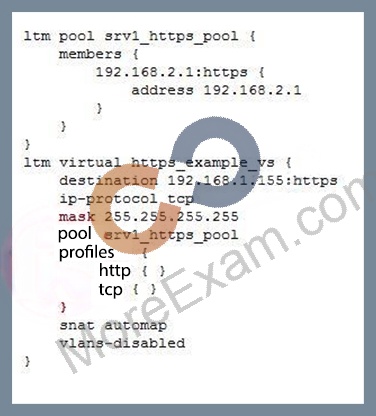
Question139: An LTM Specialist is troubleshooting an issue with a new virtual server. When connecting through the virtual server, clients receive the message "The connection was reset" in the browser, although connections directly to the pool member show the application is functioning correctly.
ltm pool srv1_https_pool {
members {
192.168.2.1:https{
address 192.168.2.1
}
}
}
ltm virtual https_example_vs {
destination 192.168.1.155:https
ip-protocol tcp
mask 255.255.255.255
pool srv1_https_pool
profiles {
http { }
tcp { }
}
snat automap
vlans-disabled
}
How should the LTM Specialist resolve this issue?

Question140: A BIG-IP Administrator needs to install a HotFix on a standalone BIG-IP device, which has HD1.1 as the Active Boot Location. The BIG-IP Administrator has already re-activated the license and created an UCS archive of the configuration. In which sequence should the BIG-IP Administrator perform the remaining steps?

Question141: An LTM device has a virtual server configured as a Performance Layer 4 virtual listening on 0.0.0.0:0 to perform routing of packets to an upstream router. The client machine at IP address 192.168.0.4 is attempting to contact a host upstream of the LTM device on IP address 10.0.0.99.
The network flow is asymmetrical, and the following TCP capture displays:
# tcpdump -nnni 0.0 'host 192.168.0.4 and host 10.0.0.99'
tcpdump: verbose output suppressed, use -v or -vv for full protocol decode listening on 0.0, link-type EN10MB (Ethernet), capture size 96 bytes
05:07:55.499954 IP 192.168.0.4.35345 > 10.0.0.99.443: S 3205656213:3205656213(0) ack 3267995082 win
1480
05:07:55.499983 IP 10.0.0.99.443 > 192.168.0.4.35345: R 1:1(0) ack 1 win 0
05:07:56.499960 IP 192.168.0.4.35345 > 10.0.0.99.443: S 3205656213:3205656213(0) ack 3267995082 win
1480
05:07:56.499990 IP 10.0.0.99.443 > 192.168.0.4.35345: R 1:1(0) ack 1 win 0
4 packets captured
Which option within the fastL4 profile needs to be enabled by the LTM Specialist to prevent the LTM device from rejecting the flow?

Question142: Refer to the exhibit.

A pool is contoured with four members. A user has a currentconnection established with 10.18.1.40. The virtual server has a persistence Profile configured.

Question143: A BIG-IP Administrator needs to find which modules have been licensed for use on the BIG-IP system. In which section of the Configuration Utility can the BIG-IP Administrator find this information?

Question144: -- Exhibit -

-- Exhibit --
Refer to the exhibit.
An LTM Specialist configures a virtual server to load balance to a pool of FTP servers. File transfers are failing. The virtual server is configured as follows:
ltm virtual ftp_vs {
destination 10.10.1.103:ftp
ip-protocol tcp
mask 255.255.255.255
pool ftp_pool
profiles {
tcp { }
}
vlans-disabled
}
Which change will resolve the problem?

Question145: An LTM Specialist needs to gather website statistics such as latency and throughput on the existing virtual server. This virtual server loadBalances the backend web servers.
Which F5 feature will provide this?

Question146: Users report that traffic is negatively affected every time a BIG-IP device fails over. The traffic becomes stabilized after a few minutes.
What should the BIG-IP Administrator do to reduce the impact of future failovers?

Question147: To improve application security, an LTM Specialist must configure a BIG application access. The BIG IPsystem to authenticate the client certificate before permitting application access. The BIG-IP system must also support the ability to red to redirect users to a certificate enrolment system without generating a browser error.
Within the Client SSL profile, which value should the LTM Specialist select for the Client Certificate option?

Question148: The LTM device is configured to provide load balancing to a set of web servers that implement access control lists (ACL) based on the source IP address of the client. The ACL is at the network level and the web server is configured to send a TCP reset back to the client if it is NOT permitted to connect.
The virtual server is configured with the default OneConnect profile.
The ACL is defined on the web server as:
Permit: 192.168.136.0/24
Deny: 192.168.116.0/24
The packet capture is taken of two individual client flows to a virtual server with IP address 192.168.136.100.
Client A - Src IP 192.168.136.1 - Virtual Server 192.168.136.100:
Clientside:
09:35:11.073623 IP 192.168.136.1.55684 > 192.168.136.100.80: S 869998901:869998901(0) win 8192 <mss
1460,nop,wscale 2,nop,nop,sackOK>
09:35:11.073931 IP 192.168.136.100.80 > 192.168.136.1.55684: S 2273668949:2273668949(0) ack
869998902 win 4380 <mss 1460,nop,wscale 0,sackOK,eol>
09:35:11.074928 IP 192.168.136.1.55684 > 192.168.136.100.80: . ack 1 win 16425
09:35:11.080936 IP 192.168.136.1.55684 > 192.168.136.100.80: P 1:299(298) ack 1 win 16425
09:35:11.081029 IP 192.168.136.100.80 > 192.168.136.1.55684: . ack 299 win 4678 Serverside:
09:35:11.081022 IP 192.168.136.1.55684 > 192.168.116.128.80: S 685865802:685865802(0) win 4380 <mss
1460,nop,wscale 0,sackOK,eol>
09:35:11.081928 IP 192.168.116.128.80 > 192.168.136.1.55684: S 4193259095:4193259095(0) ack
685865803 win 5840 <mss 1460,nop,nop,sackOK,nop,wscale 6>
09:35:11.081943 IP 192.168.136.1.55684 > 192.168.116.128.80: . ack 1 win 4380
09:35:11.081955 IP 192.168.136.1.55684 > 192.168.116.128.80: P 1:299(298) ack 1 win 4380
09:35:11.083765 IP 192.168.116.128.80 > 192.168.136.1.55684: . ack 299 win 108 Client B - Src IP 192.168.116.1 - Virtual Server 192.168.136.100:
Clientside:
09:36:11.244040 IP 192.168.116.1.55769 > 192.168.136.100.80: S 3320618938:3320618938(0) win 8192
<mss 1460,nop,wscale 2,nop,nop,sackOK>
09:36:11.244152 IP 192.168.136.100.80 > 192.168.116.1.55769: S 3878120666:3878120666(0) ack
3320618939 win 4380 <mss 1460,nop,wscale 0,sackOK,eol>
09:36:11.244839 IP 192.168.116.1.55769 > 192.168.136.100.80: . ack 1 win 16425
09:36:11.245830 IP 192.168.116.1.55769 > 192.168.136.100.80: P 1:299(298) ack 1 win 16425
09:36:11.245922 IP 192.168.136.100.80 > 192.168.116.1.55769: . ack 299 win 4678 Serverside:
09:36:11.245940 IP 192.168.136.1.55684 > 192.168.116.128.80: P 599:897(298) ack 4525 win 8904
09:36:11.247847 IP 192.168.116.128.80 > 192.168.136.1.55684: P 4525:5001(476) ack 897 win 142 Why was the second client flow permitted by the web server?

Question149: An LTM device load balances a pool of routers. The LTM device needs to verify pathavailability to an HTTP server with the IP address 192 168.10 10. located beyond the routers.
Which monitor type and parameters arc required?

Question150: Refer to the exhibit.

Why is the virtual server responsive to incoming connections?

Question151: An LTM Specialist creates an Analytics wide to show the type of browsers used to access a certain application. However, the generated statistics only sum up all transaction for that application under one item called ' Aggregated.'' What should the LTM Specialist do to resolve this problem?

Question152: A BIG-IP Administrator needs to configure the BIG-IP system to perform load balancing for FTP servers running passive mode FTP.
How should the administrator configure the Virtual Server to perform this load balancing?

Question153: A pool has four members. Ail of the servers have been designed and configured with the same application.
Each client's request can significantly the performance of the servers.
Which load balancing method should the LTM Specialist use to maintain a relatively even loadacross all servers?

Question154: Refer to the exhibit.

A BIG-IP Administrator configures a Virtual Server to handle HTTPS traffic. Users report that the application is NOT working.
Which actional configuration is regard to resolve this issue?

Question155: -- Exhibit -

-- Exhibit --
Refer to the exhibit.
An LTM Specialist is performing an HTTP trace on the client side of the LTM device and notices there are many undesired headers being sent by the server in the response. The LTM Specialist wants to remove all response headers except "Set-Cookie" and "Location." How should the LTM Specialist modify the HTTP profile to remove undesired headers from the HTTP response?

Question156: An LTM Specialist needs to configure a virtual server with the requirements displayed below.
Application is currently an internal HTTPapplication
Encrypted external user access
Links are hard for siteA example.com and need to rewritten to siteB.Example.com Which profiles must the LTM Specialist use to provide the proper functionality?

Question157: -- Exhibit -

-- Exhibit --
Refer to the exhibit.
An LTM Specialist sets up AVR alerts and notifications for a specific virtual server if the server latency exceeds 50ms. The LTM Specialist simulates a fault so that the server latency is consistently exceeding the
50ms threshold; however, no alerts are being received.
Which configuration should the LTM Specialist modify to achieve the expected results?

Question158: The output of a tmsh command is: ------------------------------------------------------------ Net::Interface Name Status Bits Bits Errs Errs Drops Drops Colli In Out In Out In Out sions
------------------------------------------------------------ 1.1 down 0 0 0 0 0 0 0 1.2 up 191.4K 0 0 0 374 0 0 1.3 down 0 0 0 0 0 0 0 1.4 up 22.5K 0 0 0 44 0 0 2.1 miss 0 0 0 0 0 0 0 2.2 miss 0 0 0 0 0 0 0 mgmt up 43.2G
160.0G 0 0 0 0 0
Which command was executed on the LTM device to show the output?

Question159: A failover event is recorded in the log messages:
Jan 01 00:00:50 BIG-IP notice sod[5855]: 01140029:5: HA proc_running tmm fails action is go offline and down links.
Jan 01 00:00:50 BIG-IP notice sod[5855]: 010c0050:5: Sod requests links down.
Jan 01 00:00:50 BIG-IP notice sod[5855]: 010c0054:5: Offline for traffic group /Common/traffic-group-1.
Jan 01 00:00:50 BIG-IP notice sod[5855]: 010c003e:5: Offline
Jan 01 00:00:50 BIG-IP notice logger: /usr/bin/tmipsecd --tmmcount 4 ==> /usr/bin/bigstart stop racoon Jan 01 00:00:50 BIG-IP info lacpd[5502]: 01160016:6: Failover event detected. (Switchboard failsafe disabled while offline) Jan 01 00:00:51 BIG-IP err bcm56xxd[5296]: 012c0010:3: Failover event detected. Marking external interfaces down. bsx.c(3633) Jan 01 00:00:51 BIG-IP info bcm56xxd[5296]: 012c0015:6: Link: 1.1 is DOWN Jan 01 00:00:56 BIG-IP notice mcpd[5318]: 0107143c:5: Connection to CMI peer 10.0.0.3 has been removed Jan 01 00:00:56 BIG-IP notice mcpd[5318]: 0107143a:5: CMI reconnect timer: enabled Jan 01 00:00:56 BIG-IP notice mcpd[5318]: 01071431:5: Attempting to connect to CMI peer 10.0.0.3 port
6699
What is the cause of the failover?

Question160: A node is assigned two monitors as seen in this configuration.

What is the status of a member that runs on that node and listens on port 443?

Question161: A web developer has created a custom HTTP call to a backend application. The HTTP headers being sent by the HTTP call are:
GET / HTTP/1.1
User-Agent: MyCustomApp (v1.0)
Accept: text/html
Cache-Control: no-cache
Connection: keep-alive
CookiE. somecookie=1
The backend server is responding with the following:
HTTP/1.1 400 Bad Request
DatE. Wed, 20 Jul 2012 17:22:41 GMT
Connection: close
Why is the HTTP web server responding with a HTTP 400 Bad Request?

Question162: An LTM Specialist sees these entries in /var/log/ltm:
Oct 25 03:34:31 tmm warning tmm[7150]: 01260017:4: Connection attempt to insecure SSL server (see RFC5746) aborteD. 172.16.20.1:443 Oct 25 03:34:32 tmm warning tmm[7150]: 01260017:4: Connection attempt to insecure SSL server (see RFC5746) aborteD. 172.16.20.1:443 Oct 25 03:34:32 tmm warning tmm[7150]: 01260017:4: Connection attempt to insecure SSL server (see RFC5746) aborteD. 172.16.20.1:443 Oct 25 03:34:32 tmm warning tmm[7150]: 01260017:4: Connection attempt to insecure SSL server (see RFC5746) aborteD. 172.16.20.1:443 Oct 25 03:34:32 tmm warning tmm[7150]: 01260017:4: Connection attempt to insecure SSL server (see RFC5746) aborteD. 172.16.20.1:443 Oct 25 03:34:33 tmm warning tmm[7150]: 01260017:4: Connection attempt to insecure SSL server (see RFC5746) aborteD. 172.16.20.1:443 Assume 172.16.20.0/24 is attached to the VLAN "internal." What should the LTM Specialist use to troubleshoot this issue?

Question163: A new iRule needs to be tested. The LTM Specialist needs to measure page load times and monitor potential changes in memory usage A load test is scheduled.
Which two featuresshould the LTM Specialist use to monitor these requirements? (Choose two.)

Question164: The interface 1.1 of the BIG-IP device has been connected to a link dedicated to traffic on VLAN 120. What should the BIG-IP Administrator do to receive traffic from the VLAN?

Question165: A web application is meant to log the URI of the resource that responded to the client's initial Request-URI.
Which HTTP header will supply this information?

Question166: -- Exhibit -

-- Exhibit --
Refer to the exhibit.
Users report that a web application works incorrectly. Sometimes contextual data displayed on the web pages is accurate; other times it is inaccurate.
The LTM administrator looks at the connection table with a filter on one of the client IP addresses currently connected using the command "tmsh show sys connection cs-client-addr 10.0.20.1" with the following results:
10.0.20.1:60048 10.0.20.88:80 10.0.20.1:60048 172.16.20.1:80 tcp 3 (tmm: 0)
10.0.20.1:60050 10.0.20.88:80 10.0.20.1:60050 172.16.20.3:80 tcp 3 (tmm: 0)
10.0.20.1:60047 10.0.20.88:80 10.0.20.1:60047 172.16.20.2:80 tcp 3 (tmm: 0)
10.0.20.1:60049 10.0.20.88:80 10.0.20.1:60049 172.16.20.1:80 tcp 3 (tmm: 0) What is the solution to the problem?

Question167: A Standard Virtual Server for a web application is configured with Automap for the Source Address Translation option. The original source address of the client must be known by the backend servers. What should the BIG-IP Administrator configure to meet this requirement?

Question168: An organization's development team creates an application to put behind the F5LTM device. The application can be quite load intensive at first, and then evens out over time. The team's load balancing method needs to select a pool after taking into account the pool member's response over the time to avoid landing on a busy pool member.
Which of the following load balancing methods meets this requirement?

Question169: Refer to the exhibit.

A pool member fails the monitor checks for about 30 minutes and then starts passing the monitor checks. New traffic is Not being sent to the pool member.
What is the likely reason for this problem?

Question170: A BIG-IP Administrator is configuring an SSH Pool with five members.
Which Health Monitor should be applied to ensure that available pool members are monitored accordingly?

Question171: A BIG-IP Administrator uses backend servers to host multiple services per server. There are multiple virtual servers and pools defined, referencing the same backend servers.
Which load balancing algorithm is most appropriate to have an equal number of connections on each backend server?

Question172: A new web application is being deployed Mutual SSL authentication must be used to authenticate clients.
Which of the following two tasks must be completed to meet therequirements? (Choose two)

Question173: A virtual server for a set of web services is constructed on an LTM device. The LTM Specialist has created an iRule and applied this iRule to the virtual server:
when HTTP_REQUEST {
switch [HTTP::uri] {
"/WS1/ws.jsp" {
log local0. "[HTTP::uri]-Redirected to JSP Pool"
pool JSP
}
default { log local0. "[HTTP::uri]-Redirected to Non-JSP Pool"
pool NonJSP
}
}
}
However, the iRule is NOT behaving as expected. Below is a snapshot of the log:
/WS1/ws.jsp-Redirected to JSP Pool
/WS1/WS.jsp-Redirected to Non-JSP Pool
/ws1/WS.jsp-Redirected to Non-JSP Pool
/WS1/ws.jsp-Redirected to JSP Pool
/ws1/ws.jsp-Redirected to Non-JSP Pool
What is the problem?

Question174: A local user account (Users) on the BIG-IP device is assigned the User Manager role. Userl attempts to modify the properties of another account (User2), but the action fails. The BIG-IP Administrator can successfully modify the User2 account.
Assuming the principle of least privilege, what is the correct way to allow User 1 to modify User2 properties?

Question175: An LTM Specialist is setting up a monitor for an HTTP 1.1 server. The response to a GET / is:
HTTP/1.1 302 Moved Temporarily
Location:
http://www.example.com/new/location.html
Which send string settings should the LTM Specialist use to force a proper response?

Question176: Which log file should the BIG-IP Administrator check to determine if a specific user tried to log in to the
8IG-IP Configuration by utility?

Question177: An LTM Specialist is experiencing issues in a failover event. Certain long-lasting FTP event. Certain long-lasting FTP connections using a single node pool are forced to reconnect. The bigip.conf extract isshown:

What does the LTM Specialist need to change in the configuration to avoid this issue?

Question178: In the BIG-IP Configuration Utility, a user requests a single screen view to determine the status of all Virtual Servers and associated pool members, as well as any iRules in use. Where should the BIG-IP Administrator instruct the user to find this view?

Question179: Refer to the exhibit.

How many nodes are represented on the network map shown?

Question180: A 8IG-IP Administrator configures a node with a standard icmp Health Monitor. The Node shows as DOWN although the Backend Server is configured to answer ICMP requests. Which step should the administrator take next to find the root cause of this issue?

Question181: ABIG IP system load balances connections to a web application. A TCP-based Denial of Service attack against the web application is occurring, which has caused very high memory utilization on the LTM device due to stale TCP connections.
Which TCPprofile option should be used to reduce memory utilization?

Question182: An LTM Specialist uploaded new releases .iso and .md5 files titled "BIGIP-FILENAME" via the GUI.
Which commands are run via the command line from the root directory to verify the integrity of the new .iso file?

Question183:
A BIG-IP Administrator notices that one of the servers that runs an application is NOT receiving any traffic.
The BIG-IP Administrator examines the configuration status of the application and observes the displayed monitor configuration and affected Pool Member status. What is the possible cause of this issue?

Question184: An application is configured on an LTM device:
Virtual server: 10.0.0.1:80 (VLAN vlan301)
SNAT IP: 10.0.0.1
Pool members: 10.0.1.1:8080, 10.0.1.2:8080, 10.0.1.3:8080 (VLAN vlan302) Which packet capture should the LTM Specialist perform on the LTM device command line interface to capture only server traffic specifically for this application?

Question185: The BIG-IP Administrator configures an HTTP monitor with a specific receive string. The status is marked
'down'.
Which tool should the administrator use to identify the problem?

Question186: -- Exhibit -


-- Exhibit --
Refer to the exhibits.
An LTM Specialist is troubleshooting an application configured on an LTM device on a one-armed configuration. The application is NOT working through the LTM device but does work when accessed directly via the application servers. The virtual server 192.168.1.211:443 is configured to SNAT using the address
192.168.1.144 and references a pool with the member 192.168.10.80:443. No Client or Server SSL profiles are associated. The LTM Specialist has collected two traffic captures to help determine the issue.
What is the problem with the configuration on the LTM device?

Question187: A virtual server is configured to handle https traffic. The clientssl profile is configured to use a2048-bit RSA key. Due to security requirements, is the LTM Specialist needs to use a 4096-bit RSA key in the future.
What two effects will this change have on the BIG-IP device? (Choose two)

Question188: AN LTM Specialist needs to determine the delay between anLTM device and the internal web server for a specific client.
Which two AVR reporting options should the LTM Specialist enable to measure the delay? (Choose two.)

Question189: A BIG-IP Administrator defines a device Self IP . The Self IP is NOT reachable from the network. What should the BIG-IP Administrator verify first?

Question190: Which file should be modified to create custom SNMP alerts?

Question191: How should a BIG-IP Administrator persistent sessions from being sent to a pool member so that the server administrator can perform maintenance?