MoreExam
1. Question Content...
EXPLANATION
Answer: X - EXPLANATION Content.
Question1: You've uploaded some PDFs to a public bucket. When users browse to the documents, they're downloaded rather than viewed in the browser. How can we ensure that the PDFs are viewed in the browser?
Question2: What is the gcloud command to create a cluster named ch09-cluster-10 with four nodes?
Question3: You are migrating a production-critical on-premises application that requires 96 vCPUs to perform its task. You want to make sure the application runs in a similar environment on GCP. What should you do?
Question4: You need to track and verity modifications to a set of Google Compute Engine instances in your Google Cloud project. In particular, you want to verify OS system patching events on your virtual machines (VMs). What should you do?
Question5: Your company has a mission-critical application that serves users globally. You need to select a transactional, relational data storage system for this application. Which two products should you consider
Question6: You are migrating a production-critical on-premises application that requires 96 vCPUs to perform its task. You want to make sure the application runs in a similar environment on GCP. What should you do?
Question7: You manage three Google Cloud projects with the Cloud Monitoring API enabled. You want to follow Google-recommended practices to visualize CPU and network metrics for all three projects together. What should you do?
Question8: You recently deployed a new version of an application to App Engine and then discovered a bug in the release. You need to immediately revert to the prior version of the application. What should you do?
Question9: Your team has been working towards using desired state configuration for your entire infrastructure, which is why they're excited to store the Kubernetes Deployments in YAML. You created a Kubernetes Deployment with the kubectl apply command and passed on a YAML file. You need to edit the number of replicas. What steps should you take to update the Deployment?
Question10: You need to set up a policy so that videos stored in a specific Cloud Storage Regional bucket are moved to Coldline after 90 days, and then deleted after one year from their creation. How should you set up the policy?
Question11: You have a project using BigQuery. You want to list all BigQuery jobs for that project. You want to set this project as the default for the bq command-line tool. What should you do?
Question12: Your company has a large quantity of unstructured data in different file formats. You want to perform ETL transformations on the data. You need to make the data accessible on Google Cloud so it can be processed by a Dataflow job. What should you do?
Question13: You have an application on a general-purpose Compute Engine instance that is experiencing excessive disk read throttling on its Zonal SSD Persistent Disk. The application primarily reads large files from disk. The disk size is currently 350 GB. You want to provide the maximum amount of throughput while minimizing costs.What should you do?
Question14: Your organization uses Active Directory (AD) to manage user identities. Each user uses this identity for federated access to various on-premises systems. Your security team has adopted a policy that requires users to log into Google Cloud with their AD identity instead of their own login.You want to follow the Google-recommended practices to implement this policy.What should you do?
Question15: You need to manage multiple Google Cloud Platform (GCP) projects in the fewest steps possible. You want to configure the Google Cloud SDK command line interface (CLI) so that you can easily manage multiple GCP projects. What should you?
Question16: Your organization has a dedicated person who creates and manages all service accounts for Google Cloud projects. You need to assign this person the minimum role for projects. What should you do?
Question17: You have a project for your App Engine application that serves a development environment. The required testing has succeeded and you want to create a new project to serve as your production environment.What should you do?
Question18: You are hosting an application on bare-metal servers in your own data center. The application needs access to Cloud Storage. However, security policies prevent the servers hosting the application from having public IP addresses or access to the internet. You want to follow Google-recommended practices to provide the application with access to Cloud Storage. What should you do?
Question19: Your company implemented BigQuery as an enterprise data warehouse. Users from multiple business units run queries on this data warehouse. However, you notice that query costs for BigQuery are very high, and you need to control costs. Which two methods should you use?(Choose two.)
Question20: Your auditor wants to view your organization's use of data in Google Cloud. The auditor is most interested in auditing who accessed data in Cloud Storage buckets. You need to help the auditor access the data they need. What should you do?
Question21: You have an application running in Google Kubernetes Engine (GKE) with cluster autoscaling enabled. The application exposes a TCP endpoint. There are several replicas of this application. You have a Compute Engine instance in the same region, but in another Virtual Private Cloud (VPC), called gce-network, that has no overlapping IP ranges with the first VPC. This instance needs to connect to the application on GKE. You want to minimize effort. What should you do?
Question22: You have been asked to set up Object Lifecycle Management for objects stored in storage buckets. The objects are written once and accessed frequently for 30 days. After 30 days, the objects are not read again unless there is a special need. The object should be kept for three years, and you need to minimize cost. What should you do?
Question23: You're working for a company as a Cloud engineer. You have a managed instance group for which the autoscaling is enabled if CPU utilization is 70%. Right now there are 4 instances available in this instance group. When you connect to one of the instance, you see that the CPU utilization is 75% and there is no new instance is started in the group. What could be the possible reason for not starting another instance here?
Question24: A photo-sharing website running on AWS allows users to generate thumbnail images of photos stored in Amazon S3. An Amazon DynamoDB table maintains the locations of photos, and thumbnails are easily re- created from the originals if they are accidentally deleted.How should the thumbnail images be stored to ensure the LOWEST cost?
Question25: Your managed instance group raised an alert stating that new instance creation has failed to create new instances. You need to maintain the number of running instances specified by the template to be able to process expected application traffic. What should you do?
Question26: You need to create a custom IAM role for use with a GCP service. All permissions in the role must be suitable for production use. You also want to clearly share with your organization the status of the custom role. This will be the first version of the custom role. What should you do?
Question27: Your company's infrastructure is on-premises, but all machines are running at maximum capacity. You want to burst to Google Cloud. The workloads on Google Cloud must be able to directly communicate to the workloads on-premises using a private IP range. What should you do?
Question28: Your team maintains the infrastructure for your organization. The current infrastructure requires changes. You need to share your proposed changes with the rest of the team. You want to follow Google's recommended best practices. What should you do?
Question29: A Solutions Architect must select the storage type for a big data application that requires very high sequential I/O. The data must persist if the instance is stopped.Which of the following storage types will provide the best fit at the LOWEST cost for the application?
Question30: You are hosting an application on bare-metal servers in your own data center. The application needs access to Cloud Storage. However, security policies prevent the servers hosting the application from having public IP addresses or access to the internet. You want to follow Google- recommended practices to provide the application with access to Cloud Storage. What should you do?
Question31: You want to verify the IAM users and roles assigned within a GCP project named my-project. What should you do?
Question32: You are deploying an application to App Engine. You want the number of instances to scale based on request rate. You need at least 3 unoccupied instances at all times. Which scaling type should you use?
Question33: You have created a code snippet that should be triggered whenever a new file is uploaded to a Cloud Storage bucket. You want to deploy this code snippet. What should you do?
Question34: Your company uses Cloud Storage to store application backup files for disaster recovery purposes. You want to follow Google's recommended practices. Which storage option should you use?
Question35: Your team has created 4 projects, one for each distinct application. You have a single budget for all of these projects. What is the best way to pay for all of these projects?
Question36: You have a Google Cloud Platform account with access to both production and development projects. You need to create an automated process to list all compute instances in development and production projects on a daily basis. What should you do?
Question37: You want to run a single caching HTTP reverse proxy on GCP for a latency-sensitive website. This specific reverse proxy consumes almost no CPU. You want to have a 30-GB in-memory cache, and need an additional 2 GB of memory for the rest of the processes. You want to minimize cost. How should you run this reverse proxy?
Question38: You significantly changed a complex Deployment Manager template and want to confirm that the dependencies of all defined resources are properly met before committing it to the project. You want the most rapid feedback on your changes. What should you do?
Question39: You need to configure optimal data storage for files stored in Cloud Storage for minimal cost. The files are used in a mission-critical analytics pipeline that is used continually. The users are in Boston, MA (United States). What should you do?
Question40: You need to assign a Cloud Identity and Access Management (Cloud IAM) role to an external auditor. The auditor needs to have permissions to review your Google Cloud Platform (GCP) Audit Logs and also to review your Data Access logs. What should you do?
Question41: Your developers are trying to select the best compute service to run a static website. They have a dozen HTML pages, a few Javascript files, and some CSS. They need the site to be highly available for the few weeks it is running. They also have a limited budget.What is the best service to use to run the site?
Question42: Your organization has a dedicated person who creates and manages all service accounts for Google Cloud projects. You need to assign this person the minimum role for projects.What should you do?
Question43: You created an instance of SQL Server 2017 on Compute Engine to test features in the new version. You want to connect to this instance using the fewest number of steps. What should you do?
Question44: You have an object in a Cloud Storage bucket that you want to share with an external company. The object contains sensitive data. You want access to the content to be removed after four hours. The external company does not have a Google account to which you can grant specific user-based access privileges. You want to use the most secure method that requires the fewest steps. What should you do?
Question45: A Solutions Architect is designing a solution to monitor weather changes by the minute. The frontend application is hosted on Amazon EC2 instances. The backend must be scalable to a virtually unlimited size, and data retrieval must occur with minimal latency.Which AWS service should the Architect use to store the data and achieve these requirements?
Question46: You have 3 Cloud Storage buckets that all store sensitive data. Which grantees should you audit to ensure that these buckets are not public?
Question47: You have several users who need access to some very specific Google Cloud functionality. You'd like to follow the principle of least privilege. What's the best way to ensure these users can list Cloud Storage buckets, list BigQuery jobs, and list compute disks?
Question48: You are building an application that will run in your data center. The application will use Google Cloud Platform (GCP) services like AutoML. You created a service account that has appropriate access to AutoML.You need to enable authentication to the APIs from your on-premises environment. What should you do?
Question49: You have an application that receives SSL-encrypted TCP traffic on port 443. Clients for this application are located all over the world. You want to minimize latency for the clients. Which load balancing option should you use?
Question50: You have an object in a Cloud Storage bucket that you want to share with an external company. The object contains sensitive data. You want access to the content to be removed after four hours. The external company does not have a Google account to which you can grant specific user-based access privileges. You want to use the most secure method that requires the fewest steps. What should you do?
Question51: Your company has a large quantity of unstructured data in different file formats. You want to perform ETL transformations on the data. You need to make the data accessible on Google Cloud so it can be processed by a Dataflow job. What should you do?
Question52: You want to configure autohealing for network load balancing for a group of Compute Engine instances that run in multiple zones, using the fewest possible steps. You need to configure re-creation of VMs if they are unresponsive after 3 attempts of 10 seconds each. What should you do?
Question53: Your company publishes large files on an Apache web server that runs on a Compute Engine instance. The Apache web server is not the only application running in the project. You want to receive an email when the egress network costs for the server exceed 100 dollars for the current month as measured by Google Cloud.What should you do?
Question54: Your company wants to standardize the creation and management of multiple Google Cloud resources using Infrastructure as Code. You want to minimize the amount of repetitive code needed to manage the environment What should you do?
Question55: You want to configure autohealing for network load balancing for a group of Compute Engine instances that run in multiple zones, using the fewest possible steps. You need to configure re-creation of VMs if they are unresponsive after 3 attempts of 10 seconds each. What should you do?
Question56: You are building an application that processes data files uploaded from thousands of suppliers. Your primary goals for the application are data security and the expiration of aged data. You need to design the application to:*Restrict access so that suppliers can access only their own data.*Give suppliers write access to data only for 30 minutes.*Delete data that is over 45 days old.You have a very short development cycle, and you need to make sure that the application requires minimal maintenance. Which two strategies should you use? (Choose two.)
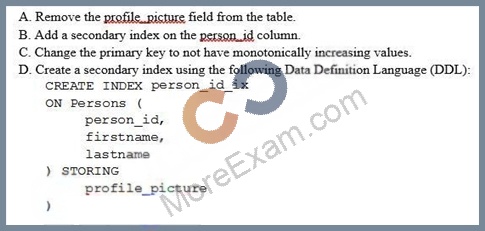
Question57: Your customer has implemented a solution that uses Cloud Spanner and notices some read latency-related performance issues on one table. This table is accessed only by their users using a primary key. The table schema is shown below.You want to resolve the issue. What should you do?
Question58: You have a web application deployed as a managed instance group. You have a new version of the application to gradually deploy. Your web application is currently receiving live web traffic. You want to ensure that the available capacity does not decrease during the deployment. What should you do?
Question59: You've seen some errors in the logs for a specific Deployment. You've narrowed the issue down to the Pod named "ad-generator" that is throwing the errors. Your engineers aren't able to reproduce the error in any other environment. They've told you that if they could just "connect into the container" for 5 minutes, they could figure out the root cause. What steps would allow them to run commands against the container?
Question60: You need to update a deployment in Deployment Manager without any resource downtime in the deployment.Which command should you use?
Question61: Your development team has asked for your help. They need a simple, reproducible way to create and terminate a new Compute Engine instance so that they can automate it as a part of their CI/CD process. What is the best option for accomplishing that?
Question62: Your finance team wants to view the billing report for your projects. You want to make sure that the finance team does not get additional permissions to the project. What should you do?
Question63: You need to monitor resources that are distributed over different projects in Google Cloud Platform. You want to consolidate reporting under the same Stackdriver Monitoring dashboard.What should you do?
Question64: You have an application running in Google Kubernetes Engine (GKE) with cluster autoscaling enabled. The application exposes a TCP endpoint. There are several replicas of this application.You have a Compute Engine instance in the same region, but in another Virtual Private Cloud (VPC), called gce- , that has no overlapping IP ranges with the first VPC. This instance needs to connect to the network application on GKE. You want to minimize effort. What should you do?
Question65: You want to select and configure a cost-effective solution for relational data on Google Cloud Platform. You are working with a small set of operational data in one geographic location. You need to support point- in-time recovery. What should you do?
Question66: Your company has a Google Cloud Platform project that uses BigQuery for data warehousing.Your data science team changes frequently and has few members. You need to allow members of this team to perform queries.You want to follow Google-recommended practices. What should you do?
Question67: You deployed an LDAP server on Compute Engine that is reachable via TLS through port 636 using UDP. You want to make sure it is reachable by clients over that port. What should you do?
Question68: You are asked to set up application performance monitoring on Google Cloud projects A, B, and C as a single pane of glass. You want to monitor CPU, memory, and disk. What should you do?
Question69: You are working with a Cloud SQL MySQL database at your company. You need to retain a month-end copy of the database for three years for audit purposes. What should you do?
Question70: You are working with a Cloud SQL MySQL database at your company. You need to retain a month-end copy of the database for three years for audit purposes. What should you do?
Question71: You want to configure an SSH connection to a single Compute Engine instance for users in the dev1 group. This instance is the only resource in this particular Google Cloud Platform project that the dev1 users should be able to connect to. What should you do?
Question72: You deployed a new application inside your Google Kubernetes Engine cluster using the YAML file specified below.You check the status of the deployed pods and notice that one of them is still in PENDING status:You want to find out why the pod is stuck in pending status. What should you do?
Question73: Your company publishes large files on an Apache web server that runs on a Compute Engine instance. The Apache web server is not the only application running in the project. You want to receive an email when the egress network costs for the server exceed 100 dollars for the current month as measured by Google Cloud Platform (GCP). What should you do?
Question74: You're using Deployment Manager to deploy your application to an autoscaled, managed instance group on Compute Engine. The application is a single binary, What is the fastest way to get the binary onto the instance, without introducing undue complexity?
Question75: You are a project owner and need your co-worker to deploy a new version of your application to App Engine. You want to follow Google's recommended practices. Which IAM roles should you grant your co-worker?
Question76: You are using Data Studio to visualize a table from your data warehouse that is built on top of BigQuery. Data is appended to the data warehouse during the day. At night, the daily summary is recalculated by overwriting the table. You just noticed that the charts in Data Studio are broken, and you want to analyze the problem. What should you do?
Question77: You've created a Pod using the kubectl run command. Now you're attempting to remove the Pod, and it keeps being recreated. Which command might help you as you attempt to remove the pod?
Question78: You have production and test workloads that you want to deploy on Compute Engine. Production VMs need to be in a different subnet than the test VMs. All the VMs must be able to reach each other over internal IP without creating additional routes. You need to set up VPC and the 2 subnets. Which configuration meets these requirements?
Question79: You need a dynamic way of provisioning VMs on Compute Engine. The exact specifications will be in a dedicated configuration file. You want to follow Google's recommended practices. Which method should you use?
Question80: You have been asked to create robust Virtual Private Network (VPN) connectivity between a new Virtual Private Cloud (VPC) and a remote site. Key requirements include dynamic routing, a shared address space of10.19.0.1/22, and no overprovisioning of tunnels during a failover event. You want to follow Google-recommended practices to set up a high availability Cloud VPN. What should you do?
Question81: Your company uses Cloud Storage to store application backup files for disaster recovery purposes. You want to follow Google's recommended practices. Which storage option should you use?
Question82: Your company set up a complex organizational structure on Google Could Platform. The structure includes hundreds of folders and projects. Only a few team members should be able to view the hierarchical structure. You need to assign minimum permissions to these team members and you want to follow Google-recommended practices. What should you do?
Question83: You create a Deployment with 2 replicas in a Google Kubernetes Engine cluster that has a single preemptible node pool. After a few minutes, you use kubectl to examine the status of your Pod and observe that one of them is still in Pending status:What is the most likely cause?
Question84: You are using Deployment Manager to create a Google Kubernetes Engine cluster. Using the same Deployment Manager deployment, you also want to create a DaemonSet in the kube- system namespace of the cluster. You want a solution that uses the fewest possible services.What should you do?
Question85: You created several resources in multiple Google Cloud projects. All projects are linked to different billing accounts. To better estimate future charges, you want to have a single visual representation of all costs incurred. You want to include new cost data as soon as possible. What should you do?
Question86: You have one project called proj-sawhere you manage all your service accounts. You want to be able to use a service account from this project to take snapshots of VMs running in another project called proj-vm.What should you do?
Question87: You want to configure autohealing for network load balancing for a group of Compute Engine instances that run in multiple zones, using the fewest possible steps. You need to configure re-creation of VMs if they are unresponsive after 3 attempts of 10 seconds each. What should you do?
Question88: You need to produce a list of the enabled Google Cloud Platform APIs for a GCP project using the gcloud command line in the Cloud Shell. The project name is my-project. What should you do?
Question89: Every employee of your company has a Google account. Your operational team needs to manage a large number of instances on Compute Engine. Each member of this team needs only administrative access to the servers. Your security team wants to ensure that the deployment of credentials is operationally efficient and must be able to determine who accessed a given instance. What should you do?
Question90: You have an application that uses Cloud Spanner as a backend database. The application has a very predictable traffic pattern. You want to automatically scale up or down the number of Spanner nodes depending on traffic. What should you do?
Question91: For analysis purposes, you need to send all the logs from all of your Compute Engine instances to a BigQuery dataset called platform-logs. You have already installed the Stackdriver Logging agent on all the instances. You want to minimize cost. What should you do?
Question92: A colleague handed over a Google Cloud Platform project for you to maintain. As part of a security checkup, you want to review who has been granted the Project Owner role. What should you do?
Question93: You have been asked to set up the billing configuration for a new Google Cloud customer. Your customer wants to group resources that share common IAM policies. What should you do?
Question94: You are running multiple VPC-native Google Kubernetes Engine clusters in the same subnet. The IPs available for the nodes are exhausted, and you want to ensure that the clusters can grow in nodes when needed. What should you do?
Question95: You have deployed multiple Linux instances on Compute Engine. You plan on adding more instances in the coming weeks. You want to be able to access all of these instances through your SSH client over me Internet without having to configure specific access on the existing and new instances. You do not want the Compute Engine instances to have a public IP. What should you do?
Question96: You are hosting an application on bare-metal servers in your own data center. The application needs access to Cloud Storage. However, security policies prevent the servers hosting the application from having public IP addresses or access to the internet. You want to follow Google-recommended practices to provide the application with access to Cloud Storage. What should you do?
Question97: A company has many applications on Amazon EC2 instances running in Auto Scaling groups. Company policies require that data on the attached Amazon EBS volume must be retained.Which actions will meet this requirement without impacting performance?
Question98: Several employees at your company have been creating projects with Cloud Platform and paying for it with their personal credit cards, which the company reimburses. The company wants to centralize all these projects under a single, new billing account. What should you do?
Question99: You need to estimate the annual cost of running a Bigquery query that is scheduled to run nightly.What should you do?
Question100: Your company wants to standardize the creation and management of multiple Google Cloud resources using Infrastructure as Code. You want to minimize the amount of repetitive code needed to manage the environment. What should you do?
Question101: You want to deploy an application on Cloud Run that processes messages from a Cloud Pub/Sub topic. You want to follow Google-recommended practices. What should you do?
Question102: Your company set up a complex organizational structure on Google Cloud. The structure includes hundreds of folders and projects. Only a few team members should be able to view the hierarchical structure. You need to assign minimum permissions to these team members, and you want to follow Google-recommended practices.What should you do?
Question103: You need to create a custom IAM role for use with a GCP service. All permissions in the role must be suitable for production use. You also want to clearly share with your organization the status of the custom role. This will be the first version of the custom role. What should you do?
Question104: A website keeps a record of user actions using a globally unique identifier (GIUD) retrieved from Amazon Aurora in place of the user name within the audit record. Security protocols state that the GUID content must not leave the company's Amazon VPC.As the web traffic has increased, the number of web servers and Aurora read replicas has also increased to keep up with the user record reads for the GUID.What should be done to reduce the number of read replicas required while improving performance?
Question105: You have a single binary application that you want to run on Google Cloud Platform. You decided to automatically scale the application based on underlying infrastructure CPU usage. Your organizational policies require you to use virtual machines directly. You need to ensure that the application scaling is operationally efficient and completed as quickly as possible. What should you do?
Question106: You have been asked to set up Object Lifecycle Management for objects stored in storage buckets. The objects are written once and accessed frequently for 30 days. After 30 days, the objects are not read again unless there is a special need. The object should be kept for three years, and you need to minimize cost. What should you do?
Question107: You have a virtual machine that is currently configured with 2 vCPUs and 4 GB of memory. It is running out of memory. You want to upgrade the virtual machine to have 8 GB of memory.What should you do?
Question108: You need to create a Compute Engine instance in a new project that doesn't exist yet. What should you do?
Question109: You want to select and configure a cost-effective solution for relational data on Google Cloud Platform. You are working with a small set of operational data in one geographic location. You need to support point-in-time recovery. What should you do?
Question110: You have an application that uses Cloud Spanner as a database backend to keep current state information about users. Cloud Bigtable logs all events triggered by users. You export Cloud Spanner data to Cloud Storage during daily backups. One of your analysts asks you to join data from Cloud Spanner and Cloud Bigtable for specific users. You want to complete this ad hoc request as efficiently as possible. What should you do?
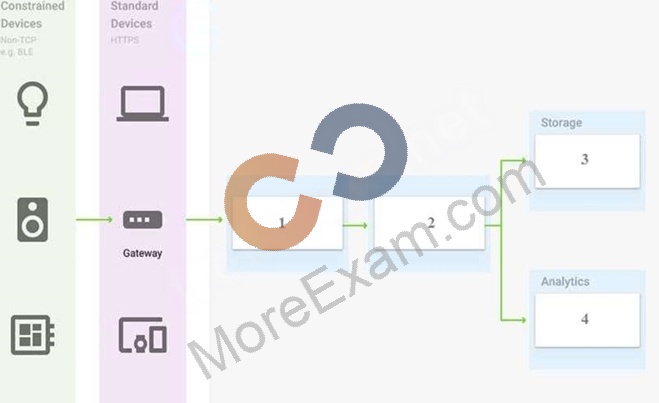
Question111: You are building a pipeline to process time-series data. Which Google Cloud Platform services should you put in boxes 1,2,3, and 4?
Question112: You have a development project with appropriate IAM roles defined. You are creating a production project and want to have the same IAM roles on the new project, using the fewest possible steps. What should you do?
Question113: Your project has all its Compute Engine resources in the europe-west1 region. You want to set europe-west1 as the default region for gcloud commands. What should you do?
Question114: You have a batch workload that runs every night and uses a large number of virtual machines (VMs). It is fault-tolerant and can tolerate some of the VMs being terminated. The current cost of VMs is too high.What should you do?
Question115: You are hosting an application on bare-metal servers in your own data center. The application needs access to Cloud Storage. However, security policies prevent the servers hosting the application from having public IP addresses or access to the internet. You want to follow Google-recommended practices to provide the application with access to Cloud Storage. What should you do?
Question116: You have a large 5-TB AVRO file stored in a Cloud Storage bucket. Your analysts are proficient only in SQL and need access to the data stored in this file. You want to find a cost-effective way to complete their request as soon as possible. What should you do?
Question117: You deployed an App Engine application using gcloud app deploy, but it did not deploy to the intended project. You want to find out why this happened and where the application deployed.What should you do?
Question118: You need to run an important query in BigQuery but expect it to return a lot of records. You want to find out how much it will cost to run the query. You are using on-demand pricing. What should you do?
Question119: You're trying to provide temporary access to some files in a Cloud Storage bucket. You want to limit the time that the files are available to 10 minutes. With the fewest steps possible, what is the best way to generate a signed URL?
Question120: You have an object in a Cloud Storage bucket that you want to share with an external company.The object contains sensitive data. You want access to the content to be removed after four hours. The external company does not have a Google account to which you can grant specific user-based access privileges. You want to use the most secure method that requires the fewest steps. What should you do?
Question121: You need to create a custom VPC with a single subnet. The subnet's range must be as large as possible.Which range should you use?
Question122: You are migrating a production-critical on-premises application that requires 96 vCPUs to perform its task.You want to make sure the application runs in a similar environment on GCP. What should you do?
Question123: You are setting up a Windows VM on Compute Engine and want to make sure you can log in to the VM via RDP. What should you do?
Question124: You built an application on your development laptop that uses Google Cloud services. Your application uses Application Default Credentials for authentication and works fine on your development laptop. You want to migrate this application to a Compute Engine virtual machine (VM) and set up authentication using Google-recommended practices and minimal changes.What should you do?
Question125: Every employee of your company has a Google account. Your operational team needs to manage a large number of instances on Compute Engine. Each member of this team needs only administrative access to the servers. Your security team wants to ensure that the deployment of credentials is operationally efficient and must be able to determine who accessed a given instance. What should you do?
Question126: You have a Compute Engine instance hosting an application used between 9 AM and 6 PM on weekdays. You want to back up this instance daily for disaster recovery purposes. You want to keep the backups for 30 days. You want the Google-recommended solution with the least management overhead and the least number of services. What should you do?
Question127: Your development team needs a new Jenkins server for their project. You need to deploy the server using the fewest steps possible. What should you do?
Question128: You are running an application on multiple virtual machines within a managed instance group and have autoscaling enabled. The autoscaling policy is configured so that additional instances are added to the group if the CPU utilization of instances goes above 80%. VMs are added until the instance group reaches its maximum limit of five VMs or until CPU utilization of instances lowers to 80%. The initial delay for HTTP health checks against the instances is set to 30 seconds. The virtual machine instances take around three minutes to become available for users. You observe that when the instance group autoscales, it adds more instances then necessary to support the levels of end-user traffic. You want to properly maintain instance group sizes when autoscaling.What should you do?
Question129: You are building an archival solution for your data warehouse and have selected Cloud Storage to archive your data. Your users need to be able to access this archived data once a quarter for some regulatory requirements.You want to select a cost-efficient option. Which storage option should you use?
Question130: You are building an application that processes data files uploaded from thousands of suppliers. Your primary goals for the application are data security and the expiration of aged data. You need to design the application to:* Restrict access so that suppliers can access only their own data.* Give suppliers write access to data only for 30 minutes.* Delete data that is over 45 days old.You have a very short development cycle, and you need to make sure that the application requires minimal maintenance. Which two strategies should you use? (Choose two.)
Question131: You want to verify the IAM users and roles assigned within a GCP project named my-project. What should you do?
Question132: You need to set up permissions for a set of Compute Engine instances to enable them to write data into a particular Cloud Storage bucket. You want to follow Google-recommended practices.What should you do?
Question133: A Solutions Architect is reviewing an application that writes data to an Amazon DynamoDB table on a daily basis. Random table reads occur many times per second.The company needs to allow thousands of low-latency reads and avoid any negative impact to the rest of the application.What should the Solutions Architect do to meet the company's goals?
Question134: You significantly changed a complex Deployment Manager template and want to confirm that the dependencies of all defined resources are properly met before committing it to the project. You want the most rapid feedback on your changes. What should you do?
Question135: Your organization uses Active Directory (AD) to manage user identities. Each user uses this identity for federated access to various on-premises systems. Your security team has adopted a policy that requires users to log into Google Cloud with their AD identity instead of their own login. You want to follow the Google-recommended practices to implement this policy. What should you do?
Question136: You work in a small company where everyone should be able to view all resources of a specific project. You want to grant them access following Google's recommended practices. What should you do?
Question137: A Solutions Architect is building an online shopping application where users will be able to browse items, add items to a cart, and purchase the items. Images of items will be stored in Amazon S3 buckets organized by item category. When an item is no longer available for purchase, the item image will be deleted from the S3 bucket.Occasionally, during testing, item images deleted from the S3 bucket are still visible to some users.What is a flaw in this design approach?
Question138: You want to verify the IAM users and roles assigned within a GCP project named my-project.What should you do?