MoreExam
1. Question Content...
EXPLANATION
Answer: X - EXPLANATION Content.
Question1: You are responsible for designing a new connectivity solution for your organization's enterprise network to access and use Google Workspace. You have an existing Shared VPC with Compute Engine instances in us-west1. Currently, you access Google Workspace via your service provider's internet access. You want to set up a direct connection between your network and Google. What should you do?
Question2: Your company's on-premises network is connected to a VPC using a Cloud VPN tunnel. You have a static route of 0.0.0.0/0 with the VPN tunnel as its next hop defined in the VPC. All internet bound traffic currently passes through the on-premises network. You configured Cloud NAT to translate the primary IP addresses of Compute Engine instances in one region. Traffic from those instances will now reach the internet directly from their VPC and not from the on-premises network. Traffic from the virtual machines (VMs) is not translating addresses as expected. What should you do?
Question3: You recently noticed a recurring daily spike in network usage in your Google Cloud project. You need to identify the virtual machine (VM) instances and type of traffic causing the spike in traffic utilization while minimizing the cost and management overhead required. What should you do?
Question4: You want Cloud CDN to serve the https://www.example.com/images/spacetime.png static image file that is hosted in a private Cloud Storage bucket, You are using the VSE ORIG.-X_NZADERS cache mode You receive an HTTP 403 error when opening the file In your browser and you see that the HTTP response has a Cache-control: private, max-age=O header How should you correct this Issue?
Question5: All the instances in your project are configured with the custom metadata enable-oslogin value set to FALSE and to block project-wide SSH keys. None of the instances are set with any SSH key, and no project-wide SSH keys have been configured. Firewall rules are set up to allow SSH sessions from any IP address range. You want to SSH into one instance.What should you do?
Question6: You are configuring an HA VPN connection between your Virtual Private Cloud (VPC) and on-premises network. The VPN gateway is named VPN_GATEWAY_1. You need to restrict VPN tunnels created in the project to only connect to your on-premises VPN public IP address: 203.0.113.1/32. What should you do?
Question7: Your company recently migrated to Google Cloud in a Single region. You configured separate Virtual Private Cloud (VPC) networks for two departments. Department A and Department B. Department A has requested access to resources that are part Of Department Bis VPC. You need to configure the traffic from private IP addresses to flow between the VPCs using multi-NIC virtual machines (VMS) to meet security requirements Your configuration also must* Support both TCP and UDP protocols* Provide fully automated failover* Include health-checksRequire minimal manual Intervention In the client VMSWhich approach should you take?
Question8: Your organization's security policy requires that all internet-bound traffic return to your on-premises data center through HA VPN tunnels before egressing to the internet, while allowing virtual machines (VMs) to leverage private Google APIs using private virtual IP addresses 199.36.153.4/30. You need to configure the routes to enable these traffic flows. What should you do?
Question9: Your company is planning a migration to Google Kubernetes Engine. Your application team informed you that they require a minimum of 60 Pods per node and a maximum of 100 Pods per node Which Pod per node CIDR range should you use?
Question10: You have provisioned a Partner Interconnect connection to extend connectivity from your on-premises data center to Google Cloud. You need to configure a Cloud Router and create a VLAN attachment to connect to resources inside your VPC. You need to configure an Autonomous System number (ASN) to use with the associated Cloud Router and create the VLAN attachment.What should you do?
Question11: You are designing a hybrid cloud environment for your organization. Your Google Cloud environment is interconnected with your on-premises network using Cloud HA VPN and Cloud Router. The Cloud Router is configured with the default settings. Your on-premises DNS server is located at 192.168.20.88 and is protected by a firewall, and your Compute Engine resources are located at 10.204.0.0/24. Your Compute Engine resources need to resolve on-premises private hostnames using the domain corp.altostrat.com while still resolving Google Cloud hostnames. You want to follow Google-recommended practices. What should you do?
Question12: Your company's security team tends to use managed services when possible. You need to build a dashboard to show the number of deny hits that occur against configured firewall rules without increasing operational overhead. What should you do?
Question13: You just finished your company's migration to Google Cloud and configured an architecture with 3 Virtual Private Cloud (VPC) networks: one for Sales, one for Finance, and one for Engineering. Every VPC contains over 100 Compute Engine instances, and now developers using instances in the Sales VPC and the Finance VPC require private connectivity between each other. You need to allow communication between Sales and Finance without compromising performance or security. What should you do?
Question14: You created a VPC network named Retail in auto mode. You want to create a VPC network named Distribution and peer it with the Retail VPC.How should you configure the Distribution VPC?
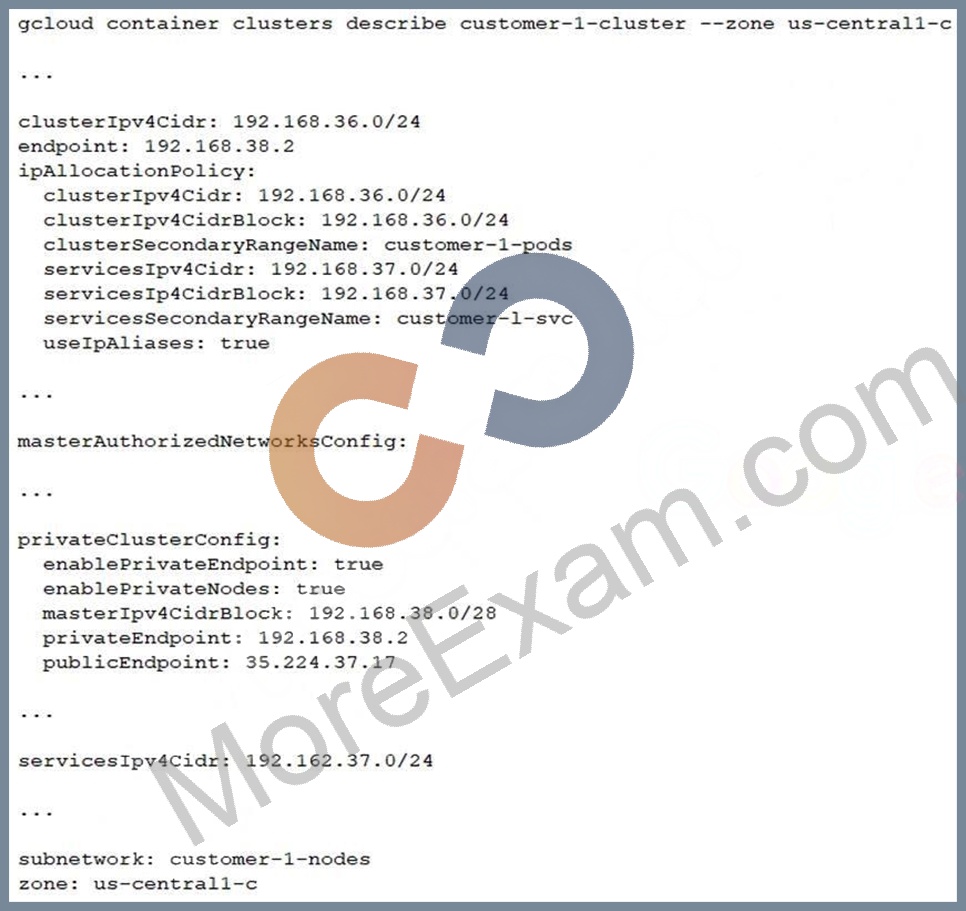
Question15: You have the following private Google Kubernetes Engine (GKE) cluster deployment:You have a virtual machine (VM) deployed in the same VPC in the subnetwork kubernetes-management with internal IP address 192.168.40 2/24 and no external IP address assigned. You need to communicate with the cluster master using kubectl. What should you do?
Question16: Your company has a Virtual Private Cloud (VPC) with two Dedicated Interconnect connections in two different regions: us-west1 and us-east1. Each Dedicated Interconnect connection is attached to a Cloud Router in its respective region by a VLAN attachment. You need to configure a high availability failover path. By default, all ingress traffic from the on-premises environment should flow to the VPC using the us-west1 connection. If us-west1 is unavailable, you want traffic to be rerouted to us-east1. How should you configure the multi-exit discriminator (MED) values to enable this failover path?
Question17: You have deployed a new internal application that provides HTTP and TFTP services to on-premises hosts. You want to be able to distribute traffic across multiple Compute Engine instances, but need to ensure that clients are sticky to a particular instance across both services.Which session affinity should you choose?
Question18: Your on-premises data center has 2 routers connected to your GCP through a VPN on each router. All applications are working correctly; however, all of the traffic is passing across a single VPN instead of being load-balanced across the 2 connections as desired.During troubleshooting you find:* Each on-premises router is configured with the same ASN.* Each on-premises router is configured with the same routes and priorities.* Both on-premises routers are configured with a VPN connected to a single Cloud Router.* The VPN logs have no-proposal-chosen lines when the VPNs are connecting.* BGP session is not established between one on-premises router and the Cloud Router.What is the most likely cause of this problem?
Question19: You need to establish network connectivity between three Virtual Private Cloud networks, Sales, Marketing, and Finance, so that users can access resources in all three VPCs. You configure VPC peering between the Sales VPC and the Finance VPC. You also configure VPC peering between the Marketing VPC and the Finance VPC. After you complete the configuration, some users cannot connect to resources in the Sales VPC and the Marketing VPC. You want to resolve the problem.What should you do?
Question20: After a network change window one of your company's applications stops working. The application uses an on-premises database server that no longer receives any traffic from the application. The database server IP address is 10.2.1.25. You examine the change request, and the only change is that 3 additional VPC subnets were created. The new VPC subnets created are 10.1.0.0/16, 10.2.0.0/16, and 10.3.1.0/24/ The on-premises router is advertising 10.0.0.0/8.What is the most likely cause of this problem?
Question21: You have recently been put in charge of managing identity and access management for your organization. You have several projects and want to use scripting and automation wherever possible. You want to grant the editor role to a project member.Which two methods can you use to accomplish this? (Choose two.)
Question22: You recently deployed Compute Engine instances in regions us-west1 and us-east1 in a Virtual Private Cloud (VPC) with default routing configurations. Your company security policy mandates that virtual machines (VMs) must not have public IP addresses attached to them. You need to allow your instances to fetch updates from the internet while preventing external access. What should you do?
Question23: You need to enable Private Google Access for use by some subnets within your Virtual Private Cloud (VPC). Your security team set up the VPC to send all internet-bound traffic back to the on- premises data center for inspection before egressing to the internet, and is also implementing VPC Service Controls in the environment for API-level security control. You have already enabled the subnets for Private Google Access. What configuration changes should you make to enable Private Google Access while adhering to your security team's requirements?
Question24: You have the following firewall ruleset applied to all instances in your Virtual Private Cloud (VPC):You need to update the firewall rule to add the following rule to the ruleset:You are using a new user account. You must assign the appropriate identity and Access Management (IAM) user roles to this new user account before updating the firewall rule. The new user account must be able to apply the update and view firewall logs. What should you do?
Question25: You have a storage bucket that contains two objects. Cloud CDN is enabled on the bucket, and both objects have been successfully cached. Now you want to make sure that one of the two objects will not be cached anymore, and will always be served to the internet directly from the origin.What should you do?
Question26: In your Google Cloud organization, you have two folders: Dev and Prod. You want a scalable and consistent way to enforce the following firewall rules for all virtual machines (VMs) with minimal cost:Port 8080 should always be open for VMs in the projects in the Dev folder.Any traffic to port 8080 should be denied for all VMs in your projects in the Prod folder.What should you do?
Question27: In your project my-project, you have two subnets in a Virtual Private Cloud (VPC): subnet-a with IP range 10.128.0.0/20 and subnet-b with IP range 172.16.0.0/24. You need to deploy database servers in subnet- a. You will also deploy the application servers and web servers in subnet-b. You want to configure firewall rules that only allow database traffic from the application servers to the database servers. What should you do?
Question28: You are responsible for enabling Private Google Access for the virtual machine (VM) instances in your Virtual Private Cloud (VPC) to access Google APIs. All VM instances have only a private IP address and need to access Cloud Storage. You need to ensure that all VM traffic is routed back to your on-premises data center for traffic scrubbing via your existing Cloud Interconnect connection. However, VM traffic to Google APIs should remain in the VPC. What should you do?
Question29: Your organization has a single project that contains multiple Virtual Private Clouds (VPCs). You need to secure API access to your Cloud Storage buckets and BigQuery datasets by allowing API access only from resources in your corporate public networks. What should you do?
Question30: You have an application running on Compute Engine that uses BigQuery to generate some results that are stored in Cloud Storage. You want to ensure that none of the application instances have external IP addresses.Which two methods can you use to accomplish this? (Choose two.)
Question31: You are designing a new global application using Compute Engine instances that will be exposed by a global HTTP(S) load balancer. You need to secure your application from distributed denial-of-service and application layer (layer 7) attacks. What should you do?
Question32: Your company is working with a partner to provide a solution for a customer. Both your company and the partner organization are using GCP. There are applications in the partner's network that need access to some resources in your company's VPC. There is no CIDR overlap between the VPCs.Which two solutions can you implement to achieve the desired results without compromising the security? (Choose two.)
Question33: Your company's security team wants to limit the type of inbound traffic that can reach your web servers to protect against security threats. You need to configure the firewall rules on the web servers within your Virtual Private Cloud (VPC) to handle HTTP and HTTPS web traffic for TCP only. What should you do?
Question34: You want to use Cloud Interconnect to connect your on-premises network to a GCP VPC. You cannot meet Google at one of its point-of-presence (POP) locations, and your on-premises router cannot run a Border Gateway Protocol (BGP) configuration.Which connectivity model should you use?
Question35: You need to centralize the Identity and Access Management permissions and email distribution for the WebServices Team as efficiently as possible.What should you do?
Question36: You are disabling DNSSEC for one of your Cloud DNS-managed zones. You removed the DS records from your zone file, waited for them to expire from the cache, and disabled DNSSEC for the zone. You receive reports that DNSSEC validating resolves are unable to resolve names in your zone.What should you do?
Question37: You have configured a service on Google Cloud that connects to an on-premises service via a Dedicated Interconnect. Users are reporting recent connectivity issues. You need to determine whether the traffic is being dropped because of firewall rules or a routing decision. What should you do?
Question38: You need to enable Cloud CDN for all the objects inside a storage bucket. You want to ensure that all the object in the storage bucket can be served by the CDN.What should you do in the GCP Console?
Question39: You suspect that one of the virtual machines (VMs) in your default Virtual Private Cloud (VPC) is under a denial-of-service attack. You need to analyze the incoming traffic for the VM to understand where the traffic is coming from. What should you do?
Question40: Your company is planning a migration to Google Kubernetes Engine. Your application team informed you that they require a minimum of 60 Pods per node and a maximum of 100 Pods per node Which Pod per node CIDR range should you use?
Question41: You want to implement an IPSec tunnel between your on-premises network and a VPC via Cloud VPN. You need to restrict reachability over the tunnel to specific local subnets, and you do not have a device capable of speaking Border Gateway Protocol (BGP).Which routing option should you choose?
Question42: You work for a multinational enterprise that is moving to GCP.These are the cloud requirements:* An on-premises data center located in the United States in Oregon and New York with Dedicated Interconnects connected to Cloud regions us-west1 (primary HQ) and us-east4 (backup)* Multiple regional offices in Europe and APAC* Regional data processing is required in europe-west1 and australia-southeast1* Centralized Network Administration TeamYour security and compliance team requires a virtual inline security appliance to perform L7 inspection for URL filtering. You want to deploy the appliance in us-west1.What should you do?
Question43: You have a Cloud Storage bucket in Google Cloud project XYZ. The bucket contains sensitive dat a. You need to design a solution to ensure that only instances belonging to VPCs under project XYZ can access the data stored in this Cloud Storage bucket. What should you do?
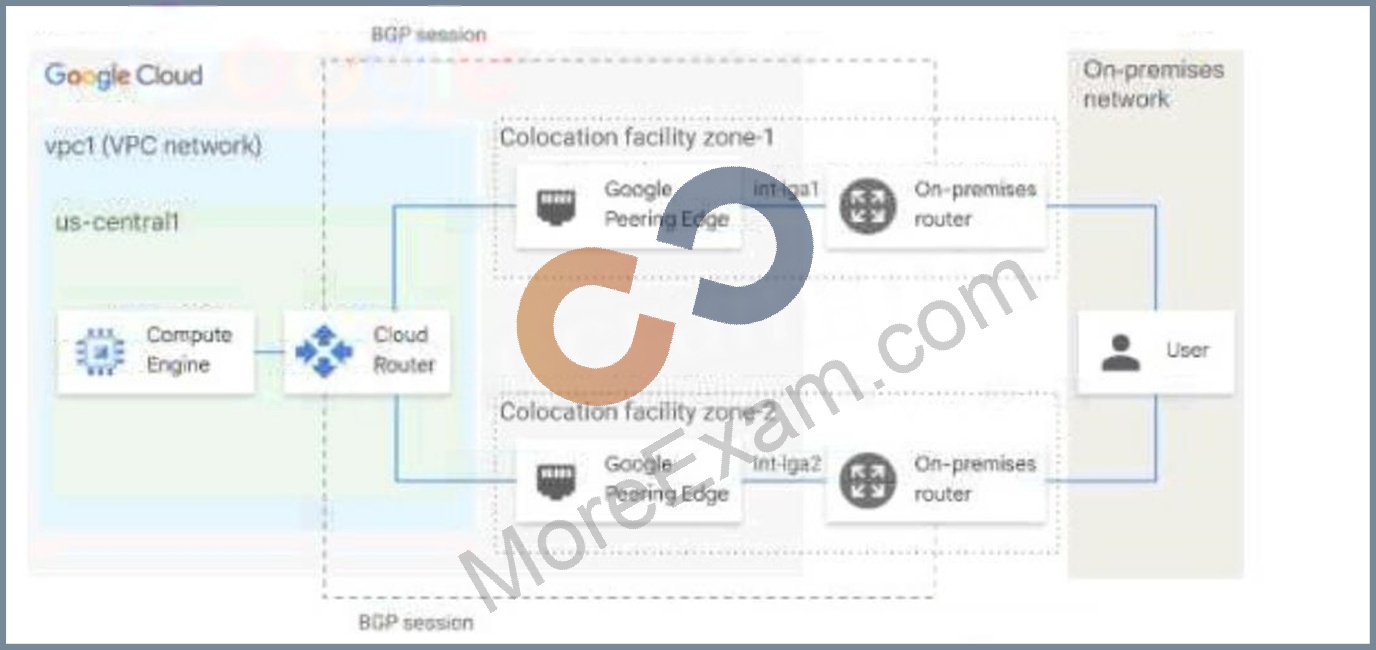
Question44: You have the networking configuration shown in the diagram. A pair of redundant Dedicated Interconnect connections (int-Igal and int-Iga2) terminate on the same Cloud Router. The Interconnect connections terminate on two separate on-premises routers. You are advertising the same prefixes from the Border Gateway Protocol (BGP) sessions associated with the Dedicated Interconnect connections. You need to configure one connection as Active for both ingress and egress traffic. If the active Interconnect connection fails, you want the passive Interconnect connection to automatically begin routing all traffic Which two actions should you take to meet this requirement? (Choose Two)
Question45: Your organization has Compute Engine instances in us-east1, us-west2, and us-central1. Your organization also has an existing Cloud Interconnect physical connection in the East Coast of the United States with a single VLAN attachment and Cloud Router in us-east1. You need to provide a design with high availability and ensure that if a region goes down, you still have access to all your other Virtual Private Cloud (VPC) subnets. You need to accomplish this in the most cost-effective manner possible. What should you do?
Question46: You are migrating to Cloud DNS and want to import your BIND zone file.Which command should you use?
Question47: One instance in your VPC is configured to run with a private IP address only. You want to ensure that even if this instance is deleted, its current private IP address will not be automatically assigned to a different instance.In the GCP Console, what should you do?
Question48: Your company is running out of network capacity to run a critical application in the on-premises data center. You want to migrate the application to GCP. You also want to ensure that the Security team does not lose their ability to monitor traffic to and from Compute Engine instances.Which two products should you incorporate into the solution? (Choose two.)
Question49: You are using the gcloud command line tool to create a new custom role in a project by coping a predefined role. You receive this error message:INVALID_ARGUMENT: Permission resourcemanager.projects.list is not valid What should you do?
Question50: Your company has a single Virtual Private Cloud (VPC) network deployed in Google Cloud with access from your on-premises network using Cloud Interconnect. You must configure access only to Google APIs and services that are supported by VPC Service Controls through hybrid connectivity with a service level agreement (SLA) in place. What should you do?
Question51: You have created an HTTP(S) load balanced service. You need to verify that your backend instances are responding properly.How should you configure the health check?
Question52: You are designing a hybrid cloud environment. Your Google Cloud environment is interconnected with your on-premises network using HA VPN and Cloud Router in a central transit hub VPC. The Cloud Router is configured with the default settings. Your on-premises DNS server is located at 192.168.20.88. You need to ensure that your Compute Engine resources in multiple spoke VPCs can resolve on-premises private hostnames using the domain corp.altostrat.com while also resolving Google Cloud hostnames. You want to follow Google-recommended practices. What should you do?
Question53: You ate planning to use Terraform to deploy the Google Cloud infrastructure for your company, The design must meet the following requirements* Each Google Cloud project must represent an Internal project that your team Will work on* After an Internal project is finished, the infrastructure must be deleted* Each Internal project must have Its own Google Cloud project owner to manage the Google Cloud resources.* You have 10-100 projects deployed at a timeWhile you are writing the Terraform code, you need to ensure that the deployment is simple and the code is reusable With centralized management What should you do?
Question54: You have enabled HTTP(S) load balancing for your application, and your application developers have reported that HTTP(S) requests are not being distributed correctly to your Compute Engine Virtual Machine instances. You want to find data about how the request are being distributed.Which two methods can accomplish this? (Choose two.)
Question55: You want to use Partner Interconnect to connect your on-premises network with your VPC. You already have an Interconnect partner.What should you first?
Question56: You are using a third-party next-generation firewall to inspect traffic. You created a custom route of 0.0.0.0/0 to route egress traffic to the firewall. You want to allow your VPC instances without public IP addresses to access the BigQuery and Cloud Pub/Sub APIs, without sending the traffic through the firewall.Which two actions should you take? (Choose two.)
Question57: You recently deployed two network virtual appliances in us-central1. Your network appliances provide connectivity to your on-premises network, 10.0.0.0/8. You need to configure the routing for your Virtual Private Cloud (VPC). Your design must meet the following requirements:All access to your on-premises network must go through the network virtual appliances.Allow on-premises access in the event of a single network virtual appliance failure.Both network virtual appliances must be used simultaneously.Which method should you use to accomplish this?
Question58: You have deployed a proof-of-concept application by manually placing instances in a single Compute Engine zone. You are now moving the application to production, so you need to increase your application availability and ensure it can autoscale.How should you provision your instances?
Question59: You are in the process of deploying an internal HTTP(S) load balancer for your web server virtual machine (VM) Instances What two prerequisite tasks must be completed before creating the load balancer?Choose 2 answers
Question60: You recently deployed your application in Google Cloud. You need to verify your Google Cloud network configuration before deploying your on-premises workloads. You want to confirm that your Google Cloud network configuration allows traffic to flow from your cloud resources to your on- premises network. This validation should also analyze and diagnose potential failure points in your Google Cloud network configurations without sending any data plane test traffic. What should you do?
Question61: You need to configure the Border Gateway Protocol (BGP) session for a VPN tunnel you just created between two Google Cloud VPCs, 10.1.0.0/16 and 172.16.0.0/16. You have a Cloud Router (router-1) in the 10.1.0.0/16 network and a second Cloud Router (router-2) in the 172.16.0.0/16 network. Which configuration should you use for the BGP session?
Question62: Your organization is implementing a new security policy to control how firewall rules are applied to control flows between virtual machines (VMs). Using Google-recommended practices, you need to set up a firewall rule to enforce strict control of traffic between VM A and VM B. You must ensure that communications flow only from VM A to VM B within the VPC, and no other communication paths are allowed. No other firewall rules exist in the VPC. Which firewall rule should you configure to allow only this communication path?
Question63: You are trying to update firewall rules in a shared VPC for which you have been assigned only Network Admin permissions. You cannot modify the firewall rules. Your organization requires using the least privilege necessary.Which level of permissions should you request?
Question64: You are adding steps to a working automation that uses a service account to authenticate. You need to drive the automation the ability to retrieve files from a Cloud Storage bucket. Your organization requires using the least privilege possible.What should you do?
Question65: You create multiple Compute Engine virtual machine instances to be used as TFTP servers.Which type of load balancer should you use?
Question66: You are designing a hub-and-spoke network architecture for your company's cloud-based environment. You need to make sure that all spokes are peered with the hub. The spokes must use the hub's virtual appliance for internet access.The virtual appliance is configured in high-availability mode with two instances using an internal load balancer with IP address 10.0.0.5. What should you do?
Question67: You are configuring a new instance of Cloud Router in your Organization's Google Cloud environment to allow connection across a new Dedicated Interconnect to your data center Sales, Marketing, and IT each have a service project attached to the Organization's host project.Where should you create the Cloud Router instance?
Question68: You are responsible for configuring firewall policies for your company in Google Cloud. Your security team has a strict set of requirements that must be met to configure firewall rules.Always allow Secure Shell (SSH) from your corporate IP address.Restrict SSH access from all other IP addresses.There are multiple projects and VPCs in your Google Cloud organization. You need to ensure that other VPC firewall rules cannot bypass the security team's requirements. What should you do?
Question69: You are using a 10-Gbps direct peering connection to Google together with the gsutil tool to upload files to Cloud Storage buckets from on-premises servers. The on-premises servers are 100 milliseconds away from the Google peering point. You notice that your uploads are not using the full 10-Gbps bandwidth available to you. You want to optimize the bandwidth utilization of the connection.What should you do on your on-premises servers?
Question70: You are designing a Partner Interconnect hybrid cloud connectivity solution with geo-redundancy across two metropolitan areas. You want to follow Google-recommended practices to set up the following region/metro pairs:(region 1/metro 1)(region 2/metro 2)What should you do?
Question71: Your company has defined a resource hierarchy that includes a parent folder with subfolders for each department. Each department defines their respective project and VPC in the assigned folder and has the appropriate permissions to create Google Cloud firewall rules. The VPCs should not allow traffic to flow between them. You need to block all traffic from any source, including other VPCs, and delegate only the intra-VPC firewall rules to the respective departments. What should you do?
Question72: You need to give each member of your network operations team least-privilege access to create, modify, and delete Cloud Interconnect VLAN attachments.What should you do?
Question73: You configured Cloud VPN with dynamic routing via Border Gateway Protocol (BGP). You added a custom route to advertise a network that is reachable over the VPN tunnel. However, the on-premises clients still cannot reach the network over the VPN tunnel. You need to examine the logs in Cloud Logging to confirm that the appropriate routers are being advertised over the VPN tunnel. Which filter should you use in Cloud Logging to examine the logs?
Question74: You are deploying an application that runs on Compute Engine instances. You need to determine how to expose your application to a new customer You must ensure that your application meets the following requirements* Maps multiple existing reserved external IP addresses to the Instance* Processes IP Encapsulating Security Payload (ESP) trafficWhat should you do?
Question75: You have two Google Cloud projects in a perimeter to prevent data exfiltration. You need to move a third project inside the perimeter; however, the move could negatively impact the existing environment. You need to validate the impact of the change. What should you do?
Question76: You are designing an IP address scheme for new private Google Kubernetes Engine (GKE) clusters. Due to IP address exhaustion of the RFC 1918 address space In your enterprise, you plan to use privately used public IP space for the new clusters. You want to follow Google-recommended practices. What should you do after designing your IP scheme?
Question77: You need to define an address plan for a future new GKE cluster in your VPC. This will be a VPC native cluster, and the default Pod IP range allocation will be used. You must pre-provision all the needed VPC subnets and their respective IP address ranges before cluster creation. The cluster will initially have a single node, but it will be scaled to a maximum of three nodes if necessary. You want to allocate the minimum number of Pod IP addresses.Which subnet mask should you use for the Pod IP address range?
Question78: You are designing a shared VPC architecture. Your network and security team has strict controls over which routes are exposed between departments. Your Production and Staging departments can communicate with each other, but only via specific networks. You want to follow Google-recommended practices.How should you design this topology?
Question79: You have the following routing design. You discover that Compute Engine instances in Subnet-2 in the asia-southeast1 region cannot communicate with compute resources on-premises. What should you do?
Question80: Your end users are located in close proximity to us-east1 and europe-west1. Their workloads need to communicate with each other. You want to minimize cost and increase network efficiency.How should you design this topology?