MoreExam
1. Question Content...
EXPLANATION
Answer: X - EXPLANATION Content.
Question1: Your company offers a popular gaming service. Your instances are deployed with private IP addresses, and external access is granted through a global load balancer. You believe you have identified a potential malicious actor, but aren't certain you have the correct client IP address. You want to identify this actor while minimizing disruption to your legitimate users.What should you do?
Question2: (Your digital media company stores a large number of video files on-premises. Each video file ranges from100 MB to 100 GB. You are currently storing 150 TB of video data in your on-premises network, with no room for expansion. You need to migrate all infrequently accessed video files older than one year to Cloud Storage to ensure that on-premises storage remains available for new files. You must also minimize costs and control bandwidth usage. What should you do?)
Question3: You are designing a hub-and-spoke network architecture for your company's cloud-based environment. You need to make sure that all spokes are peered with the hub. The spokes must use the hub's virtual appliance for internet access.The virtual appliance is configured in high-availability mode with two instances using an internal load balancer with IP address 10.0.0.5. What should you do?
Question4: You have a storage bucket that contains the following objects:- folder-a/image-a-1.jpg- folder-a/image-a-2.jpg- folder-b/image-b-1.jpg- folder-b/image-b-2.jpgCloud CDN is enabled on the storage bucket, and all four objects have been successfully cached. You want to remove the cached copies of all the objects with the prefix folder-a, using the minimum number of commands.What should you do?
Question5: Your company has recently installed a Cloud VPN tunnel between your on-premises data center and your Google Cloud Virtual Private Cloud (VPC). You need to configure access to the Cloud Functions API for your on-premises servers. The configuration must meet the following requirements:Certain data must stay in the project where it is stored and not be exfiltrated to other projects.Traffic from servers in your data center with RFC 1918 addresses do not use the internet to access Google Cloud APIs.All DNS resolution must be done on-premises.The solution should only provide access to APIs that are compatible with VPC Service Controls.What should you do?
Question6: You successfully provisioned a single Dedicated Interconnect. The physical connection is at a colocation facility closest to us-west2. Seventy-five percent of your workloads are in us-east4, and the remaining twenty-five percent of your workloads are in us-central1. All workloads have the same network traffic profile. You need to minimize data transfer costs when deploying VLAN attachments. What should you do?
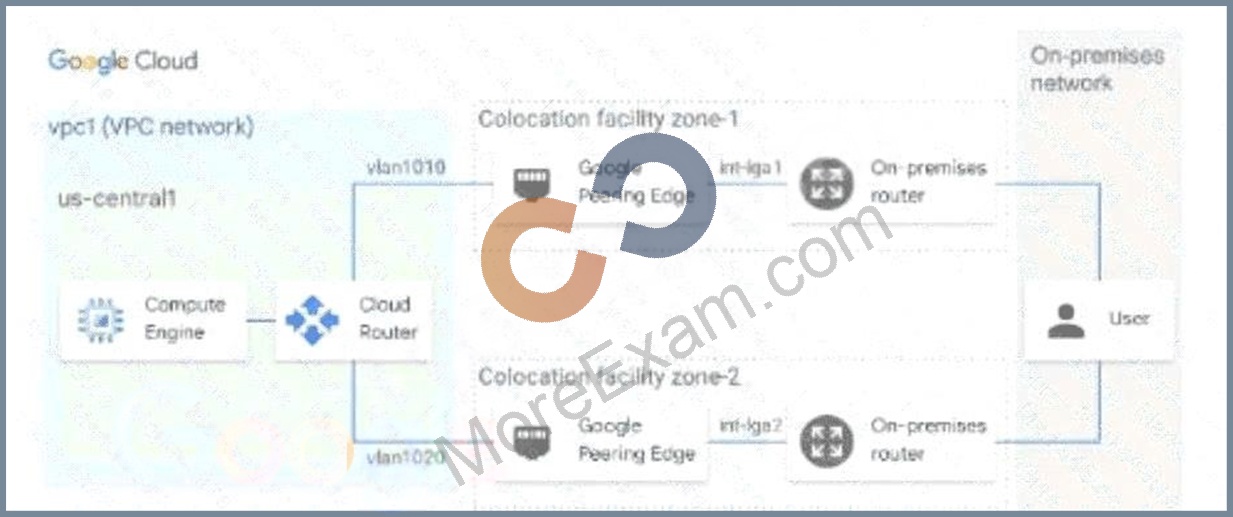
Question7: You have the networking configuration shown. In the diagram Two VLAN attachments associated With two Dedicated Interconnect connections terminate on the same Cloud Router (mycloudrouter). The Interconnect connections terminate on two separate on-premises routers. You advertise the same prefixes from the Border Gateway Protocol (BOP) sessions associated with each Of the VLAN attachments.You notice an asymmetric traffic flow between the two Interconnect connections. Which of the following actions should you take to troubleshoot the asymmetric traffic flow?
Question8: Your on-premises data center has 2 routers connected to your Google Cloud environment through a VPN on each router. All applications are working correctly; however, all of the traffic is passing across a single VPN instead of being load-balanced across the 2 connections as desired.During troubleshooting you find:* Each on-premises router is configured with a unique ASN.* Each on-premises router is configured with the same routes and priorities.* Both on-premises routers are configured with a VPN connected to a single Cloud Router.* BGP sessions are established between both on-premises routers and the Cloud Router.* Only 1 of the on-premises router's routes are being added to the routing table.What is the most likely cause of this problem?
Question9: Your organization has Compute Engine instances in us-east1, us-west2, and us-central1. Your organization also has an existing Cloud Interconnect physical connection in the East Coast of the United States with a single VLAN attachment and Cloud Router in us-east1. You need to provide a design with high availability and ensure that if a region goes down, you still have access to all your other Virtual Private Cloud (VPC) subnets. You need to accomplish this in the most cost-effective manner possible. What should you do?
Question10: Your organization wants to set up hybrid connectivity with VLAN attachments that terminate in a single Cloud Router with 99.9% uptime. You need to create a network design for your on-premises router that meets those requirements and has an active/passive configuration that uses only one VLAN attachment at a time.What should you do?
Question11: (You are managing an application deployed on Cloud Run. The development team has released a new version of the application. You want to deploy and redirect traffic to this new version of the application. To ensure traffic to the new version of the application is served with no startup time, you want to ensure that there are two idle instances available for incoming traffic before adjusting the traffic flow. You also want to minimize administrative overhead. What should you do?)
Question12: You have a web application that is currently hosted in the us-central1 region. Users experience high latency when traveling in Asi a. You've configured a network load balancer, but users have not experienced a performance improvement. You want to decrease the latency.What should you do?
Question13: You work for a university that is migrating to GCP.These are the cloud requirements:* On-premises connectivity with 10 Gbps* Lowest latency access to the cloud* Centralized Networking Administration TeamNew departments are asking for on-premises connectivity to their projects. You want to deploy the most cost-efficient interconnect solution for connecting the campus to Google Cloud.What should you do?
Question14: You need to create the technical architecture for hybrid connectivity from your data center to Google Cloud This will be managed by a partner. You want to follow Google-recommended practices for production-level applications. What should you do?
Question15: Your company has separate Virtual Private Cloud (VPC) networks in a single region for two departments:Sales and Finance. The Sales department's VPC network already has connectivity to on-premises locations using HA VPN, and you have confirmed that the subnet ranges do not overlap. You plan to peer both VPC networks to use the same HA tunnels for on-premises connectivity, while providing internet connectivity for the Google Cloud workloads through Cloud NAT. Internet access from the on-premises locations should not flow through Google Cloud. You need to propagate all routes between the Finance department and on- premises locations. What should you do?
Question16: You are configuring the firewall endpoints as part of the Cloud Next Generation Firewall (Cloud NGFW) intrusion prevention service in Google Cloud. You have configured a threat prevention security profile, and you now need to create an endpoint for traffic inspection. What should you do?
Question17: You decide to set up Cloud NAT. After completing the configuration, you find that one of your instances is not using the Cloud NAT for outbound NAT.What is the most likely cause of this problem?
Question18: In your project my-project, you have two subnets in a Virtual Private Cloud (VPC): subnet-a with IP range10.128.0.0/20 and subnet-b with IP range 172.16.0.0/24. You need to deploy database servers in subnet-a.You will also deploy the application servers and web servers in subnet-b. You want to configure firewall rules that only allow database traffic from the application servers to the database servers. What should you do?
Question19: Question:You are configuring the final elements of a migration effort where resources have been moved from on- premises to Google Cloud. While reviewing the deployed architecture, you noticed that DNS resolution is failing when queries are being sent to the on-premises environment. You log in to a Compute Engine instance, try to resolve an on-premises hostname, and the query fails. DNS queries are not arriving at the on-premises DNS server. You need to use managed services to reconfigure Cloud DNS to resolve the DNS error. What should you do?
Question20: You are disabling DNSSEC for one of your Cloud DNS-managed zones. You removed the DS records from your zone file, waited for them to expire from the cache, and disabled DNSSEC for the zone. You receive reports that DNSSEC validating resolves are unable to resolve names in your zone.What should you do?
Question21: Your company has provisioned 2000 virtual machines (VMs) in the private subnet of your Virtual Private Cloud (VPC) in the us-east1 region. You need to configure each VM to have a minimum of 128 TCP connections to a public repository so that users can download software updates and packages over the internet. You need to implement a Cloud NAT gateway so that the VMs are able to perform outbound NAT to the internet. You must ensure that all VMs can simultaneously connect to the public repository and download software updates and packages. Which two methods can you use to accomplish this? (Choose two.)
Question22: You are planning a large application deployment in Google Cloud that includes on-premises connectivity. The application requires direct connectivity between workloads in all regions and on-premises locations without address translation, but all RFC 1918 ranges are already in use in the on-premises locations. What should you do?
Question23: One instance in your VPC is configured to run with a private IP address only. You want to ensure that even if this instance is deleted, its current private IP address will not be automatically assigned to a different instance.In the GCP Console, what should you do?
Question24: You are adding steps to a working automation that uses a service account to authenticate. You need to drive the automation the ability to retrieve files from a Cloud Storage bucket. Your organization requires using the least privilege possible.What should you do?
Question25: (You are deploying an application to Google Kubernetes Engine (GKE). The application needs to make API calls to a private Cloud Storage bucket. You need to configure your application Pods to authenticate to the Cloud Storage API, but your organization policy prevents the usage of service account keys. You want to follow Google-recommended practices. What should you do?)
Question26: You recently deployed Cloud VPN to connect your on-premises data canter to Google Cloud. You need to monitor the usage of this VPN and set up alerts in case traffic exceeds the maximum allowed. You need to be able to quickly decide whether to add extra links or move to a Dedicated Interconnect. What should you do?
Question27: (You are managing the security configuration of your company's Google Cloud organization. The Operations team needs specific permissions on both a Google Kubernetes Engine (GKE) cluster and a Cloud SQL instance. Two predefined Identity and Access Management (IAM) roles exist that contain a subset of the permissions needed by the team. You need to configure the necessary IAM permissions for this team while following Google-recommended practices. What should you do?)
Question28: You are the network administrator responsible for hybrid connectivity at your organization. Your developer team wants to use Cloud SQL in the us-west1 region in your Shared VPC. You configured a Dedicated Interconnect connection and a Cloud Router in us-west1, and the connectivity between your Shared VPC and on-premises data center is working as expected. You just created the private services access connection required for Cloud SQL using the reserved IP address range and default settings. However, your developers cannot access the Cloud SQL instance from on-premises. You want to resolve the issue. What should you do?
Question29: Your organization has a new security policy that requires you to monitor all egress traffic payloads from your virtual machines in region us-west2. You deployed an intrusion detection system (IDS) virtual appliance in the same region to meet the new policy. You now need to integrate the IDS into the environment to monitor all egress traffic payloads from us-west2. What should you do?
Question30: Your company's on-premises network is connected to a VPC using a Cloud VPN tunnel. You have a static route of 0.0.0.0/0 with the VPN tunnel as its next hop defined in the VPC. All internet bound traffic currently passes through the on-premises network. You configured Cloud NAT to translate the primary IP addresses of Compute Engine instances in one region. Traffic from those instances will now reach the internet directly from their VPC and not from the on-premises network. Traffic from the virtual machines (VMs) is not translating addresses as expected. What should you do?
Question31: You are deploying an application that runs on Compute Engine instances. You need to determine how to expose your application to a new customer You must ensure that your application meets the following requirements* Maps multiple existing reserved external IP addresses to the Instance* Processes IP Encapsulating Security Payload (ESP) trafficWhat should you do?
Question32: Your on-premises data center has 2 routers connected to your GCP through a VPN on each router. All applications are working correctly; however, all of the traffic is passing across a single VPN instead of being load-balanced across the 2 connections as desired.During troubleshooting you find:*Each on-premises router is configured with the same ASN.*Each on-premises router is configured with the same routes and priorities.*Both on-premises routers are configured with a VPN connected to a single Cloud Router.*The VPN logs have no-proposal-chosen lines when the VPNs are connecting.*BGP session is not established between one on-premises router and the Cloud Router.What is the most likely cause of this problem?
Question33: Question:Your organization has an on-premises data center. You need to provide connectivity from the on-premises data center to Google Cloud. Bandwidth must be at least 1 Gbps, and the traffic must not traverse the internet.What should you do?
Question34: You configured a single IPSec Cloud VPN tunnel for your organization to a third-party customer. You confirmed that the VPN tunnel is established; however, the BGP session status states that BGP is not configured. The customer has provided you with their BGP settings:* Local BGP address: 169.254.11.1/30* Local ASN: 64515* Peer BGP address: 169.254.11.2* Peer ASN: 64517* Base MED: 1000* MD5 Authentication: DisabledYou need to configure the local BGP session for this tunnel based on the settings provided by the customer.You already associated the Cloud Router with the Cloud VPN Tunnel. What settings should you use for the BGP session?
Question35: You recently deployed Cloud VPN to connect your on-premises data center to Google Cloud. You need to monitor the usage of this VPN and set up alerts in case traffic exceeds the maximum allowed. You need to be able to quickly decide whether to add extra links or move to a Dedicated Interconnect. What should you do?
Question36: You have recently been put in charge of managing identity and access management for your organization.You have several projects and want to use scripting and automation wherever possible. You want to grant the editor role to a project member.Which two methods can you use to accomplish this? (Choose two.)
Question37: There are two established Partner Interconnect connections between your on-premises network and Google Cloud. The VPC that hosts the Partner Interconnect connections is named "vpc-a" and contains three VPC subnets across three regions, Compute Engine instances, and a GKE cluster. Your on-premises users would like to resolve records hosted in a Cloud DNS private zone following Google-recommended practices. You need to implement a solution that allows your on-premises users to resolve records that are hosted in Google Cloud. What should you do?
Question38: You need to create a GKE cluster in an existing VPC that is accessible from on-premises. You must meet the following requirements:* IP ranges for pods and services must be as small as possible.* The nodes and the master must not be reachable from the internet.* You must be able to use kubectl commands from on-premises subnets to manage the cluster.How should you create the GKE cluster?
Question39: You are responsible for configuring firewall policies for your company in Google Cloud. Your security team has a strict set of requirements that must be met to configure firewall rules.Always allow Secure Shell (SSH) from your corporate IP address.Restrict SSH access from all other IP addresses.There are multiple projects and VPCs in your Google Cloud organization. You need to ensure that other VPC firewall rules cannot bypass the security team's requirements. What should you do?
Question40: You are designing a shared VPC architecture. Your network and security team has strict controls over which routes are exposed between departments. Your Production and Staging departments can communicate with each other, but only via specific networks. You want to follow Google-recommended practices.How should you design this topology?
Question41: Your company offers a popular gaming service. Your instances are deployed with private IP addresses, and external access is granted through a global load balancer. You have recently engaged a traffic-scrubbing service and want to restrict your origin to allow connections only from the traffic-scrubbing service.What should you do?
Question42: (You need to migrate multiple PostgreSQL databases from your on-premises data center to Google Cloud.You want to significantly improve the performance of your databases while minimizing changes to your data schema and application code. You expect to exceed 150 TB of data per geographical region. You want to follow Google-recommended practices and minimize your operational costs. What should you do?)
Question43: You need to centralize the Identity and Access Management permissions and email distribution for the WebServices Team as efficiently as possible.What should you do?
Question44: Your organization has resources in two different VPCs, each in different Google Cloud projects, and requires connectivity between the resources in the two VPCs. You have already determined that there is no IP address overlap; however, one VPC uses privately used public IP (PUPI) ranges. You would like to enable connectivity between these resources by using a lower cost and higher performance method. What should you do?
Question45: Your company just completed the acquisition of Altostrat (a current GCP customer). Each company has a separate organization in GCP and has implemented a custom DNS solution. Each organization will retain its current domain and host names until after a full transition and architectural review is done in one year. These are the assumptions for both GCP environments.* Each organization has enabled full connectivity between all of its projects by using Shared VPC.* Both organizations strictly use the 10.0.0.0/8 address space for their instances, except for bastion hosts (for accessing the instances) and load balancers for serving web traffic.* There are no prefix overlaps between the two organizations.* Both organizations already have firewall rules that allow all inbound and outbound traffic from the 10.0.0.0/8 address space.* Neither organization has Interconnects to their on-premises environment.You want to integrate networking and DNS infrastructure of both organizations as quickly as possible and with minimal downtime.Which two steps should you take? (Choose two.)
Question46: You created a new VPC for your development team. You want to allow access to the resources in this VPC via SSH only.How should you configure your firewall rules?
Question47: All the instances in your project are configured with the custom metadata enable-oslogin value set to FALSE and to block project-wide SSH keys. None of the instances are set with any SSH key, and no project-wide SSH keys have been configured. Firewall rules are set up to allow SSH sessions from any IP address range.You want to SSH into one instance.What should you do?
Question48: You are designing a Google Kubernetes Engine (GKE) cluster for your organization. The current cluster size is expected to host 10 nodes, with 20 Pods per node and 150 services. Because of the migration of new services over the next 2 years, there is a planned growth for 100 nodes, 200 Pods per node, and 1500 services.You want to use VPC-native clusters with alias IP ranges, while minimizing address consumption.How should you design this topology?
Question49: You have ordered Dedicated Interconnect in the GCP Console and need to give the Letter of Authorization/Connecting Facility Assignment (LOA-CFA) to your cross-connect provider to complete the physical connection.Which two actions can accomplish this? (Choose two.)
Question50: You are configuring an HA VPN connection between your Virtual Private Cloud (VPC) and on-premises network. The VPN gateway is named VPN_GATEWAY_1. You need to restrict VPN tunnels created in the project to only connect to your on-premises VPN public IP address: 203.0.113.1/32. What should you do?
Question51: You recently deployed Compute Engine instances in regions us-west1 and us-east1 in a Virtual Private Cloud (VPC) with default routing configurations. Your company security policy mandates that virtual machines (VMs) must not have public IP addresses attached to them. You need to allow your instances to fetch updates from the internet while preventing external access. What should you do?
Question52: After a network change window one of your company's applications stops working. The application uses an on-premises database server that no longer receives any traffic from the application. The database server IP address is 10.2.1.25. You examine the change request, and the only change is that 3 additional VPC subnets were created. The new VPC subnets created are 10.1.0.0/16, 10.2.0.0/16, and 10.3.1.0/24/ The on-premises router is advertising 10.0.0.0/8.What is the most likely cause of this problem?
Question53: You are migrating to Cloud DNS and want to import your BIND zone file.Which command should you use?
Question54: You have created an HTTP(S) load balanced service. You need to verify that your backend instances are responding properly.How should you configure the health check?
Question55: You have configured a Compute Engine virtual machine instance as a NAT gateway. You execute the following command:gcloud compute routes create no-ip-internet-route \--network custom-network1 \--destination-range 0.0.0.0/0 \--next-hop instance nat-gateway \--next-hop instance-zone us-central1-a \--tags no-ip --priority 800You want existing instances to use the new NAT gateway. Which command should you execute?
Question56: You want to configure a NAT to perform address translation between your on-premises network blocks and GCP.Which NAT solution should you use?
Question57: Question:You are designing the architecture for your organization so that clients can connect to certain Google APIs.Your plan must include a way to connect to Cloud Storage and BigQuery. You also need to ensure the traffic does not traverse the internet. You want your solution to be cloud-first and require the least amount of configuration steps. What should you do?
Question58: Your company has just launched a new critical revenue-generating web application. You deployed the application for scalability using managed instance groups, autoscaling, and a network load balancer as frontend. One day, you notice severe bursty traffic that the caused autoscaling to reach the maximum number of instances, and users of your application cannot complete transactions. After an investigation, you think it as a DDOS attack. You want to quickly restore user access to your application and allow successful transactions while minimizing cost.Which two steps should you take? (Choose two.)
Question59: You are configuring your Google Cloud environment to connect to your on-premises network. Your configuration must be able to reach Cloud Storage APIs and your Google Kubernetes Engine nodes across your private Cloud Interconnect network. You have already configured a Cloud Router with your Interconnect VLAN attachments. You now need to set up the appropriate router advertisement configuration on the Cloud Router. What should you do?
Question60: You are designing an IP address scheme for new private Google Kubernetes Engine (GKE) clusters, Due to IP address exhaustion of the RFC 1918 address space in your enterprise, you plan to use privately used public IP space for the new dusters. You want to follow Google-recommended practices, What should you do after designing your IP scheme?
Question61: Question:Your organization is deploying a mission-critical application with components in different regions due to strict compliance requirements. There are latency issues between different applications that reside in us- central1 and us-east4. The application team suspects the Google Cloud network as the source of the excessive latency despite using the Premium Network Service Tier. You need to use Google-recommended practices with the least amount of effort to verify the inter-region latency by investigating network performance. What should you do?
Question62: You are deploying a global external TCP load balancing solution and want to preserve the source IP address of the original layer 3 payload.Which type of load balancer should you use?
Question63: You recently deployed two network virtual appliances in us-central1. Your network appliances provide connectivity to your on-premises network, 10.0.0.0/8. You need to configure the routing for your Virtual Private Cloud (VPC). Your design must meet the following requirements:All access to your on-premises network must go through the network virtual appliances.Allow on-premises access in the event of a single network virtual appliance failure.Both network virtual appliances must be used simultaneously.Which method should you use to accomplish this?
Question64: You have deployed a proof-of-concept application by manually placing instances in a single Compute Engine zone. You are now moving the application to production, so you need to increase your application availability and ensure it can autoscale.How should you provision your instances?
Question65: Your software team is developing an on-premises web application that requires direct connectivity to Compute Engine Instances in GCP using the RFC 1918 address space. You want to choose a connectivity solution from your on-premises environment to GCP, given these specifications:Your ISP is a Google Partner Interconnect provider.Your on-premises VPN device's internet uplink and downlink speeds are 10 Gbps.A test VPN connection between your on-premises gateway and GCP is performing at a maximum speed of 500 Mbps due to packet losses.Most of the data transfer will be from GCP to the on-premises environment.The application can burst up to 1.5 Gbps during peak transfers over the Interconnect.Cost and the complexity of the solution should be minimal.How should you provision the connectivity solution?
Question66: Your organization's security policy requires that all internet-bound traffic return to your on-premises data center through HA VPN tunnels before egressing to the internet, while allowing virtual machines (VMs) to leverage private Google APIs using private virtual IP addresses 199.36.153.4/30. You need to configure the routes to enable these traffic flows. What should you do?
Question67: You are configuring a new HTTP application that will be exposed externally behind both IPv4 and IPv6 virtual IP addresses, using ports 80, 8080, and 443. You will have backends in two regions: us-west1 and us-east1. You want to serve the content with the lowest-possible latency while ensuring high availability and autoscaling, and create native content-based rules using the HTTP hostname and request path. The IP addresses of the clients that connect to the load balancer need to be visible to the backends. Which configuration should you use?
Question68: You built a web application with several containerized microservices. You want to run those microservices on Cloud Run. You must also ensure that the services are highly available to your customers with low latency.What should you do?
Question69: You are deploying an HA VPN within Google Cloud. You need to exchange routes dynamically between your on-premises gateway and Google Cloud. You have already created an HA VPN gateway and a peer VPN gateway resource. What should you do?
Question70: Question:Your organization has a hub and spoke architecture with VPC Network Peering, and hybrid connectivity is centralized at the hub. The Cloud Router in the hub VPC is advertising subnet routes, but the on-premises router does not appear to be receiving any subnet routes from the VPC spokes. You need to resolve this issue.What should you do?
Question71: You are responsible for designing a new connectivity solution between your organization's on-premises data center and your Google Cloud Virtual Private Cloud (VPC) network Currently, there Is no end-to-end connectivity. You must ensure a service level agreement (SLA) of 99.99% availability What should you do?
Question72: Your company has a single Virtual Private Cloud (VPC) network deployed in Google Cloud with on-premises connectivity already in place. You are deploying a new application using Google Kubernetes Engine (GKE), which must be accessible only from the same VPC network and on-premises locations. You must ensure that the GKE control plane is exposed to a predefined list of on-premises subnets through private connectivity only. What should you do?
Question73: Your company's Google Cloud-deployed, streaming application supports multiple languages. The application development team has asked you how they should support splitting audio and video traffic to different backend Google Cloud storage buckets. They want to use URL maps and minimize operational overhead.They are currently using the following directory structure:/fr/video/en/video/es/video/../video/fr/audio/en/audio/es/audio/../audioWhich solution should you recommend?
Question74: You want to set up two Cloud Routers so that one has an active Border Gateway Protocol (BGP) session, and the other one acts as a standby.Which BGP attribute should you use on your on-premises router?
Question75: Your company runs an enterprise platform on-premises using virtual machines (VMS). Your internet customers have created tens of thousands of DNS domains panting to your public IP addresses allocated to the Vtvls Typically, your customers hard-code your IP addresses In their DNS records You are now planning to migrate the platform to Compute Engine and you want to use Bring your Own IP you want to minimize disruption to the Platform What Should you d0?
Question76: Your organization has a single project that contains multiple Virtual Private Clouds (VPCs). You need to secure API access to your Cloud Storage buckets and BigQuery datasets by allowing API access only from resources in your corporate public networks. What should you do?
Question77: In your company, two departments with separate GCP projects (code-dev and data-dev) in the same organization need to allow full cross-communication between all of their virtual machines in GCP. Each department has one VPC in its project and wants full control over their network. Neither department intends to recreate its existing computing resources. You want to implement a solution that minimizes cost.Which two steps should you take? (Choose two.)
Question78: You need to define an address plan for a future new Google Kubernetes Engine (GKE) cluster in your Virtual Private Cloud (VPC). This will be a VPC-native cluster, and the default Pod IP range allocation will be used.You must pre-provision all the needed VPC subnets and their respective IP address ranges before cluster creation. The cluster will initially have a single node, but it will be scaled to a maximum of three nodes if necessary. You want to allocate the minimum number of Pod IP addresses. Which subnet mask should you use for the Pod IP address range?
Question79: You need to create the network infrastructure to deploy a highly available web application in the us-east1 and us-west1 regions. The application runs on Compute Engine instances, and it does not require the use of a database. You want to follow Google-recommended practices. What should you do?
Question80: You have enabled HTTP(S) load balancing for your application, and your application developers have reported that HTTP(S) requests are not being distributed correctly to your Compute Engine Virtual Machine instances. You want to find data about how the request are being distributed.Which two methods can accomplish this? (Choose two.)
Question81: You are designing a new application that has backends internally exposed on port 800. The application will be exposed externally using both IPv4 and IPv6 via TCP on port 700. You want to ensure high availability for this application. What should you do?
Question82: You are maintaining a Shared VPC in a host project. Several departments within your company have infrastructure in different service projects attached to the Shared VPC and use Identity and Access Management (IAM) permissions to manage the cloud resources in those projects. VPC Network Peering is also set up between the Shared VPC and a common services VPC that is not in a service project. Several users are experiencing failed connectivity between certain instances in different Shared VPC service projects and between certain instances and the internet. You need to validate the network configuration to identify whether a misconfiguration is the root cause of the problem. What should you do?
Question83: Question:Your organization's security team recently discovered that there is a high risk of malicious activities originating from some of your VMs connected to the internet. These malicious activities are currently undetected when TLS communication is used. You must ensure that encrypted traffic to the internet is inspected. What should you do?
Question84: You are designing a hybrid cloud environment. Your Google Cloud environment is interconnected with your on-premises network using HA VPN and Cloud Router in a central transit hub VPC. The Cloud Router is configured with the default settings. Your on-premises DNS server is located at 192.168.20.88. You need to ensure that your Compute Engine resources in multiple spoke VPCs can resolve on-premises private hostnames using the domain corp.altostrat.com while also resolving Google Cloud hostnames. You want to follow Google-recommended practices. What should you do?
Question85: You want to apply a new Cloud Armor policy to an application that is deployed in Google Kubernetes Engine (GKE). You want to find out which target to use for your Cloud Armor policy.Which GKE resource should you use?
Question86: You have the following private Google Kubernetes Engine (GKE) cluster deployment:You have a virtual machine (VM) deployed in the same VPC in the subnetwork kubernetes-management with internal IP address 192.168.40 2/24 and no external IP address assigned. You need to communicate with the cluster master using kubectl. What should you do?
Question87: You are the network administrator responsible for hybrid connectivity at your organization. Your developer team wants to use Cloud SQL in the us-west1 region in your Shared VPC. You configured a Dedicated Interconnect connection and a Cloud Router in us-west1, and the connectivity between your Shared VPC and on-premises data center is working as expected. You just created the private services access connection required for Cloud SQL using the reserved IP address range and default settings. However, your developers cannot access the Cloud SQL instance from on-premises. You want to resolve the issue. What should you do?
Question88: Your organization is deploying a single project for 3 separate departments. Two of these departments require network connectivity between each other, but the third department should remain in isolation. Your design should create separate network administrative domains between these departments. You want to minimize operational overhead.How should you design the topology?
Question89: Question:Your organization wants to seamlessly migrate a global external web application from Compute Engine to GKE. You need to deploy a simple, cloud-first solution that exposes both applications and sends 10% of the requests to the new application. What should you do?
Question90: You have provisioned a Partner Interconnect connection to extend connectivity from your on-premises data center to Google Cloud. You need to configure a Cloud Router and create a VLAN attachment to connect to resources inside your VPC. You need to configure an Autonomous System number (ASN) to use with the associated Cloud Router and create the VLAN attachment.What should you do?
Question91: You work for a university that is migrating to Google Cloud.These are the cloud requirements:On-premises connectivity with 10 GbpsLowest latency access to the cloudCentralized Networking Administration TeamNew departments are asking for on-premises connectivity to their projects. You want to deploy the most cost-efficient interconnect solution for connecting the campus to Google Cloud.What should you do?
Question92: You need to restrict access to your Google Cloud load-balanced application so that only specific IP addresses can connect.What should you do?
Question93: Question:Your organization has a subset of applications in multiple regions that require internet access. You need to control internet access from applications to URLs, including hostnames and paths. The compute instances that run these applications have an associated secure tag. What should you do?
Question94: You are using the gcloud command line tool to create a new custom role in a project by coping a predefined role. You receive this error message:INVALID_ARGUMENT: Permission resourcemanager.projects.list is not valid What should you do?