MoreExam
1. Question Content...
EXPLANATION
Answer: X - EXPLANATION Content.
Question1: Your organization wants to publish yearly reports of your website usage analytics. You must ensure that no data with personally identifiable information (PII) is published by using the Cloud Data Loss Prevention (Cloud DLP) API. Data integrity must be preserved. What should you do?
Question2: Your company runs a website that will store PII on Google Cloud Platform. To comply with data privacy regulations, this data can only be stored for a specific amount of time and must be fully deleted after this specific period. Data that has not yet reached the time period should not be deleted. You want to automate the process of complying with this regulation.What should you do?
Question3: You're developing the incident response plan for your company. You need to define the access strategy that your DevOps team will use when reviewing and investigating a deployment issue in your Google Cloud environment. There are two main requirements:* Least-privilege access must be enforced at all times.* The DevOps team must be able to access the required resources only during the deployment issue.How should you grant access while following Google-recommended best practices?
Question4: Your team wants to centrally manage GCP IAM permissions from their on-premises Active Directory Service. Your team wants to manage permissions by AD group membership.What should your team do to meet these requirements?
Question5: You need to use Cloud External Key Manager to create an encryption key to encrypt specific BigQuery data at rest in Google Cloud. Which steps should you do first?
Question6: You need to enable VPC Service Controls and allow changes to perimeters in existing environments without preventing access to resources. Which VPC Service Controls mode should you use?
Question7: Your security team wants to reduce the risk of user-managed keys being mismanaged and compromised. To achieve this, you need to prevent developers from creating user-managed service account keys for projects in their organization. How should you enforce this?
Question8: You perform a security assessment on a customer architecture and discover that multiple VMs have public IP addresses. After providing a recommendation to remove the public IP addresses, you are told those VMs need to communicate to external sites as part of the customer's typical operations. What should you recommend to reduce the need for public IP addresses in your customer's VMs?
Question9: A patch for a vulnerability has been released, and a DevOps team needs to update their running containers in Google Kubernetes Engine (GKE).How should the DevOps team accomplish this?
Question10: You are the project owner for a regulated workload that runs in a project you own and manage as an Identity and Access Management (IAM) admin. For an upcoming audit, you need to provide access reviews evidence.Which tool should you use?
Question11: You are deploying a web application hosted on Compute Engine. A business requirement mandates that application logs are preserved for 12 years and data is kept within European boundaries. You want to implement a storage solution that minimizes overhead and is cost-effective. What should you do?
Question12: You plan to deploy your cloud infrastructure using a CI/CD cluster hosted on Compute Engine. You want to minimize the risk of its credentials being stolen by a third party. What should you do?
Question13: A company allows every employee to use Google Cloud Platform. Each department has a Google Group, with all department members as group members. If a department member creates a new project, all members of that department should automatically have read-only access to all new project resources. Members of any other department should not have access to the project. You need to configure this behavior.What should you do to meet these requirements?
Question14: You want to update your existing VPC Service Controls perimeter with a new access level. You need to avoid breaking the existing perimeter with this change, and ensure the least disruptions to users while minimizing overhead. What should you do?
Question15: You run applications on Cloud Run. You already enabled container analysis for vulnerability scanning.However, you are concerned about the lack of control on the applications that are deployed. You must ensure that only trusted container images are deployed on Cloud Run.What should you do?Choose 2 answers
Question16: Your organization's Google Cloud VMs are deployed via an instance template that configures them with a public IP address in order to host web services for external users. The VMs reside in a service project that is attached to a host (VPC) project containing one custom Shared VPC for the VMs. You have been asked to reduce the exposure of the VMs to the internet while continuing to service external users. You have already recreated the instance template without a public IP address configuration to launch the managed instance group (MIG). What should you do?
Question17: You manage a fleet of virtual machines (VMs) in your organization. You have encountered issues with lack of patching in many VMs. You need to automate regular patching in your VMs and view the patch management data across multiple projects.What should you do?Choose 2 answers
Question18: You are exporting application logs to Cloud Storage. You encounter an error message that the log sinks don't support uniform bucket-level access policies. How should you resolve this error?
Question19: Applications often require access to "secrets" - small pieces of sensitive data at build or run time. The administrator managing these secrets on GCP wants to keep a track of "who did what, where, and when?" within their GCP projects.Which two log streams would provide the information that the administrator is looking for? (Choose two.)
Question20: Your organization uses Google Workspace Enterprise Edition tor authentication. You are concerned about employees leaving their laptops unattended for extended periods of time after authenticating into Google Cloud. You must prevent malicious people from using an employee's unattended laptop to modify their environment.What should you do?
Question21: Your team uses a service account to authenticate data transfers from a given Compute Engine virtual machine instance of to a specified Cloud Storage bucket. An engineer accidentally deletes the service account, which breaks application functionality. You want to recover the application as quickly as possible without compromising security.What should you do?
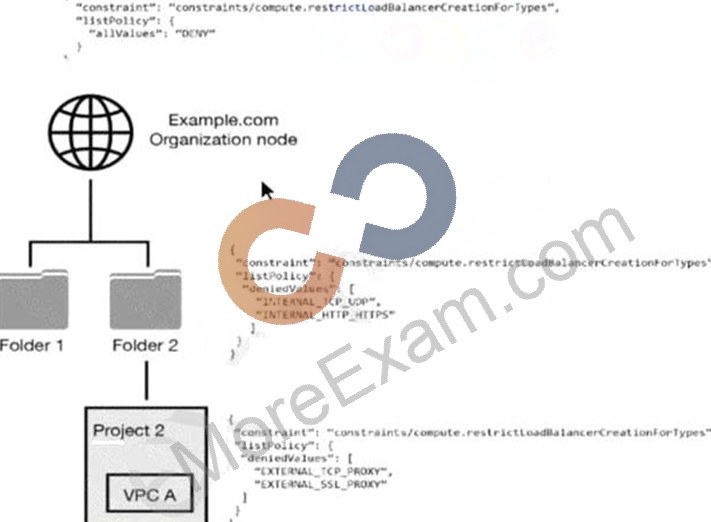
Question22: You have the following resource hierarchy. There is an organization policy at each node in the hierarchy as shown. Which load balancer types are denied in VPC A?
Question23: A customer wants to make it convenient for their mobile workforce to access a CRM web interface that is hosted on Google Cloud Platform (GCP). The CRM can only be accessed by someone on the corporate network. The customer wants to make it available over the internet. Your team requires an authentication layer in front of the application that supports two-factor authentication Which GCP product should the customer implement to meet these requirements?
Question24: Your company operates an application instance group that is currently deployed behind a Google Cloud load balancer in us-central-1 and is configured to use the Standard Tier network. The infrastructure team wants to expand to a second Google Cloud region, us-east-2. You need to set up a single external IP address to distribute new requests to the instance groups in both regions.What should you do?
Question25: You have been tasked with implementing external web application protection against common web application attacks for a public application on Google Cloud. You want to validate these policy changes before they are enforced. What service should you use?
Question26: Your company must follow industry specific regulations. Therefore, you need to enforce customer-managed encryption keys (CMEK) for all new Cloud Storage resources in the organization called org1.What command should you execute?
Question27: You are working with a client who plans to migrate their data to Google Cloud. You are responsible for recommending an encryption service to manage their encrypted keys. You have the following requirements:* The master key must be rotated at least once every 45 days.* The solution that stores the master key must be FIPS 140-2 Level 3 validated.* The master key must be stored in multiple regions within the US for redundancy.Which solution meets these requirements?
Question28: Your team wants to make sure Compute Engine instances running in your production project do not have public IP addresses. The frontend application Compute Engine instances will require public IPs. The product engineers have the Editor role to modify resources. Your team wants to enforce this requirement.How should your team meet these requirements?
Question29: After completing a security vulnerability assessment, you learned that cloud administrators leave Google Cloud CLI sessions open for days. You need to reduce the risk of attackers who might exploit these open sessions by setting these sessions to the minimum duration.What should you do?
Question30: Your organization is building a real-time recommendation engine using ML models that process live user activity data stored in BigQuery and Cloud Storage. Each new model developed is saved to Artifact Registry.This new system deploys models to Google Kubernetes Engine and uses Pub/Sub for message queues. Recent industry news has been reporting attacks exploiting ML model supply chains. You need to enhance the security in this serverless architecture, specifically against risks to the development and deployment pipeline.What should you do?
Question31: You manage a mission-critical workload for your organization, which is in a highly regulated industry The workload uses Compute Engine VMs to analyze and process the sensitive data after it is uploaded to Cloud Storage from the endpomt computers. Your compliance team has detected that this workload does not meet the data protection requirements for sensitive data. You need to meet these requirements;* Manage the data encryption key (DEK) outside the Google Cloud boundary.* Maintain full control of encryption keys through a third-party provider.* Encrypt the sensitive data before uploading it to Cloud Storage* Decrypt the sensitive data during processing in the Compute Engine VMs* Encrypt the sensitive data in memory while in use in the Compute Engine VMs What should you do?Choose 2 answers
Question32: An organization is starting to move its infrastructure from its on-premises environment to Google Cloud Platform (GCP). The first step the organization wants to take is to migrate its ongoing data backup and disaster recovery solutions to GCP. The organization's on-premises production environment is going to be the next phase for migration to GCP. Stable networking connectivity between the on-premises environment and GCP is also being implemented.Which GCP solution should the organization use?
Question33: Which Identity-Aware Proxy role should you grant to an Identity and Access Management (IAM) user to access HTTPS resources?
Question34: Your company's new CEO recently sold two of the company's divisions. Your Director asks you to help migrate the Google Cloud projects associated with those divisions to a new organization node. Which preparation steps are necessary before this migration occurs? (Choose two.)
Question35: Which type of load balancer should you use to maintain client IP by default while using the standard network tier?
Question36: Your DevOps team uses Packer to build Compute Engine images by using this process:1 Create an ephemeral Compute Engine VM.2 Copy a binary from a Cloud Storage bucket to the VM's file system.3 Update the VM's package manager.4 Install external packages from the internet onto the VM.Your security team just enabled the organizational policy. consrraints/compure.vnExtemallpAccess. to restrict the usage of public IP Addresses on VMs. In response your DevOps team updated their scripts to remove public IP addresses on the Compute Engine VMs however the build pipeline is failing due to connectivity issues.What should you do?Choose 2 answers
Question37: Your organization processes sensitive health information. You want to ensure that data is encrypted while in use by the virtual machines (VMs). You must create a policy that is enforced across the entire organization.What should you do?
Question38: Your company has deployed an application on Compute Engine. The application is accessible by clients on port 587. You need to balance the load between the different instances running the application. The connection should be secured using TLS, and terminated by the Load Balancer.What type of Load Balancing should you use?
Question39: An engineering team is launching a web application that will be public on the internet. The web application is hosted in multiple GCP regions and will be directed to the respective backend based on the URL request.Your team wants to avoid exposing the application directly on the internet and wants to deny traffic from a specific list of malicious IP addresses Which solution should your team implement to meet these requirements?
Question40: You are a Security Administrator at your organization. You need to restrict service account creation capability within production environments. You want to accomplish this centrally across the organization. What should you do?
Question41: You are troubleshooting access denied errors between Compute Engine instances connected to a Shared VPC and BigQuery datasets. The datasets reside in a project protected by a VPC Service Controls perimeter. What should you do?
Question42: You are the security admin of your company. You have 3,000 objects in your Cloud Storage bucket. You do not want to manage access to each object individually. You also do not want the uploader of an object to always have full control of the object. However, you want to use Cloud Audit Logs to manage access to your bucket.What should you do?
Question43: In a shared security responsibility model for IaaS, which two layers of the stack does the customer share responsibility for? (Choose two.)
Question44: Your organization has on-premises hosts that need to access Google Cloud APIs You must enforce private connectivity between these hosts minimize costs and optimize for operational efficiency What should you do?
Question45: In order to meet PCI DSS requirements, a customer wants to ensure that all outbound traffic is authorized.Which two cloud offerings meet this requirement without additional compensating controls? (Choose two.)
Question46: You want to use the gcloud command-line tool to authenticate using a third-party single sign-on (SSO) SAML identity provider. Which options are necessary to ensure that authentication is supported by the third-party identity provider (IdP)? (Choose two.)
Question47: You are a member of your company's security team. You have been asked to reduce your Linux bastion host external attack surface by removing all public IP addresses. Site Reliability Engineers (SREs) require access to the bastion host from public locations so they can access the internal VPC while off-site. How should you enable this access?
Question48: Your organization is using GitHub Actions as a continuous integration and delivery (Cl/CD) platform. You must enable access to Google Cloud resources from the Cl/CD pipelines in the most secure way.What should you do?
Question49: Your application is deployed as a highly available cross-region solution behind a global external HTTP(S) load balancer. You notice significant spikes in traffic from multiple IP addresses but it is unknown whether the IPs are malicious. You are concerned about your application's availability. You want to limit traffic from these clients over a specified time interval.What should you do?
Question50: Your Google Cloud organization allows for administrative capabilities to be distributed to each team through provision of a Google Cloud project with Owner role (roles/ owner). The organization contains thousands of Google Cloud Projects Security Command Center Premium has surfaced multiple cpen_myscl_port findings.You are enforcing the guardrails and need to prevent these types of common misconfigurations.What should you do?
Question51: Your organization is moving virtual machines (VMs) to Google Cloud. You must ensure that operating system images that are used across your projects are trusted and meet your security requirements.What should you do?
Question52: Your organization uses a microservices architecture based on Google Kubernetes Engine (GKE). Security reviews recommend tighter controls around deployed container images to reduce potential vulnerabilities and maintain compliance. You need to implement an automated system by using managed services to ensure that only approved container images are deployed to the GKE clusters. What should you do?
Question53: Your organization operates Virtual Machines (VMs) with only private IPs in the Virtual Private Cloud (VPC) with internet access through Cloud NAT Everyday, you must patch all VMs with critical OS updates and provide summary reports What should you do?
Question54: You need to implement an encryption at-rest strategy that reduces key management complexity for non- sensitive data and protects sensitive data while providing the flexibility of controlling the key residency and rotation schedule. FIPS 140-2 L1 compliance is required for all data types. What should you do?
Question55: You have numerous private virtual machines on Google Cloud. You occasionally need to manage the servers through Secure Socket Shell (SSH) from a remote location. You want to configure remote access to the servers in a manner that optimizes security and cost efficiency.What should you do?
Question56: You need to centralize your team's logs for production projects. You want your team to be able to search and analyze the logs using Logs Explorer. What should you do?
Question57: As adoption of the Cloud Data Loss Prevention (DLP) API grows within the company, you need to optimize usage to reduce cost. DLP target data is stored in Cloud Storage and BigQuery. The location and region are identified as a suffix in the resource name.Which cost reduction options should you recommend?
Question58: Your organization leverages folders to represent different teams within your Google Cloud environment. To support Infrastructure as Code (IaC) practices, each team receives a dedicated service account upon onboarding. You want to ensure that teams have comprehensive permissions to manage resources within their assigned folders while adhering to the principle of least privilege. You must design the permissions for these team-based service accounts in the most effective way possible. What should you do?
Question59: A customer is running an analytics workload on Google Cloud Platform (GCP) where Compute Engine instances are accessing data stored on Cloud Storage. Your team wants to make sure that this workload will not be able to access, or be accessed from, the internet.Which two strategies should your team use to meet these requirements? (Choose two.)
Question60: An administrative application is running on a virtual machine (VM) in a managed group at port 5601 inside a Virtual Private Cloud (VPC) instance without access to the internet currently. You want to expose the web interface at port 5601 to users and enforce authentication and authorization Google credentials What should you do?
Question61: A large financial institution is moving its Big Data analytics to Google Cloud Platform. They want to have maximum control over the encryption process of data stored at rest in BigQuery.What technique should the institution use?
Question62: You have been tasked with configuring Security Command Center for your organization's Google Cloud environment. Your security team needs to receive alerts of potential crypto mining in the organization's compute environment and alerts for common Google Cloud misconfigurations that impact security. Which Security Command Center features should you use to configure these alerts? (Choose two.)
Question63: You are creating a new infrastructure CI/CD pipeline to deploy hundreds of ephemeral projects in your Google Cloud organization to enable your users to interact with Google Cloud. You want to restrict the use of the default networks in your organization while following Google-recommended best practices. What should you do?
Question64: You are consulting with a client that requires end-to-end encryption of application data (including data in transit, data in use, and data at rest) within Google Cloud. Which options should you utilize to accomplish this? (Choose two.)
Question65: A company is backing up application logs to a Cloud Storage bucket shared with both analysts and the administrator. Analysts should only have access to logs that do not contain any personally identifiable information (PII). Log files containing PII should be stored in another bucket that is only accessible by the administrator.What should you do?
Question66: Your organization deploys a large number of containerized applications on Google Kubernetes Engine (GKE). Node updates are currently applied manually. Audit findings show that a critical patch has not been installed due to a missed notification. You need to design a more reliable, cloud-first, and scalable process for node updates. What should you do?
Question67: An application running on a Compute Engine instance needs to read data from a Cloud Storage bucket. Your team does not allow Cloud Storage buckets to be globally readable and wants to ensure the principle of least privilege.Which option meets the requirement of your team?
Question68: A company migrated their entire data/center to Google Cloud Platform. It is running thousands of instances across multiple projects managed by different departments. You want to have a historical record of what was running in Google Cloud Platform at any point in time.What should you do?
Question69: A database administrator notices malicious activities within their Cloud SQL instance. The database administrator wants to monitor the API calls that read the configuration or metadata of resources. Which logs should the database administrator review?
Question70: A company is using Google Kubernetes Engine (GKE) with container images of a mission-critical application The company wants to scan the images for known security issues and securely share the report with the security team without exposing them outside Google Cloud.What should you do?
Question71: A business unit at a multinational corporation signs up for GCP and starts moving workloads into GCP. The business unit creates a Cloud Identity domain with an organizational resource that has hundreds of projects.Your team becomes aware of this and wants to take over managing permissions and auditing the domain resources.Which type of access should your team grant to meet this requirement?
Question72: Your company is storing sensitive data in Cloud Storage. You want a key generated on-premises to be used in the encryption process.What should you do?
Question73: An organization is moving applications to Google Cloud while maintaining a few mission-critical applications on-premises. The organization must transfer the data at a bandwidth of at least 50 Gbps. What should they use to ensure secure continued connectivity between sites?
Question74: You want to make sure that your organization's Cloud Storage buckets cannot have data publicly available to the internet. You want to enforce this across all Cloud Storage buckets. What should you do?
Question75: Your company is moving to Google Cloud. You plan to sync your users first by using Google Cloud Directory Sync (GCDS). Some employees have already created Google Cloud accounts by using their company email addresses that were created outside of GCDS. You must create your users on Cloud Identity.What should you do?
Question76: You want data on Compute Engine disks to be encrypted at rest with keys managed by Cloud Key Management Service (KMS). Cloud Identity and Access Management (IAM) permissions to these keys must be managed in a grouped way because the permissions should be the same for all keys.What should you do?
Question77: You define central security controls in your Google Cloud environment for one of the folders in your organization you set an organizational policy to deny the assignment of external IP addresses to VMs. Two days later you receive an alert about a new VM with an external IP address under that folder.What could have caused this alert?
Question78: Your organization is using Vertex AI Workbench Instances. You must ensure that newly deployed instances are automatically kept up-to-date and that users cannot accidentally alter settings in the operating system.What should you do?
Question79: Which two security characteristics are related to the use of VPC peering to connect two VPC networks?(Choose two.)
Question80: Your organization is using Vertex AI Workbench Instances. You must ensure that newly deployed instances are automatically kept up-to-date and that users cannot accidentally alter settings in the operating system.What should you do?
Question81: Your team needs to obtain a unified log view of all development cloud projects in your SIEM. The development projects are under the NONPROD organization folder with the test and pre-production projects.The development projects share the ABC-BILLING billing account with the rest of the organization.Which logging export strategy should you use to meet the requirements?
Question82: A company is running workloads in a dedicated server room. They must only be accessed from within the private company network. You need to connect to these workloads from Compute Engine instances within a Google Cloud Platform project.Which two approaches can you take to meet the requirements? (Choose two.)
Question83: For compliance reasons, an organization needs to ensure that in-scope PCI Kubernetes Pods reside on "in- scope" Nodes only. These Nodes can only contain the "in-scope" Pods.How should the organization achieve this objective?
Question84: You are a security engineer at a finance company. Your organization plans to store data on Google Cloud, but your leadership team is worried about the security of their highly sensitive data Specifically, your company is concerned about internal Google employees' ability to access your company's data on Google Cloud. What solution should you propose?
Question85: Your organization s record data exists in Cloud Storage. You must retain all record data for at least seven years This policy must be permanent.What should you do?
Question86: Your organization strives to be a market leader in software innovation. You provided a large number of Google Cloud environments so developers can test the integration of Gemini in Vertex AI into their existing applications or create new projects. Your organization has 200 developers and a five-person security team.You must prevent and detect proper security policies across the Google Cloud environments. What should you do? (Choose 2 answers)
Question87: A customer needs an alternative to storing their plain text secrets in their source-code management (SCM) system.How should the customer achieve this using Google Cloud Platform?
Question88: A company has redundant mail servers in different Google Cloud Platform regions and wants to route customers to the nearest mail server based on location.How should the company accomplish this?
Question89: Your organization wants to protect all workloads that run on Compute Engine VM to ensure that the instances weren't compromised by boot-level or kernel-level malware. Also, you need to ensure that data in use on the VM cannot be read by the underlying host system by using a hardware-based solution.What should you do?
Question90: Your organization is transitioning to Google Cloud You want to ensure that only trusted container images are deployed on Google Kubernetes Engine (GKE) clusters in a project. The containers must be deployed from a centrally managed. Container Registry and signed by a trusted authority.What should you do?Choose 2 answers
Question91: Your company is concerned about unauthorized parties gaming access to the Google Cloud environment by using a fake login page. You must implement a solution to protect against person-in-the-middle attacks.Which security measure should you use?
Question92: A customer's data science group wants to use Google Cloud Platform (GCP) for their analytics workloads.Company policy dictates that all data must be company-owned and all user authentications must go through their own Security Assertion Markup Language (SAML) 2.0 Identity Provider (IdP). The Infrastructure Operations Systems Engineer was trying to set up Cloud Identity for the customer and realized that their domain was already being used by G Suite.How should you best advise the Systems Engineer to proceed with the least disruption?
Question93: A manager wants to start retaining security event logs for 2 years while minimizing costs. You write a filter to select the appropriate log entries.Where should you export the logs?
Question94: Your team needs to configure their Google Cloud Platform (GCP) environment so they can centralize the control over networking resources like firewall rules, subnets, and routes. They also have an on-premises environment where resources need access back to the GCP resources through a private VPN connection. The networking resources will need to be controlled by the network security team.Which type of networking design should your team use to meet these requirements?
Question95: You need to enforce a security policy in your Google Cloud organization that prevents users from exposing objects in their buckets externally. There are currently no buckets in your organization. Which solution should you implement proactively to achieve this goal with the least operational overhead?
Question96: You are deploying regulated workloads on Google Cloud. The regulation has data residency and data access requirements. It also requires that support is provided from the same geographical location as where the data resides.What should you do?
Question97: You are implementing a new web application on Google Cloud that will be accessed from your on-premises network. To provide protection from threats like malware, you must implement transport layer security (TLS) interception for incoming traffic to your application. What should you do?
Question98: A customer implements Cloud Identity-Aware Proxy for their ERP system hosted on Compute Engine. Their security team wants to add a security layer so that the ERP systems only accept traffic from Cloud Identity- Aware Proxy.What should the customer do to meet these requirements?
Question99: Your company plans to move most of its IT infrastructure to Google Cloud. They want to leverage their existing on-premises Active Directory as an identity provider for Google Cloud. Which two steps should you take to integrate the company's on-premises Active Directory with Google Cloud and configure access management? (Choose two.)
Question100: An organization's typical network and security review consists of analyzing application transit routes, request handling, and firewall rules. They want to enable their developer teams to deploy new applications without the overhead of this full review.How should you advise this organization?
Question101: You are setting up a new Cloud Storage bucket in your environment that is encrypted with a customer managed encryption key (CMEK). The CMEK is stored in Cloud Key Management Service (KMS). in project"pr j -a", and the Cloud Storage bucket will use project "prj-b". The key is backed by a Cloud Hardware Security Module (HSM) and resides in the region europe-west3. Your storage bucket will be located in the region europe-west1. When you create the bucket, you cannot access the key. and you need to troubleshoot why.What has caused the access issue?
Question102: Users are reporting an outage on your public-facing application that is hosted on Compute Engine. You suspect that a recent change to your firewall rules is responsible. You need to test whether your firewall rules are working properly. What should you do?
Question103: You are a consultant for an organization that is considering migrating their data from its private cloud to Google Cloud. The organization's compliance team is not familiar with Google Cloud and needs guidance on how compliance requirements will be met on Google Cloud. One specific compliance requirement is for customer data at rest to reside within specific geographic boundaries. Which option should you recommend for the organization to meet their data residency requirements on Google Cloud?
Question104: When creating a secure container image, which two items should you incorporate into the build if possible?(Choose two.)
Question105: Your organization wants to be continuously evaluated against CIS Google Cloud Computing Foundations Benchmark v1 3 0 (CIS Google Cloud Foundation 1 3). Some of the controls are irrelevant to your organization and must be disregarded in evaluation. You need to create an automated system or process to ensure that only the relevant controls are evaluated.What should you do?
Question106: You are working with a client that is concerned about control of their encryption keys for sensitive data. The client does not want to store encryption keys at rest in the same cloud service provider (CSP) as the data that the keys are encrypting. Which Google Cloud encryption solutions should you recommend to this client?(Choose two.)
Question107: You are working with protected health information (PHI) for an electronic health record system. The privacy officer is concerned that sensitive data is stored in the analytics system. You are tasked with anonymizing the sensitive data in a way that is not reversible. Also, the anonymized data should not preserve the character set and length. Which Google Cloud solution should you use?
Question108: Your company's Chief Information Security Officer (CISO) creates a requirement that business data must be stored in specific locations due to regulatory requirements that affect the company's global expansion plans.After working on the details to implement this requirement, you determine the following:The services in scope are included in the Google Cloud Data Residency Terms.The business data remains within specific locations under the same organization.The folder structure can contain multiple data residency locations.You plan to use the Resource Location Restriction organization policy constraint. At which level in the resource hierarchy should you set the constraint?
Question109: Your company is using GSuite and has developed an application meant for internal usage on Google App Engine. You need to make sure that an external user cannot gain access to the application even when an employee's password has been compromised.What should you do?
Question110: You must ensure that the keys used for at-rest encryption of your data are compliant with your organization's security controls. One security control mandates that keys get rotated every 90 days. You must implement an effective detection strategy to validate if keys are rotated as required. What should you do?
Question111: You have noticed an increased number of phishing attacks across your enterprise user accounts. You want to implement the Google 2-Step Verification (2SV) option that uses a cryptographic signature to authenticate a user and verify the URL of the login page. Which Google 2SV option should you use?
Question112: You are creating an internal App Engine application that needs to access a user's Google Drive on the user's behalf. Your company does not want to rely on the current user's credentials. It also wants to follow Google- recommended practices.What should you do?
Question113: Your Security team believes that a former employee of your company gained unauthorized access to Google Cloud resources some time in the past 2 months by using a service account key. You need to confirm the unauthorized access and determine the user activity. What should you do?
Question114: A customer is collaborating with another company to build an application on Compute Engine. The customer is building the application tier in their GCP Organization, and the other company is building the storage tier in a different GCP Organization. This is a 3-tier web application. Communication between portions of the application must not traverse the public internet by any means.Which connectivity option should be implemented?
Question115: You work for an organization in a regulated industry that has strict data protection requirements. The organization backs up their data in the cloud. To comply with data privacy regulations, this data can only be stored for a specific length of time and must be deleted after this specific period.You want to automate the compliance with this regulation while minimizing storage costs. What should you do?
Question116: Your company is using Cloud Dataproc for its Spark and Hadoop jobs. You want to be able to create, rotate, and destroy symmetric encryption keys used for the persistent disks used by Cloud Dataproc. Keys can be stored in the cloud.What should you do?
Question117: You want to limit the images that can be used as the source for boot disks. These images will be stored in a dedicated project.What should you do?
Question118: You are designing a new governance model for your organization's secrets that are stored in Secret Manager.Currently, secrets for Production and Non-Production applications are stored and accessed using service accounts. Your proposed solution must:Provide granular access to secretsGive you control over the rotation schedules for the encryption keys that wrap your secrets Maintain environment separation Provide ease of management Which approach should you take?
Question119: A customer wants to run a batch processing system on VMs and store the output files in a Cloud Storage bucket. The networking and security teams have decided that no VMs may reach the public internet.How should this be accomplished?
Question120: A customer terminates an engineer and needs to make sure the engineer's Google account is automatically deprovisioned.What should the customer do?
Question121: You have been tasked with inspecting IP packet data for invalid or malicious content. What should you do?
Question122: You work for a large organization where each business unit has thousands of users. You need to delegate management of access control permissions to each business unit. You have the following requirements:Each business unit manages access controls for their own projects.Each business unit manages access control permissions at scale.Business units cannot access other business units' projects.Users lose their access if they move to a different business unit or leave the company.Users and access control permissions are managed by the on-premises directory service.What should you do? (Choose two.)
Question123: Your organization has had a few recent DDoS attacks. You need to authenticate responses to domain name lookups. Which Google Cloud service should you use?
Question124: You want to evaluate GCP for PCI compliance. You need to identify Google's inherent controls.Which document should you review to find the information?