MoreExam
1. Question Content...
EXPLANATION
Answer: X - EXPLANATION Content.
Question1: When designing a Superdome X configuration for a customer, which storage configuration should the architect choose?
Question2: An architect is determining the amount of memory to propose for an HPE XL230a compute tray.The customer specifies several requirements, properties, and parameter of the application.Which factor will critically affect the memory amount requirement to prevent a potential memory bottleneck?
Question3: A customer plans to purchase some c7000 blade enclosures equipped with Virtual Connect FlexFabric modules to support its development and test team. The customer is concerned about frequent changes to the server blade connectivity. In the initial proposal, an architect included HPE OneView, and now the customer wants to learn how HPE OneView will address their concern.Which HPE OneView functionality should the architect explain to the customer?
Question4: A customer's Gen9 web server resides behind a firewall.What is the most secure and efficient method to monitor this server?
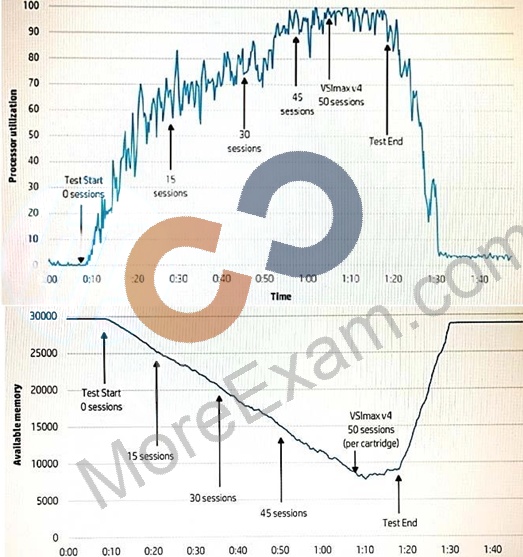
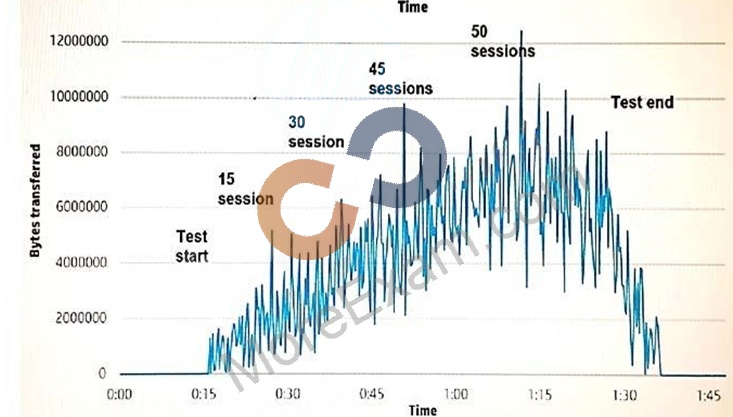
Question5: View the Exhibit.Refer to the exhibit. An architect is planning an HPE Moonshot System with m710 cartridges to support a customer application virtualization solution. The customer indicated that the maximum acceptable response time for the solution is three seconds. The architect has implemented a POC and tested a single cartridge with different numbers of user sessions.The architect monitored resource utilization throughout the tests. The results of the test with the point at which the response time exceeded three seconds are shown, marked as the "VSI max." What should the architect conclude from this test?
Question6: A customer needs high performance computing (HPC) and a small-scale solution with up to eight processors. The solution should also provide storage in a modular form factor. The customer's HPC application is designed so that some nodes act as compute nodes while others act as storage nodes that serve data to the compute nodes.Which HPE Apollo system is most appropriate for this situation?
Question7: An architect reviews an HPE Apollo 6000 design and finds that there are plans for redundant iLO connections on each HPE Apollo 6000 chassis to a pair of top-of-rack switches. These switches are set up as individual switches connected to a single core.Which configuration change should the architect recommend to ensure a loop free management topology?
Question8: An architect needs to design a solution for a customer that stores all data on third-party NAS storage, and that does not yet have a database solution. The new HPE-based solution must be optimized for data mining.How can the current data stored on the NAS be used for data mining?
Question9: An architect is planning an HPE Moonshot System to host a customer Hadoop MapReduce2 application.The architect originally proposed the following:m710 cartridgesHPE 45XGc switchesHPE 4-QSFP+ Uplink ModulesThe customer now needs each HPE Moonshot chassis to provide at least 1TB of memory and 40TB or local storage.Cartridge nodes needs two 10GbE ports each.What does the architect need to replace in the solution to meet the customer's new requirements?
Question10: A customer needs to streamline monitoring to its HPE Apollo 6000 solution.Which benefit can HPE Advanced Power Management (APM) provide to this customer?
Question11: A customer needs a hosted physical desktop solution. Users will run typical oꢀice applications with limited use of some media-rich applications such as Adobe Photoshop. The customer needs the densest and most cost-effective solution that can support such users.Which HPE Moonshot cartridge should the architect recommend?
Question12: An architect is planning an HPE Moonshot solution with m710p cartridges. The customer's application requires cartridge nodes to connect to a NAS. The customer's current infrastructure supports 10GbE. In the future, the customer plans to upgrade the fabric between the HPE Moonshot and the NAS solution to support 40GbE.Which switch modules and uplink modules should the architect recommend to meet both the current and future needs?
Question13: An architect is proposing an HPE Moonshot System, including m710 cartridges, an iLO Chassis Manager, switch, and uplink modules. The customer needs IT staff to be able to access cartridges over a Remote console.What should the architect explain to the customer?
Question14: What is one advantage of hard partitioning, or nPartitioning, for HPE Integrity Superdome X as compared to virtual partitioning?
Question15: A customer needs a mission critical SQL database. The customer has an HPE StoreServ and plans to use this as storage.The solution must meet the following requirements:- 240 logical cores (Hyper-Threading enabled)- support for 6TB Memory- 16GB FC- 35TB RAID 1 storage- the ability for hardware partitioning to build different physical partitions and scale as the need for CPU and memory resources grows Which solution should the architect recommend?
Question16: An architect is designing a solution, a key element of which is the capability for fast VMware cluster growth with minimal administrative interaction.Which HPE solution should the architect recommend?
Question17: A customer is deploying HPE Apollo Systems, which the customer hopes will help the organization achieve its goals for efficient energy operations. In assessing the customer maturity, the architect finds that IT staff has limited insight into how efficiently servers are operating and limited ability to enforce energy efficiency policies.Which solution should the architect recommend to help solve these issues?
Question18: Under which Transformation Area do HPE Moonshot solutions with Citrix fail?
Question19: A customer has a mixed environment based on the G6, G7, Gen8, and Gen9 ProLiant server blades. The customer is interested in implementing HPE OneView but needs to understand security and monitoring mechanisms for different server generations.Which statement most accurately describes different platform support in HPE OneView?
Question20: An architect is writing a response to a Request for Proposal (RFP). The customer has requested financial information on the monetary amount by which assets are valued in business records.Which value does the architect need to consider?
Question21: During a data center transformation discussion, an architect obtains the following customer information:core business depends heavily on advanced data modelling techniques that has been developedinternallyinfrastructure in use takes anywhere from 10 hours to five days to complete complex data models forthe various development teams that rely on themhas a proud reputation as an "environmentally friendly" Fortune 500 companyincreasing productivity of its development team is the highest priorityWhich large scale HPC solution should the architect recommend to help the customer achieve its transformation goals?
Question22: A customer requires a server infrastructure update for its Hadoop HBase solution. The HBase maximum dataset size will be 120TB.To host HBase, the architect is planning three HPE Moonshot 1500 chassis fully populated with cartridges.The populated chassis provide the following in total:- 135 processors with four 2.9GHz cores each- 4.23TB RAM- 64.8TB local storage on SSDsAn aspect of the design is under provisioned and is likely to cause performance to degrade to one-tenth or even one-hundredth of its potential.How can the architect resolve this problem?
Question23: Which network infrastructure components should an architect consider when recommending 40GbE in a server solution?
Question24: A customer needs a live transcoding solution that meets the following requirements:Supports thousands of HD streamsProvides GPU accelerationProvides a high density of streams per Watt and rack unitWhich solution should the architect recommend?
Question25: A customer plans to add a high performance computing system capable of hard partitioning to a data center that employs HPE StoreServ 7000.Which solution should the architect include in the design?
Question26: An architect plans to propose a solution and illustrate how it will reduce the predictable and repeatable costs for items and services not registered as assets.Which reporting period information helps the architect achieve this goal?
Question27: An architect is proposing a solution that has two HPE Moonshot 1500 chassis, each of which is full of m700 cartridges. The customer needs the solution to quickly deploy the OS to cartridges, back up a golden node image. and clone the image.The customer is concerned about cost and is not interested in managing or monitoring performance of the solution, Which solution meets these requirements?
Question28: What is a basic assumption for an architect using the HPE Servers TCO calculator to justify a customer's migration away from a fully depreciated set of hardware?
Question29: A customer is working on a project to enable workplace productivity. The customer needs a solution that will allow employees to connect to their workplace environment by using a personal mobile phone, tablet, laptop, or desktop computer. Employees must be able to stop and resume work seamlessly while travelling between offices.Which purpose-built hardware can the customer use to help achieve this goal?
Question30: A customer's business critical application server, which is managed by HPE OneView, recovered from an automatic ASR reboot. HPE Support requests an Active Health System log.What should the customer use to access the log while the server is online?
Question31: Which factors must the architect consider to help define an appropriate HPE server solution to meet a customer's needs?
Question32: A proposed solution includes the HPE Moonshot-4QSFP+ Uplink Modules. The customer informs the architect that the planned purchase of 40GbE switches has been postponed. The customer still intends to purchase 40GbE switches within a year, but in the meantime, existing 10GbE switches will be used. These switches are HPE network switches located 25 meters from the location of the racks that house the HPE Moonshot Solution. The customer needs 30Gb/s bandwidth.Which action should the architect recommend to allow the customer to deploy the solution immediately and easily take advantage of 40GbE when deployed later?
Question33: Which of the HPE Transformation Areas should the architect discuss when the customer's concerns span backup and recovery, high availability, and disaster recovery?
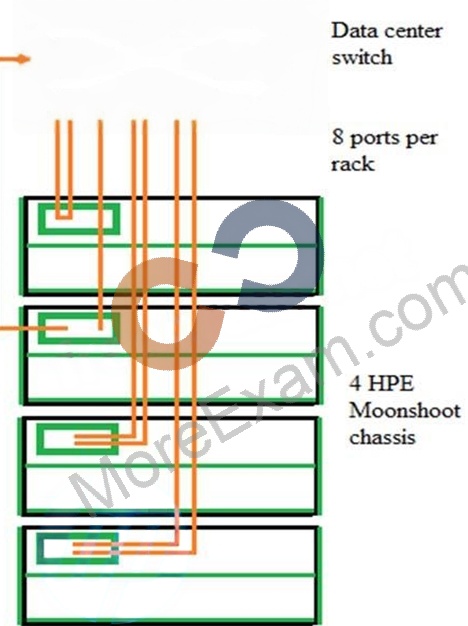
Question34: An architect proposes an HPE Moonshot solution to a customer. The customer informs the architect that the data center switches can only provide four 40GbE ports per rack.How should the architect modify the proposed solution so that each rack meets the requirement?
Question35: An architect is designing an HPE Apollo 6000 solution to support a customer application. The architect is choosing between the HPE ProLiant XL230a and the XL250a compute tray.What is one reason for choosing the XL250a tray?
Question36: An architect is designing a data center solution that contains an HPE BladeSystem for the virtual application, infrastructure, and VDI environment. It also contains an HPE Moonshot for the web servers.In which parts of the HPE Transformation Area does this solution fit?
Question37: An architect finds several vulnerabilities with a customer's digital enterprise that could lead to data loss on a third-party storage system for critical business segments.Which solution should the architect propose to help the customer to protect their digital enterprise?
Question38: A customer needs an HPE Apollo 6000 solution and Remote Direct Memory Access (RDMA).Which network interconnects should the architect recommend for this solution? (Choose two.)
Question39: An architect explains a software-defined data center (SDDC) concept and its benefits to a customer. The customer indicates an interest and so the architect needs to verify whether the customer is ready to move to the SDDC.Which additional information should the architect obtain from the customer to verify this?
Question40: How does the HPE c7000 BladeSystems use of network infrastructure compare with the HPE Apollo6000's?
Question41: An architect has selected the FlexibleLOM option fur HPE XL230a compute trays, which will host an HPC application.When should the architect select a FlexibleLOM adapter that supports Fibre Channel over Ethernet (FCoE)?
Question42: A customer has a large Oracle-based ERP solution that runs on HPUX and multiple rx2800 i2 servers. The customer plans to move to an open source solution to reduce operating expenses. The customer needs the ability to deliver incremental capacity and needs to avoid incremental Oracle licensing costs.Which HPE Server solution will help meet the customer's needs?
Question43: A customer needs to integrate an existing incident management application with HPE OneView. The customer needs to be notified when the physical resource status changes or when a new server is added to the infrastructure.Which HPE OneView feature should the architect recommend to the customer?
Question44: An architect is planning an HPE Apollo 4530 solution to support the Cloudera distribution of Spark and HDFS. Each HPE ProLiant XL450 in the solution uses the following baseline recommendations:- 15 8TB HDDs (120TB total)- 2 10-core 2.3GHz processors- 128GB memory (64GB on each processor)- 2-port 10GbE FlexibleLOMThe architect has planned enough servers to meet the customer's requirements for total capacity.Which two components in this plan are most likely to cause a bottleneck as an increasing number of Spark applications run?
Question45: An architect is planning an HPE Integrity Superdome X solution with the following nPartitions:nPar 1= Slots 1, 3, and 5nPar 2 = Slots 2, 4, and 6The Superdome X solution must connect to a Fibre Channel SAN solution, which provides boot disks for the Superdome X solution.The architect has selected a FlexibleLOM adapter for each blade.What is a valid plan for additional adapters?
Question46: A customer has an HPE Integrity Superdome X system with an nPartition that has been provisioned with a supported OS and application.What first detects data corruption caused by an installed DIMM module?
Question47: A customer needs a server quote for a DL Gen9 server. The requirements are as follows:- Gen9 technology with internal storage to support 12 drives- Exchange database capacity of at least 1.2TB- 512GB of LRDIMM memory- 10Gbe Ethernet supportThe architect is proposing the DL380 Gen9 server to meet this customer's current needs and some near future expansion.Which component should the architect add to the quote to meet the customer's requirements?