MoreExam
1. Question Content...
EXPLANATION
Answer: X - EXPLANATION Content.
Question1: Does this correctly describe the ArubaOS-CX architecture?Solution: The ArubaOS-CX time-series database helps to support network analytics and troubleshooting.
Question2: A data center has a three-tier topology with ArubaOS-CX switches at each layer, is this a use case for implementing Virtual Switching Extension (VSX) at the core?Solution: The aggregation layer operates at Layer 2 only, and the core provides Layer 2 and Layer 3 functions.
Question3: You plan to use multi-protocol BGP to implement dynamic VRF route leaking on an ArubaOS-CX switch.Is this a rule for the setup?Solution: You cannot leak multicast routes.
Question4: Is this a way that a data center technology can help meet requirements for multi-tenancy?Solution: Virtual Extensible LAN (VXLAN) provides millions of IDs to scale for the needs of a multi-tenant environment
Question5: Is this a rule for configuring schedule profiles on an ArubaOS-CX switch?Solution: With the exception of a single strict priority queue, all queues must use the same scheduling algorithm.
Question6: Does this correctly describe Network Analytics Engine (NAE) limitations on ArubaOS-CX switches?Solution: Different switches have different limitations for the number of NAE scripts, monitors, and agents supported.
Question7: Does this correctly describe routing information advertised by a VXLAN Tunnel Endpomt (VTEP) that uses EVPN?Solution: MAC/IP advertisement routes advertise the MAC addresses that can be reached through the VTEP.
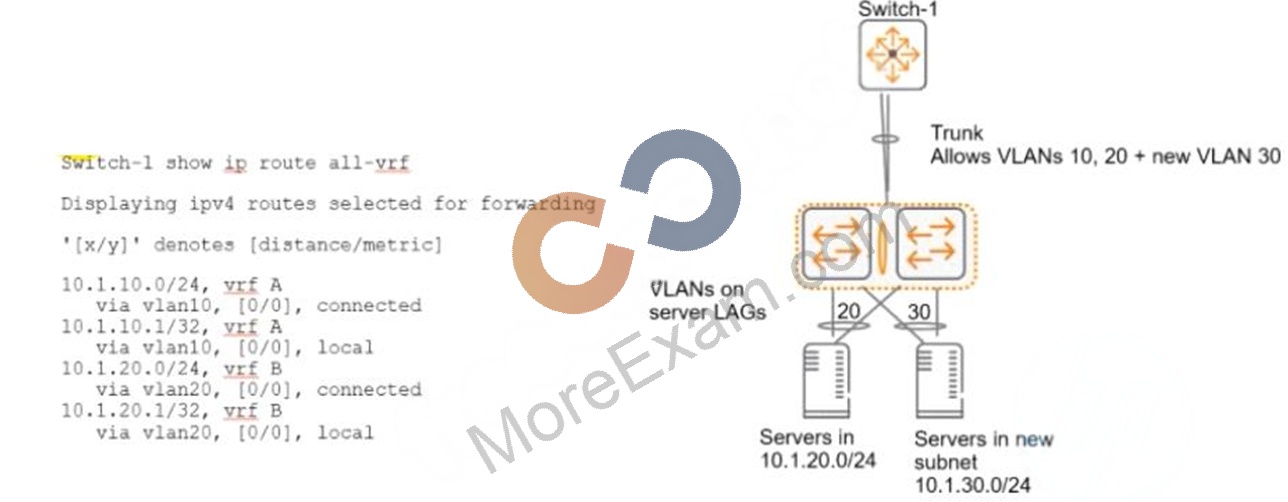
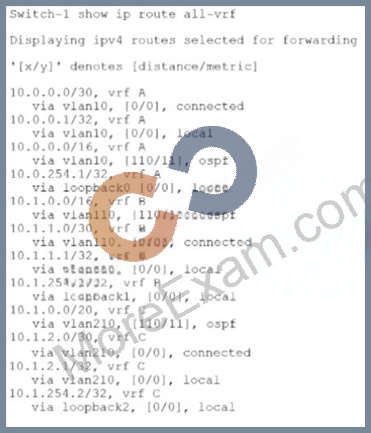
Question8: Refer to the exhibit.Refer to the exhibit.You are adding a VLAN 30, subnet 10.0.30.0/24 to the network shown in the exhibit. (This network is simplified to just the relevant switches for this item.) This subnet belongs in VRF A, and you have added a Layer 3 VLAN 30 interface attached to this VRF on Switch-1. You want to make the services in this VLAN available to devices in 10.1.20.0/24 in VRF B.Is this part of a valid setup for meeting these requirements?Solution: Add VRF B as the secondary VRF on VLAN interface 30.
Question9: Refer to the exhibit.You are adding a VLAN 30, subnet 10.0.30.0/24 to the network shown in the exhibit. (This network is simplified to just the relevant switches for this item.) This subnet belongs in VRF A, and you have added a Layer 3 VLAN 30 interface attached to this VRF on Switch-1. You want to make the services in this VLAN available to devices in 10.1.20.0/24 in VRF B.Is this part of a valid setup for meeting these requirements?Solution: Add a route with this command: ip route 10.1.20.0/24 vlan20 vrf A
Question10: AtubaOS-CX switches are acting as Virtual Extensible LAN (VXLAN) Tunnel Endpoints (VTEPs) WITHOUT Ethernet VPN (EVPN).Does this correctly describe how the VTEPs handle VXLAN traffic forwarding?Solution: VTEPs that use headend replication forward unicasts with unknown destination MAC addresses as unicast packets to each VTEP in the same VNl.
Question11: Is this a way that Virtual Switching Extension (VSX) differs from Virtual Switching Framework (VSF)?Solution: VSX permits admins to select which features to synchronize between members while VSF requires manual configuration of Identical features on each member of the VSF fabric.
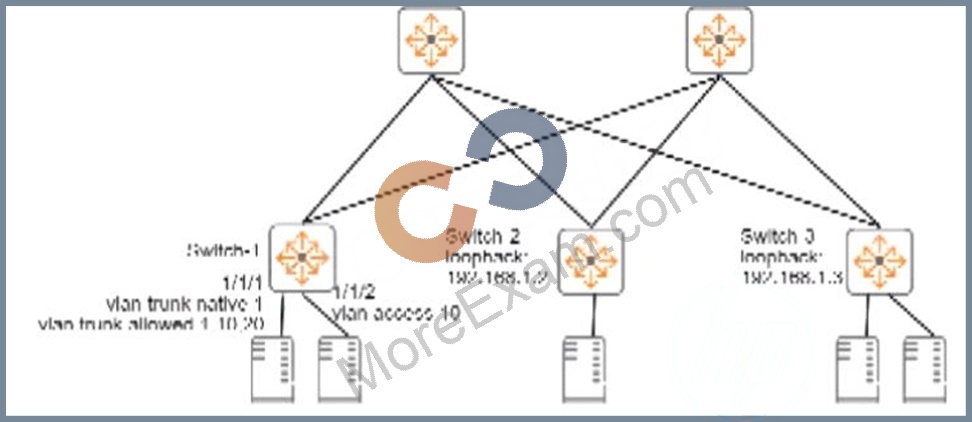
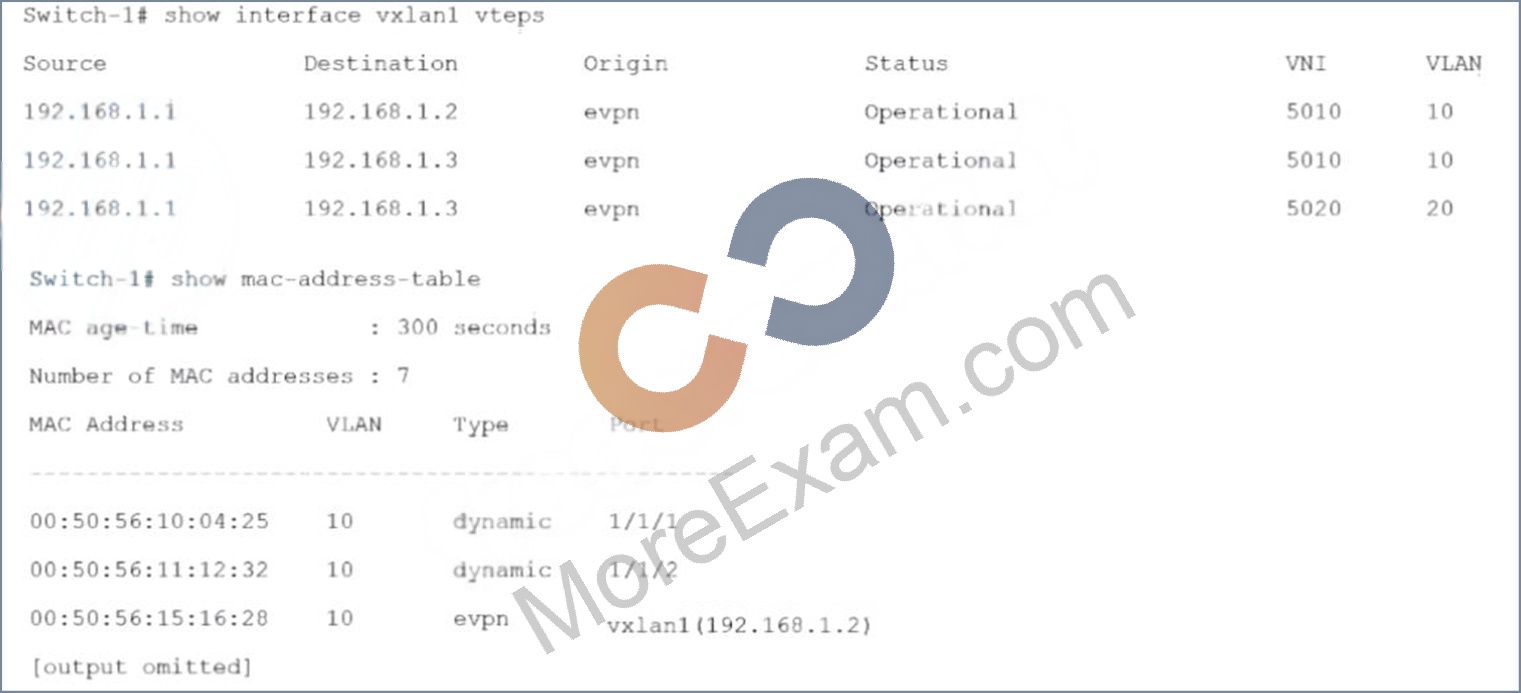
Question12: Refer to the exhibits.Is this how the switch-1 handles the traffic?Solution: A broadcast arrives in VLAN 10 on Switch-1. Switch 1 forwards the frame on all interfaces assigned to VLAN 10, except the incoming interface. It encapsulates the broadcast with VXIAN and sends it to 192.168.1.3, out not 192.168.1.2.
Question13: Does this correctly describe how Network Analytics Engine (NAE) agents work?Solution: Agents write data to the switch's current state database.
Question14: Refer to the exhibits.Is this how the switch handles the traffic?Solution: A broadcast arrives in VLAN 10 on Switch-1. Switch 1 forwards the frame on all interfaces assigned to VLAN10, except the incoming interface. It encapsulates the broadcast with VXIAN and sends it to 192.168.1.2. but not 192.168.1.3.
Question15: A customer's servers use ISCSI, and they send data and storage traffic on the same pair of I OGbE links. Is this a best practice for supporting the ISCSI requirements?Solution: Set up dedicated switches to connect to iSCSl arrays. Connect top of rack (ToR) switches, which will support both data and storage traffic, to those dedicated switches.
Question16: Your task is to configure an EVPN solution for a dual-stack IPv4 and IPv6 protocol in the overlay networks. Is this statement about EVPN and IPv6 correct?Solution: Different virtual MAC must be used for IPv4 and IPv6 Active Gateway.
Question17: You are using NetEdit to manage AruDaOS-CX switches. You want to deploy a standard config to the switches, but need the config to include a few device-specific settings such as hostname and IP address.Is this what you should do?Solution: Inside a configuration plan, light-click any device-specific parameters and modify the parameter per-device.
Question18: Is this correct positioning of AtubaOS-CX switches in the data center?Solution: Aruba CX 8325 switches are an appropriate choice for leaf switches in a leaf-spine topology that uses Virtual Extensible LAN (VXLAN) with Ethernet VPN (EVPN).
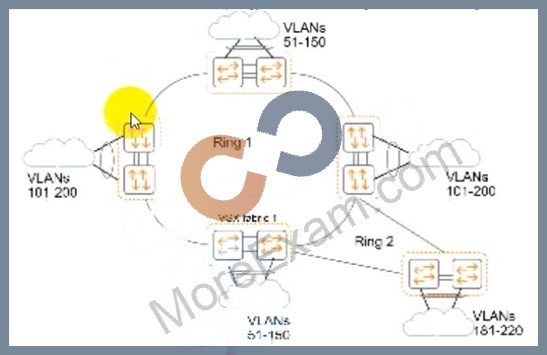
Question19: Refer to the exhibit.which shows the topology tot an Ethernet Ring Protection Switching (ERPS) solution.Is this a valid design for the control and protected VLANs on the VSX fabric 1 switches?Solution: Ring l, instance 1:control VLAN: 1000 protected VLANs: 51-135 Ring 1, Instance 2:control VLAN: 1000 protected VLANs: 136-220 Ring 2, Instance 1: control VLAN: 1001 protected VLANs: 181 -200 Ring 2, Instance 2: control VLAN: 1001 protected VLANs: 201 -220
Question20: Refer to the exhibit.which shows the topology tot an Ethernet Ring Protection Switching (ERPS) solution.Is this a valid design for the control and protected VLANs on the VSX fabric 1 switches?Solution: Ring 1, instance 1:control VLAN: 1000protected VLANs: 51-135 Ring l,Instance2:control VLAN: 1001 protected VLANs: 136-220 Ring 2, Instance 1: control VLAN: 1000 protected VLANs: 181 -200 Ring 2, Instance 2: control VLAN: 1003 protected VLANs: 201 -220
Question21: Is this a use case for implementing Enhanced Transmission Selection (ETS) on an ArubaOS-CX switch?Solution: to help the switch to look inside tunneled traffic and apply different quality of service (QoS) settings to different types of traffic
Question22: You enter this command on an ArubaOS-CX switch:Switch# show erps status ring 1Is this what the specified status means?Solution: The status is Protection, which means that the ring is up and fully connected with the RPL port blocked.
Question23: Is this a use case for implementing Enhanced Transmission Selection (ETS) on an ArubaOS-CX switch?Solution: ensures a minimum bandwidth guarantee between two endpoints traffic with various 802.1 p values.
Question24: Refer to the exhibits.Is this how the switch-1 handles the traffic?Solution: A broadcast arrives in VLAN 10 on Switch-1. Switch 1 forwards the frame on all interfaces assigned to VLAN10. except the incoming interface. It replicates the broadcast, encapsulates each broadcast with VXLAN. and sends the VXLAN traffic to 192.168.1.2 and 192.168.1.3.
Question25: You plan to use multi-protocol BGP to implement dynamic VRF route leaking on an ArubaOS-CX switch.Is this a rule for the setup?Solution: You can only leak routes between up to three VRFs.
Question26: Is this a best practice when positioning ArubaOS-CX switches in data center networks?Solution: Deploy Aruba CX 6300 switches as data center spine switches.
Question27: Refer to the exhibit.You want to enable devices in VRF B and VRF C to reach shared resources in VRFA.is this a valid strategy for meeting this goal?Solution: Place ad three VRF$ in the same OSPF process on Switch-1.