EMT Practice Test

1. Question Content...


Question List

Question1: An administrator adds local administrative accounts to manage the Aruba Mobility Controllers (MCs). Which role should be assigned to an administrator who needs to only generate reports and monitor WLANS and ports?

Question2: An administrator wants to implement 802.1X authentication on Ethernet ports on branch office controllers.
What must the administrator do to implement this policy?

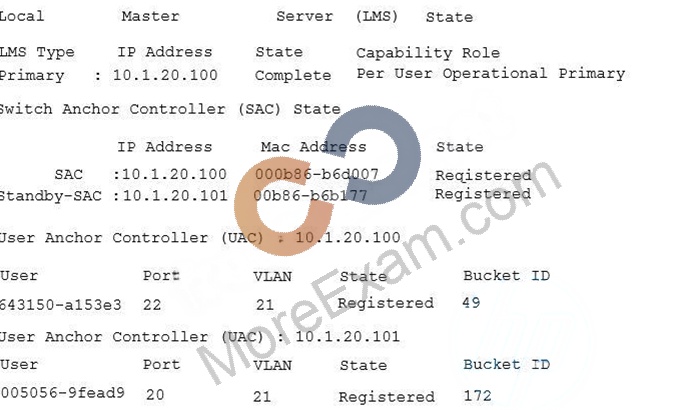
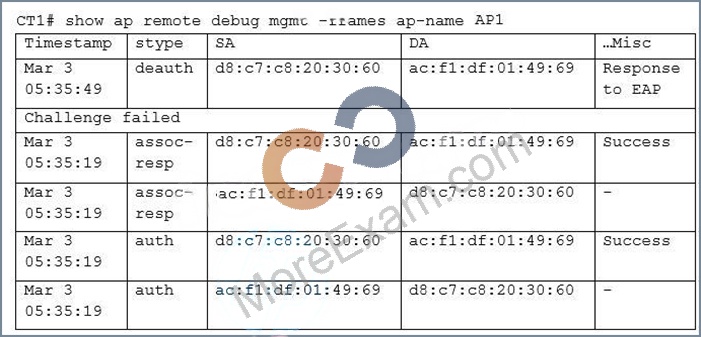
Question3: Once connected to a WLAN, a user cannot reliably access resources in a company's network. Based on the output shown in the exhibit, what can be determined about the users connection?

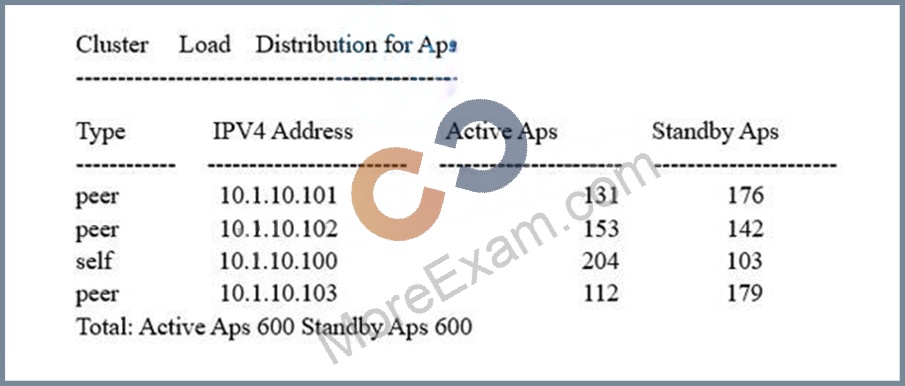
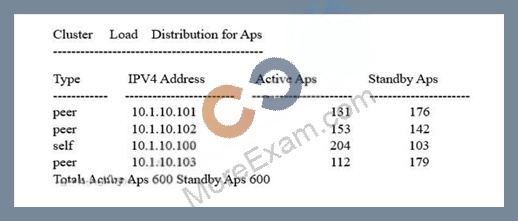
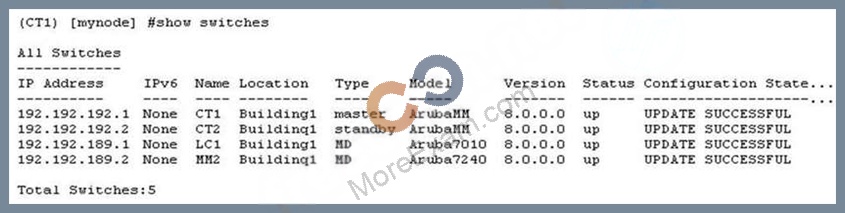
Question4: Refer to the exhibit.

An administrator sets up a cluster of Aruba MobilityControllers (MCs). What can the administrator determine about the cluster from the command output shown in the exhibit?

Question5: An administrator needs to apply a patch to an Aruba environment to implement improvements for AirMatch.
What is the Aruba recommended approach for this process without a reboot?

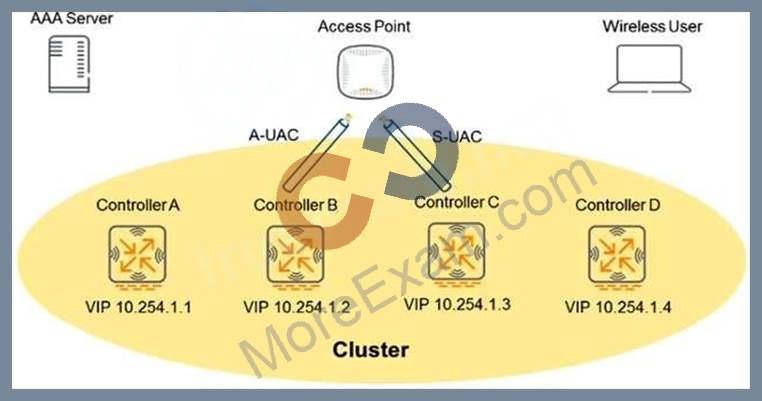
Question6: Refer to the exhibit.

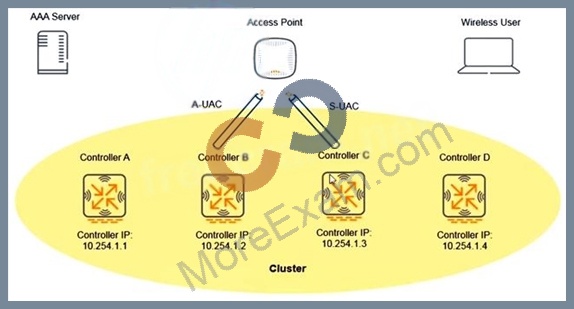
An AP is connected to a cluster of controllers. An AAA server provides all authentication and authorization functions for wireless users. A wireless user connects to an AP, and Active User Anchor Controller (A-UAC) and Standby UAC (S-UAC) tunnels are built from the AP to the respective controllers in the cluster.
Why would an administrator create four VRRP groups with four Virtual IP (VIP) addresses in the cluster?

Question7: An administrator creates a User Rule for rolederivation on the Mobility Master (MM). Which client information can an administrator specify to identify that a particular user should be assigned a different role from the initial role?

Question8: An administrator wants to temporarily deny login access who fail 802.1xauthentication functions three or more times. Which process will the administrator need to configure?

Question9: An AP connects to a controller. Then, the AP loses power and reboots.
Which parameters will the AP remember and use from its initial connection? (Choose two.)

Question10: An administrator configures two Mobility Masters (MMs) for redundancy and databasesynchronization.
Which protocol transports database information between the two MMs?

Question11: An administrator wants to change the default roles for the pre- and post-authentication user roles for a WLAN on a Mobility Master (MM). The controllers in the network perform all authentication.
Under the Managed Network hierarchy, where can the administrator assign these roles?

Question12: An administrator needs to authenticate users connected to an ArubaOS-Switch. The Aruba Mobility Controller (MC) authenticates the user and assigns user roles to wired users.
Which mode should the administrator configure on the MC?

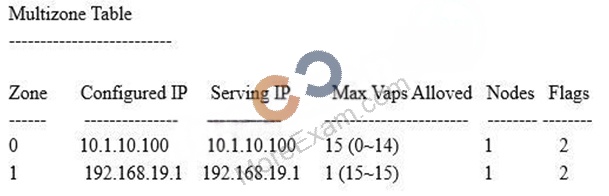
Question13: Refer to the exhibit.
An administrator wants to verify the operation of MultiZone in a network. The administrator uses the command show ap debug multizone to generate the output shown in the exhibit.
Based on the output, which statement is true?

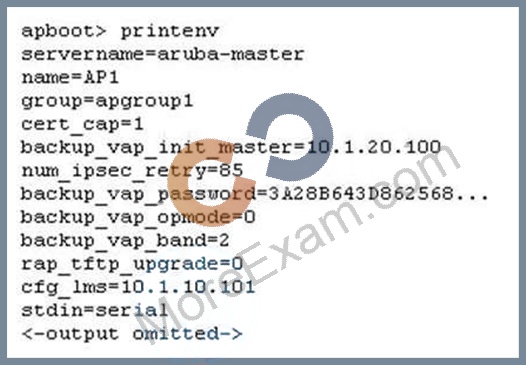
Question14: The administrator expects the AP to connect to a cluster, but the AP fails to connect. The administrator examines the configuration of an AP from apboot mode shown in the exhibit. What can the administrator determine about the configuration of the AP?

Question15: An administrator needs to modify a VAP used for a branch office RAP. The VAP's operating mode is currently defined as backup and uses tunnel mode forwarding. The administrator wants to implement split-tunnel forwardingmode in the VAP.
Which WLAN operating mode must the administrator define for the VAP before the tunnel forwarding mode can be changed to split-tunnel?

Question16: On the Aruba Mobility Master (MM), when is an AP configured to act as Mesh Portal or Mesh Point?

Question17: An administrator manages an Aruba wireless solution, deployed in a company with locations across the world.
In one country, the local government organization that controls wireless transmissions increases the maximum EIRP allowed for certain channels.
Which component does the administrator need to update on the Mobility Master (MM) to accommodatethis change?

Question18: An administrator wants to add a new folder in AirWave. Where would the administrator perform this action?

Question19: An administrator has a cluster of Aruba Mobility Controllers (MCs). The administrator wants to manually reboot one of the controllers.
Before rebooting, which command should the administrator use to move the APs?

Question20: Which network components are tracked by Aruba Clarity? (Choose two.)

Question21: A guest establishes an authenticated wireless session to an ArubaMobility Controller (MC). The controller uses a ClearPass server for all AAA functions.
Which AAA component disconnects the user when the guest exceeds their allowed duration?

Question22: An administrator wants to use AirWave to manage the configuration policysettings of a set of ArubaOS-Switches. Where should the administrator perform this action?

Question23: An administrator needs to support Unified Communications and Collaboration (UCC) in a company's network. The network infrastructure requires the OpenFlow protocol to support SDN-capable applications.
Which controller topology meets these requirements?

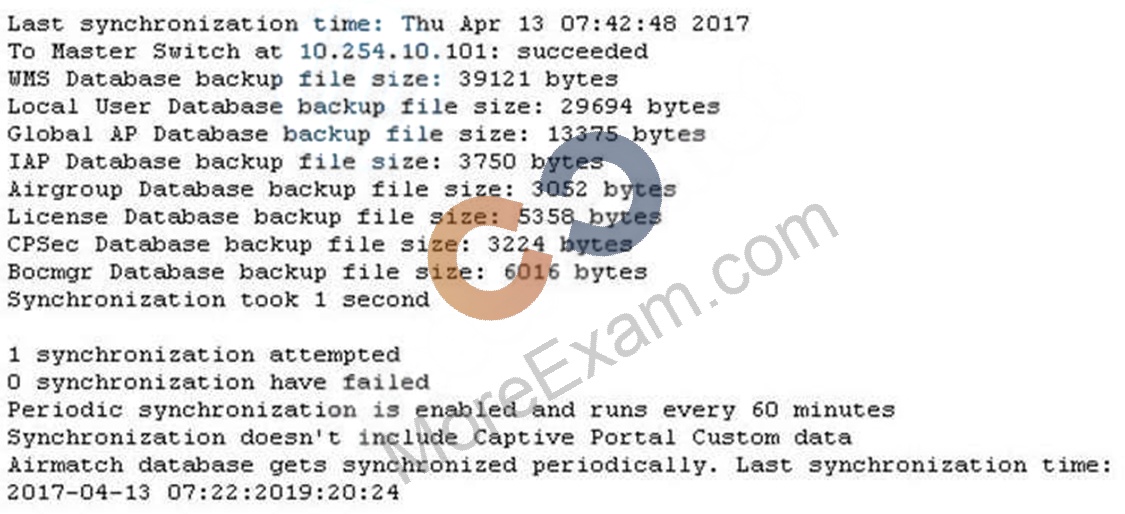
Question24: What is true about the operation of the Aruba Mobility Controller (MC) shown below?

Question25: Refer to the exhibit.

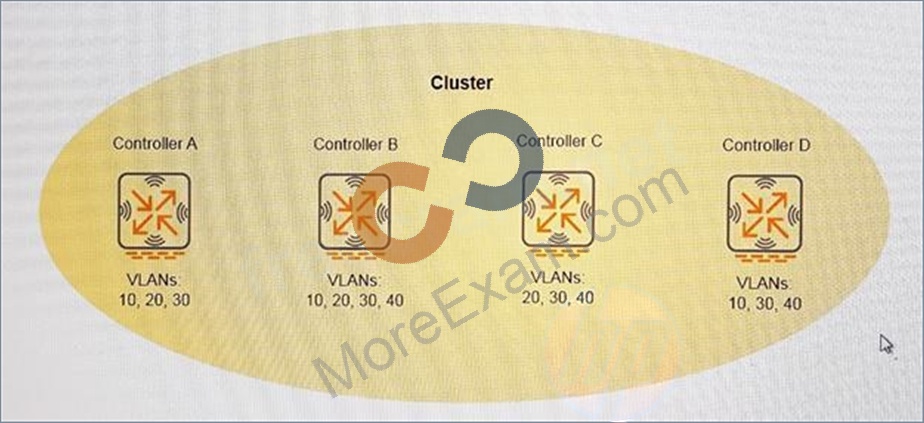
Which controller shown in the exhibit is elected as the cluster leader?

Question26: Refer to the exhibit.

An administrator sets up a cluster of Aruba Mobility Controllers (MCs). What can the administrator determine about the cluster from the command output shown in the exhibit?

Question27: Refer to the exhibit. What can the determined from the command shown in the exhibit?
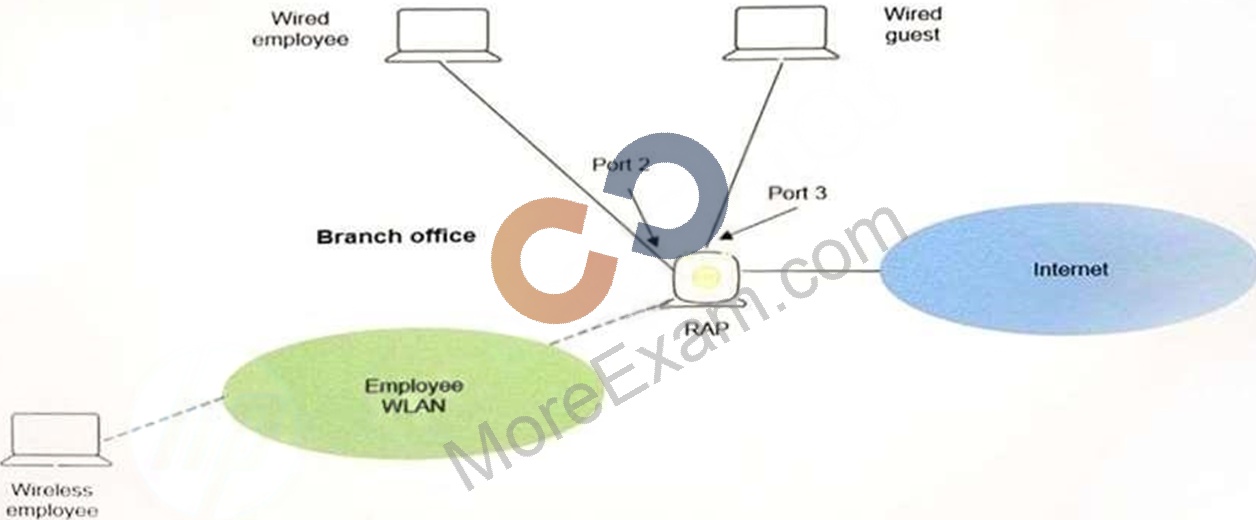
Question28: Refer to the exhibit.

The Branch office RAP shown in the exhibit provides secure wireless employee access. Because of security concerns, the company's security policy does not allow wireless guest access. Some customers that visit the Branch office need Internet access. A RAP's Ethernet Port 3 is used for wired guest access and Port 2 is used for wired employee access. When employees connect to Port 2, they are authenticated successfully and a split-tunnel policy allows them access to both corporate and Internet resources from the Branch office. Guest users, however, cannot access Internet resources on Port 3.
How can the administrator provide guest users Internet access?

Question29: An administrator needs to implement multiple configuration changes on a set of Aruba Mobility Controllers (MCs) that involve both VLAN and interface configurations at the same time. The controllers are deployed in a cluster.
How can the administrator accomplish this task?

Question30: An administrator purchases a pair of Mobility Masters (MM) and wants to deploy 16 Virtual Mobility Controllers (VMCs). What is the minimum number of clusters that the administrator needs to implement to support the number of VMCs?

Question31: Refer to the exhibit.

What can an administrator determine from this Aruba device output?

Question32: Refer to the exhibit.

The administrator expects the AP to connect to a cluster, but the AP fails to connect. The administrator examines the configuration of an AP from apboot mode shown in the exhibit. What can the administrator determine about the configuration of the AP?

Question33: An administrator deploys an Aruba wireless solution comprised of:
-a pair of Mobility Masters (MMs)
-multiple Mobility Controllers (MCs) and virtual Mobility Controllers (VMCs)
-an AirWave server
-a ClearPass server
The Aruba Mobility solution runs ArubaOS 8.X.
Which component in this environment globally defines anddeploys VLANs for wireless users?

Question34: On the Aruba Mobility Master (MM), when is an AP configured to act as a Mesh Portal or Mesh Point?

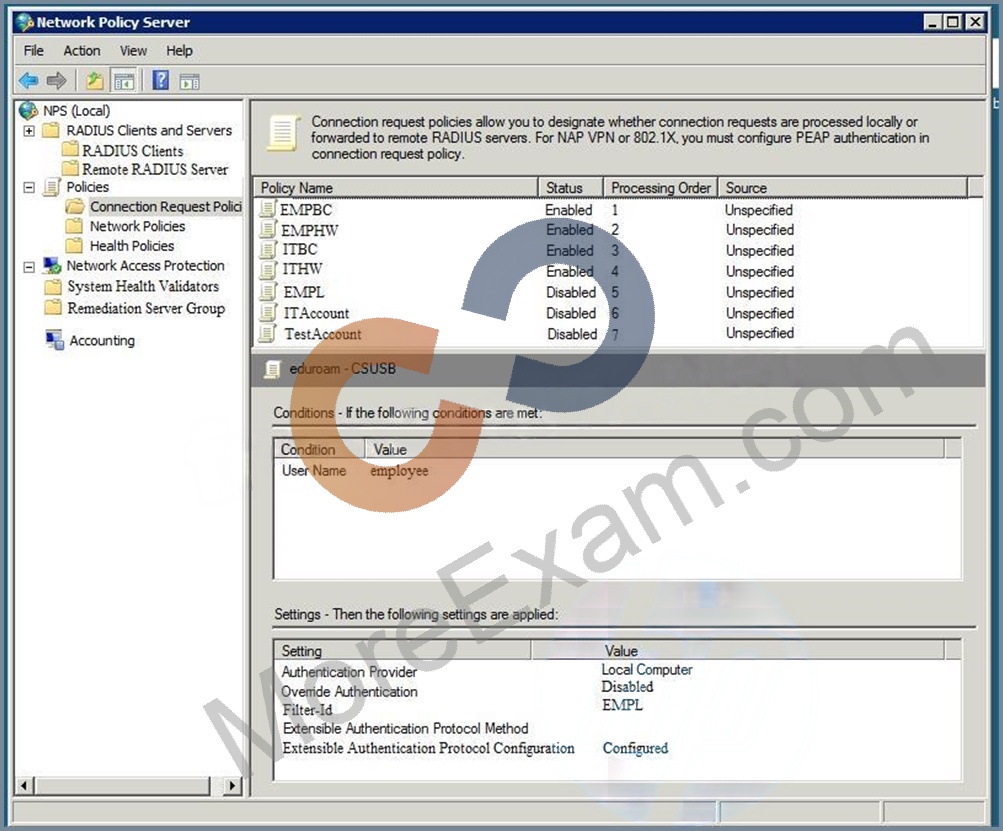
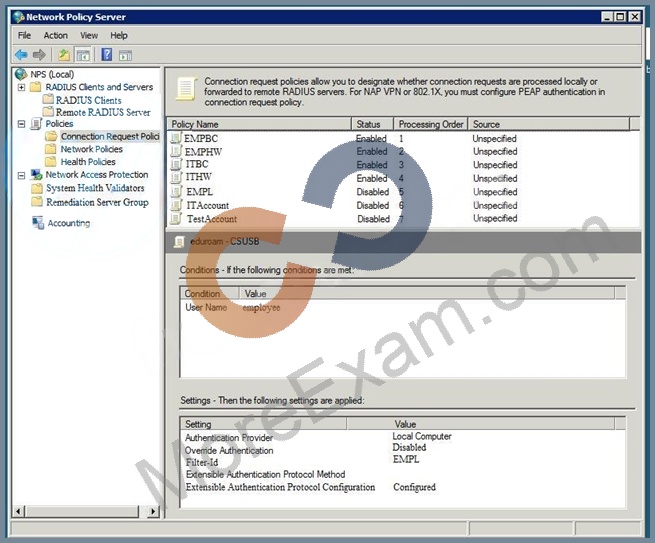
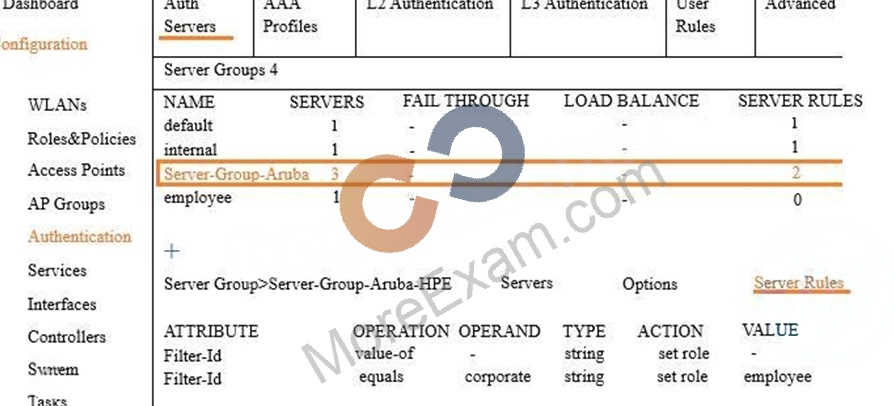
Question35: Refer to the exhibits.
Exhibit 1: WLAN VAP configuration

Exhibit 2: Microsoft NPS server configuration

Exhibit 3: Server group configuration for the VAP.

An employee authenticates with the username employee and the correct password. However, once the user authenticates, an administrator notices that the employee is assigned the authenticated role and not the desired employee role.
What should the administrator do to solve this problem?

Question36: An administrator supports an Aruba wireless network. The administrator configures as AAA profile referenced in a WLAN profile, where:
* The initial role assigned in the AAA profile is logon
* The MAC authentication default role is guest
* The 802.1X authentication role is authenticated
ClearPass is used to verify the 802.1X user credentials. A user authenticates and is assigned the authenticated default role instead of the role assigned in the ClearPass serverconfiguration.
What must the administrator do so that the ClearPass role is assigned to the user?

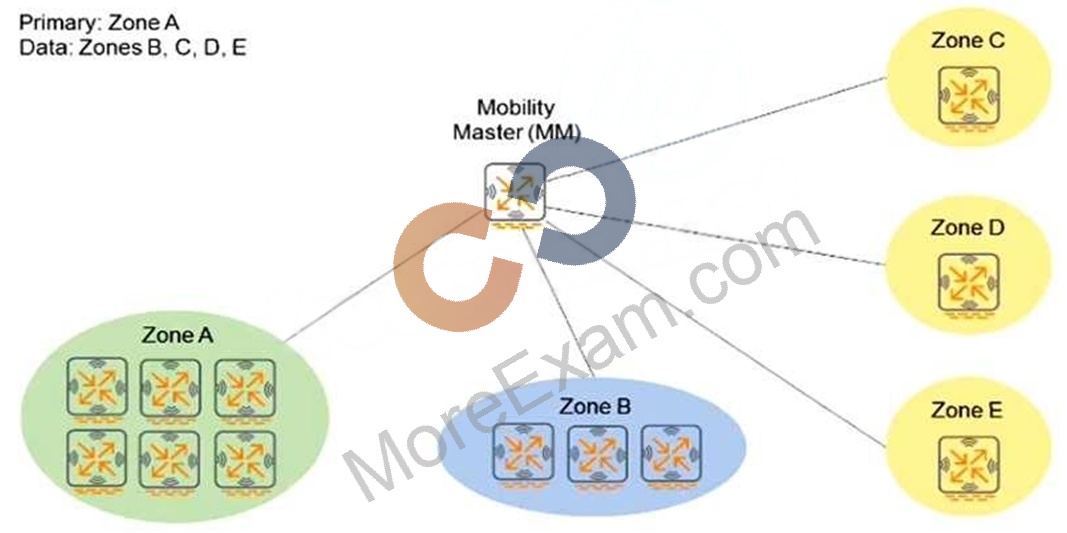
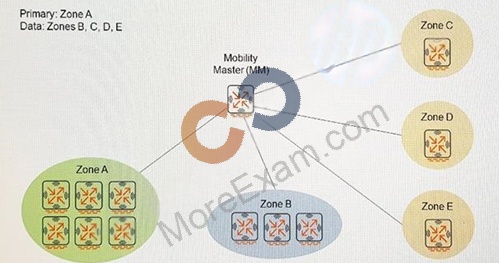
Question37: Refer to the exhibit.

An administrator implements the MultiZone feature. The administrator sets up five zones as shown in the exhibit.
* Zone A has six controllers that form a cluster.
* Zone B has three controllers that form a cluster.
* Zones C, D, and E have a single standalone controller each.
A total of 13 VAPs are created across the five zones. A zone needs to accept RAP connections from branch offices. All zones have the same AP Group name. One of the zones will not accept connections from the MultiZone APs.
What could be a cause of this problem?

Question38: Refer to the exhibit.

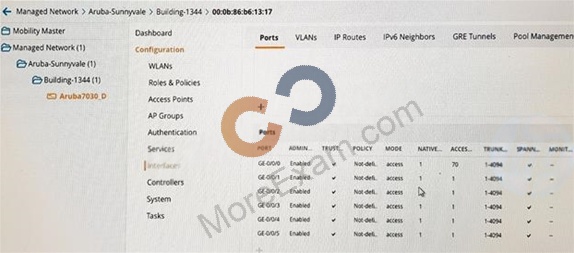
An administrator configures a split-tunnel policy to be used by RAPs at branch offices. Under the Configuration section on the Mobility master (MM) shown in the exhibit, where should the administrator configure the split-tunnel mode so that it can be deployed to the RAPs?

Question39: Anadministrator has multiple AAA servers, some Microsoft RADIUS and some ClearPass. When 802.1X users authenticate, the administrator wants to ensure that the authentication requests are handled by the appropriate AAA server. Users enter their username in this format: username@domain_name.
What must the administrator implement to ensure the correct AAA server processes the authentication request?

Question40: Refer to the exhibit.

An administrator wants to centralize administrative access to the Aruba Mobility Controllers (MC) and Mobility Master (MM). ClearPass is set up and the preferred authentication protocol is TACACS+. Where should the administrator perform this configuration in the MM hierarchy shown in the exhibit?

Question41: An administrator implements blacklisting of users that fail authentication functions three or more times. By default, how long will these users have to wait before they can successfully log into the network again?

Question42: Which VPN component must be configured on the Mobility Master (MM) to allow a RAP to use the built-in certificate to successfully connect to a Mobility Controller (MC)?

Question43: A company opens a new branch office and a RAP is used to connect to a corporate office Aruba Mobility Controller (MC). The company needs to provide connectivity to the office across the street. There is an AP across the street. However, there is no wired connectivity between the buildings.
Which actions can the administrator select to provide the required connectivity? (Choose two.)

Question44: An administrator wants to implement a Live Upgrade (in-service upgrade) of a cluster in an Aruba wireless solution. Which ArubaOS feature does the Mobility Master (MM) use to ensure RF redundancy, so that when one or more APs are rebooted there is no loss of wireless coverage for users?

Question45: An administrator wants to temporarily deny login access to users who fail 802.1x authentication functions three or more times. Which process will the administrator need to configure?

Question46: What can be determined from the command output shown below?

Question47: An administrator configures an ArubaOS-Switch for per-user tunneled node. Which protocols does the switch use to establish and maintain a connection with the Aruba Mobility Controller (MC)? (Choose two.)

Question48: An administrator creates a mesh cluster profile and has defined the RF band and cluster name. What else must the administrator configure in the profile?

Question49: Refer to the exhibit.

What is true about the configuration shown in the exhibit?

Question50: An administrator implements a standalone controller that runs ArubaOS 8.x. Which feature should the administrator configure to optimize the RF operation for the company's WLAN?

Question51: IEEE 802.11r relies on which technology to reduce re-authentication delays when clients roam between APs?

Question52: An AP connects to a controller. Then, the AP loses power and reboots.
Which parameters will the AP remember and use from its initial connection? (Selecttwo.)

Question53: In a cluster-controllerenvironment, which Aruba component in a network builds a cache table of mDNS records that can be used to help user devices access Apple Bonjour services?

Question54: Refer to the exhibit.

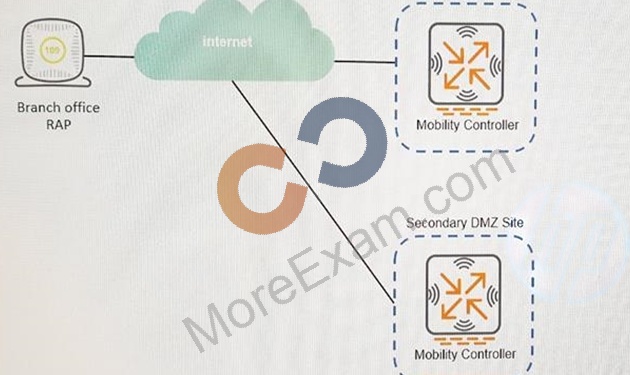
An administrator supports a RAP at a branch office shown in the exhibit. The company has one Mobility Controller (MC) at the Primary DMZ site and one at the Secondary DMZ site. The RAP is configured to connect to only the MC at the Primary DMZ site. A network outage with the ISP at the Primary DMZ site causes the RAP to reboot. Upon reboot, the RAP cannot build a tunnel to the Secondary DMZ site MC because the administrator forgot to add the Second LMS IP address to the AP Group configuration. Once the RAP can successfully connect, the administrator can add the Secondary DMZ MC as a backup LMS to fix the AP Group.
What should the administrator implement to allow the RAP to connect to the MC at the Secondary DMZ site while the outage at the primary site persists?

Question55: An administrator wants to deploy Zero Touch Provisioning (ZTP) with Activate. The controllers run ArubaOS.8.x.
Which Aruba architecture should the administrator deploy?

Question56: Refer to the exhibit.

Controllers are configured in a cluster as shown in the exhibit. These are the network details.
* A Mobility Master (MM) manages the cluster.
* The cluster contains two controllers C1 and C2.
* AP1 and AP2 use C1 as their Active AP Anchor Controller (A-AAC), with C2 as their Standby AAC (S-AAC).
* AP3 and AP4 use C2 as their A-AAC, with C1 as their S-AAC.
User1 establishes a wireless connection via AP1, where the Active User Anchor Controller (A-UAC) assigned is C1, with C2 as the standby. What happens when User1 roams the wireless network and eventually their session is handled by AP3?

Question57: Refer to the exhibit.

What can be determined from the command output shown in the exhibit?

Question58: An administrator at Campus A manages Aruba Mobility Controllers (MCs). The administrator defines a server group that includes a local ClearPass server and a remote Microsoft RADIUS server. The ClearPass server has the credentials for users at Campus A and the Microsoft RADIUS server has the credentials for users at Campus B.
Users at CampusA successfully authenticate and connect to the Campus A wireless network.
However, when users from Campus B visit Campus A they fail authentication.
What can the administrator do to solve this problem?

Question59: What can the administrator determine from the configuration shown below?

Question60: Which IEEE standard should user devices support to implement Fast BSS Transition when a network implements wireless roaming (mobility)?

Question61: An administrator creates a cluster of four Mobility Controllers (MCs). When the administrator verifies the cluster operation, the administrator notices that it is operating as an L3-connected cluster.
What should the administrator do to ensure that the cluster operates as an L2-connected cluster? (Choose two.)

Question62: Which two protocols does AirWave use to monitor Aruba Mobility Controllers ()?

Question63: A company opens a new branch office and a RAP is used to connect to a corporate office Aruba Mobility Controller (MC). The company needs to provide connectivity to the office across the street.There is an AP across the street. However, there is no wired connectivity between the buildings.
Which actions can the administrator select to provide the required connectivity? (Choose two.)

Question64: An administrator wants to simulate network traffic and analyze results in an Aruba wireless network to test components such as WPA-2, DHCP, and other protocols. Which Aruba solution implements these functions?

Question65: An administrator at Campus A manages Aruba Mobility Controllers (MCs). The administrator defines a server group that includes a local ClearPass server and a remote Microsoft RADIUS server. The ClearPass server has the credentials for users at Campus A and the Microsoft RADIUS server has the credentials for users at Campus B. Users at Campus A successfully authenticate and connect to the Campus A wireless network.
However, when users from Campus B visit Campus A they fail authentication.
What can the administrator do to solve this problem?

Question66: An administrator troubleshoots a roaming problem where a user loses connectivity to the network during the roaming process. To help troubleshoot this problem, which device or devices in a wireless network initiates the roaming process?

Question67: Refer to the exhibit.

An administrator configures a cluster with only the members shown in the exhibit. AP load balancing is enabled.There are no other cluster parameters configured. What occurs when a cluster member experiences a failure?

Question68: An administrator supports a RAP to abranch office. Employees at the branch office connect to an employee SSID that allows for split tunneling of the employee traffic. The RAP initially connects to the corporate office controller, but later loses connectivity to it.
Which operating mode should the administrator configure for a secondary SSID to be advertised during the loss of connectivity?

Question69: An administrator implements a standalone controller that runs ArubaOS 8.x. Which feature should the administrator configure to optimize the RF operation for the company's WLAN?

Question70: Anadministrator implements per-user tunneled node that involves ArubaOS-Switches and Aruba Mobility Controllers (MCs). What always happens when a wired client connects to the network?

Question71: An administrator supports a group of engineers that commonly troubleshoot company problems from any location without wired connectivity. They need secure connectivity to a corporate web-based portal with their Android smartphones. Which solution should the administrator recommend to solve the engineer's connectivity problem?

Question72: An administrator supports an Aruba wireless solution that uses ClearPass to implement server role assignment. A user reports that they are not able to access the correct department resources. The administrator determines from the connected controller that the user is associated to the login user profile instead of the department user profile.
What should the administrator examine on the ClearPass server to determine the Aruba VSA User Role value that ClearPass returns to the controller?

Question73: An administrator wants to implement the MultiZone feature in a company's network to segregate corporate and guest traffic. Corporate traffic will have APs establish connections to a cluster managed by a Mobility Master (MM), and guest traffic will have the same APs establish connections to a standalone controller at the company's DMZ.
What is true about the implementation of MultiZones in this scenario?

Question74: A group of users on the same floor of a campus residence experience connectivity problems continuously throughout the morning. The administrator suspects that it is a L1 problem with physical interference.
What can the administrator do to find the cause of this problem?

Question75: Which protocol do Mobility Controllers (MCs) use to detect a failed Mobility Master (MM)?

Question76: Refer to the exhibit.

A user uses Microsoft Windows for a wireless session. Based on the output shown in the exhibit for the selected Aruba AP, what is the possible problem with this user's wireless session?

Question77: An administrator configures AirGroup policies to define which Apple services are visible and available to wireless users in a campus WLAN. However, the policies are not being enforced.
Where must the administrator enable the AirGroup functionality on the Mobility Master (MM) so that the policies will be in effect?

Question78: An administrator mistakenly configures the wrong VLAN setting on a managed controller's interface. This causes the controller to lose management access to the Mobility Master (MM).
Which mechanism will then attempt to restore the previous working configuration on the managed controller?

Question79: An administrator needs to add connectivity between two buildings that are within 15 meters of each other on a company's campus. The administrator decides to implement Aruba's wireless mesh feature between an AP in each building. How should the administrator deploy the two APs to implement the mesh feature?

Question80: An administrator configures a port on a RAP through the association of an AAA profile with 802.1X authentication to a RAP Ethernet port. This port connects to a switch with user desktops attached. The administrator notices that when users connect wirelessly to the RAP, a user role correctly restricts their traffic.
But, when users connect with their wired desktops, they are assigned an initial role and routed to a Captive Portal page.
What must the administrator do to enable desktop usage based on the user's role assignment?

Question81: Anadministrator manages an AirWave Management Platform (AMP). The AMP server receives many SNMP traps from managed devices, but no alerts are generated on the AMP for certain critical traps.
Which rule should the administrator create to cause the AMP serverto generate an alert based on receipt of a critical SNMP trap from an Aruba Mobility Controller (MC)?

Question82: An administrator deploys an Aruba wireless solution comprised of:
-a pair of Mobility Masters (MMs)
-multiple Mobility Controllers (MCs) and virtual Mobility Controllers (VMCs)
-an AirWave server
-a ClearPass server
The Aruba Mobility solution runs ArubaOS 8.X.
Which component in this environment globally defines and deploys VLANs for wireless users?

Question83: An administrator manages an AirWave Management Platform (AMP). The AMP server receives many SNMP traps from managed devices, but no alerts are generated on the AMP for certain critical traps.
Which rule should the administrator create to cause the AMP server to generate an alert based on receipt of a critical SNMP trap from an Aruba Mobility Controller (MC)?

Question84: Which protocol is used between Aruba Mobility Controllers (MC) and ArubaOS-Switches to negotiate tunneled node?

Question85: An administrator needs to apply a patch to an Aruba environment to implement improvements for AirMatch.
What is theAruba recommended approach for this process without a reboot?

Question86: In a VPN that uses certificate-based authentication, which component must be configured on the Mobility Master (MM) to allow a RAP to successfully connect to aMobility Controller (MC)?

Question87: An administrator moves an AP from Campus 1 to Campus 2. At the Campus 2, the moved AP does not connect to a controller and download an AP Group configuration.
Which process should the administrator perform to reset the AP back to its initial default state?

Question88: Refer to the exhibit.

An AP is connected to a cluster of controllers. An AAA server provides all authentication and authorization functions for wireless users. A wireless user connects to an AP, and Active User Anchor Controller (A-UAC) and Standby UAC (S-UAC) tunnels are built from the AP to the respective controllers in the cluster.
Why would an administrator create four VRRP groups with four Virtual IP (VIP) addresses in the cluster?

Question89: An administrator moves an AP from Campus 1 to Campus 2. At the Campus 2, the moved AP does not connect to a controller and download an AP Group configuration.
Which process should the administrator perform to reset the AP back to its initial default state?

Question90: A company opens a new branch office and a RAP is used to connect to a corporate office Aruba Mobility Controller (MC). The company needs to provide connectivity to the office across the street. There isan AP across the street. However, there is no wired connectivity between the buildings.
Which actions can the administrator select to provide the required connectivity? (Choose two.)

Question91: An administrator makes a configuration change on a Mobility Master (MM) that causes a Managed Controller to lose connectivity with the MM. The MC attempts auto roll-back, but this fails.
How should the administrator recover from this problem?

Question92: Which device can terminate to a cluster of Aruba Mobility Controllers (MCs) that run ArubaOS.8.x?

Question93: Refer to theexhibit.

An administrator configures a split-tunnel policy to be used by RAPs at branch offices. Under the Configuration section on the Mobility master (MM) shown in the exhibit, where should the administrator configure the split-tunnel mode sothat it can be deployed to the RAPs?

Question94: Which protocol is used between Aruba Mobility Controllers (MC) and ArubaOS-Switches to negotiate tunneled node?

Question95: Refer to the exhibits.
Exhibit 1: WLAN VAP configuration

Exhibit 2: Microsoft NPS server configuration

Exhibit 3: Server group configuration for the VAP.

An employee authenticates with the username employee and the correct password. However, once the user authenticates, an administrator notices that the employee is assigned the authenticated role and not the desired employee role.
What should the administrator do to solve this problem?

Question96: An administrator manages an Arubawireless network. ClearPass is used to centralize AAA functions. The administrator wants to implement server role derivation.
Which information will the ClearPass server return in regards to the user role assignment?

Question97: Refer to the exhibit.

An administrator configures a split-tunnel policy to be used by RAPs at branch offices. Under theConfiguration section on the Mobility master (MM) shown in the exhibit, where should the administrator configure the split-tunnel mode so that it can be deployed to the RAPs?

Question98: An administrator configures a network scan set in AirWare to scan a subnet to discover new switches. The scan completes and AirWave successfully uses the SNMP credentials to validate SNMP access. However, SSH access fails and the administrator must manually configure the SSH credentials used for all of these devices.
To prevent this problem in the future, what should the administrator complete prior to running the network scan?

Question99: An administrator wants to implement the MultiZone feature in a company's network to segregate corporate and guest traffic. Corporate traffic will have APs establish connections to a cluster managed by a Mobility Master (MM), and guest traffic will have the same APs establish connections to a standalone controller at the company's DMZ.
Given this scenario, what is true about the implementation of Multizone?

Question100: In a cluster-controller environment, which Aruba component in a network builds a cache table of mDNS records that can be used to help user devices access Apple Bonjour services?

Question101: A network of Mobility Controllers (MCs) is managed by a Mobility Master (MM). An administrator misconfigures the IP addressing on an MC and the MC loses connectivity to the MM.
How should the administrator fix this problem?

Question102: An administrator configures an ArubaOS switch for per-user tunneled node. Which protocol does the switch use to communicate with the Aruba Mobility Controller (MC)?

Question103: Refer to the exhibit.

An administrator implements the MultiZone feature. The administrator sets up five zones as shown in the exhibit.
-Zone A has six controllers that form a cluster.
-Zone B has three controllers that from a cluster.
-Zones C, D, and E have a single standalone controller each.
A total of 13 VAPs are created across the five zones. Azone needs to accept RAP connections form branch offices. All zones have the same AP Group name. One of the zones will not accept connections from the MultiZone APs.
Which could be a cause of this problem?

Question104: An administrator wants to use AirWave to manage the configuration policy settings of a set of ArubaOS-Switches. Where should the administrator perform this action?

Question105: Which protocol is used to tunnel user traffic when an administrator implements tunneled node between an ArubaOS-Switch and an Aruba Mobility Controller (MC)?

Question106: A company has a wireless network that contains a cluster of four Aruba 7030 Mobility Controllers (MC) managed by a Mobility Master (MM) located in the data center. The company has Aps deployed that are nearing thecapacity of the cluster. The administrator wants to increase AP capacity.
How can the administrator solve the problem?

Question107: An administrator wants to implement the MultiZone feature in a company's network to segregate corporate and guest traffic. Corporate traffic will have APs establish connections to a cluster managed by a Mobility Master (MM), and guest traffic will have the same APs establish connections to a standalone controllerat the company's DMZ.
Given this scenario, what is true about the implementation of Multizone?

Question108: An administrator configures two Mobility Masters (MMs) for redundancy and database synchronization.
Which protocol transports database information between the two MMs?

Question109: Refer to the exhibit.

An administrator configures policies to allow RAPs to connect to the corporate office and remote users to access resources. Which function does the VPN address pool serve in this situation?

Question110: An administrator implements the Aruba AitGroup feature to accommodate the Apple Bonjour service. In this implementation, which protocol advertises devices such as printers, computers, and their services?

Question111: Which configuration command needs to be executed on an Aruba Mobility Controller (MC) to forward AP statistical data to an AirWave Management Platform (AMP)?

Question112: Anadministrator wants to implement bandwidth limits to restrict employee access to high-risk web sites. On the Mobility Master (MM), where would the administrator define these limits?

Question113: Which ArubaOS CLI command can an administrator execute to determine if AP load balancing is enabled in a cluster?

Question114: An administrator defines credentials in the Mobility Master> Configuration> System section to configure a Mobility Master (MM). The administrator then accesses AirWave and adds the MM in Monitor-Only mode.
Theadministrator expects AirWave to automatically discover the Aruba Virtual Mobility Controllers (VMCs) also managed by the MM, but does not see these under APs/Devices> New section in AirWave.
What should the administrator do to solve this problem?

Question115: An administrator wants to implement the MultiZone feature in a company's network to segregate corporate and guest traffic. Corporate traffic will have APs establish connections to acluster managed by a Mobility Master (MM), and guest traffic will have the same APs establish connections to a standalone controller at the company's DMZ.
What is true about the implementation of MultiZones in this scenario?

Question116: Refer to the exhibit.

Once connected to a WLAN, a user cannot reliably access resources in a company's network. Based on the output shown in theexhibit, what can be determined about the user's connection?

Question117: Refer to the exhibit.

An administrator implements an L2 cluster of Aruba Mobility Controllers (MCs) as shown in the exhibit. An external RADIUS AAA server authentication clients associated with the Active User Anchor Controller (A-UAC), where the NAS IP address sent from Controller B is 10.254.1.2.
By default, what happens to the user's session when it is handed over to the Standby UAC (S-UAC) after a failover?

Question118: A Microsoft RADIUS server isused to centralize AAA functions by a company. Upon a successful authentication lookup performed by an Aruba Mobility Controller (MC), the administrator wants to have the RADIUS server pass back the correct post-authentication role name that the controllershould apply to the user's traffic.
Which additional task must the administrator perform for the controller's configuration to implement this process?

Question119: Refer to the exhibit.

The administrator expects the AP to connect to a cluster, but the AP fails to connect. The administrator examines the configuration of an AP from apboot mode shown in theexhibit. What can the administrator determine about the configuration of the AP?

Question120: When an administrator manually adds a Mobility Controller (MC) on the Mobility Master (MM) hierarchy, which parameters must be specified? (Select three.)

Question121: Refer to the exhibit.

A user uses a wireless client for a wireless session. Based on the output shown in the exhibit for the selected Aruba AP, what is the possible problem with this user's wireless session?

Question122: Refer tothe exhibits.
Exhibit 1: WLAN VAP configuration

Exhibit 2: Microsoft NPS server configuration

Exhibit 3: Server group configuration for the VAP.

An employee authenticates with the username employee and the correct password. However, once theuser authenticates, an administrator notices that the employee is assigned the authenticated role and not the desired employee role.
What should the administrator do to solve this problem?

Question123: Refer to the exhibit.

What can an administrator determine from this Aruba device output?

Question124: An administrator implements the MultiZone feature anduses two clusters that utilize CPSec. A primary and a data zone are created. MultiZone APs successfully build sessions to the primary cluster but fail to establish sessions to the data zone cluster.
What must the administrator do to solve this problem?

Question125: An administrator implements a cluster of four Aruba Mobility Controllers (MCs) managed by a Mobility Master (MM). An AP Group is configured with two VAPs and deployed to an AP thatwill connect to the cluster. Each AP contains two radios.
How many GRE tunnels will be built from the AP to the Active AP Anchor Controller (A-AAC)?

Question126: An administrator has a standalone controller that runs ArubaOS 8.x software and wants to upgrade it to a newer release. The upgrade will be performed from the front panel of the physical controller. The administrator places the new software in the root directory of a USB drive. On the controller's LCD panel, no image is found.
What is the cause of this problem?

Question127: Refer to the exhibit. An administrator implements an L2 cluster of Aruba Mobility Controllers (MCs) as shown in the exhibit. An external RADUIS AAA server authenticates clients associated with the Active User Anchor Controller (A-UAC), where the NAS IP address sent from Controller B is 10.254.1.2.

By default, what happens to the user's session when it is handed over to the Standby UAC (S-UAC) after a failover?

Question128: An administrator has a standalone controller that runs ArubaOS 8.x software and wants to upgrade it to a newer release. The upgrade will be performed from the front panel of the physical controller. The administrator places the new software in the root directory of a USB drive. On the controller's LCD panel, no image is found.
What is the cause of this problem?

Question129: Which Aruba Mobility Controller (MC) administrative role should an administrator assign to a receptionist so that they can create and manage guest accounts?

Question130: An administrator needs toauthenticate users connected to an ArubaOS-Switch where the switch authenticates the user, assign the firewall policies to the user, and processes some of the users' traffic. Which connection method should the administrator configure on the ArubaOS-Switch?