EMT Practice Test

1. Question Content...


Question List

Question1: Which of the following terms is used to describe a major deliverable or key even in the project used to measure project progress?

Question2: Which of the following is mandatory in most software development projects?

Question3: Your organization uses the MoSCoW approach to requirements prioritization.
What does MoSCoW mean?

Question4: A new project has to implement a cyber security release in China, Italy, Germany, the United States, and Canada. The project is a $5 million initiative and must 'go live' in production in all countries on the same day and time to be effective.
Which of the approaches mentioned is suitable for this project based on the size and complexity?

Question5: Which of the following techniques involves coordinating and collaborating with other credible sources in risk?

Question6: Which of the following diagrams is known as Ishikawa diagram?

Question7: The stakeholder of a new product that is in early adaptive development has requested a change to an approved feature. How should the business analyst (BA) handle this change?

Question8: A financial institution engaged in mortgage lending has embarked on a business process improvement initiative to eliminate the activities that hinder growth to ultimately improve the success rate of its mortgage business. As a benchmark for identification, the institution is keen on improving any business process that has less than a 75% success rate. The institution has appointed a business analyst (BA) to review the business transactions for the processes of origination, payments, and closures, as well as identify opportunities for improvements and recommend solutions.
The BA has collected the following information over the last three months pertaining to these business processes:
*All the business processes are at their maximum capacity in terms of the current number of transactions.
*Each business process has a certain number of rejects and the reasons for rejection include documentation, verification, collateral, and funding. Funding rejects occur when the bank's customers have failed to make payment of their mortgage processing fee or mortgage closure payment.
The BA has also recommended the use of documentation checklists as a solution to eliminate the documentation rejects.

If the financial institution always works at full capacity month to month and the new success rate continues to remain the same after implementing the BA's recommendation, what is the average number of successes per month for the mortgage closure process, if the current process capability were increased by 50%?

Question9: What type of requirements elicitation technique is the Delphi Technique?

Question10: A large insurance company wants to buy a new claims processing system or upgrade one of its two existing system. Each year the claims department is given a $3.5 million budget to spend. Time is of the essence since there are tome regulatory charges that will be coming the following year that will require several features that currently neither one of the two claims System currently support.
There are eight stakeholders involved in this initiative. There are local to where the claim system is managed, while five are located across the country. The business analyst (BA) struggled to get all stakeholders to agree on the desired features but ultimately got agreement on ten identified key features for the new claims system.
The BA was able to build a current state and future state process model which included all ten key features.
System a process 75% of the company's claims. It is 5 years old and the claim processors love it because it is easy to use. However, it must go offline for two hours each day. The code is very module so it does have flexibility to be modified. To upgrade system A to have all ten features it would cost $5 million. System A would be at capacity if it were to process all of the company's claims.
System B process 25% of the company's claims. It is an older mainframe system, but rarely goes offline. It could easily handle double the number of claims that system A processes. However, it has a lot of legacy code and would cost $6 million to upgrade.
Both systems have some of the desired key features. But neither system has all ten. The cost to buy a new system would be $7 million.
Below is the estimated cost for each feature in priority order.

If the budget for the initiative was firm, what is a feasible solution to make sure the project stays within budget?

Question11: A financial institution engaged in mortgage lending has embarked on a business process improvement initiative to eliminate the activities that hinder growth to ultimately improve the success rate of its mortgage business. As a benchmark for identification, the institution is keen on improving any business process that has less than a 75% success rate. The institution has appointed a business analyst (BA) to review the business transactions for the processes of origination, payments, and closures, as well as identify opportunities for improvements and recommend solutions.
The BA has collected the following information over the last three months pertaining to these business processes:
*All the business processes are at their maximum capacity in terms of the current number of transactions.
*Each business process has a certain number of rejects and the reasons for rejection include documentation, verification, collateral, and funding. Funding rejects occur when the bank's customers have failed to make payment of their mortgage processing fee or mortgage closure payment.
The BA has also recommended the use of documentation checklists as a solution to eliminate the documentation rejects.

If an additional recommendation to reduce Verification Rejects by 50% were to be introduced into the mortgage origination process, what is the potential success rate of the mortgage origination process?

Question12: An organization is trying to streamline its current processes to improve performance and reduce costs. A business analyst (BA) conducted a process improvement workshop and identified the following issues as the top three items to be addressed:
1: There are multiple teams to define systems, functionality, and content in many instances, multiple teams are defining the same functionalities while other functionalities are not being defined at all leading to unclear understanding of business requirements.
2: Product specification forms are published each year. A comparison tool is used to evaluate specification differences between yearly releases; but does not adequately identify changes between versions and needs to be improved.
3: Training consists of a new team member shadowing a seasoned team member. There are no written training materials or formal training sources therefore training is inconsistent and not meeting the needs of the organization.
What analysis approach must the BA use to determine changes required to address the training needs?

Question13: Jenni is the business analyst for the UHQ Organization. She is preparing to complete the conduct elicitation activity for her organization.
Jenni can use all of the following techniques as part of this activity except for which one?

Question14: Which of the following can be used in root cause analysis?
Question15: You need to identify assumptions as part of the assessment of capability gaps.
Which of the following is an example of an assumption?

Question16: You are the business analyst for your organization and you are preparing the business case for a proposed solution. You need to include the management horizon in your business case.
What is the management horizon?

Question17: You are currently working on creating the activity list for an initiative in your organization.
What characteristic must be assigned to each task in your task list?

Question18: A business analyst (BA) is working on a payment system (PS) implementation. A set of systems which should interact with a new system has been identified. The business analyst defined that a user with role of
"Supervisor" in the PS must pass a two-factor authentication before an execution of the functions: "Change system parameters" and "Set up new supervisor." A user must have the role of "Supervisor" to use the standard functions "Send mail notification" or "Send SMS notification".
The BA defined the following use cases:
*"Change system parameters"
*"Setup new supervisor"
*"Send mail notification"
*"Send SMS notification"
*"Send notification"
*"Pass a two-factor authentication"
The BA wants to create a Use Case diagram.
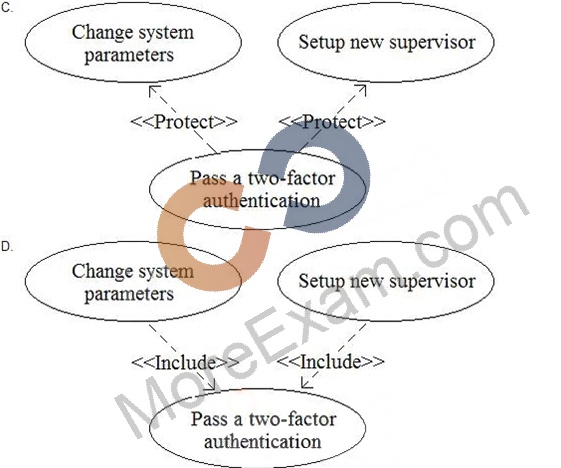
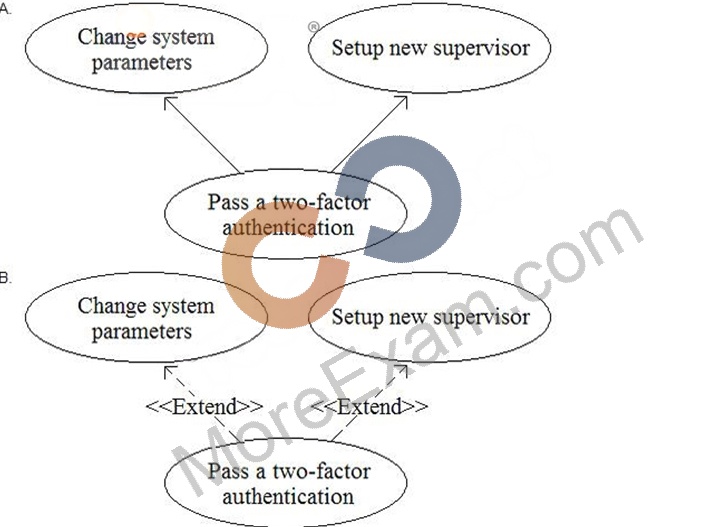
What standard relationship should be defined between "Change system parameters", "Setup new supervisor" and "Pass a two-factor authentication"?

Question19: You are the business analyst for your organization and working with Tim to identify the assumptions within the business solution.
Which one of the following is an assumption?

Question20: You are the business analyst for a smaller project where there are few requirements. Management would still like you to create a method to trace the few requirements for this project.
What type of matrix would be best in this instance?

Question21: You are the business analyst for your organization and are working on a solution that will connect several databases to a web application. You are concerned that the databases may not be operable with the software solution a programmer is recommending.
What requirements elicitation technique can help you determine the interoperability of the software, the databases, and the web application?

Question22: You are the business analyst for your organization. You want to use a requirements elicitation technique to produce a broad set of options for an identified problem. You want the stakeholders to help you identify options, factors that affect the solution, any possible delays in the solution implementation, and ideas for creating a solution.
Which of the following requirements elicitation activities would best satisfy these requirements?

Question23: A multi-domain project has stakeholders with different technical backgrounds. The presentation prepared by the business analyst (BA) for domain 1 was also used for domain 2 but the presentation was not clear and caused concerns for stakeholders in domain 2.
What can the BA do to alleviate the concerns of the stakeholders in domain 2?

Question24: You are the business analyst for your organization and are to conduct stakeholder analysis. Which of the following statements best describes the conduct stakeholder analysis task?

Question25: While reviewing a subset of requirements with stakeholders, a business analyst (BA) finds a requirement that does not deliver benefit to any of the stakeholders. After much discussion, the stakeholders decide that the requirement does not align with the solution scope.
What recommendation will the BA make?

Question26: Gary is the business analyst for his organization. He has realized that he has overlooked a key group of stakeholders during the conduct stakeholder analysis process.
What is the danger in overlooking a key set of stakeholders?

Question27: Which of the following is the best definition of the business rules analysis?

Question28: A business analyst (BA) is capturing the requirements for an application which displays information on a mobile device. The information will be extracted from a database owned by another department within the organization. Which of the following will identify the stakeholder who can approve access to the database?

Question29: Enterprise analysis provides many things for an organization.
All of the following are tasks included in enterprise analysis except for which one?

Question30: You are completing enterprise analysis. Management has asked you to create a document that will help them create a go/no go decision to invest and more forward with a proposed project.
What document does management want you to create?

Question31: After determining mat the enterprise culture was the driving force behind recent solution change decisions a business analyst (BA) has decided to conduct an enterprise-wide cultural assessment. What information can the 8A expect to learn from the results?

Question32: Which of the following is a flowchart that shows all the processes and the interfaces that interact with the project processes?

Question33: The creative thinking process has three values to determine the effectiveness of the process.
Which one of the following is not a measurement of effective creative thinking?

Question34: You are the business analyst for the TGH Organization and are determining if you should buy or build a solution for your company. You have determined that you can create the in-house solution for $78,000 with a monthly support cost of $8,765. A vendor can create the solution for $61,000 with a monthly support cost of
$7,990.
How long will it take your company to break even if you choose the internal solution versus the vendor's solution?

Question35: You are the business analyst for the NHQ Project. You have identified several stakeholders that need different types of information related to the requirements.
Which stakeholder would need detailed technical interface requirements?

Question36: Which of the following processes includes tasks and roles, risk categories, schedules for risk management activities, definitions of probability and impact, and the stakeholders' tolerances?

Question37: You are creating a model that shows how data moves through a system. Each function that modifies the data in any manner is identified, decomposed to smaller levels, and the system is completely described from start to storage.
What type of a modeling technique are you using in this scenario?

Question38: Most users of a pilot application have experienced more efficient processing compared to the old system.
However, the business analyst (BA) has observed that a few people took much longer to complete the process.
The system event log shows that those users encountered errors when they attempted to sign on.
Which of the following would the BA recommend to improve overall performance?

Question39: A business analyst (BA) working on a recently implemented project is approached by the sponsor to provide artifacts that can be used organization wide for the long -term. Which of the following should the BA provide?

Question40: You are the business analyst for the YGT Organization. You have just completed capabilities gap assessment and have determined that your organization does not have the necessary resources and technology to seize a business opportunity.
What is the most likely course of action for the organization?

Question41: While validating requirements for a software implementation project, the business analyst (BA) needs to identify scenarios that would alter the benefit delivered by a requirement.
Which of the following techniques should the BA use to identify such scenarios?

Question42: You are creating the solution scope for a proposed solution in your organization. You need to understand the scope of work that needs to be completed. You elect to identify the solution scope and then break the solution scope into smaller work products or deliverables.
What technique are you using in this instance?

Question43: Which of the following directs the improvement efforts to those areas that will have the biggest impact?

Question44: A business analyst (BA) has a meeting next week with the project sponsor to ensure that the requirements align with the objective of the project. Prior to the meeting, the BA must ensure that the requirements are:

Question45: You are completing the requirements for vendor selection and need to create a procurement form that will ask the vendor to provide only a price for commercial-off-the-shelf solution.
What type of procurement form will you need to provide to the vendor?

Question46: Gary is the business analyst for his organization and he is preparing a presentation about the requirements for a large software development project.
Before Gary makes the presentation what should he do as part of his preparation for the presentation?

Question47: You are the business analyst for THY Organization and you have gathered the requirements. You have presented the requirements to the stakeholders and they have approved your requirements.
You are now working with Francie on recording the dependencies and relationships for each of the requirements.
Why would you want to record the dependencies and relationships for the requirements?

Question48: You have completed the requirements documentation and the stakeholders have signed off on the requirements. Now the requirements are advancing into a project as your organization has chartered a project based on the identified requirements.
What stakeholder is now responsible for assessing the solution scope to determine the project scope?

Question49: An online stock trading system is under implementation.
Which of the following events can be considered as a trigger for re-prioritization?

Question50: Management would like you to front-load the requirements with the most risk requirements.
Why would management prefer the risky requirements first in the prioritization?

Question51: You are the business analyst for your organization. Management has asked that you create a model of the requirements so the stakeholders can better understand the requirements and the project as a whole.
Which of the following statements best describes a model?

Question52: Which of the following techniques is used to divide a project into controllable parts?

Question53: You are working with Terry on the conduct stakeholder analysis task as part of the business analysis duties in your company. Terry wants to know why it's so important to identify stakeholders so early in the business analysis duties.
Which one of the following statements best addresses the need to identify the stakeholders early on in the business analysis duties?

Question54: Before investing further in the project, a customer and the key stakeholders of the project want to be able to visualize the final product. Which elicitation technique should the business analyst (BA) select?

Question55: You are the business analyst for a large project in your organization. You are working with Ben to create requirements packages to present to the stakeholders, the business analyst team, and to the project manager.
Ben wants to know why you're creating requirements packages.
What's the primary goal of developing a requirements package?

Question56: A solution implemented three months ago has decreased performance as the volume of transactions has increased. A business analyst (BA) is tasked with analyzing the performance of the application and providing recommendations.
What actions does the BA need to take?

Question57: A business analyst (BA) finds that the solution service level agreement (SLA) cannot be met m one out of five identified scenarios. is there 4 a dependency on a requirement which is a part of a future release. How should the BA approach the solution limitation?

Question58: A business analyst (BA) is assessing tie different solution proposals. What type of financial calculation would the BA use to determine which solution is worth investing in based on its breakeven point?

Question59: Enterprise analysis creates just five outputs.
Which one of the following is an output of the enterprise analysis tasks?

Question60: Bob and Susan are business analysts for their organization. They are examining two materials that could be used in an upcoming project. They aretesting the materials and measuring the results of each test to compare the materials to each other. This process will help Bob and Susan determine which material is best for their upcoming project.
What type of process are Bob and Susan completing with these materials?

Question61: A popular department store chain wants to make computer upgrades as well as conduct a major remodeling effort to increase revenue to all their 100 stores over the next 2 years. The remodeling will occur in two phases. The two phases are required at each store and can be completed in any order, but each phase must be fully completed before the next phase can begin. Phase 1 will take approximately 32 weeks and will not require a store to be temporarily closed. Phase 2 will take approximately 20 weeks and will require a store to be temporarily closed.
In order to keep inventory level and total revenue for the department store chain at an operational level, 75% of the stores must remain open to the public at all times. Against the board of director's advice, the Chief Executive Officer (CEO) made a decision to start and complete the top 25 revenue-producing stores in the first year to get those stores remodeled and fully operational.
A business analyst (BA) has been brought in to help with planning the project and gathering requirements.
Based on the CEO's executive decision, which risk tolerance attitude is the CEO exhibiting?

Question62: Henry is the business analyst for the UUH Organization. Currently Henry is working on several work products as part of the requirements development process. He may need to share these work products with the stakeholders.
Which of the following is not an example of a work product?

Question63: What is the purpose of the business case?
Question64: Which of the following roles approves the project scope statement, phase gate reviews, solution validations, scope changes, and project success criteria?

Question65: The business sponsor of a project to automate a high risk, high profile process has expressed concerns that some activities people perform will be missed. The business analyst (BA) has already created a process flow with associated user stories.
Which of the following actions will address the sponsor's concerns?

Question66: A major manufacturer of popular beverages has appointed a local distributor to serve a specific territory. The demand for the beverages has a pronounced seasonal pattern. The distributor performs well overall, but is repeatedly unable to keep up with fulfilling many customer orders during peak demand periods. The distributor's current delivery capability is stretched to deliver 60 tons of merchandise per day whereas the season's peak demand periods need a daily delivery capability of up to 100 tons.
The distributor is under pressure to fully meet the year-round market demand in order to stay in business. The distributor's management wants to identify and consider more cost-effective options as resorting to adding more trucks and drivers would not be economically feasible.
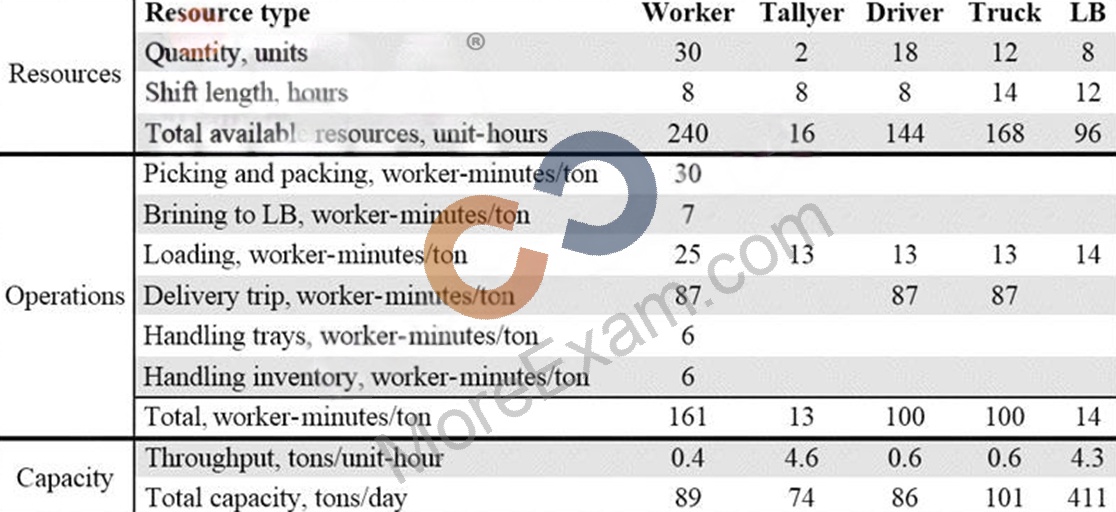
A business analyst (BA) has spent several days observing and measuring the warehouse activities to understand the situation and to gain insights into possible solutions. The delivery workflow is a four-step process: (1) picking the orders and assembling them on trays, (2) bringing the trays to the loading bay, (3) loading the orders into trucks, and (4) delivering the orders to customers. As the following table illustrates, overall performance depends is dependent on five major resources: (1) the workers who pick the orders and load them into trucks, (2) the tallyers who check the orders, (3) the drivers, (4) the trucks, and (5) eight loading bays (LBs).

Preparing a customer order for loading takes about one hour. Upon the BA's observation, only 30% of trips have their orders available for loading when a truck arrives. This causes a waste of both the truck's and the driver's time.
What should the BA recommend to eliminate such waste?

Question67: You are the business analyst for a large project that will create new software for the entire organization. This new software will affect all of the administrative assistants in the organization schedule meetings, reserve facilities, and share calendars. There are approximately 2,400 administrative assistants in your organization and not all of these people can attend requirements gathering workshops.
What approach can you use to manage and gather requirements from these 2,400 administrative assistants?

Question68: A business unit of a transnational manufacturer wants to implement a robust process for addressing integrity- critical equipment deterioration incidents. Timely and complete resolution of such incidents is vital for the business unit's continuous safe and profitable operation. Treating each incident involves many employees from different departments extensively collaborating and exchanging information. That information is spread across multiple systems having their access limited to particular user groups. With the current manual process, some incidents get forgotten and remain unresolved for years.
The project's Sponsor is an Equipment Integrity and Reliability Advisor, who moved into this position from another business unit. That business unit implemented a proprietary application to integrate the information and to assist in tracking and managing the incidents. Having a positive experience with the application, the Sponsor is suggesting to customize it and reuse in the new business unit.
The business unit's Enterprise Architect (EA), who is responsible for assessing solution options and presenting them to executive decision makers, has a few concerns with adopting the existing application. The application uses point-to-point interfaces with other data sources whereas the business unit's target architecture relies on a data warehouse-based integration. Moreover, the two business units use different legacy systems, as well as different front-end implementation technologies. Additionally, the existing application is monolingual, while the business unit needs user interfaces and some data to be presented in two languages. With all of this, it may be easier to build a new application from scratch than to customize the existing one. To understand which option is better, the EA asks a business analyst (BA) to define business requirements.
With the team ready to consider design options, they are reviewing the following requirement: "Appropriate stakeholders shall be timely and reliably notified on incident-related events." What quality criteria does this requirement fail to satisfy?

Question69: You are the business analyst for a large, complex solution and you are working with the stakeholders to determine the prioritization of the requirements. You would like to use the decision analysis to determine the best decision for the requirements outcome. You must know four things as part of decision analysis.
Which one of the following will not help you with this approach to the requirements prioritization process?

Question70: Which of the following defines how the project will be estimated, budgeted, and how changes to cost will be managed?

Question71: You are the business analyst for your organization and are coaching Roberta on how business analysis works.
Roberta is confused about what a business analysis methodology is during the business analysis planning and monitoring phase of the business analysis duties.
What is a methodology?

Question72: Which one of the following diagrams when properly laid out is always laid in a left to right display to properly reflect the chronology of all project work?

Question73: A floral company wants to gather information about each of its 30 international facilities to determine whether employees are satisfied with their jobs.
Which of the following elicitation techniques should the business analyst (BA) use?

Question74: You are the business analyst for your organization. As part of the requirements prioritization you have given each key stakeholder $10,000 in play money to distribute among the identified requirements. Each stakeholder can assign their play money to any of the requirements, but the requirementswill be prioritized based on the value of the play money assigned to each requirement.
What type of requirements prioritization is happening in this scenario?

Question75: An organization implements a solution to increase the efficiency of its internal processes. The business analyst (BA) felt that the success of the solution is tied to the organizational structure and confirmed that the solution conforms to the organizational hierarchy. After the solution rolled out, the solution was not widely adopted among stakeholders and some features were not being utilized.
Which aspect of the organizational structure did the BA fail to consider?

Question76: Which of the following is responsible for preparing the business architecture, feasibility studies, and business cases?

Question77: You are the business analyst for your organization and are working on prioritizing the project requirements.
Management has asked you to prioritize the requirements based on the cost-benefit analysis for the requirements' value to the organization.
What basis for prioritization are you using in this instance?

Question78: Which of the following is NOT a component of flowchart?
Question79: Due to the complexity of a project the project board a concerned that the business analyst (BA) will not be able to ensure all requirements are verified. What toed can the BA present to the project board to mitigate their concern?

Question80: Contracts are currently managed by more than 20 contract owners across the organization, each happily managing in their own way. A business analyst (BA) is tasked to elicit requirements for centrally managing software maintenance and license contracts.
Which of the following does the BA need to carry out first?

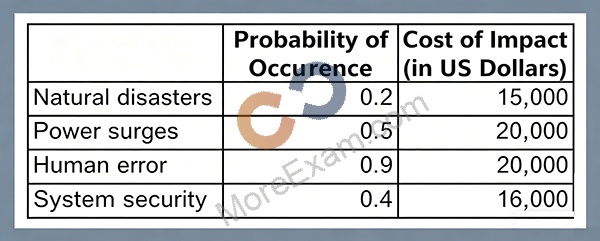
Question81: In a risk assessment exercise of a software implementation program, the business analyst (BA) has successfully computed the probability of occurrence (POC) and the cost of impact for each of the identified risks as follows:

Which of the following will have the highest negative impact to value?

Question82: Which of the following captures all of the activities within a business, the inputs and outputs of each activity, and the required resources to complete each activity?

Question83: Which of the following is a table of all stakeholders showing the mapping of which stakeholders will contribute information to other stakeholders?

Question84: A company with a big information technology (IT) department has hired a lead business analyst (BA) to enhance its business analysis practices. The lead BA discovers that sponsors are not satisfied with project outcomes. Developers complain about incomplete, ambiguous, and changing requirements. All stakeholders, including project managers, are blaming long cycles of analysis for the delays. The business analysts, in turn, feel overwhelmed with the number of projects and frustrated by the lack of collaboration from reviewers of their deliverables. All of the evidence is anecdotal and none of the groups could strongly substantiate their opinions.
The lead BA wants the BAs to report anticipated and actual completion dates for their deliverables, as well as the time spent on planned and unplanned activities. What is the lead BA trying to do by analyzing the results of such measurements?

Question85: Which of the following represents the duration of activities against a calendar?

Question86: The seminar administrator reviewed these three diagrams and asked the BA to create a fourth diagram to model the various levels that a trainee goes through (e.g., white belt to yellow belt yellow belt to green belt etc). What modeling technique will the BA use to create this diagram?

Question87: All of the following are examples of transference risk response except for which one?

Question88: A business analyst (BA) has defined a business analysis approach and presented the documents to the sponsors, the senior executives, the domain experts, the project manager and the head of technology, to obtain agreement from all. At this juncture, the prefect manager objected to some of the estimates determined m the budget and refused to agree with the estimates. Which guideline or tool, if followed by the BA. would have helped in avoiding such disagreements?

Question89: A non-profit utility company has 900 employees, a majority of whom are hourly employees and must track their time using a paper based process A few years ago, the Director of Human Resources purchased a software system to eliminate the current paper-based time reporting process. No requirements specific to the utility company were defined prior to the purchase. A team was formed to implement the software During implementation process, the team discovered the software lacked functionality and was not robust enough to support the general ledger requirements The company stopped the effort and incurred a $500,000 USD loss on the cost of the software.
This year, the Director of Finance requested that a team investigate the current paper based time reporting process and recommend solutions. The Director of Finance feels that the Director of Human Resources must be involved as a critical stakeholder. The Director of Human Resources is still bitter about the last effort because the process stopped'.
During a brainstorming session on improvement opportunities, the Director of Human Resources repeatedly interrupts the group and states why the proposed ideas will not work.
Which approach should the business analyst (BA) take to refocus the group?

Question90: There are 50 stakeholders in the current project. How many communication channels exist in this project?

Question91: You are the business analyst for your organization and are preparing for the conduct elicitation activity. You'll need several stakeholders' roles as you prepare for this activity in your organization.
Which one of the following stakeholders may be responsible to dictate that a specific process or technique be followed during your requirements elicitation activities?

Question92: In a software implementation project, the designated business analyst (BA) has conducted all the elicitation activities and now needs to confirm the elicitation results.
What is used by the BA Professional to guide which sources of information and which results are to be compared?

Question93: Which of the following participants have to keep the minutes and details of the conversation during Interviews?

Question94: You are the business analyst for your organization. You are currently working with Steve on the organize requirements process. You and Steve have elected to use the user stories approach for this process.
What is the user stories approach for requirements organization?

Question95: You are the business analyst for your organization and preparing to complete the requirements elicitation activities. Your manager wants to know when the requirements elicitation process will be completed.
Which of the following responses best describes the nature of the requirements elicitation process?

Question96: A business analyst (BA) has been assigned to manage the ongoing stakeholder collaboration after completing a project. The BA needs to understand the stakeholders' level of satisfaction and wants to offer stakeholders an opportunity to help improve the working relationships based on this information.
Which technique should the BA use?

Question97: You are the business analyst for your organization and are in the process of creating the solution approach for a technology problem.
Which one of the following definitions best describes the solution approach?

Question98: Which of the following can be an effective tool during quality control to help determine the how the problem occurred?

Question99: Martha is observing Gary complete several activities as part of her requirements elicitation process. Martha is simply observing the steps Gary takes to complete his work and she is taking notes. In this instance Martha does not ask Gary any questions.
What type of observation technique is Martha completing?

Question100: You are the business analyst for a large project in your organization. While your company prefers face-to-face communications there are many stakeholders located in different geographical locations.
How can you still effectively serve as a business analyst when the stakeholders are not collocated?

Question101: A business analyst (BA) is developing an approach for information management. The BA needs to identify and categorize which information is to be managed.
Which of the following techniques should the BA use to achieve this objective?

Question102: Which of the following tasks cannot start until other tasks are completed?

Question103: Which of the following is a narrative description of the work required for the project?
Question104: Which of the following stages of a project defines the number of risks and opportunities, including intense planning and anticipation of risk events?

Question105: A business analyst (BA) works for a financial institution that wants to acquire new systems and migrate all future business operations to the new systems. The BA is responsible for performing a gap analysis and has reviewed the current state of systems.
What is the next task that the BA needs to do to complete the gap analysis?

Question106: You are the business analyst for your organization and are beginning the requirements analysis processes.
Which one of the following statements best describes the requirements analysis processes?

Question107: Ben is the business analyst for his organization. Ben is currently working on a solution to improve a laser printer. He has taken the laser printer apart, identified each component, and documented each component's purpose.
What type of requirements organization is Ben doing in this scenario?

Question108: Zoe is the business analyst for her organization. She is currently prioritizing the requirements based on the implementation difficulty of the requirements to help with the solution planning.
Which of the following best describes the approach Zoe is taking with requirements prioritization?

Question109: A health insurance provider undertakes enhancements to its mobile application platform and finalizes the following capabilities as part of the scope of the next release:
I). Ability to integrate online maps and global positioning system (GPS) technology with the mobile application In real time to display location of service providers in the subscriber's vicinity that participate in the subscriber's plan network.
II). Ability for the subscriber to lookup the service providers by specifying either a postal code or a search area radius in miles.
III). Ability for the subscriber to initiate the download of fee information for one or more service providers in a single request.
Through requirements workshops the business analyst elicits the following detailed business requirements:
1. The company's mobile application platform must support real time integrate with the following third party systems:
A). GPS System
B). Postal Code Validation
What is the appropriate model type to assist the stakeholders in testing the performance and visual aspects of requirements 3 through 11?

Question110: A business analyst (BA) is preparing for observation. A passive approach has been selected for establishing performance metrics. What should be identic for the next step?

Question111: The BA is analyzing the requirements that are represented in the Class Diagram. In addition to the diagram, the BA would like to include a separate document that has the information about the data elements to ensure a common understanding of the classes' attributes. What technique is used to define the data elements?

Question112: A business analyst (BA) is working on an initiative to decommission a legacy system and has discovered the requirement ''Ability to view policies created m the legacy system for a period of 6 months. ''How should the BA classify the requirement based on the requirements classification schema?

Question113: Which of the following requires that all parties in the conflict must give up something?

Question114: Whatare timeless events that show progress in the project.
These are typically achieved at the end of phase in the project lifecycle.

Question115: A business analyst (BA) is running a workshop with a group of stakeholders to understand the requirements for a change that the company is planning to implement.
What important factor does the BA need to understand to ensure the workshop remains focused on the topic in question?

Question116: A popular department store chain wants to make computer upgrades as well as conduct a major remodeling effort to increase revenue to all their 100 stores over the next 2 years. The remodeling will occur in two phases. The two phases are required at each store and can be completed in any order, but each phase must be fully completed before the next phase can begin. Phase 1 will take approximately 32 weeks and will not require a store to be temporarily closed. Phase 2 will take approximately 20 weeks and will require a store to be temporarily closed.
In order to keep inventory level and total revenue for the department store chain at an operational level, 75% of the stores must remain open to the public at all times. Against the board of director's advice, the Chief Executive Officer (CEO) made a decision to start and complete the top 25 revenue-producing stores in the first year to get those stores remodeled and fully operational.
A business analyst (BA) has been brought in to help with planning the project and gathering requirements.
What tool will help the BA understand the changes needed to keep the majority of the stores open?

Question117: A business analyst (BA) plans to hold a workshop next week to elicit requirements for a project. In an informal conversation, another employee mentioned that one of the attendees is likely to be unhappy about the project's impact on their work.
Which of the following techniques will the BA use to avoid disrupting the workshop?

Question118: A company is about to embark upon a large organizational change initiative that involves restructuring its service offerings. A senior business analyst (BA) is assigned the work of establishing performance measures for the business analysis work to be performed by the 6A ream. Which of the following performance measures is appropriate to assess the value delivered by the work products against the cost time, and resource investments expended to create them?

Question119: Your organization is using a plan-driven approach to business analysis.
What characteristic must be true of changes in the approach that your organization is using?

Question120: The business analyst (BA) has been tasked with assessing and recommending the best solution that fits an organization's need for a new third-party sales tool.
What technique would be used for identifying suitable options?

Question121: What business analysis process ensures that requirements specifications and models meet the necessary standard of quality to allow them to be used effectively to guide further work?

Question122: Before investing further in the project, a customer and the stakeholder of the project wants to be able to visualize the final product. Which elicitation technique should the business analyst (BA) select?

Question123: You are the business analyst for your organization and you are completing the verify requirements process.
There are eight characteristics each requirement should have: cohesive, complete, consistent, correct, and feasible.
Which one of the following four is not a characteristic of a requirement?

Question124: A major manufacturer of popular beverages has appointed a local distributor to serve a specific territory. The demand for the beverages has a pronounced seasonal pattern. The distributor performs well overall, but is repeatedly unable to keep up with fulfilling many customer orders during peak demand periods. The distributor's current delivery capability is stretched to deliver 60 tons of merchandise per day whereas the season's peak demand periods need a daily delivery capability of up to 100 tons.
The distributor is under pressure to fully meet the year-round market demand in order to stay in business. The distributor's management wants to identify and consider more cost-effective options as resorting to adding more trucks and drivers would not be economically feasible.
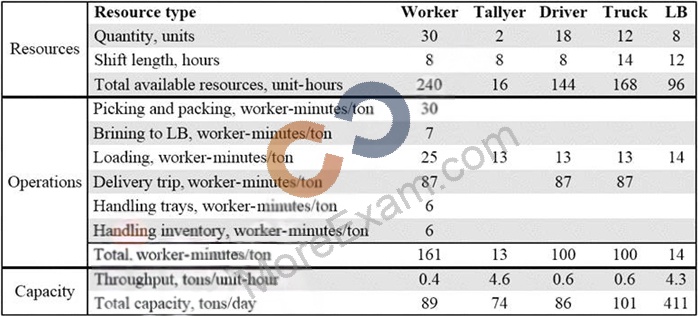
A business analyst (BA) has spent several days observing and measuring the warehouse activities to understand the situation and to gain insights into possible solutions. The delivery workflow is a four-step process: (1) picking the orders and assembling them on trays, (2) bringing the trays to the loading bay, (3) loading the orders into trucks, and (4) delivering the orders to customers. As the following table illustrates, overall performance depends is dependent on five major resources: (1) the workers who pick the orders and load them into trucks, (2) the tallyers who check the orders, (3) the drivers, (4) the trucks, and (5) eight loading bays (LBs).

What is the company's primary business objective in this scenario?

Question125: A leading software manufacturing company has appointed a business analyst (BA) to ensure that requirements are managed effectively and efficiently. The BA discovered some missing functionality as well as some implemented functionality which are not supported by requirements.
Which of the following tasks did the BA use to discover the issues?

Question126: Which of the following document is created first after project is awarded and statement of work is handed over to the project manager?

Question127: Robert is the business analyst for his organization and he's working with several stakeholders to identify the business need for an opportunity. Robert needs to identify the stakeholder that will be responsible for authorizing the actions needed in order to meet the identified business need.
Which stakeholder does Robert need to identify?

Question128: A business unit of a transnational manufacturer wants to implement a robust process for addressing integrity- critical equipment deterioration incidents. Timely and complete resolution of such incidents is vital for the business unit's continuous safe and profitable operation. Treating each incident involves many employees from different departments extensively collaborating and exchanging information. That information is spread across multiple systems having their access limited to particular user groups. With the current manual process, some incidents get forgotten and remain unresolved for years.
The project's Sponsor is an Equipment Integrity and Reliability Advisor, who moved into this position from another business unit. That business unit implemented a proprietary application to integrate the information and to assist in tracking and managing the incidents. Having a positive experience with the application, the Sponsor is suggesting to customize it and reuse in the new business unit.
The business unit's Enterprise Architect (EA), who is responsible for assessing solution options and presenting them to executive decision makers, has a few concerns with adopting the existing application. The application uses point-to-point interfaces with other data sources whereas the business unit's target architecture relies on a data warehouse-based integration. Moreover, the two business units use different legacy systems, as well as different front-end implementation technologies. Additionally, the existing application is monolingual, while the business unit needs user interfaces and some data to be presented in two languages. With all of this, it may be easier to build a new application from scratch than to customize the existing one. To understand which option is better, the EA asks a business analyst (BA) to define business requirements.
Through the elicitation process, the BA identifies the following requirement: "Particular incident-related activities require approval by authorized personnel before beginning them, as well as confirmation of acceptance of their completion." What kind of asset should the BA provide to fully specify the approval requirement?

Question129: You are the business analyst for your organization and are creating the solution scope definition.
Which of the following should be included in the solution scope definition?

Question130: Which stakeholder must approve the business analysis approach to ensure that the business analysis approach is compatible with the other project activities?

Question131: All of the following are techniques that can be used to specify or model requirements except for which one?

Question132: Which of the following diagrams is used to display sensitivity analysis data?

Question133: After the new report "Customer Sales by Date" was deployed last week, the sales team is now unable to generate the previously existing report "Consolidated Sales by Customer, " which is causing customer dissatisfaction.
What could the business analyst (BA) have assessed to prevent this situation?

Question134: You are creating the solution scope for an identified problem in your organization. You are working with several stakeholders during this process including the domain subject matter expert, the implementation subject matter expert, the project manager, and the sponsor.
Which of these stakeholders will be responsible for writing the project scope?

Question135: You are the business analyst for your organization. You are currently writing the business goals and objectives as part of the elements for the define business process.
Which one of the following statements best describes the business goals and objectives element?

Question136: You are the business analyst for your organization and are planning the business analysis approach. One of the techniques you are considering for this undertaking is to rate the available methodologies against the organizational needs and objectives.
Which of the following terms describes the business analysis technique that you are currently considering in this scenario?

Question137: Holly's organization uses a plan-driven approach to business analysis.
When it comes to communication in Holly's organization what type of communication will likely be required?

Question138: A business analyst is helping management determine which solution they should choose. As it happens that the organization can only choose one of the two solutions due to time and resource restrictions. Solution A worths $456,000 to the organization while solution B worths $565,000 to the organization. While solution A costs less, it is less risky and takes less time to complete so management elects to seize Solution A.
What is the opportunity cost?

Question139: Mark is the business analyst for his organization. He is working with the solution development team and he believes that the team does not want to implement a certain portion of the requirements. The team is expressing the difficulty of the requirements and how it will be extremely challenging to complete. When Mark asks about a similar project that the team completed, they insist that this is a different type of requirements though Mark believes that it is not.
What is the solution development team appearing to do to the requirements?

Question140: A company finalized the implementation of a new, corporate-wide database. After nearly three months of operation, the solution is repeatedly producing invalid outputs. A business analyst (BA) has been asked to investigate the solution's problem. The BA has been able to find several instances where the outputs from the solution are below an acceptable level of quality.
Which of the following techniques should the BA use to identify the solution limitations?

Question141: You are the business analyst for your organization. Management realizes that a proposed solution has risks that may cause the entire project to fail. They would like you to prioritize the requirements with maximum risks first so that if the project fails, there is little loss of capital in the project implementation.
What requirements prioritization approach is management asking you to create in this instance?

Question142: A health insurance provider undertakes enhancements to its mobile application platform and finalizes the following capabilities as part of the scope of the next release:
I.Ability to integrate online maps and global positioning system (GPS) technology with the mobile application in real time to display location of service providers in the subscriber's vicinity that participate in the subscriber's plan network.
II.Ability for the subscriber to lookup the service providers by specifying either a postal code or a search area radius in miles.
III.Ability for the subscriber to initiate the download of fee information for one or more service providers in a single request.
Through requirements workshops the business analyst elicits the following detailed business requirements:
1.The company's mobile application platform must support real time integration with the following third-party systems:
A ) GPS System
B ) Postal Code Validation
2.The service providers available for selection must participate in the subscriber's medical plan network as of the current system date.
3.The map display shall highlight the boundary of the search area with a dotted yellow line.
4.The extent and shape of the search area shall be determined based on one of the following user choices:
A ) Postal code - Subscriber location acquired from GPS shall be used to determine and populate the related postal code as the default postal code with options for the user to change the postal code.
B ) Radius for the search area around the subscriber's location, that will have default value of 5 miles. The radius can be changed by the subscriber with a maximum range of 50 miles.
5.Subscriber shall be able to select one of the options above and supply corresponding input.
6.System shall validate the user input and display appropriate error messages if invalid.
7.Based on the inputs and the plan of the subscriber, the system shall retrieve information for the participating service providers that are located within the designated search area.
8.System shall display a map including visual markers to indicate locations of the service providers in the top half of the device screen and a list of the same service providers in the bottom half of the device screen.
9.The list of service providers shall include the Name, Phone Number and Street Address.
10.If the subscriber specified the radius or retained the default postal code for the search area, the list shall additionally include the approximate driving distance in miles from the subscriber's last registered location and the list shall be sorted in the ascending order of the driving distance.
11.The subscriber shall be able to select a service provider either from the list or from the map and download a document that contains the name, contact telephone, email address, fax number and the fee schedule for the covered services applicable to the subscriber's plan.
Which primary subscriber business need is addressed with the enhancements?

Question143: A business analyst (BA) facilitated elicitation activities with subject matter experts and end users using observation, workshops, and interviews.
After comparing the results, how should the BA resolve the variations?

Question144: Which of the following requirement attributes lacks any ambiguous characteristics?
Question145: Which of the following chart shows the correlation between project team members and the work they've been assigned to complete?

Question146: You are the business analyst for your organization and are about to conduct requirements elicitation for a process to streamline the customer fulfillment system your organization uses. You need to understand how the people, processes, and technology within the customer fulfillment system operates before you begin the elicitation process.
What type of analytical thinking are you participating in this scenario?

Question147: The business analyst (BA) is preparing to determine the impact of various risks associated with the business analysis effort currently underway.
Which of the following would the BA use as an input into the assessment of risk?

Question148: You are working with several business analysts to determine the solution approach for an identified problem.
All of the following techniques are acceptable for identifying the solution approach except for which one?

Question149: A team is working on a user privilege and access control system. A business analyst (BA) selects use cases as the technique for requirements specification.
What is the relationship between use cases "Create a role" and "Find a role" when there is a high level of formality?

Question150: A software development company is in the process of creating a new product for their customer base. It has been several years since such a project has been initiated and the organization has created a new team to own and develop the product. The project team will be evaluated by the successful adoption of the product, which will be developed over the next 12 months.
The team's business analyst (BA) has analyzed the current state in partnership with the product owner and has been meeting with senior management to identify the goals that need to be attained. A broad view of the business has been analyzed in order to have an understanding of how the company is currently providing value to its customer base.
After the BA completed the initial analysis, the information is reviewed with leadership. At this point in the project, what will the BA be presenting?

Question151: Nancy has asked you to trace a particular requirement for her.
What does 'to trace a requirement' mean?

Question152: Marcy is the business analyst for her organization. She is completing the business analysis task of defining the business needs. She has the business goals and objectives and the requirements stated documentation.
What must she confirm about the requirements stated documentation before defining the business need based on her analysis?

Question153: Whilst working on business requirements to improve a process, a business analyst (BA) has created flowcharts from the viewpoint of several different users. The stakeholders have expressed some confusion because the flows seem inconsistent.
What ensures that the process models relate to each other?

Question154: Which of the following is the process of analyzing the areas of a project that are most affected by risk?

Question155: You are coaching Marcy, a new business analyst for your organization, on business analysis processes. Marcy is concerned about the define solution scope process, especially the implementation approach element.
Which of the following statements best defines the implementation approach element for Marcy?

Question156: You are the business analyst for your organization. Gary and Janet, two key stakeholders in the project, are in disagreement over a requirement for the type of software to be installed on the server your solution calls for.
What must happen in this instance before formal approval can be offered?

Question157: Paul has been asked to complete SWOT analysis for his solution scope. What does SWOT analysis mean?

Question158: Company A is a nation-wide leader in commercial demolition. Having just celebrated its 100th year of operations, the company decided to begin doing work internationally. The current system used for reporting company finances is unable to keep pace with the potential demands of doing work in geographically dispersed locations. Therefore, the company decided to replace its client-based Profit & Loss (P&L) reporting system with a more robust, web-based system. This will ensure transparency across the organization and enable better decision making.
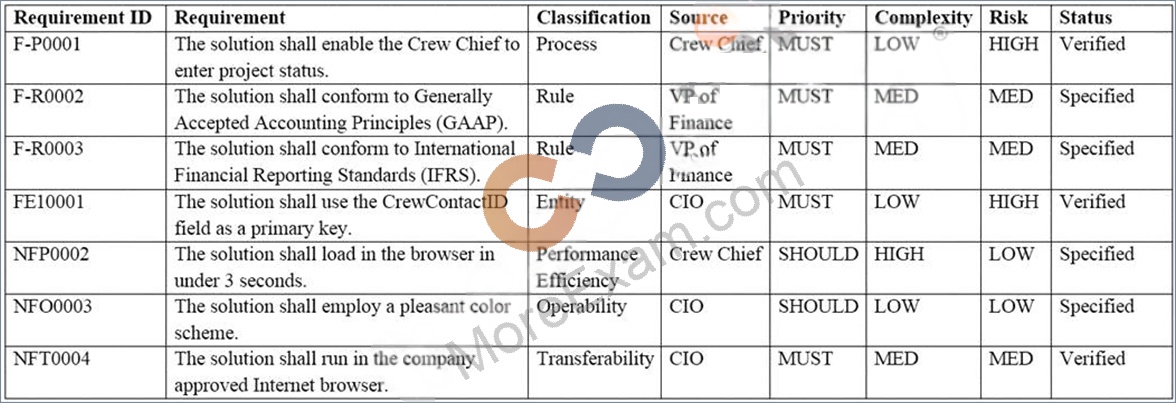
The business analyst (BA) at Company A has recently completed several rounds of elicitation to determine the requirements for the new, web-based system. Over 1250 requirements were elicited. An initial Requirements Traceability Matrix (RTM) has been drafted, and a subset of the RTM can be seen below:

The risk associated with Requirement ID F-P0001 is HIGH. The BA has gone back to the Crew Chief to determine why this requirement's risk is HIGH. The Crew Chief stated that it was based on an assumption.
Which of the following assumptions would make this requirement's risk high?

Question159: Which of the following reports is generated whenever the project is slipping off the project schedule and includes an of the problem?

Question160: Which of the following inputs of Monitor and Control Risks acquires information from performance measurements and evaluates it to provide variance analysis and forecasting?

Question161: Which of the following displays the relative importance of the defects?
Question162: A software development company is in the process of creating a new product for their customer base. It has been several years since such a project has been initiated and the organization has created a new team to own and develop the product. The project team will be evaluated by the successful adoption of the product, which will be developed over the next 12 months.
The team's business analyst (BA) has analyzed the current state in partnership with the product owner and has been meeting with senior management to identify the goals that need to be attained. A broad view of the business has been analyzed in order to have an understanding of how the company is currently providing value to its customer base.
What has the BA evaluated to help determine value of the project?

Question163: You are the business analyst for your organization. On your current project you'll be using the change-driven approach for defining requirements and gathering feedback.
Which of the following statements best describes the change-driven approach?

Question164: What element of the conduct elicitation activity is tracked to provide a basis for future planning?

Question165: A company has a process improvement initiative that is projected to increase revenue by $150,000 USD non- compounded per year. The budgeted cost of the initiative is $200.000 and supporting the initiative will cost
$30.000 for years two and three.
What is the projected return on investment over the first 3 years?

Question166: You are the business analyst for your organization and are trying to determine the best solution for an identified problem. You have determined that you could create a software solution using inhouse resources for
$65,000 and with an ongoing support of $5,600 per month. A vendor offers you a quote that they can create the software for $49,000 with an ongoing support of $6,100 per month.
Which solution should you choose?

Question167: Ned is the business analyst for the NHQ Company. He is working with Stan on completing the requirements prioritization of all the identified requirements.
Why would Stan and Ned complete requirements prioritization?

Question168: A business unit of a transnational manufacturer wants to implement a robust process for addressing integrity- critical equipment deterioration incidents. Timely and complete resolution of such incidents is vital for the business unit's continuous safe and profitable operation. Treating each incident involves many employees from different departments extensively collaborating and exchanging information. That information is spread across multiple systems having their access limited to particular user groups. With the current manual process, some incidents get forgotten and remain unresolved for years.
The project's Sponsor is an Equipment Integrity and Reliability Advisor, who moved into this position from another business unit. That business unit implemented a proprietary application to integrate the information and to assist in tracking and managing the incidents. Having a positive experience with the application, the Sponsor is suggesting to customize it and reuse in the new business unit.
The business unit's Enterprise Architect (EA), who is responsible for assessing solution options and presenting them to executive decision makers, has a few concerns with adopting the existing application. The application uses point-to-point interfaces with other data sources whereas the business unit's target architecture relies on a data warehouse-based integration. Moreover, the two business units use different legacy systems, as well as different front-end implementation technologies. Additionally, the existing application is monolingual, while the business unit needs user interfaces and some data to be presented in two languages. With all of this, it may be easier to build a new application from scratch than to customize the existing one. To understand which option is better, the EA asks a business analyst (BA) to define business requirements.
The EA wants to understand whether the integration capabilities of the existing solution match the business unit's IT landscape. The requirement definition that the EA needs should read as, "Each record of an incident shall."

Question169: The project manager wants to have the requirements analysis phase approved and asks the business analyst (BA) if this is possible The BA wants to ensure that the requirements package <s complete poor to closing the analysis phase. What would help the 8A expedite the approval process for the analysis phase?

Question170: You are the business analyst for your organization and are preparing to conduct stakeholder analysis. As part of this process you realize that you'll need several inputs.
Which one of the following is NOT an input you'll use for the conduct stakeholder analysis task?

Question171: A utility company found mat its current billing system charges customers 'or tie r usage, but does so incorrectly when the system estimates reads on meters rather than performs actual reads. Company stakeholders would i*e to improve this aspect of the system but are hesitant to make changes because they are otherwise pleased with the system A business analyst (BA) has completed a current state diagram and would like to start discussions on what the future state may look like. What information can the BA determine by having a current slate diagram?

Question172: It's often impossible or difficult to prove that the implementation of a solution will change the current state of an organization to the desired future state. The business analyst must document the characteristics and risk of the implementation of a solution in case the belief that the solution will achieve the desired results will prove invalid.
What is the belief that the solution will create the desired effect for the organization called?

Question173: Which of the following process models needs to complete each set of tasks in one phase before moving into the next phase in a project development life cycle?

Question174: You and Tom are writing the solution scope for a new project in your organization. You need to create a method to define what solution will and will not provide for the organization.
What technique can you and Tom use to establish appropriate boundaries for the solution?

Question175: When determining the success criteria for an initiative a business analyst (BA) engages end users in order to understand what they would define is an effective solution. What two types of data will the end men need to perform the evaluation?

Question176: You are the business analyst for your organization. Management has asked you to create a plan that will define the proposed structure and schedule for communicating the business analysis activities to the appropriate stakeholders.
What plan does management want you to create?

Question177: Which of the following describes the actual users who interact with one another, a system, or data moved between two users?

Question178: Herb is the business analyst for the HYY Organization. As Herb is completing the organize requirements process, he recognizes that requirements typically need to answer one question for identification.
What is the one interrogative that requirements should answer?

Question179: A business analyst (BA) has recently completed a comprehensive stakeholder analysis. Next the BA would like to consider ways in which to ensure that the stakeholders remain engaged throughout the change strategy.
Some of the considerations include timing and frequency, location, available tools, delivery methods and the stakeholders' preferences. In which of the following plans would the BA document these considerations?

Question180: A business analyst (BA) is in the process of allocating requirements to various releases of a solution.
On what should the BA base requirements to maximize the value of the solution?

Question181: Rachel is writing the business case for her organization. As she's completing this process Rachel is concerned that she's including all the correct information for management.
Which one of the following should Rachel not include in her business case?

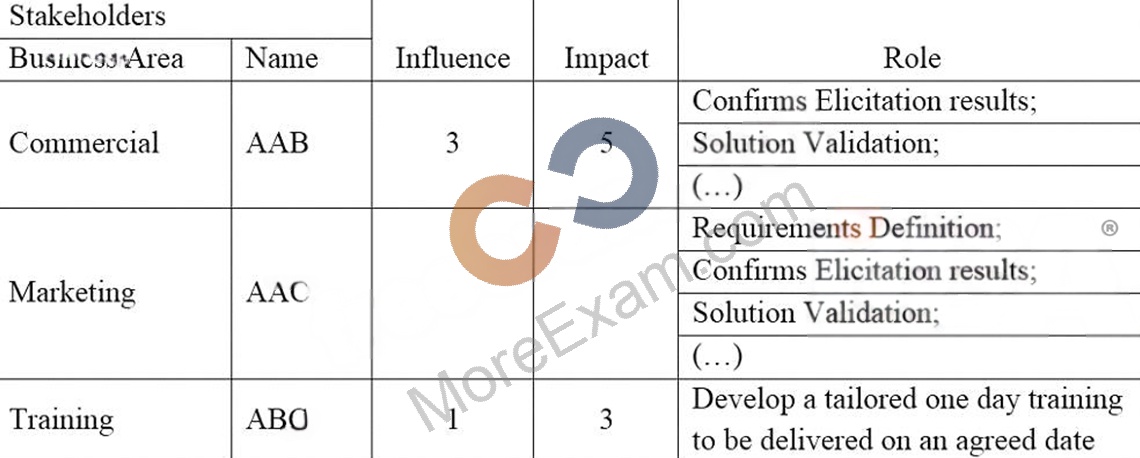
Question182: A company wants to launch an existing product in another channel and the business analyst (BA) is starting to perform the stakeholder analysis.

Legend: Influence/Impact 1 to 5 (1 = very limited impact/influence: 5 = very high impact/influence).
Considering the analysis, what values for influence and impact will the BA assign to the marketing?

Question183: A company wants to develop a product roadmap to guide future development efforts. The product owner asks a business analyst IBA) to lead the analysis effort. Feature suggestions have been compiled from customer support calls. Which of the following should the BA do first?

Question184: The technology team at a financial institution has successfully constructed a software application to be deployed as part of a digital banking strategy. A business analyst (BA) has completed a review of the current state description and now needs to evaluate the solution and determine limiting factors for value realization.
What additional input is required to perform the assessment of enterprise limitations?

Question185: A very large insurer of General Liability and Property Damage insurance has an upward trend of increased claims over the past 5 years.
The Risk Control Area for that company has just completed a 12 month Pilot of a new improved Risk Control Site.
The purpose of the site is to help their customers manage their exposures and ideally prevent them from having claims There were 100 customers that were part of the Pilot that represented 25 different industries.
The business goals were to increase use of the site and provide tools to help customer awareness of their exposures, so that they may reduce existing exposures and ultimately reduce claims.
The sites Features were as follows:
* Improvements to the search engine to all customers to search for articles, tools and services on the site
* A checklist function that allow customer to create their own unique Checklists or utilize a sample provided by ABC company to use daily, weekly etc for an area of their facility.
* A promotion feature - where Risk preventing Articles, and tools on the site are marketed toward a customer.
* A profile section allowing for Customer Name, Address and contact Phone number.
Alter the 12 month pilot the business sponsor received an assessment of what was working and what was not.
The Assessment of the pilot revealed overall site activity had significantly increased, however only 5% of the time the promotions were viewed. And the most shocking was that total claims increased by nearly 20% for these 100 customers during the pilot period. The business sponsor was perplexed as he had an expectation of reduced claims and at least for 30% viewing of promotions since the project team had spent a lot of careful time and effort on this feature. A BA was assigned to do further analysis regarding the low use of the promotions and why claims were not being reduced.
Regarding the use of promotions the BA looked into other similar companies to see what they did differently to get their customer to look at their promotions. The BA found that similar companies had promotions that targeted the industry the customer was in so it was more relevant to them and they were more interested to view the promotion. In addition the BA sent out a survey to all 100 pilot customers asking probing questions about what they thought of the site and if they felt it had decreased their exposure to risk sufficiently. The Survey responses came back with raving positive comments and providing examples of how the site had been helping in the reduction of claims from the customer's perspective. In addition the survey also revealed insight that the customers found the promotion often irrelevant to their industry.
The BA asked for a dump of all documentation of the 1000 claims that were filed over the 12 month pilot period. The BA found the nearly 90% of the claim filed were all in one region of the country and were all for property damage related to several severe winter storms in the region and the claims were nearly all unavoidable by the customers. The BA brought all this analysis back to the business sponsor and made the recommendation to the business sponsor to require the customer to select 1 of 25 industries in their profile.
This would in turn allow for the ability to show industry specific promotions and promote search results relative to a customer's industry to be sorted at the top giving the customer a more personalized experience.
What was the business sponsor looking to validate about the use of promotions?

Question186: Several risks were identified for an upcoming change initiative. One risk is related to a slippage concern because of loose gravel at the local site of the change initiative. The business analyst (BA) has recommended that all on-site stakeholders must wear durable, slip-resistant boots while the change initiative is being executed.
This is an example of which type of risk treatment?

Question187: A business analyst (BA) has engaged various groups from across the organization to define the business opportunity a potential project will address. The BA must consolidate the information collected from the groups.
The BA should ensure the business needs.

Question188: A business analyst (BA) is working on a payment system (PS) implementation. A set of systems which should interact with a new system has been identified. The business analyst defined that a user with role of
"Supervisor" in the PS must pass a two-factor authentication before an execution of the functions: "Change system parameters" and "Set up new supervisor." A user must have the role of "Supervisor" to use the standard functions "Send mail notification" or "Send SMS notification".
The BA defined the following use cases:
*"Change system parameters"
*"Setup new supervisor"
*"Send mail notification"
*"Send SMS notification"
*"Send notification"
*"Pass a two-factor authentication"
The BA wants to create a Use Case diagram.
Which technique should be used to define a communications protocol between the PS and other systems?

Question189: Which of the following techniques is used to test customer acceptance of the solution and to measure marketplace demand?

Question190: There are four inputs to the plan business analysis activities.
Which one of the following is not an input to the plan business analysis activities process?

Question191: What business analysis element tries to identify as many potential options as possible to meet the business objectives and fill identified gaps in capabilities?

Question192: Holly is the business analyst for her organization. Holly encourages teamwork and open communications among the business analysis team and the stakeholders. She wants stakeholders to drop by her office and freely discuss the requirements, the solution scope, and other concerns about the solution she's working on.
Holly definitely prefers informal communications.
What is the danger Holly may experience with informal communications?

Question193: You are the business analyst for the NHQ Organization. Management has asked that you examine the workflow and internal processes for order fulfillment. Specifically, they'd like you to complete an in-depth analysis and documentation of the business problems and opportunities that may be exist for the organization.
What business analysis knowledge area does this activity map to?

Question194: Which of the following is a procurement document?
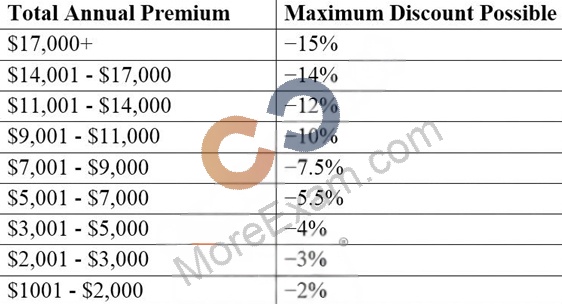
Question195: An insurance company wants to increase sales by 15% and customer retention by 10% within 1 calendar year.
Various strategies to achieve this were considered and a restructure to the existing pricing model is selected to help achieve these goals.
A business analyst (BA) works with stakeholders such as actuaries, product specialists, sales staff, risk managers, and underwriters who agree to applying varying levels of discounts to customers based on:
*Total annual premium the customer has with the company (Financial worth)
*Time with the insurance company (Loyalty)
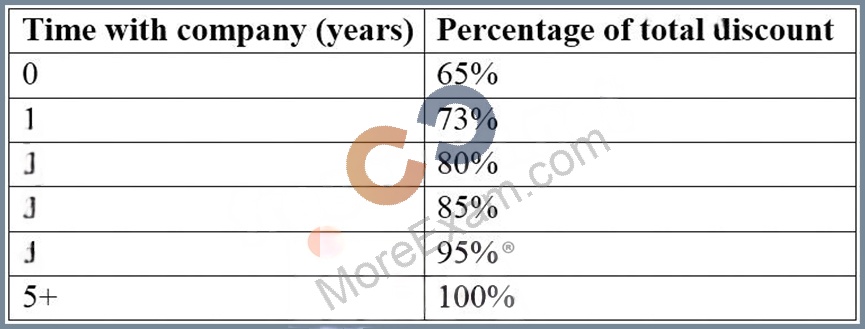
Various financial models are considered but the stakeholders agree that an initial applicable discount is determined based on the customer's overall premium:

The percentage of the maximum possible discount available to the customer is adjusted based on time with the company:

If within the first six months, customer retention increased by 5 % and sales increased by 6%, then when will the desired sales and retention goals be achieved assuming the trend continues at the same pace?

Question196: A company with a big information technology (IT) department has hired a lead business analyst (BA) to enhance its business analysis practices. The lead BA discovers that sponsors are not satisfied with project outcomes. Developers complain about incomplete, ambiguous, and changing requirements. All stakeholders, including project managers, are blaming long cycles of analysis for the delays. The business analysts, in turn, feel overwhelmed with the number of projects and frustrated by the lack of collaboration from reviewers of their deliverables. All of the evidence is anecdotal and none of the groups could strongly substantiate their opinions.
Even after dozens of reviews, some stakeholders refuse to sign off on the requirements specification documents because of a few questionable requirements. This puts the projects at risk and creates tension between the participants. What should the lead BA do first?

Question197: Which of the following is the comparison of planned project results with actual project results?

Question198: The business analysis approach generally defines all of the following attributes except for which one?

Question199: As part of the requirements analysis a business analyst can use the same tools and techniques to model the current state of an organization.
All of the following are valid reasons why would a business analyst want to create a current state domain model except for which one?

Question200: A business analyst (BA) is preparing a governance approach. The BA is trying to define the approval process.
Which factors should the BA consider?

Question201: A software development company is in the process of creating a new product for their customer base. It has been several years since such a project has been initiated and the organization has created a new team to own and develop the product. The project team will be evaluated by the successful adoption of the product, which will be developed over the next 12 months.
The team's business analyst (BA) has analyzed the current state in partnership with the product owner and has been meeting with senior management to identify the goals that need to be attained. A broad view of the business has been analyzed in order to have an understanding of how the company is currently providing value to its customer base.
What has the BA been identifying that will be used to evaluate the solution?

Question202: You are the business analyst for your organization and are training Tracy on business analysis duties. You are explaining to Tracy how it's important for a business analyst to generate new ideas to approaching problems, solving problems, and to generate alternative solutions. You stress that it's important for the business analyst to generate new ideas and innovative concepts.
What type of analytical thinking are you describing for Tracy?

Question203: What does the T in SWOT analysis mean?
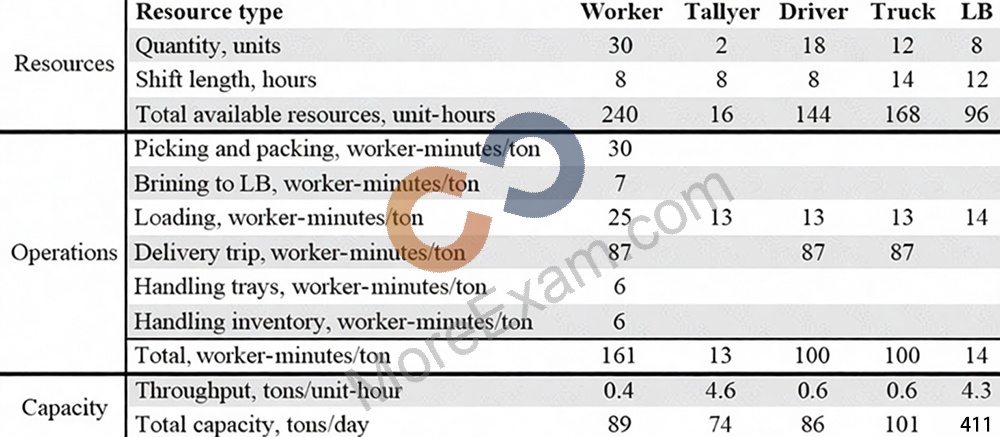
Question204: As part of identifying an enterprise's capability to adopt a potential solution, a business analyst (BA) is reviewing existing processes and tools within the enterprise for their ability to adapt to a new solution.
Which of the following assessments is the BA performing?

Question205: A business analyst (BA) working on a recently implemented project is approached by the sponsor to provide artifacts that can be used organization wide for the long -term.
Which of the following should the BA provide?

Question206: A national branch of a global company is struggling to improve business processes of its Public and Government Affairs (PGA) department. To work with external stakeholders effectively, PGA employees need to collect, manage, and exchange a vast amount of information. Complex cases involve collaboration of many employees from different departments. The ability to share information and to coordinate corresponding activities is crucial for the company's growth plans. Their current tools and practices do not serve the purpose well. The existing system, which was deployed a couple of years ago, has only a few active users. The majority of PGA employees avoid using it because the system is hard to use and lacks needed functionality.
Consequently, available information is mostly unstructured and stored either locally or on a shared network drive. Some of the information exists only in a paper form.
The branch's PGA head, who sponsors the project, wants to implement a configurable solution that two other branches successfully deployed several months ago. Both deployments were done by three solution consultants, who will be available to assist in the project. They will be responsible for tailoring the solution to PGA needs, as well as for training the PGA staff. With their help, the sponsor plans to complete the project in approximately three months.
The solution consultants reside in another country 7 hours ahead of the rest of the project team. They will be available part-time, but are planning two one-week long trips to the PGA central office to conduct initial training and to participate in the final deployment of the system into production. The consultants, in turn, expect a business analyst (BA) to assist in collecting necessary data and defining customization requirements.
What should define the timing of business analysis work in this project?

Question207: You are the business analyst for your organization. For the past several months you have been completing the business analysis duties for the solution stakeholders. You now have, you believe, the solution requirements identified and documented.
What must you now do with the requirements before proceeding?

Question208: Company A has been engaged to provided solution software to Company B as part of a combined service offering to Company C.
The initiative requires a sub project for Companies A and B learn Company Cs statutory requirements, a sub project for Company A to write custom functionality for the solution, and a sub project for Company B to develop infrastructure and support for the solution as well as the main project of implementation and cutover from Company Cs current data processing solution to the service from Company B, How does the business analyst (BA) assign requirements to the various solution components to ensure all objectives are met?

Question209: You are the business analyst for your organization. Management has asked that you create a method to store the project requirements including those under development, under review, and the requirements which have been approved.
What is management asking you to create?

Question210: You are the business analyst for a solution that has 435 stakeholders.
How many communication channels exist in this project?

Question211: A major manufacturer of popular beverages has appointed a local distributor to serve a specific territory. The demand for the beverages has a pronounced seasonal pattern. The distributor performs well overall, but is repeatedly unable to keep up with fulfilling many customer orders during peak demand periods. The distributor's current delivery capability is stretched to deliver 60 tons of merchandise per day whereas the season's peak demand periods need a daily delivery capability of up to 100 tons.
The distributor is under pressure to fully meet the year-round market demand in order to stay in business. The distributor's management wants to identify and consider more cost-effective options as resorting to adding more trucks and drivers would not be economically feasible.
A business analyst (BA) has spent several days observing and measuring the warehouse activities to understand the situation and to gain insights into possible solutions. The delivery workflow is a four-step process: (1) picking the orders and assembling them on trays, (2) bringing the trays to the loading bay, (3) loading the orders into trucks, and (4) delivering the orders to customers. As the following table illustrates, overall performance depends is dependent on five major resources: (1) the workers who pick the orders and load them into trucks, (2) the tallyers who check the orders, (3) the drivers, (4) the trucks, and (5) eight loading bays (LBs).

Each truck can only make two trips a day. The BA has noticed that only 30% of trips have their orders available for loading when a truck arrives. Otherwise the truck has to wait one extra hour until the orders are picked and brought to the loading bay.
If trucks are the only constraint, approximately how many hours are lost due to this downtime?

Question212: A corporation is experiencing poor financial performance and needs to change many aspects of its business strategy in coder to become solvent again. A business analyst (BA) is conducting a feasibility analysis and analyzing resources required. The BA has identified the existing resources, the resources that need to be increased, and the required additional capabilities. What is the other dimension this analysis should indicate?

Question213: You are the business analyst for a new project. Part of this project is for the project team to manually install new workstations through the company's campus. Based on your research you have determined that the project team can install 25 new workstations per hour. Since there is a fixed amount of time that these workstations need to be installed you are considering adding additional labor for the implementation. You are also considering to adjust the prioritization of the project requirements based on the amount of workstations the project team can install per hour.
What does the 25 workstations per hour represent in this scenario?

Question214: The objective of a solution implemented was to increase the number of customer calls resolved per hour.
When using basic statistical sampling concepts, what does the business analyst (BA) need to consider?

Question215: A business analyst (BA) assigned to a project has been asked to implement regulatory requirements based on priority. What type of traceability relationship can the BA use to find an the solution components that need to be implemented?

Question216: In performing the task of planning for business analysis governance for a software implementation project, the business analyst (BA) recommends that prioritization of requirements be done based on the amount of work that the project team is capable of delivering in a given period of time.
Which of the following techniques is the BA recommending?

Question217: A busmen analyst (BA) is assigned a new project to improve a delivery process. Which of the following does the BA create as an output of the initial meeting with experts?

Question218: Paul is the business analyst for his organization. He is examining a single solution to determine if the solution he and his team have identified carries enough business value to justify its implementation.
What business analysis process is Paul performing in this scenario?

Question219: You are the business analyst for your organization and you are completing the manage requirements traceability process. You are tracking the requirements to determine how the requirements are interrelated with one another and with the actual delivery of the project scope.
There are actually three reasons why the business analyst should trace requirements.
Which one of the following is not one of the three reasons why trace requirements is useful?

Question220: A customer has provided a business analyst (BA) with many business requirements and some have inter-dependencies with other requirements. To ensure the requirements are delivered according to customer expectations which requirements attribute should the BA consider including in the project requirements document?

Question221: An insurance company wants to increase sales by 15% and customer retention by 10% within 1 calendar year.
Various strategies to achieve this were considered and a restructure to the existing pricing model is selected to help achieve these goals.
A business analyst (BA) works with stakeholders such as actuaries, product specialists, sales staff, risk managers, and underwriters who agree to applying varying levels of discounts to customers based on:
*Total annual premium the customer has with the company (Financial worth)
*Time with the insurance company (Loyalty)
Various financial models are considered but the stakeholders agree that an initial applicable discount is determined based on the customer's overall premium:

The percentage of the maximum possible discount available to the customer is adjusted based on time with the company:

What did the BA create to ensure that everyone who needed to be included had been?

Question222:
The table illustrate the statement of cash flower for a courier company for the last fiscal year:
Due to aggressive market competition the management of the company performed a strategy review and based on their0-findings and the current market conditions, they came up with strategic and tactical changes in order to keep a competitive market position.
In order to strength customer retention strategies through a new competitive advantage, the company is considering implementing a live parcel tracking system. The added value will be that the customers may determine the exact location on of the parcel whether it is in a warehouse, crossing the ocean through an overseas the exact location of th parcel whether it is in a warehouse, crossing the ocean through an overseas the ship, or travelling in a delivery truck at any time. The system tracks the location of the parcel by tracking the vehicle in which it is contained. However, for a group of old delivery trucks, it was noticed that the engine sound and vibration disturbed the tracking signal and caused of management would like to sell these vehicles and replace them with newer ones, the Chief Financial Officer (CFO) was strongly against that approach. The CFO argoad that instead of hanging tracking devices on the trucks body they can have the truck drivers manually send the truck send the truck location from a hand held mobile device every 20 minutes.
The CFO's resistance to replacing the older vehicles represents which type of cost?

Question223: Which of the following models demonstrates the attributes, operations, and relationship to entities within the solution?

Question224: A business analyst (BA) is outlining who should participate in an upcoming requirements elicitation meeting.
From whom should the BA obtain approval before selecting the participants?

Question225: Which of the following authorizes the project to exist within the organization?
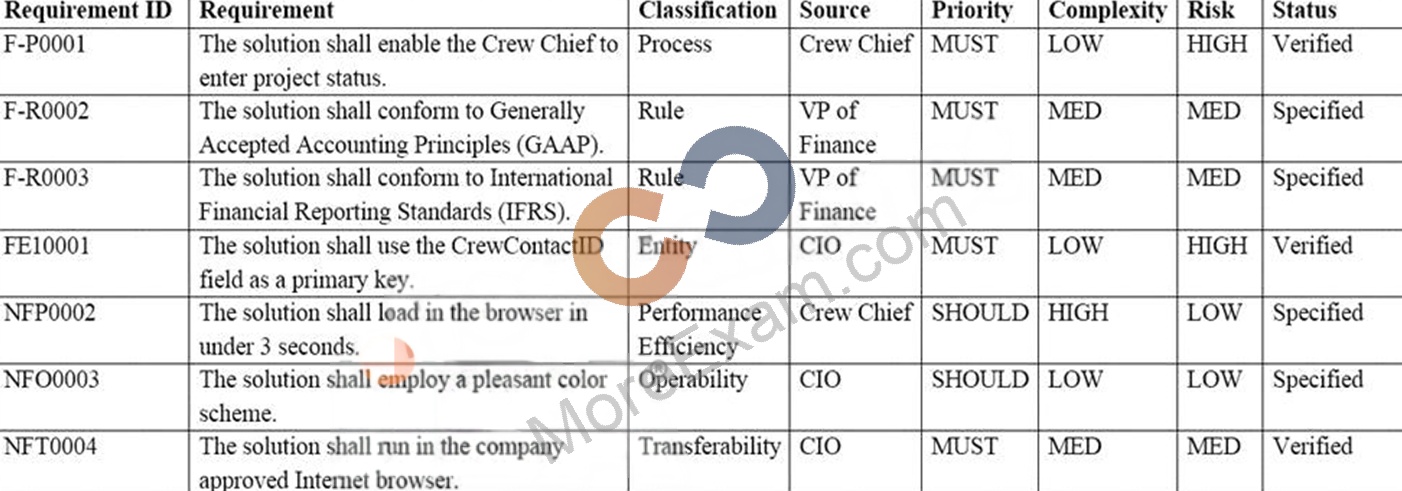
Question226: A business analyst (BA) has been given a defect during user acceptance testing. After analyzing the defect, the BA determines it is a change in the requirement.
What does the BA need to do to assess the change?

Question227: Which of the following documents is described in the statement below?
"It is a type of procurement document used to request proposals from prospective sellers of products or services."

Question228: Company A is a nation-wide leader in commercial demolition. Having just celebrated its 100th year of operations, the company decided to begin doing work internationally. The current system used for reporting company finances is unable to keep pace with the potential demands of doing work in geographically dispersed locations. Therefore, the company decided to replace its client-based Profit & Loss (P&L) reporting system with a more robust, web-based system. This will ensure transparency across the organization and enable better decision making.
The business analyst (BA) at Company A has recently completed several rounds of elicitation to determine the requirements for the new, web-based system. Over 1250 requirements were elicited. An initial Requirements Traceability Matrix (RTM) has been drafted, and a subset of the RTM can be seen below:

The BA is working on identifying additional improvement opportunities based on these requirements. Which of the following improvement opportunities is reflected in Requirement ID NFP0002?

Question229: A business analyst (BA) is preparing to specify requirements. Various attributes can be specified for each requirement or set of requirements.
Which approach contains a suitable set of attributes?

Question230: A team of business analysts (BAs) were assigned to review an enhancement request that would involve changes in a stockroom and the inventory of products. The changes will impact several groups of people and the amount of savings is in excess of $1 million dollars. The recommended process improvement will be presented to management for approval.
What should the team do first?

Question231: Which of the following processes is used to make certain that the project team members are completing the project work according to the project plan?

Question232: A company with a big information technology (lT) department has hired a lead business analyst (BA) to enhance its business analysis practices The lead BA discovers that sponsors are not satisfied with project outcomes. Developers complain about incomplete, ambiguous, and changing requirements. All stakeholders including project managers, are blaming long cycles of analysis for the delays The business analysts, in turn feel overwhelmed with the number of projects and frustrated by the lack of collaboration from reviewers of their deliverables All of the evidence is anecdotal and none of the groups could strongly substantiate their opinions.
What should the lead BA implement to identify areas of improvement?

Question233: Which of the following processes is used by organizations to set the risk tolerance, identify the potential risks, and prioritize the tolerance for risk?

Question234: Donna is leading a brainstorming session for her organization. She has asked the participants in this group to come up with at least ten ideas for possible solutions to an identified problem.
What is the problem with setting the goal as ten ideas for possible solutions in this session?

Question235: A very large insurer of General Liability and Property Damage insurance has an upward trend of increased claims over the past 5 years.
The Risk Control Area for that company has just completed a 12 month Pilot of a new improved Risk Control Site.
The purpose of the site is to help their customers manage their exposures and ideally prevent them from having claims There were 100 customers that were part of the Pilot that represented 25 different industries.
The business goals were to increase use of the site and provide tools to help customer awareness of their exposures, so that they may reduce existing exposures and ultimately reduce claims.
The sites Features were as follows:
* Improvements to the search engine to all customers to search for articles, tools and services on the site
* A checklist function that allow customer to create their own unique Checklists or utilize a sample provided by ABC company to use daily, weekly etc. for an area of their facility.
* A promotion feature - where Risk preventing Articles, and tools on the site are marketed toward a customer.
* A profile section allowing for Customer Name, Address and contact Phone number.
Alter the 12 month pilot the business sponsor received an assessment of what was working and what was not.
The Assessment of the pilot revealed overall site activity had significantly increased, however only 5% of the time the promotions were viewed. And the most shocking was that total claims increased by nearly 20% for these 100 customers during the pilot period. The business sponsor was perplexed as he had an expectation of reduced claims and at least for 30% viewing of promotions since the project team had spent a lot of careful time and effort on this feature. A BA was assigned to do further analysis regarding the low use of the promotions and why claims were not being reduced.
Regarding the use of promotions the BA looked into other similar companies to see what they did differently to get their customer to look at their promotions. The BA found that similar companies had promotions that targeted the industry the customer was in so it was more relevant to them and they were more interested to view the promotion. In addition the BA sent out a survey to all 100 pilot customers asking probing questions about what they thought of the site and if they felt it had decreased their exposure to risk sufficiently. The Survey responses came back with raving positive comments and providing examples of how the site had been helping in the reduction of claims from the customer's perspective. In addition the survey also revealed insight that the customers found the promotion often irrelevant to their industry.
The BA asked for a dump of all documentation of the 1000 claims that were filed over the 12 month pilot period. The BA found the nearly 90% of the claim filed were all in one region of the country and were all for property damage related to several severe winter storms in the region and the claims were nearly all unavoidable by the customers. The BA brought all this analysis back to the business sponsor and made the recommendation to the business sponsor to require the customer to select 1 of 25 industries in their profile.
This would in turn allow for the ability to show industry specific promotions and promote search results relative to a customer's industry to be sorted at the top giving the customer a more personalized experience.
What technique was the BA using to understand why the promotions were not being viewed?

Question236: There are four inputs to writing the business case as part of enterprise analysis.
Which one of the following is not an input to writing the business case process?

Question237: A popular department store chain wants to make computer upgrades as well as conduct a major remodeling effort to increase revenue to all their 100 stores over the next 2 years. The remodeling will occur in two phases. The two phases are required at each store and can be completed in any order, but each phase must be fully completed before the next phase can begin. Phase 1 will take approximately 32 weeks and will not require a store to be temporarily closed. Phase 2 will take approximately 20 weeks and will require a store to be temporarily closed.
In order to keep inventory level and total revenue for the department store chain at an operational level, 75% of the stores must remain open to the public at all times. Against the board of director's advice, the Chief Executive Officer (CEO) made a decision to start and complete the top 25 revenue-producing stores in the first year to get those stores remodeled and fully operational.
A business analyst (BA) has been brought in to help with planning the project and gathering requirements.
What activity should the BA do to determine which stores will be the first to start the renovations?

Question238: Which of the following techniques involves determining and documenting the variance between business requirements and current capabilities?

Question239: What technique used during the manage business analysis performance process can help identify the underlying causes of failures or difficulties in accomplishing business analysis work?