EMT Practice Test

1. Question Content...


Question List

Question1: What condition of the requirements must be fulfilled in order to use the matrix documentation approach to specify and model requirements?

Question2: What type of a business analysis approach focuses on the rapid delivery of business value in short iterations?

Question3: John and Hanna are business analysts in their organization and they are completing the verification activities to check for completeness of the requirements. When should John and Hanna perform these verification activities?

Question4: Ralph is a business analyst for his organization and he's using the plan-driven approach for business analysis. Ralph has captured the requirements of the project, but what must happen before he can begin capturing and defining the requirements at a deeper level of detail?

Question5: There are many stakeholders that need to be involved in the allocated requirements. One of the stakeholders in the task will be responsible for verifying released and solution components. Which stakeholder has this responsibility?

Question6: You are the business analyst for your organization and you're working with the project manager to complete some business analysis activities. The project manager has the authority to approve the requirements based on the short iterations of business analysis activities.
What approach of business analysis are you using in this scenario?

Question7: A business analyst is studying the cost of the endeavor in relation to the projected income the endeavor will bring once the project is completed. What financial valuation technique can the business analyst use to determine the breakeven point for the project?

Question8: A business analyst (BA) is eliciting requirements for a pharmaceutical distribution company with an expansion plan across many states, each with their own tools and methods. To make the requirements as re-usable as possible, what should the BA do?

Question9: You are the business analyst for your organization. You are currently writing the business goals and objectives as part of the elements for the define business process. Which one of the following statements best describes the business goals and objectives element?

Question10: A business analyst (BA) is creating a business process model (BPM) showing how the organization will handle errors reported on its website. The BA held a workshop with stakeholders about how the process might work. The BA was also given an instruction manual about a similar error-handling situation, but was advised that some minor aspects are not applicable to the new process. How can the BA use the manual?

Question11: A facilities management company has an ambitious growth plan of doubling the revenue of their office waste recycling service over the next 12 months. The business analyst (BA) plans to define the objectives and align them with the enterprise's vision, mission and goals. What element of 'SMART' goals would this objective refer to?

Question12: You are the business analyst for your organization and you're preparing to elicit requirements from the stakeholders. You've gathered several inputs to help with the elicitation process. Which input(s) will be used to ensure that you understand the type of information that should be elicited from the stakeholders?

Question13: Martha is the business analyst for her organization and she's been asked to help create a SMART goal for her company. Which one of the following organizational goals could be considered SMART?

Question14: What should an organization do if the business analyst has determined that the existing capabilities are inadequate to seize an opportunity?

Question15: You are the business analyst for your organization and you've been working with several stakeholders to gather requirements for approval.
The requirements have been approved with the exception of a conflict on one requirement. What must you and the stakeholders do in regard to this conflict before the business analysis endeavor may continue?

Question16: Which of the following is used to define and document the business analysis approach?

Question17: There are three inputs for stakeholder analysis. Which input describes the existing organizational units and their interactions with one another?

Question18: By which of the following is the performance of all requirements management and communication activities governed?

Question19: The RGQ Organization utilizes a change log. What is a change log?

Question20: Which element of the process of assessing the capability gaps is best described as gathering as much enterprise architecture information as is available about the current state of the organization and the areas affected by the business need?

Question21: Which elicitation activity is best described to ensure that the needed resources are organized and available for the elicitation?

Question22: A business analyst (BA) has been asked to develop a plan to complete the associated business analysis activities for a project in which an organization is switching from a manual to an automated process for receiving payments. As the final step in developing the plan, which technique will the BA use?

Question23: A business analyst (BA) has discovered an old checklist prepared for another initiative, which includes the following characteristics: Complete, Feasible, Unambiguous, Testable. What is the purpose of this checklist?

Question24: There are four methods to generate the business need in an organization. Which approach is described as the need to achieve a strategic goal?

Question25: A business analyst needs to prepare the requirements package for her endeavor in a predefined template for her company. What term can be assigned to this standardized template for packaging the requirements?

Question26: You have identified a task in your task list that cannot be completed until the inspector for the project signs off on the initial deliverables. The inspector's signoff on the initial deliverables is called what?

Question27: Enterprise analysis provides many things for an organization. All of the following are tasks included in enterprise analysis except for which one?

Question28: As a business analyst, you need to define when the activities of the business analysis approach will take place. This includes all of the following business analysis approach activities except for which one?

Question29: What term is given to the collection of notes and diagrams used by the business analyst to develop the requirements during the requirements development process?

Question30: What does MoSCoW mean when it comes to requirements prioritization?

Question31: Which stakeholder map shows the relative influence, impact, and relation of stakeholders by plotting them closer to or farther away from the solution?

Question32: The business analyst (BA) assigned to support a legacy system has developed a customer survey to assess its usability. Before distributing the survey, what should the BA do?

Question33: You are the business analyst for your organization and you and your staff are creating as many solutions as possible to an identified problem in the solution approach process. What is this activity element called?

Question34: Which requirements allocation technique is best described as the breaking down of the solution scope into smaller units for allocation?

Question35: Sam is preparing for the task of prioritizing requirements and he'll need five inputs to accomplish the task. Which one of the following is not an input that Sam will use to prioritize requirements?

Question36: Shelly is the business analyst for her organization and she's working with Thomas to review the business requirements. They are discussing the identified requirements, how the requirements will transition to the operations, and the longevity of the solution. Thomas is concerned that the identified requirements may not map to the desired future state of the organization. What business analysis task is Shelly facilitating in this scenario?

Question37: You are the business analyst for your organization. Your stakeholders have recently reviewed and approved the set of requirements that you've presented to them. You have now baselined the requirements. What does it mean to baseline the requirements in the light of this scenario? Choose the best answer.

Question38: A business analyst (BA) is in the process of eliciting requirements. It has been determined that not all requirements can be implemented by the project deadline due to complexity. What must the BA do to ensure maximum benefit for the stakeholders?

Question39: You are the business analyst for your organization and you're reviewing a change to your requirements. During this impact analysis, what tool can best help you assess the total impact of a requirement change?

Question40: A business analyst (BA) is designing solutions for a set of requirements and finds that there is an opportunity to improve the operations of the business. Which of the following is an opportunity for improvement the BA could recommend?

Question41: During a requirements elicitation workshop, a stakeholder raises an issue that is outside of the project's scope. The business analyst (BA) facilitating the workshop should:

Question42: You are a Business Analyst for your organization, and you're preparing to elicit requirements from stakeholders. You've gathered several inputs to help with the elicitation process. Which input will you use to ensure that you understand the type of information that should be elicited from stakeholders?

Question43: Which task in the requirements analysis knowledge area is best described as ensuring that the requirements specifications and models meet the necessary standard of quality to allow them to be used effectively to guide further work?

Question44: Henry is the business analyst for the UUH Organization. Currently Henry is working on several work products as part of the requirements development process. He may need to share these work products with the stakeholders. Which of the following is not an example of a work product?

Question45: What is problem tracking?

Question46: Nancy has asked you to trace a particular requirement for her. What does 'to trace a requirement' mean?

Question47: As a business analyst, you should work to identify opportunities to improve the operations of your organization. Which one of the following improvement opportunities aims to improve the experience of the customer?

Question48: Which of the following defines all of the required work to satisfy the requirements of the project?

Question49: A business analyst (BA) was asked to send the requirement details to the project manager (PM), director, vice president (VP), and Chief Information Officer (CIO). The BA shares the complete set of requirements to the PM and director, while creating a summarized version for the VP and CIO. Which aspect of requirement specification and modeling was the BA performing?

Question50: You are the business analyst for your organization. Your current project is using a plan-driven approach for the requirements, business analysis, and monitoring. Which one of the following statements best describes the plan-driven approach to business analysis planning and monitoring?

Question51: During planning, elicitation, and sign off of requirements, the stakeholders felt that their opinions were not heard and information was not frequently shared. What major competency was lacking in this process?

Question52: A business analyst (BA) is working on a set of tasks to establish a governance process for the project. The BA intends to identify who has authority and responsibility to propose changes, who should be involved in the change discussions, and how changes will be documented and communicated. Which of the following are the inputs that would help the BA complete the task?

Question53: Robert is the business analyst for his organization and is preparing to host a workshop for twenty stakeholders. The goal of this workshop is to comprehensively identify the requirements for new software that will be created for Robert's organization. What must first be established in the workshop to ensure that the elicitation process moves smoothly?

Question54: A business analyst (BA) has just started a large project and is collaborating with stakeholders to define requirements. Another BA is joining soon to help with this initiative. What action should the BA take to ensure that the new BA understands the project?

Question55: A business analyst (BA) is planning the requirements attributes. The BA received a long list of requirements that must be implemented in different phases. Which requirements attribute can the BA include to allocate the requirements to the proper phase?

Question56: You are the business analyst for your organization and are leading a presentation about an identified problem. This presentation will help the stakeholders to understand the problem and it will help you when you begin to elicit requirements from the stakeholders. Which type of learner learns best through the presentation of models?

Question57: When a business analyst wants to present requirements for review, she must consider the requirements, audience, and what other factor to determine the level of formality in the presentation?

Question58: As a candidate for the CCBA exam, you should be able to recognize the activities associated with each knowledge are a. All of the following are the business analysis planning & monitoring activities except for which one?

Question59: You are a business analyst in an organization that has recently embraced business analysis as part of its initiative for new projects. In this organization, there is not an organizational standard for tailoring business analysis duties and expectations. Which one of the following best describes the action that you should take to begin business analysis?

Question60: Ben is the business analyst for his organization. Ben is currently working on a solution to improve a laser printer. He has taken the laser printer apart, identified each component, and documented each component's purpose. What type of requirements organization is Ben doing in this scenario?

Question61: You are the project manager of the NGQQ Project for your company. To help you communicate project status to your stakeholders, you are going to create a stakeholder register. All of the following information should be included in the stakeholder register except for which one?

Question62: The creative thinking process has three values to determine the effectiveness of the process. Which one of the following is not a measurement of effective creative thinking?

Question63: There are competing needs from the different business areas that will use a new system. The business analyst (BA) sets up a weekly meeting with a structured agenda to review the total effort, cost, business impact and risk of each requirement with the business leads to determine what is included in each release of the solution. What approach has the BA defined?

Question64: There are four methods to generate a business need in an organization. Which approach would an organization use when there's recognized competition in the marketplace?

Question65: When can changes to requirements occur in a business analysis planning and monitoring assignment?

Question66: Project Communication Management includes the processes required to .

Question67: Which approach is used to focus on minimizing up-front uncertainty?

Question68: You are hired as a contract project manager for Dreams Unlimited Inc. The project involves setting up ten servers and fifty client computers on the network. From past experience, you know it takes around fifteen hours to install, test, and finalize a server, while it takes only ten hours for a client. You consider these data for making an estimate of schedule of the task. Which of the following estimation techniques has been used?

Question69: You are the business analyst for your organization and you're creating a data flow diagram to show how information is input, processed, stored, and output from a system. Which element of a data flow diagram represents a process that transforms data by combining it with other data?

Question70: Bonny is the business analyst for her organization and she's making a determination from which vendor the solution should be purchased. She has identified several categories to measure each vendor's overall performance and solution. cost, schedule, experience, certification, references, and years in business. For each category, she has identified scores the vendor may earn; for example, cost is worth 25 points, schedule is worth up to 20 points, and years in business is worth up to ten points. The vendor who gets the most points in the assessment will win the contract. What is Bonny using in this scenario?

Question71: In a change-driven environment, what's more important than formal communications in regard to effective requirements management?

Question72: Some of the requirements in the solution must be completed because of laws and regulations in your industry.
Management would like you, the business analyst, to rank the requirements according to the relevant laws. What type of requirements prioritization is management having you complete?

Question73: You are the business analyst for your organization and you've identified a business need. In order to satisfy this business need, you believe that your organization will need to hire three electrical engineers, purchase equipment, and likely provide training to existing resources. What process is being described in this scenario?

Question74: Management in your organization wants you to create a graphical model to show the business logic of the requirements. What other term are graphical models known as?

Question75: You are the business analyst for your organization and you are completing the manage requirements traceability process. You are tracking the requirements to determine how the requirements are interrelated with one another and with the actual delivery of the project scope.
There are actually three reasons why the business analyst should trace requirements. Which one of the following is not one of the three reasons why trace requirements are useful?

Question76: A business analyst (BA) was asked by the vice president (VP) to evaluate the organization's claims processing capability and recommend improvements. The VP agreed to the BA's recommended solution approach and identified an external vendor to develop the modernized claims processing system. Before contracting with the external vendor, the BA realized that the budget should be approved by the Chief Financial Officer. What was missed by the BA when performing stakeholder analysis?

Question77: According to the book 'A Guide to the Business Analysis Body of Knowledge', effective business analysis practices can do what to the amount of change to requirements in a stable business environment?

Question78: A business analyst (BA) is working on a project that has a number of stakeholder conflicts and issues. The BA is finding it difficult to resolve the conflicts and issues effectively. What should the BA do to prevent a similar situation in the future?

Question79: You need to identify assumptions as part of the assessment of capability gaps. Which of the following is an example of an assumption?

Question80: You are the business analyst for your organization and you're notifying the key stakeholders of a need to gather requirements for an endeavor. One of the stakeholders that you'll need to attend your requirements workshop is the project manager. What role will the project manager have in this workshop?

Question81: You are the business analyst in your organization. Management comes to you with a customer complaint that they'd like you to analyze. What's the common task associated with customer complaints or loss of revenue?

Question82: A business analyst has been assigned the task of developing a model of the current state of an organization. The business analyst doesn't understand why a current state may be needed. All of the following are good reasons to create a current state model of an organization except for which one?

Question83: A recent survey shows that a newly implemented system has features that the users have never used. Upon reviewing the survey report, the Chief Executive Officer (CEO) highlighted that the company must avoid future implementations with functionality that does not provide any business value. What must the business analyst (BA) do to ensure future requirements meet a business need?

Question84: A business analyst (BA) needs to obtain agreement on and approval of requirements for a software solution. In order for this task to proceed, what does the BA need to understand?

Question85: Which business analysis task in the requirements management and communication domain is best described as creating and maintaining relationships among business objectives, requirements, team deliverables, and solution components to support business analysis activities?

Question86: When a business analyst assists in the planning of the solution implementation, she must always consider the constraints for implementation. Which one of the following cannot be considered as an implementation constraint?

Question87: You are the business analyst for an organization and you're managing your stakeholders through the requirements validation activities. Your stakeholders are categorized by executives, functional managers, directors, end users, and customers. Which of these stakeholders are involved in the requirements validation activities?

Question88: You are the business analyst for your organization. You're considering if you should make a solution or purchase it from a vendor. If your team creates the solution, it will cost $286,000 and will cost $2,400 per month to support. The vendor's solution, however, will cost $239,000 and will cost $2,850 per month to support. How long will you need to use your in-house solution to be more cost effective than the vendor's proposed solution?

Question89: A business analyst (BA) is preparing for elicitation activities and needs to determine who should be consulted, who should participate, and what roles each should fill. Which elicitation technique should the BA use?

Question90: A system owner calls the project team to inquire about a recent change in one of the requirements, and insists that the change was never requested. What should the project team do to investigate the issue?

Question91: In order to plan the business analysis approach, the business analyst must understand the organizational process needs and what other thing?

Question92: What type of analysis can a business analyst perform to understand the functions of stakeholders, the location of stakeholders, the tasks stakeholders complete, and the stakeholders' concerns about the solution?

Question93: As a candidate for CCBA, you should be able to recognize the activities associated with each knowledge are a. Which of the following are business analysis planning and monitoring activities? Each correct answer represents a complete solution.

Question94: A business analyst (BA) working with a large insurance corporation interviewed an industry thought leader who predicted that many of the regulations currently imposed by the government will change very soon. The BA carefully documented all these inputs from the thought leader because it will impact many of the strategic initiatives of the insurance company. What specific element of requirement validation is being executed by the BA?

Question95: You are the business analyst for your organization. Management has asked you to create a plan that will define the proposed structure and schedule for communicating the business analysis activities to the appropriate stakeholders. What plan does management want you to create?

Question96: When using a change-driven approach, the business analyst may create an initial list of high-level requirements for the initiative. This high-level requirements list is also known as what term?

Question97: Which one of the following is not an event-based elicitation technique?
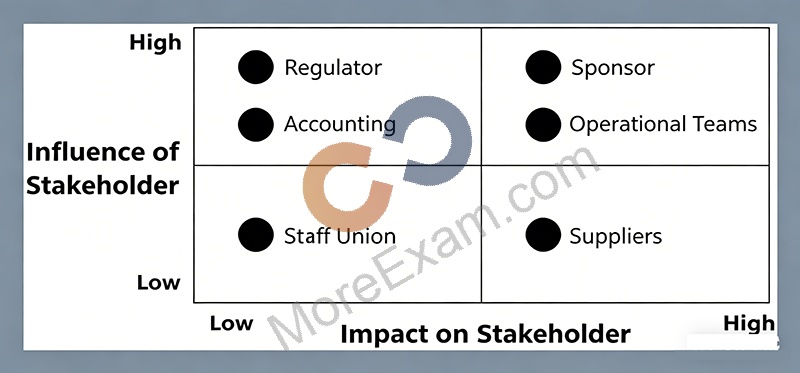
Question98: A large online retailer is introducing new technology to upgrade its aging ordering process. The business analyst (BA) has drawn a stakeholder matrix showing information on how to engage with the stakeholders throughout the project.

Using the stakeholder matrix as a guide, how should the BA engage the suppliers?

Question99: A business analyst (BA) is identifying the functions and features required for a new enterprise software solution. The BA reviews historical documents about the current business processes and then interviews each stakeholder group, individually, asking Questions about current business processes. The BA compares the information obtained during the stakeholder interviews with the information gathered from the historical documents. Which activity is the BA performing with this approach?

Question100: When an organization implements a new solution, the organization will often have to provide dual-support for the new solution and the solution that's being replaced. Which one of the following is not an input to the transitional requirements definition?

Question101: Kendra is the business analyst for her organization. She's working with the project manager and the project sponsor to discuss the current requirements. Kendra believes it's important for the project manager to first implement the requirements with the highest amount of risks. Is this a good idea?

Question102: As a business analyst, you'll need to recognize the methods that are appropriate for recording and documenting the results of elicitation activities. Which one of the following cannot be considered as a valid method for documenting elicitation?

Question103: As a business analyst, it's important to understand the relationships among requirements. All of the following are valid relationship types among requirements except for which one?

Question104: All of the following are inputs to the task assess organizational readiness except for which one?

Question105: You are working with several business analysts to determine the solution approach for an identified problem. All of the following techniques are acceptable for identifying the solution approach except for which one?

Question106: The business analyst (BA) has prepared a requirements package and it is now ready to present to the stakeholders. What is the purpose of presenting the package?

Question107: According to 'A Guide to the Business Analysis Body of Knowledge', when should the business analyst and an organization actually start requirements allocation?

Question108: A business analyst (BA) is currently verifying the accuracy and consistency of information obtained from the stakeholders. The BA needs to identify additional information. What should the BA do next?

Question109: An organization prefers to execute projects using an adaptive approach. However, the new project is much more complex than previously executed projects. What will the business analyst (BA) recommend?

Question110: What business analysis process is needed to define the solution scope and prepare the business plan for the endeavor?

Question111: You are the business analyst for your organization and you're training Marcy, a new business analyst, on how requirements are formed. Which one of the following best describes how requirements are formed?

Question112: A project to replace a financial system uses a waterfall methodology. Initially, meetings with the project subject matter experts (SMEs) were positive. As the project progressed through the requirements and design phases, the SMEs attended fewer meetings, resulting in a delay to the project build phase. What should the business analyst (BA) have done to prevent the delay?

Question113: A business analyst (BA) needs approval for the requirements which were elicited, collated, and verified by a peer. The BA needs to understand the approval process and appropriate stakeholders who have the authority to approve the requirements. Which of the following artifacts contains this information?

Question114: All of the following stakeholders participate in the prioritization of requirements except for which one?

Question115: A business analyst (BA) working with a large insurance corporation interviewed an industry thought leader who predicted that many of the regulations currently imposed by the government will change very soon. The BA communicated the observation to the leadership team of the organization because many on-going projects were triggered by those regulations. The leadership team unanimously decided to cancel the initiatives that were driven by the government regulations. What is the corporation's attitude towards risk?

Question116: The initial high-level listing of requirements in a change-driven approach is also known as what?

Question117: You are the business analyst for your organization. You are currently working with Steve on the organize requirements process. You and Steve have elected to use the user stories approach for this process. What is the user stories approach for requirements organization?

Question118: A business analyst (BA) is verifying a set of requirements. One of the requirements is "After the customer has received an email confirmation, the customer is likely to access the order status in the order history which is available upon order submission." Which one of the following requirements quality characteristic is breached?

Question119: High quality requirements have certain characteristics which distinguish them from low-quality requirements. Which characteristic of requirements demands that all requirements in a set or model support its overall purpose and scope?

Question120: A business analyst (BA) is working on a project that has a number of stakeholder conflicts and issues. The BA is finding it difficult to resolve the conflicts and issues effectively. What should the BA do to prevent a similar situation in the future?

Question121: Which approach to business analysis activities deals with rapid delivery of the business value?

Question122: Karen is the business analyst for her organization and she's reviewing the tasks within her endeavor. Several of the tasks have the characteristic that the activity will be completed with the project stakeholders, consultants, and business analyst, though this hasn't yet been approved. What is this condition of believing some things to be true about an activity without proving the validity of the belief called?

Question123: A business analyst (BA) is validating requirements and has found that the design cannot be validated to support the requirements. Which of the following is creating this situation?

Question124: A business analyst (BA) is working on an effort to upgrade a system to take advantage of new technology. Most of the end users with the business knowledge and IT staff with technical knowledge of the system are no longer with the company. What can the BA evaluate to better understand the extent of the effort?

Question125: You are a Business Analyst for your organization, and you're working with Mary. Mary wants to know what you need to complete the process of planning the business analysis approach if you're already the business analyst for your organization. Why is it important to complete the plan business analysis approach?

Question126: What can be considered the only input to the task of defining assumptions and constraints?

Question127: You are the business analyst for your organization and are working on organizing the identified requirements for a new solution. Nancy, your assistant in this process, says that these requirements aren't very complex. You agree but add that it's this thing that makes the overall solution complex. What thing adds to the level of complexity among requirements?

Question128: Several user groups are impacted by a proposed change to their daily work flow. How should the business analyst (BA) convey these changes so that the user groups understand the impact?

Question129: One of the tasks that the business analyst (BA) needs to complete is to maintain the requirements. As much as the BA values and sees the benefits of maintaining the requirements, the project manager (PM) does not see the same. In order to help the PM understand the value of this task, which following benefit of maintaining the requirements should the BA communicate to the PM?

Question130: You are the business analyst for your organization. On your current project you'll be using the change-driven approach for defining requirements and gathering feedback. Which of the following statements best describes the change-driven approach?

Question131: When a business analyst performs requirements tracing, he may need to trace the requirements backward through their lineage and may need to trace the requirements forward through their relationship to other requirements. What is the forward tracing activity called in requirements traceability?

Question132: An organization's Business Analysis Center of Excellence (BACoE) has deployed several business analysts (BAs) to provide business analysis to a cross-functional initiative. After the first phase of the project, the BACoE seeks to determine the effectiveness of the business analysis work. Which of the following techniques could be used to elicit feedback from all affected stakeholders?

Question133: A business analyst (BA) is verifying requirements for a software solution. The BA needs to confirm that items determined to be important are included in the final requirements deliverable. Which of the following will help the BA complete this task?

Question134: You are the business analyst for your organization and you're working with Fran on business analysis processes. Fran is a stakeholder who wants to ensure that your business analysis approach and activities are compatible with the project activities. Of the following, what type of business analysis stakeholder is Fran?

Question135: Which one of the following business analysis techniques for analyzing business goals converts the business goals into achievable objectives and measures?

Question136: As a business analyst, you'll need to communicate with the stakeholders of the solution you propose. Why is it important for the business analyst to review the stakeholder concerns as part of the assessment of the organization for the readiness of the solution?

Question137: A business analyst (BA) worked with two stakeholders to finalize the access rights related requirements for an internal software application. According to the first stakeholder "Comments, once entered in the application, should be stored for 365 days and should not allow the users to delete". According to the second stakeholder, "The users with super administrator privileges should be able to add/delete/modify every page/section in the entire application." Which characteristic does this pair of requirements fail to meet?

Question138: You are the business analyst for your organization. You are currently identifying opportunities for a customer to improve their business processes. The customer wants to streamline their business efforts either through new technologies, better processes, or a combination of both. The customer demands, however, that the solution should not cost more than $300,000 to implement and support for one year. What does the $300,000 represent?

Question139: A company wants to increase transaction service offerings using its on-line channels. The existing application already has some of the required functionality. A new project has been initiated to implement the additional capabilities but the company management is unsure of the complexity of the project. What exercise must be carried out to determine the changes needed in the new application?

Question140: Which of the following describes the organizational policies, procedures, forms, and methodologies the business analyst is to follow?

Question141: The project plan called for deliverables to be handed over at the end of the project. Although the client's business team was satisfied, the client's technical team was extremely resistant to this approach. What could the business analyst (BA) do to mitigate the technical team's resistance?

Question142: Which technique consists of review meetings to determine if the stakeholders agree that their needs are being met with the identified requirements?

Question143: A business analyst (BA) creates several use case scenarios to specify the requirements for a system. When the beta version of the system is released, there are problems because several important pieces of information are missing. What should the BA have done to avoid this situation?

Question144: You are the business analyst for your organization and you're creating a business analysis communications management plan. In your plan, you want to address the different locales and culture and the communication needs that may affect the business analysis approach. Which one of the following elements should not be included in the cultural analysis of the plan?

Question145: You are the business analyst for a new project. Part of this project is for the project team to manually install new workstations through the company's campus. Based on your research you have determined that the project team can install 25 new workstations per hour. Since there is a fixed amount of time that these workstations need to be installed you are considering adding additional labor for the implementation. You are also considering to adjust the prioritization of the project requirements based on the amount of workstations the project team can install per hour. What does the 25 workstations per hour represent in this scenario?

Question146: Beth is the business analyst for her organization and she's creating a data dictionary for her organization. All of the following information should be included in the data dictionary for an endeavor Beth is leading except for which one?

Question147: You are a business analyst for your organization and you're working with the stakeholders to identify the primary inputs to the business analysis approach. Which one of the following is a primary input to the business analysis approach?

Question148: A business analyst (BA), analyzing requirements, has decomposed information into components. What is the purpose of this exercise?