EMT Practice Test

1. Question Content...


Question List

Question1: Which of the following would be LEAST appropriate as part of an incident report covering the observation of a failure during testing?

Question2: Which of the following sentences is correct?

Question3: Which of the following can be considered a VALID exit criterion?
I. Estimates of defect density or reliability measures.
II. The completion and publication of an exhaustive Test Report
III. Accuracy measures, such as code, functionality or risk coverage.
IV. Residual risks such as lack of code coverage in certain areas.

Question4: A new testing tool has been selected for an organization and a pilot project has successfully completed.
The next step is to deploy the tool within the organization.
What is a key success factor in tool deployment?

Question5: Which of the following would you NOT expect to see on an incident report from test execution?

Question6: Which of the following correctly describes the goal of Statement Testing?

Question7: What is the ideal number of regression test cycles?

Question8: Consider the following excerpt from a defect report:
"To recreate the failure we used test file TST_01_TC_16.dat, which is available in the common shared folder".
Which incident report objective does this excerpt satisfy?

Question9: Which of the following statements is NOT correct?

Question10: Which of the following is a factor that could negatively influence the success of the deployment of a tool within an organization?

Question11: Which of the following statements is correct?

Question12: The ISTQB fundamental test process consists of 5 main activities. To which of these belongs the task
"Identifying necessary test data"?

Question13: Which of the following can be a common objective of testing?

Question14: Which of the following metrics are useful for monitoring the test progress?

Question15: A calculator software is used to calculate the result for 5+6. The user noticed that the result given is 6. This is an example of:

Question16: Which of the following test execution outcomes are likely to increase the overall quality of the software:
I. A test case passes
II. A test case fails, defect gets logged which subsequently gets fixed III. Some tests are deferred because test environment is not available IV. A bug is found but there is no corresponding test case

Question17: Which of the following statements regarding incidents is NOT true?
Question18:
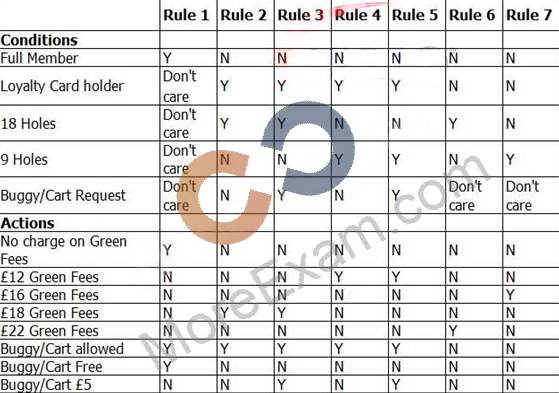
The decision table above reflects a golf club's pricing structure for green fees and buggy/cart hire.
What is the expected result (actions) for each of the following two test cases (TC1 and TC2)?
TC1 - Paul is not a full member, is a Loyalty Card holder and requests to play 18 holes with a buggy/

cart
TC2 - Cheryl is not a full member, doesn't have a Loyalty Card and requests to play 9 holes with a

buggy/cart

Question19:
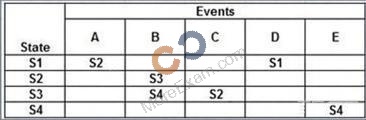
In the above State Table, which of the following represents an invalid transition?

Question20: Which of the following statements about Use Case Testing is FALSE?

Question21: A software company adopts the V-model as their development life cycle. Which of the following contains roles of a tester in this company?

Question22: A team's test strategy was to invest equal effort in testing each of a system's modules. After running one test cycle, it turned out that most of the critical bugs were detected in one of the system's modules.
Which testing principal suggests a change to the current test strategy for the next test cycle?

Question23: Which of the following is a valid collection of equivalence classes for the following problem:"An Integer numeric field shall contain values from 1 to 80 both values inclusive"

Question24: You are working on a project that is doing a maintenance release of a large, high-risk banking system.
Regression testing utilizes a set of 23525 test cases rerun against each test release. Which of the following is a benefit of test automation for this project?

Question25: Which of the following is a task of the "Test Analysis and Design" activity of the test process?

Question26: A garden irrigation system allows the user to specify 2 inputs.
1. Frequency - The number of times the system should be automatically switched on per day; minimum once per day, maximum 5 times
2. Duration - The duration of operation, in whole minutes, each time it is switched on, ranging from 1 to 60 Applying 2-value boundary value analysis which of the following options has the correct test set of valid and invalid boundary values?

Question27: During the development of a software change for a system, the developer makes a mistake in his work, which leads to a fault in the code. Unfortunately the fault is not found by software testing and is released into live.
What is the definite consequence of this mistake?

Question28: Which of the following is by definition a reactive test approach?

Question29: Which ONE of the following statements about state transition testing is correct?

Question30: A software application is supposed to calculate square root of all integers from 1 to 32767. The tester divides the input into valid and invalid equivalence classes. Valid equivalence class: 1-32767, invalid: all negative numbers, all numbers > 32767, all non-integers etc. However, when square root for all numbers in the valid equivalence class was calculated, it was found that for 3 number, the results were incorrect.
These number were not the boundary values. Which of the following is correct?

Question31: Consider the following code:
int premium=2500;
if (age<30)
{
Premium = premium + 1500;
}
Which options suits for a correct combination of Boundary value and expected result. Assume first number as boundary followed by expected result.

Question32: A money order system is designed to calculate the charge for a transfer.
- Amounts from 1 to 1999 are charged EUR 10.
- Amounts from 2000 to 5000 are charged EUR 15.
- Amounts below EUR 1 or above EUR 5000 are not accepted. Assume that only integer values can occur.
Which of these sets of amounts covers all equivalence classes?

Question33: How are statement testing and decision testing techniques similar?

Question34: Which of the following options BEST explain the pesticide paradox principle of testing?

Question35: Which of the following statements is not correct?

Question36: Which of the following are valid testing principles?
I) Exhaustive testing is in general impossible.
II) Exhaustive testing should be executed for code intended to be reused.
III) Testing may guarantee that a program is correct.
IV) Testing cannot guarantee that a program is correct.
V) Defects cluster together in certain areas of the product.

Question37: A system requirement states that up to 100 users should be able to carry out a transaction, with responses returned within 5 seconds.
What type of non-functional testing would you carry out to verify these requirements?

Question38: Which of the following are part of ISTQB code of ethics?
I. Certified software testers shall advance the integrity and reputation of the profession consistent with the public interest.
II. Certified software testers shall always sign a NDA (Non-Disclosure Agreement) in presence of customer data III. Certified software testers shall maintain integrity and independency in their professional judgment IV. Certified software testers shall act in a manner that is in the best interests of their client and employer, consistent with the public interest

Question39: Which one is the definition of Use Case?

Question40: Where and by whom is Beta testing normally performed?

Question41: Which of the following does NOT represent one of the three triggers for maintenance testing an operational system?

Question42: A live defect has been found where a code component fails to release memory after it has finished using it.
Which of the following tools would have been the MOST effective at detecting this defect prior to live implementation?

Question43: Which statement about use case testing is true?

Question44: A company that created software for managing libraries won a contract to write an application for managing inventories in a large hospital pharmacy.
The test manager decided that the test policy and all work procedures must be reviewed and updates to meet this new challenge.
Which of the following is the best explanation for this decision?

Question45: Which of the following statements are "testing general principles"?
I. Exhaustive testing is impossible
II. The defects found during the pre-release tests, or the operational failures, are uniformly distributed across the system's software modules III. Testing can show the presence of defects, but cannot demonstrate their absence IV. Testing is context-independent

Question46: Your company is developing a system with complex business rules and many branches in the structure of its code components. You need to choose one black box technique and one white box technique for test case design.
Which one of the following offers the BEST choice?

Question47: You are examining a document which gives the precise steps needed in order to execute a test.
What is the correct definition of this document?

Question48: Which of the following statements is LEAST likely to be true of non-functional testing?

Question49: When testing a mission critical system, a high coverage should be achieved. Which of the following techniques should be implemented as a structural based coverage technique in order to achieve the highest coverage?

Question50: When is use case testing appropriate?
I. For acceptance testing with user participation
II. For exhaustive testing of subsystem interaction if the system is specified by use cases III. For testing the interaction between the user and the system depending on user input and system state IV. For tests reflecting real-world use of the system under test
V. For testing mathematical algorithms if the program flow differs depending on the input given

Question51: Consider the following excerpt from a test report: "We tested the module AX45T and we got only 1 failure.
To recreate the failure, we used test file PR624_DR78_TCB0022.pkr, available under the PR624_DR78 repository in the CK01 server". Which incident report objective does this excerpt satisfy?

Question52: Which test level is concerned with testing the smallest bodies of software?

Question53: Which of the following BEST matches the attributes with a level of testing?
I. Stubs and drivers are often used
II. The test environment should correspond to the production environment II. Finding defects is not the main focus IV. Testing can be based on use cases
V. Testing is normally performed by testers
VI. Testing for functional and non-functional characteristics

Question54: In which of the following test documents would you expect to find test exit criteria described?

Question55: Which of the following is NOT an example of a common test metric?

Question56: Which of the following statements are true?

Question57: On organization is working on updating test cases for a particular module of their software.
Sam updated a set of test cases yesterday and saved the new version on his PC.
Unfortunately, the hard disk of his PC crashed, and his work was lost.
The IT department of the organization restored the contents of his hard disk with the last available back-up
- from the previous morning. However, the changes made by him yesterday were lost forever.
Which of the following tools, had it been used, would have prevented the loss of Sam's updates?

Question58: Given the following requirement:
Requirement ID: 2.8
Requirement Description: Additional Entrance Fee
Detailed Description:
An additional fee of $3 is charged during the weekend, but
1. Visitors aged under 7 are not charged.
2. Visitors aged 7 to 13 inclusive get a 20% discount off the additional fee.
3. Visitors aged greater than 65 get a 50% discount off the additional fee.
Age should be an integer of 0 or above.
Weekend means Friday to Sunday inclusive.
Which of the following statements is NOT correct?

Question59: Once a bug is fixed, it should be retested. What is the term used to define this type of testing?

Question60: When a test case is created based on a Use Case, what type of test is created?

Question61: What is the difference between system integration testing and acceptance testing?

Question62: Which of the following lists contains only black-box test techniques?

Question63: A system sets new users' password to a temporary password.
The temporary password is a random number based on the first six characters of the username.
If the username is shorter than 6 characters, the system displays an error message.
Which of the following is a possible representation of equivalence classes for the username string?

Question64: Which of the following answers describes an experience-based technique where a tester simultaneously learns the system, design tests and execute tests?

Question65: Which of the following defects can NOT be found by static analysis tools?

Question66: Which of the following statements correctly describe Black-Box Testing?
Question67:
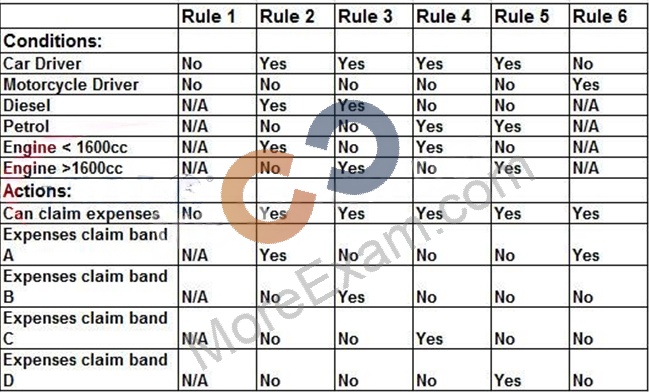
The decision table above shows a company's fuel expenses structure.
Which of the following Test Cases based on the decision table are Valid?
Test Case 1:
An employee who is not a car or motorcycle driver attempts to claim fuel expenses. Expected result:
Expense claim not allowed.
Test Case 2:
An employee who drives a 1700cc diesel car attempts to claim fuel expenses. Expected result: Expense claim accepted at band C.
Test Case 3:
An employee who rides a motorcycle attempts to claim fuel expenses. Expected result: Expense claim accepted at band A.

Question68: An online form has a "Title" input field. The valid values for this field are: Mr, Ms, Mrs. Which of the following is a correct list of the equivalence classes of the input values for this field?

Question69: For which of the following activities is a static analysis tool NOT useful?

Question70: Which of the following metrics is from the test design phase?

Question71: As the last stage of a test cycle of an embedded device, you are performing exploratory testing. You observed that some characters (A, X and Z) sent via a serial port to the device do not get registered on the device whereas they should be. You suspect that this could be due to a wrong configuration of the "bit parity" parameter.
Which of the following items of an incident report would you be UNABLE to write down based on this information?

Question72: Which of the following statements correctly emphasize the viewpoint of a developer and a tester with respect to the testing psychology?
I. If a developer implements a fundamental design error (e.g. conceptual misunderstanding), it is HIGHLY probable that he/she will not find is using own tests.
II. The tester can observe the object to be tested without prejudices. It is not his/her own product and the assumptions and misunderstandings of the developer are not, in general, the same as those of the tester.
III. An independent tester must acquire knowledge about the object to be tested in order to create test cases; the developer has good knowledge of the object to be tested and this saves time: hence, it is advisable to assign the test activities to the developer IV. The weakness of the tests done by the developer is that developers tend to be optimistic about their own software. The risk is that reasonable test cases are forgotten because the developer is more interested in development than testing.

Question73: You have been asked to improve the way test automation tools are being used in your company. Which one of the following is the BEST approach?

Question74: Which statement describes the term "Statement Coverage"?

Question75: Which type of testing would be MOST likely to include code coverage?

Question76: Which of the following is an appropriate reason for maintenance testing?

Question77: During which stage of the fundamental test process is the testability of requirements evaluated?

Question78: What is an inspection?

Question79: The following test cases for a Library Management System are available to test changes made to the functions and data structures associated with borrowers.
1. Add a new borrower to the system
2. Update a borrower's data
3. Remove a borrower from the system
4. Loan a book to a borrower
5. Return a book from a borrower
6. Reserve a book for a borrower
7. Send "reservation ready" message to a borrower
Which of the following test sequences represents a possible use case?
(a test sequence always start with test #1)

Question80: Which of the following is a Black Box test design technique?

Question81: How many minimum test cases are required to cover 100% Statement coverage and Decision coverage?
Consider the following pseudo-code
If (Walking && Midnight)
If (Raining)
Take umbrella and search light
Else
Take searchlight
End IF
Else if (Running && Sunshine)
IF (Raining)
Take umbrella
End IF
Else keep doing what you were doing
End IF

Question82: Which of the following is a project risk?

Question83: Which of the following represents good testing practice for testers, irrespective of the software lifecycle model used?

Question84: What type of testing is important after Migration, retirement or enhancement of an existing system?

Question85: Which of the following tools is most likely to detect defects in functions or methods in source code?

Question86: Which of the following is a white-box test technique?

Question87: Which of the following statements is true?
Question88: Which of the following would achieve the HIGHEST level of testing independence for a project's system test level?

Question89: Which of the following lists represents the correct sequence of the main activities of the fundamental test process (leaving out the activity of control which should take place in parallel to all the other activities)?

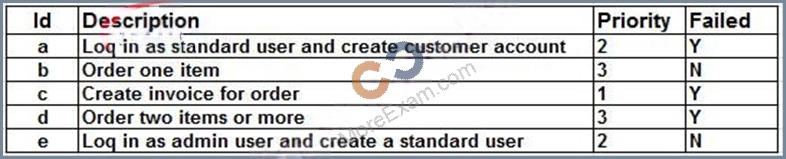
Question90: Your task is to compile a test execution schedule for the current release of software.
The system specification states the following logical dependencies:
An admin user must create/amend/delete a standard user.

A standard user is necessary to perform all other actions.

The test plan requires that re-tests must be performed first, followed by the highest priority tests. To save time, the test plan states that tests should be scheduled to create test data for the subsequent tests in the schedule.
The following test cases have been designed, with an indication of priority (1 being the highest priority) and whether the test has previously failed.

Which test execution schedule meets the test plan requirements and logical dependencies?

Question91: Which of the following tool types is the most useful one for a test manager?

Question92: To which of the following test levels can regression testing be applied?
I. Component Testing
II. Integration Testing
III. System Testing
IV. Acceptance Testing

Question93: Which of the following test types is a part of the V-Model?

Question94: Agile development can be classified as which life cycle model?

Question95: Who closes normally the defect reports?
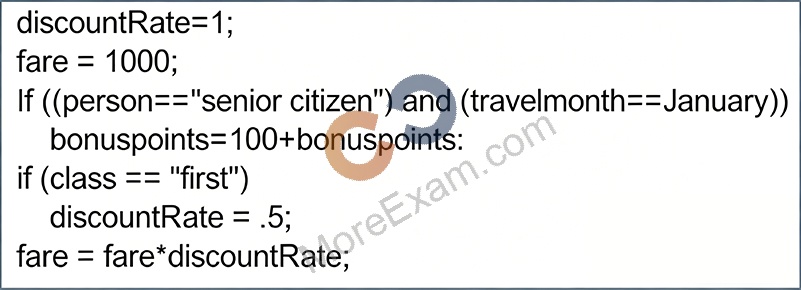
Question96: While reporting a defect, which of the following indicates the level of business importance assigned to the defect?

Question97: Which of the following is NOT a characteristic of good testing, independent of the development life cycle model?

Question98:

Question99: For the code fragment given below, which answer correctly represents minimum tests required for statement and branch coverage respectively?

Question100: Which of the following is NOT an example of a typical risk-based testing activity?

Question101: Which of the following are typical defects discovered by static analysis tools?

Question102: Which of the following statements about decision tables are TRUE?
I. Generally, decision tables are generated for low risk test items.
II. Test cases derived from decision tables can be used for component tests.
III. Several tests cases can be selected for each column of the decision table.
IV. The conditions in the decision table represent negative tests generally.

Question103: Which of the following factors is LEAST likely to be used as a basis for estimating testing effort?

Question104: Which of the following activities BEST represents the main concerns of maintenance testing?
I. Patches to correct newly-exposed vulnerabilities.
II. Review of system architecture.
III. Migration to a new operating system.
IV. Database upgrade to the latest version.
V. Pre-release changes to system requirements.

Question105: Which of the following tasks belong to "Test planning"?
I. Scheduling test analysis and design activities
II. Assigning resources to the different activities
III. Selecting metrics for monitoring
IV. Setting up the test environment
V. Acquiring and preparing test data

Question106: Which two of the following statements are true?
A) Software testing can be necessary to fulfill legal or contractual obligations.
B) Software testing is done to essentially increase the quality of developers.
C) Intensive testing can help reduce risks and problems during operation.
D) Intensive testing is used to prove correctness.

Question107: Which of the following should be considered when purchasing a test execution tool?

Question108: Which of the following statements is correct about Statement coverage and Decision coverage?

Question109: Why is it important to select a test technique?

Question110: Which of the following statements about test reports are TRUE?
I. Test reports shall be approved by the test team.
II. Test reports shall give stakeholders information as basis for decisions.
III. Test reports shall summarize what happened through a period of testing.
IV. Test reports shall be approved by the development team, the test team and the customer.
V. Test reports shall include information about remaining risks.

Question111: Which of the following statements correctly describes traceability?

Question112: Which of the following is a Black Box test technique?

Question113: Which of the following is NOT a factor on which test estimation is dependent upon?

Question114: A "functional test" is...

Question115: The following program part is given:
IF (condition A)
then DO B
END IF
How many test cases are necessary in order to achieve 100% statement coverage?

Question116: Software was found to take much more time than the stated requirement of less than one second to save a file. Upon investigation it was found that there was an unnecessary check inside a loop which was slowing down the file-save operation. The software not being able to meet the desired response time is an example of

Question117: Which ONE of the following statements does NOT describe how testing contributes to higher quality?

Question118: A program is used to control a manufacturing line (turn machines on and off, start and stop conveyor belts, add raw materials to the flow, etc.) Not all actions are possible at all times. For example, there are certain manufacturing stages that cannot be stopped - unless there is an emergency.
A tester attempts to evaluate if all such cases (where a specific action is not allowed) are covered by the tests.
Which coverage metric will provide the needed information for this analysis?

Question119: The following condition is given:
Integer x, y;
IF x > 0 AND x < 100
y=y+x;
END-IF
Using boundary analysis for x, which test cases are required?

Question120: Which of the following is NOT a deciding factor in determining the extent of testing required?

Question121: What is "Component Testing"?

Question122: What is a "test harness"?

Question123: Which of the following statements about estimation of the test effort is WRONG?

Question124: A Software was re-deployed because the backend database was changed from one vendor to another.
The Test Manager decided to perform some functional tests on the redeployed system. This is an example of test of which test type?

Question125: A booking system for a city bus service prices its fares according to the time of travel:
Peak-time tariff starts at 0600 and finishes at 1000 am

Off-peak tariff applies during all other times of service

The bus service does not operate between 2300 and the start of the next day's peak service

Note that all times mentioned are inclusive.
When applying the equivalence partitioning test design technique, which of the following options shows test case inputs that each fall into a different equivalence partition?

Question126: Which of the following statements is NOT correct?
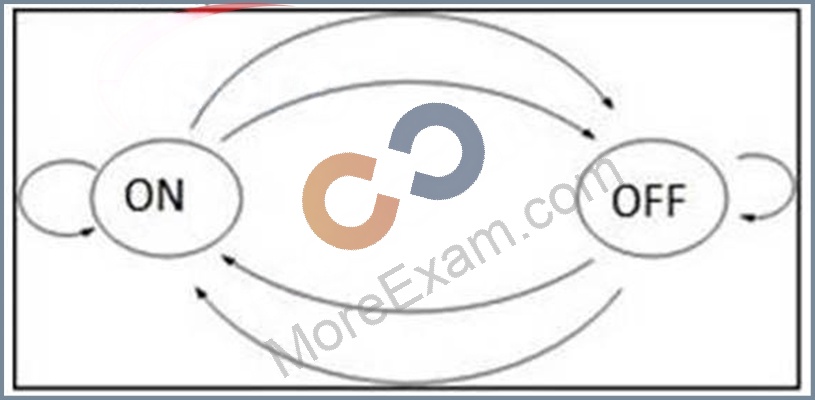
Question127: A program controls a switch:
The program has three buttons:
- "ON" to turn the switch ON, or leaves it ON if it were ON.
- "OFF" to turn the switch OFF, or leaves it OFF if it were OFF.
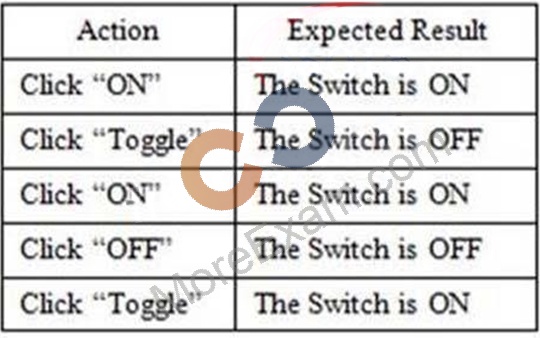
- "Toggle" to change the state of the switch (turn it ON if it was OFF; turn it OFF if it was ON) The following drawing shows drawing shows the state diagram of the program (only the states are marked; the arrows mark possible transitions and are intentionally left unlabeled)

What percentage of the transitions in the State Transition diagram is guaranteed to be covered by the test case given above?
Note: The number of covered transitions depends on the initial state of the switch! Look for the minimum coverage case.

Question128: Which of the following is NOT an objective of testing?