MoreExam
1. Question Content...
EXPLANATION
Answer: X - EXPLANATION Content.
Question1: Topic 4, Scenario 4, V2 "Test Management Tool"The project situation after 11 months is:- The first increment was released one week late but contained sufficient functionality to be declared fit for purpose'. However, there were 20 outstanding incidents deferred to increment two.- The amount of voluntary overtime worked PV the test team has reduced the second Increment slippage to just 3 weeks.- There is talk of reducing the scope of requirements. The purpose of this is to first deliver the application with support for manual testing and then to provide a delivery * weeks later to resolve any remaining points and provide support for automated testing (i.e. the link to the capture-replay tool).- Concerns have been expressed by a section of the user community, that in some places the usability is very poor.Which of the following is least likely to be used as a technique to identify project and product risks?
Question2: Topic 11, Scenario 11 "Incident Management"The following is the current incident handling process in used at the company.Step 1: Incident is documented in the incident Tile with the following information:- Software module or area where the fault occurred- Who has reported the fault- Hardware configuration used for the test that found the fault- The sequential incident number (1 greater than the last one recorded) Step 2: Developer assigned to fix the fault Step 3: Developer fixes the faultStep 4: Developer signs off the incident as closed, and it is then removed from the incident file Regarding the process described above, what is the most important recommendation you would make using IEEE 1044 as a guide?
Question3: Topic 8, Scenario 8, V2 "Test Proems Improvement'You have raised the issue that improving the testing process is also dependent on the status of the software development process.Which of the following phases in the fundamental test process is considered to deliver a document which can be used as a major input for test process improvement?
Question4: Topic 6, Scenario 6, V2 "Independent Test Team"The project has been running for a few months and the team seems not to be progressing in their test approach. The team also lacks drive and enthusiasm and is sometimes seen to be performing their tasks too slowly. You have been asked to recruit an extra person into the team.Which of the following team roles would be most appropriate to enhance the team and why?
Question5: Topic 10, Scenario 10, V3 "Online Application"The cancellation of a current major development project has released resources. The development manager has decided to respond to his own request to tender and has proposed an in-house development with the use of a Rapid Application Development (RAO) approach.As a result of the RAD based development approach, the test manager has decided to change the risk mitigation approach. Which test technique might be most appropriate to use?
Question6: Topic 6, Scenario 6, V1 "Independent Test Team"XYZ is a Swedish company and the company language is local and all system development documentation is done in the local language.As a test manager you are currently leading an independent test team of 4 people to system test the payroll functionality. The 4 members of staff of described below:- John is one of the senior testers. He has been working for the company the longest and has a good network of contacts. He is confident and tries to bring other team members together to promote team discussions. He is sometimes considered to be manipulative and is often seen to delegate personal work.- Sue is a senior tester. She always seems to be busy and often seems to have too much work to do.However, she gets her work done, regardless of what it takes. She is often inclined to worry unduly and sometimes considered to be argumentative and blunt. She is conscientious and searches out errors and omissions. She always delivers on time.- Steve is a tester. He is serious minded and often looks ahead. When he is given problems to solve he often looks at all options before deciding. He needs to be a little bit more diplomatic though in his approach to other people because his attitude often has a negative affect when trying to inspire others. He is good person discuss ideas with. Steve used to work as a business analyst on the payroll department.- Vicki is a test analyst. She is the newest member of the team and has been employed for her automation skills. Vicki is shown to be dedicated to automation, having spent the past 5 years developing the necessary skills in automation tools. Her view on testing seems too limited; she believes automation is the only way forward.Both John and Sue are highly experienced at finding defects based on their experience with the system and domain knowledge.Based on the information given in the scenario, identify how the team could be improved most effectively?
Question7: Topic 9, Scenario 9 "Test Management Documentation"A software house is concerned about the number of defects found in software released to its customers.They are starting to plan a new software product. In the past, releases have often been stopped due to poor planning and too many defects found during high level testing. You have been recruited to the newly created position of test manager and asked to develop a test strategy, manage the testing of the project and organize the resources needed to carry out the testing.As part of the test strategy, entry and exit criteria will be defined for each test level. Which is NOT a valid reason for using entry and exit criteria?
Question8: Topic 4, Scenario 4, V2 "Test Management Tool"The project situation after 11 months is:- The first increment was released one week late but contained sufficient functionality to be declared fit for purpose'. However, there were 20 outstanding incidents deferred to increment two.- The amount of voluntary overtime worked PV the test team has reduced the second Increment slippage to just 3 weeks.- There is talk of reducing the scope of requirements. The purpose of this is to first deliver the application with support for manual testing and then to provide a delivery * weeks later to resolve any remaining points and provide support for automated testing (i.e. the link to the capture-replay tool).- Concerns have been expressed by a section of the user community, that in some places the usability is very poor.Which of the following is a project risk mitigation step you might take as test manager?
Question9: Topic 4, Scenario 4, V2 "Test Management Tool"The project situation after 11 months is:- The first increment was released one week late but contained sufficient functionality to be declared fit for purpose'. However, there were 20 outstanding incidents deferred to increment two.- The amount of voluntary overtime worked PV the test team has reduced the second Increment slippage to just 3 weeks.- There is talk of reducing the scope of requirements. The purpose of this is to first deliver the application with support for manual testing and then to provide a delivery * weeks later to resolve any remaining points and provide support for automated testing (i.e. the link to the capture-replay tool).- Concerns have been expressed by a section of the user community, that in some places the usability is very poor.Which test management control option is most appropriate to adopt under these circumstances?
Question10: Topic 10, Scenario 10, V3 "Online Application"The cancellation of a current major development project has released resources. The development manager has decided to respond to his own request to tender and has proposed an in-house development with the use of a Rapid Application Development (RAO) approach.Which of the following is NOT a typical key challenge for testing in a RAD based development approach?
Question11: Topic 4, Scenario 4, V1 "Test Management Tool"A software development company that sells an established capture-replay tool has decided to complement it with a test management tool. The capture-replay tool was developed over a number of years and is used by a large number of clients.The test management tool will be developed by the same team that developed the capture-replay tool, using the same technology. The company test strategy mandates that structural testing is focussed at the component test level and dynamic non-functional testing is focussed at the acceptance test level.In response to growing customer demand, it is proposed to develop the test management tool in an incremental manner. Each increment will be developed using the V life cycle model. The target platform is a PC in a local area network. The PC uses a proprietary relational database and communicates with a single PC which acts as a server.The test management tool must interface with the company s capture replay tool. Over the first 12 months of the development period the following functionality will be developed for the tool (in two increments):basic requirements management, support for test case creation; support for test procedures, test scripts and test suites. The functionality to be included in later increments will be driven by customer demand:however they expect to provide an incident management system, a web front-end, and interfaces to other proprietary tools and database management systems.Which of the following would be the TWO most appropriate examples of entry criteria documented in the system integration test plan?
Question12: Topic 4, Scenario 4, V2 "Test Management Tool"The project situation after 11 months is:- The first increment was released one week late but contained sufficient functionality to be declared fit for purpose'. However, there were 20 outstanding incidents deferred to increment two.- The amount of voluntary overtime worked PV the test team has reduced the second Increment slippage to just 3 weeks.- There is talk of reducing the scope of requirements. The purpose of this is to first deliver the application with support for manual testing and then to provide a delivery * weeks later to resolve any remaining points and provide support for automated testing (i.e. the link to the capture-replay tool).- Concerns have been expressed by a section of the user community, that in some places the usability is very poor.Risks should be constantly reviewed. Given the current situation, which one of the following factors is most likely to lead to a revised view of product risk?
Question13: Topic 8, Scenario 8, V2 "Test Proems Improvement'You have raised the issue that improving the testing process is also dependent on the status of the software development process.During test process improvement it is recommended to use standards where possible. Standards originate from various sources and they cover different subjects in relation to testing Pick TWO sources of software standards, useful to software testing from the ones mentioned below.
Question14: Topic 6, Scenario 6, V1 "Independent Test Team"XYZ is a Swedish company and the company language is local and all system development documentation is done in the local language.As a test manager you are currently leading an independent test team of 4 people to system test the payroll functionality. The 4 members of staff of described below:- John is one of the senior testers. He has been working for the company the longest and has a good network of contacts. He is confident and tries to bring other team members together to promote team discussions. He is sometimes considered to be manipulative and is often seen to delegate personal work.- Sue is a senior tester. She always seems to be busy and often seems to have too much work to do.However, she gets her work done, regardless of what it takes. She is often inclined to worry unduly and sometimes considered to be argumentative and blunt. She is conscientious and searches out errors and omissions. She always delivers on time.- Steve is a tester. He is serious minded and often looks ahead. When he is given problems to solve he often looks at all options before deciding. He needs to be a little bit more diplomatic though in his approach to other people because his attitude often has a negative affect when trying to inspire others. He is good person discuss ideas with. Steve used to work as a business analyst on the payroll department.- Vicki is a test analyst. She is the newest member of the team and has been employed for her automation skills. Vicki is shown to be dedicated to automation, having spent the past 5 years developing the necessary skills in automation tools. Her view on testing seems too limited; she believes automation is the only way forward.Both John and Sue are highly experienced at finding defects based on their experience with the system and domain knowledge.A number of options have been suggested for the level of independence to be employed for the testing on the next project, and are shown below.i. External test specialists perform non-functional testing.ii. Testing is outsourced.iii. Testing is carried out by the developer.iv. A separate test team carries out the testing.v. Testing is performed by the business.vi. Testing is performed by a different developer.Which of the following orders the above in a correct order of independence?
Question15: Topic 10, Scenario 10, V3 "Online Application"The cancellation of a current major development project has released resources. The development manager has decided to respond to his own request to tender and has proposed an in-house development with the use of a Rapid Application Development (RAO) approach.Why might a RAD approach be a better option for the test manager rather than a sequential development?
Question16: Topic 6, Scenario 6, V1 "Independent Test Team"XYZ is a Swedish company and the company language is local and all system development documentation is done in the local language.As a test manager you are currently leading an independent test team of 4 people to system test the payroll functionality. The 4 members of staff of described below:- John is one of the senior testers. He has been working for the company the longest and has a good network of contacts. He is confident and tries to bring other team members together to promote team discussions. He is sometimes considered to be manipulative and is often seen to delegate personal work.- Sue is a senior tester. She always seems to be busy and often seems to have too much work to do.However, she gets her work done, regardless of what it takes. She is often inclined to worry unduly and sometimes considered to be argumentative and blunt. She is conscientious and searches out errors and omissions. She always delivers on time.- Steve is a tester. He is serious minded and often looks ahead. When he is given problems to solve he often looks at all options before deciding. He needs to be a little bit more diplomatic though in his approach to other people because his attitude often has a negative affect when trying to inspire others. He is good person discuss ideas with. Steve used to work as a business analyst on the payroll department.- Vicki is a test analyst. She is the newest member of the team and has been employed for her automation skills. Vicki is shown to be dedicated to automation, having spent the past 5 years developing the necessary skills in automation tools. Her view on testing seems too limited; she believes automation is the only way forward.Both John and Sue are highly experienced at finding defects based on their experience with the system and domain knowledge.Which of the following is a valid drawback of independent testing?
Question17: Topic 10, Scenario 10, V1 "Online Application"There is a formal requirement from the business to develop an additional on-line application to the company website which will allow existing policyholders to extend their cover for short-term foreign use of their vehicle overseas. The current manual process will be retained. The application must be implemented in months time in line with the marketing department's green initiative, which is anticipated to generate a significant increase in demand.The development manager has insufficient resources to meet this request and has issued an invitation to potential bidders so that the development work can be outsourced.The application must initially cover Western Europe, and later Eastern Europe, Russia, the Middle East, the Far East and Africa. A decision has yet to be made with respect to Australia, New Zealand, North and South America.You have been asked to ensure the quality and suitability of the document sent to potential bidders and also that the application delivered by the successful bidder is 'Tit for purpose'.Which of the following product risks would be most effectively addressed just by static testing?
Question18: Topic 4, Scenario 4, V1 "Test Management Tool"A software development company that sells an established capture-replay tool has decided to complement it with a test management tool. The capture-replay tool was developed over a number of years and is used by a large number of clients.The test management tool will be developed by the same team that developed the capture-replay tool, using the same technology. The company test strategy mandates that structural testing is focussed at the component test level and dynamic non-functional testing is focussed at the acceptance test level.In response to growing customer demand, it is proposed to develop the test management tool in an incremental manner. Each increment will be developed using the V life cycle model. The target platform is a PC in a local area network. The PC uses a proprietary relational database and communicates with a single PC which acts as a server.The test management tool must interface with the company s capture replay tool. Over the first 12 months of the development period the following functionality will be developed for the tool (in two increments):basic requirements management, support for test case creation; support for test procedures, test scripts and test suites. The functionality to be included in later increments will be driven by customer demand:however they expect to provide an incident management system, a web front-end, and interfaces to other proprietary tools and database management systems.Which of the following would you expect to see in the master test plan?
Question19: Topic 10, Scenario 10, V3 "Online Application"The cancellation of a current major development project has released resources. The development manager has decided to respond to his own request to tender and has proposed an in-house development with the use of a Rapid Application Development (RAO) approach.The business has asked for a weekly progress report. Which of the following would be appropriate as a measure of test coverage?
Question20: Topic 10, Scenario 10, V1 "Online Application"There is a formal requirement from the business to develop an additional on-line application to the company website which will allow existing policyholders to extend their cover for short-term foreign use of their vehicle overseas. The current manual process will be retained. The application must be implemented in months time in line with the marketing department's green initiative, which is anticipated to generate a significant increase in demand.The development manager has insufficient resources to meet this request and has issued an invitation to potential bidders so that the development work can be outsourced.The application must initially cover Western Europe, and later Eastern Europe, Russia, the Middle East, the Far East and Africa. A decision has yet to be made with respect to Australia, New Zealand, North and South America.You have been asked to ensure the quality and suitability of the document sent to potential bidders and also that the application delivered by the successful bidder is 'Tit for purpose'.The development manager is managing the review of the responses received from bidders, and has asked the in-house test manager to provide a review checklist for the test management aspects of the responses.Which of the following checkpoints would be appropriate?
Question21: Topic 6, Scenario 6, V2 "Independent Test Team"The project has been running for a few months and the team seems not to be progressing in their test approach. The team also lacks drive and enthusiasm and is sometimes seen to be performing their tasks too slowly. You have been asked to recruit an extra person into the team.You are considering involving users during test execution. In general, what is the main reason for involving users during test execution?
Question22: Topic 6, Scenario 6, V2 "Independent Test Team"The project has been running for a few months and the team seems not to be progressing in their test approach. The team also lacks drive and enthusiasm and is sometimes seen to be performing their tasks too slowly. You have been asked to recruit an extra person into the team.In addition to introducing the new team member, you have decided to raise motivation. Which of the measures listed below would be the best measure to take in order to increase the motivation of the team?
Question23: Topic 4, Scenario 4, V1 "Test Management Tool"A software development company that sells an established capture-replay tool has decided to complement it with a test management tool. The capture-replay tool was developed over a number of years and is used by a large number of clients.The test management tool will be developed by the same team that developed the capture-replay tool, using the same technology. The company test strategy mandates that structural testing is focussed at the component test level and dynamic non-functional testing is focussed at the acceptance test level.In response to growing customer demand, it is proposed to develop the test management tool in an incremental manner. Each increment will be developed using the V life cycle model. The target platform is a PC in a local area network. The PC uses a proprietary relational database and communicates with a single PC which acts as a server.The test management tool must interface with the company s capture replay tool. Over the first 12 months of the development period the following functionality will be developed for the tool (in two increments):basic requirements management, support for test case creation; support for test procedures, test scripts and test suites. The functionality to be included in later increments will be driven by customer demand:however they expect to provide an incident management system, a web front-end, and interfaces to other proprietary tools and database management systems.Which of the following would be the most significant input to estimating the time to carry out the specified testing tasks?
Question24: Topic 5, Scenario 5, V1"Human Resource System"You have recently been employed as a test manager for a software house producing Human Resource (HR) systems, namely Payroll, Personnel and Recruitment systems. The company is relatively new and wants to make a major impact in the market by producing a worldwide enterprise HR product.In addition to risk, identify TWO other components of a testing strategy.
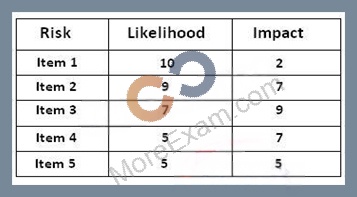
Question25: Topic 5, Scenario 5, V2 "Human Resource System"For the first increment of the new enterprise HR product you have performed a product risk analysis using the FMEA method. Five risk items have been identified and the likelihood and impact have been scored using scoring tables. This has resulted in the following scores:What is the Risk Priority Number for risk item number 2?
Question26: Topic 5, Scenario 5, V2 "Human Resource System"For the first increment of the new enterprise HR product you have performed a product risk analysis using the FMEA method. Five risk items have been identified and the likelihood and impact have been scored using scoring tables. This has resulted in the following scores:What would be a test approach regarding the test design techniques to be applied that would fit an item with the highest risk?
Question27: Topic 12, Scenario 12 "Automatic Teller Machine (ATM)"You are a test manager in charge of integration, system and acceptance testing for a bank. You are working on a project to upgrade an existing ATM to allow customers to obtain cash advances from supported credit cards. The system should allow cash advances from €20 to €500, inclusively, for all supported credit cards. The supported credit cards are American Express, VISA, Eurocard and Mastercard.In the master test plan the following items are listed in the section named "items and/or features to be tested":I All supported credit cardsII Language localizationII Valid and invalid advancesIV UsabilityV Response timeRelying only on the information provided in the scenario, select the TWO items and/or features for which sufficient information is available to proceed with test design.
Question28: Topic 5, Scenario 5, V1"Human Resource System"You have recently been employed as a test manager for a software house producing Human Resource (HR) systems, namely Payroll, Personnel and Recruitment systems. The company is relatively new and wants to make a major impact in the market by producing a worldwide enterprise HR product.You have been asked to write a testing strategy for the company. Which statement best explains how risk can be addressed within the testing strategy?
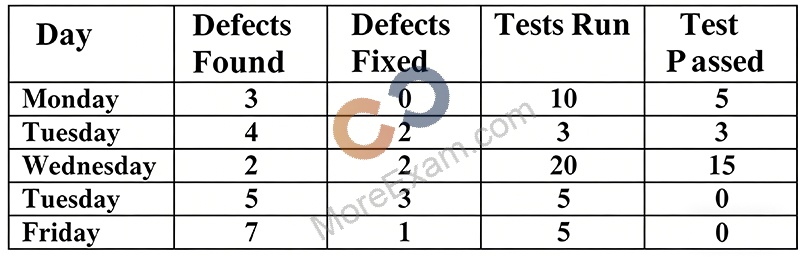
Question29: Topic 6, Scenario 6, V3 "Independent Test Team"Three exit criteria have been defined for the project:- A: Test cases passed more than 70%- B: Number of outstanding defects lest than 5- C: Number of defects per test case less than 0.5The first week of the testing has shown the following results:Evaluate the status of the project against the defined exit criteria. Which of the following options shows the correct status?