EMT Practice Test

1. Question Content...


Question List

Question1: Which SQL statement will retrieve the department number (WORKDEPT) and average departmental salary (SALARY) for all departments in a table named EMPLOYEE and arrange the result set in ascending order by average departmental salary?

Question2: Which statement about INSERT operations is true?

Question3: Which statement about large object (LOB) locators is true?
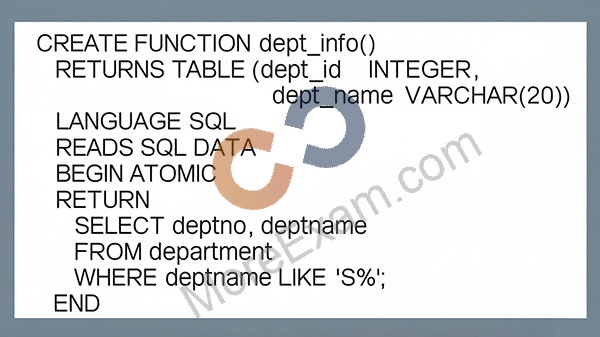
Question4: An SQL function named DEPT_INFO was created as follows:

What is the correct way to use this function in a query?

Question5: A new user named USER1 needs to retrieve information from a database named MYDB. What authority must be granted to user USER1?

Question6: Which statement regarding referential integrity constraints is true?

Question7: What mechanism is typically used to automatically update other tables, generate or transform values for inserted or updated rows, and perform tasks such as issuing alerts?

Question8: Which two operations are allowed in the body of an SQL scalar user-defined function? (Choose two.)

Question9: Which statement about BEFORE triggers is FALSE?

Question10: Which statement regarding triggers is true?

Question11: A table named STATES has the following columns: STATE_CD, REGION_CD, and STATE_NAME. Which SQL statement will return the number of states in each region, ordered by number of states?

Question12: Which type of constraint can be used to ensure that an INTEGER column in a table will never be assigned more than one record that contains a NULL value?

Question13: Which statement about system-period temporal tables is true?

Question14: A column mask that is to be used for row and column access control (RCAC) was created with the DISABLE option specified. What must be done if this mask is to be used to restrict access to data stored in a table named EMPLOYEE?

Question15: Which command will delete all rows from a table without generating log records?

Question16: Which product replaced the Control Center used in versions prior to DB2 v10?

Question17: Which type of table is best suited for recording results from application data manipulation that is not required to be persistent?

Question18: Which operation normally does NOT require an exclusive lock?

Question19: By default, where is the data stored for a column defined with an XML data type?

Question20: If the following result set is desired:
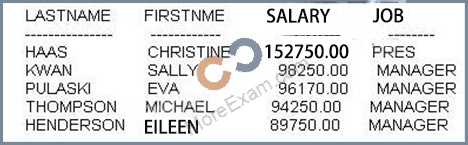
Which SQL statement must be executed?

Question21: Which statement about roll back operations is correct?

Question22: User USER1 wants to store part numbers and part descriptions in a table named PARTS; user USER1 also wants to ensure that any comparisons of part descriptions that are made will be done so in binary, regardless of the database collating sequence used. Which statement should user USER1 execute to create the desired table?

Question23: Given the following DDL statement: CREATE TABLE sales (item CHAR(20)); If a DBA wishes to increase the size of the ITEM column, which SQL statement needs to be used?

Question24: Which statement about foreign keys is true?

Question25: Which action needs to be performed in order to complete the definition of an application-period temporal table?

Question26: Application APP_A is performing updates to table TAB1 using the read stability (RS) isolation level. Which isolation level will allow application APP_B to retrieve all rows from table TAB1 immediately, rather than have to wait until application APP_A has finished making updates?

Question27: What factor influences lock escalation?

Question28: Which case will require a sequence to be dropped and recreated instead of being modified by the ALTER SEQUENCE statement?

Question29: Which two activities indicate the need for a data warehouse? (Choose two.)

Question30: User USER1 holds both DBADM and SECADM authority and you want to separate database administration activities from security administration tasks. What authority must you have in order to revoke SECADM authority from user USER1 and assign it to someone else?

Question31: When an application using a temporary table terminates or disconnects from the database unexpectedly, what happens to the temporary table and any data stored in it?

Question32: Which DB2 product is NOT suitable for very large data warehouse applications?

Question33: Which statement is true regarding constraints?

Question34: Which command is used to back out a subset of database changes that have been made within a unit of work?

Question35: If a user has been granted SYSCTRL authority, which activities can they perform?

Question36: Which SQL statement will give user USER1 the ability to assign a comment to a sequence named MYSEQ?

Question37: Which product is used to customize execution environments for the purpose of controlling system resources so that one department or service class does not overwhelm the system?

Question38: User USER1 wants to retrieve records from a table named EMPLOYEE that satisfy at least one of the following criteria:
The employee's hire date (HIREDATE) is before 1999 and the employee's salary (SALARY) is less

than $40,000.00 a year.
The employee has attended university

Which SQL statement will accomplish this?

Question39: Which function can be used to obtain values from XML documents that are to be inserted into one or more tables?

Question40: Which DB2 product is a database cluster solution for non-mainframe platforms and is best suited for Online Transaction Processing (OLTP) workloads?

Question41: Which two DB2 objects can a view be derived from? (Choose two.)

Question42: Which statement will prevent concurrent application processes from performing anything other than read- only operations against a table named TAB1?

Question43: What are INSTEAD OF triggers used for?

Question44: Which type of stored procedure is not associated with an external application program?

Question45: If no isolation level is specified, what is the default isolation level used?

Question46: Which database object provides an alternative way of describing data that exists in one or more base tables?

Question47: What functionality allows users to perform a UNION operation between a DB2 table and an Oracle view?

Question48: Which tool allows users to connect to a DB2 database using a wizard?

Question49: Which object is a stored procedure defined into?

Question50: Which statement about triggers is true?

Question51: What is used in conjunction with a foreign key to define a relationship between two tables?

Question52: The EXCLUSIVE MODE option of the LOCK TABLE statement is used to prevent which of the following?

Question53: Which statement is valid about the Row and Column Access Control (RCAC) feature?

Question54: The WITH CHECK OPTION clause of the CREATE VIEW statement allows you to do which of the following?

Question55: Which SQL statement will give a user named USER1 the ability to run an embedded SQL application named BENEFITS that calls a package named CORPDATA.PKGA?

Question56: When is an INTENT EXCLUSIVE (IX) lock required?

Question57: When is it appropriate to use a sequence?

Question58: What type of mechanism is a simple token value that is used to refer to a much bigger large object (LOB)?

Question59: When is an INTENT EXCLUSIVE (IX) lock required?

Question60: Which SQL statement would be used to retrieve only salaries that are greater than $100,000.00 from a table named EMPLOYEE?

Question61: Which DB2 object limits the user's ability to retrieve data from a table by defining a SQL statement in the object?

Question62: Which event will NOT cause a trigger to be fired?

Question63: Which statement is true about an index that is used to support a UNIQUE constraint?
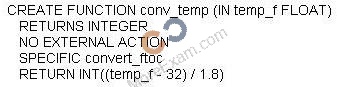
Question64: An SQL function designed to convert temperatures from Fahrenheit to Celsius was created as follows:

How can this function be used to convert average temperature (AVG_TEMP) data stored in a table called CLIMATE_INFO?

Question65: Which type of temporal table can be used to store only time-sensitive data?

Question66: A table named STATES was created as follows:
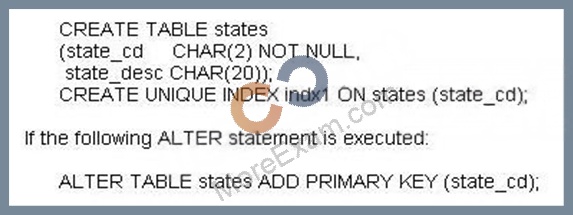
What will happen?

Question67: Which statement about application-period temporal tables is true?

Question68: Which DB2 object is used to provide a logical grouping of other database objects?

Question69: Which privilege is required to invoke a user defined function?

Question70: When a COMMIT statement is executed, what happens?

Question71: What needs to be defined in order to track changes made to a system-period temporal table over time?

Question72: In a trusted context environment, if a switch request is made with an authorization ID that is not allowed on a trusted connection, what state is the connection placed in?

Question73: What takes place when a process accesses a data object on which it already holds a lock, and the access mode requires a more restrictive lock than the one currently held?

Question74: What is the purpose of a role?

Question75: Which statement about bitemporal tables is valid?

Question76: Which SQL statement will take the ability to create tables in a table space named MYTBSP away from user USER1?

Question77: What is the minimum product required for DB2 connectivity across all platforms?

Question78: When a COMMIT statement is executed, what happens?

Question79: By default, a column defined as a TIMESTAMP includes which attributes?

Question80: What isolation level prevents dirty reads, nonrepeatable reads, and phantoms?

Question81: What is the primary purpose for using the INCLUDE clause with a CREATE UNIQUE INDEX statement?

Question82: What are two valid objects that can be created in DB2? (Choose two.)

Question83: Which object can be enabled for compression?
Question84: Given an EMPLOYEES table and a SALES table, a user wants to produce a list of all employees and their associated revenue, even if no revenue exists. Which SQL statement will produce the desired list?

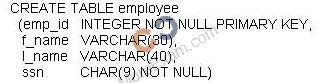
Question85: A table named EMPLOYEE was created as follows:

Which action will prevent unauthorized users from accessing SSN data?

Question86: What is the act of exchanging one lock an application holds on a resource for a more restrictive lock on the same resource known as?

Question87: What is the primary function of an Online Transaction Processing (OLTP) workload?
Question88: What type of large object (LOB) is used to store LOB data together with the formatted rows on data pages, instead of in a separate LOB storage object?

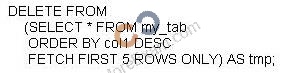
Question89: If a table named MY_TAB contains 100 rows and the following statement is executed:

What will happen?

Question90: Which clause should be included in a ALTER TABLE statement to update a table definition with a new column?

Question91: What factor influences lock conversion/promotion?

Question92: What is the primary purpose of a view?

Question93: Given the following statement:
GRANT DELETE ON TABLE sales TO User1 WITH GRANT OPTION;
Which statement is correct?

Question94: Which isolation level offers the greatest protection of data but provides the least amount of concurrency?

Question95: Given the following statements:
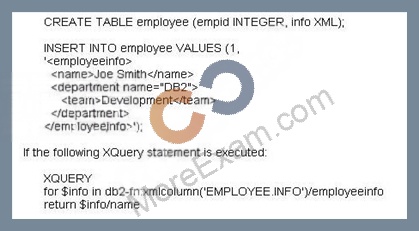
What will be the result?

Question96: Which object is used to cache table and index data as it is read from disk?

Question97: Which type of lock allows the lock owner and all concurrent applications to read, but not update, the locked data?

Question98: If the following command is executed: CREATE DATABASE test What is the page size (in kilobytes) of the database?

Question99: Which tool allows users to connect to a DB2 database using a wizard?

Question100: When a user-defined function (UDF) is created and no schema is specified, what schema is used to store the UDF?

Question101: If a table named MY_TAB contains 100 rows and the following statement is executed:

How many rows will be updated?

Question102: After creating several new indexes and executing RUNSTATS, user USER1 wants to re-create a package that is stored in the database so it will take advantage of the new indexes. Which authority/privilege must user USER1 be granted in order to re-create the package?

Question103: Which DB2 object can be used to improve the execution performance of qualified SELECT statements?

Question104: Application APP_A is performing updates to table TAB1 using the cursor stability (CS) isolation level. If application APP_B wants to retrieve all rows from table TAB1 without waiting for application APP_A to finish making updates, what isolation level must application APP_B use?

Question105: Which two statements are true about foreign key constraints? (Choose two.)

Question106: What privilege is required to create a view on a table that you are not the owner of?

Question107: Which is NOT a valid reason for creating an index?

Question108: What is a function of a table check constraint?

Question109: When a user-defined function (UDF) is created and no schema is specified, what schema is used to store the UDF?

Question110: Which object can a buffer pool be assigned to?

Question111: Which data type should be used to store data in a column that represents money and accurately returns a two position scale?

Question112: What isolation level prevents dirty reads, nonrepeatable reads, and phantoms?

Question113: A table named EMPLOYEES was created as follows:

What will be the results?

Question114: Which of the following privileges allow a user to update the comment on a sequence?

Question115: When is a mask used to limit access to data in a table?

Question116: What type of large object (LOB) is used to store LOB data together with the formatted rows on data pages, instead of in a separate LOB storage object?

Question117: Which SQL statement will retrieve the employee number (EMPNO), hire date (HIREDATE), and salary (SALARY) for each employee from a table named EMPLOYEE who was hired before 1998 and earns a salary of less than $35,000.00 per year?

Question118: Given the SQL statement: CREATE ALIAS total_sales FOR sales Which statement is valid?

Question119: Which SQL statement will create a DB2 object that can be used to store numerical data as Canadian currency?

Question120: A table named SALES contains a record for every sales transaction a company processes. A user wishes to see the number of transactions that are made by each salesman. Which SQL statement will produce the desired results?

Question121: Which protocol provides applications the ability to connect to and update multiple DB2 databases within the same transaction?

Question122: What is the act of releasing a large number of row-level locks that an application holds on a single table to acquire a table-level lock known as?

Question123: Which platform supports DB2 pureScale environments?

Question124: Which statement about UPDATE processing is FALSE?

Question125: What is the purpose of the Query Tuner?

Question126: You have a business need to query DB2 10 and DB2 9 databases and you want to write an application that can run on most platforms unchanged. Which interface would you use to achieve your goal?

Question127: Which SQL statement should be used to retrieve the minimum and maximum salaries (SALARY) for each job code (JOB), sorted by job code, from a table named EMPLOYEE?

Question128: Which statement about a deadlock is true?

Question129: A table named DEPARTMENT contains the following data:

What will happen?