MoreExam
1. Question Content...
EXPLANATION
Answer: X - EXPLANATION Content.
Question1: The employees of a large insurance firm use several applications that reside in CICS. There is also an existing application server and an in-house developed customer management system. Each application provides its own interaction services using different protocols and UIs. Which pattern is the most appropriate to create unified access to the existing applications?
Question2: A retail bank built an SOA for their customer service portal. Their layered architecture contains services at all levels. The system is not providing the performance required. What should the SOA Designer examine first to identify the cause?
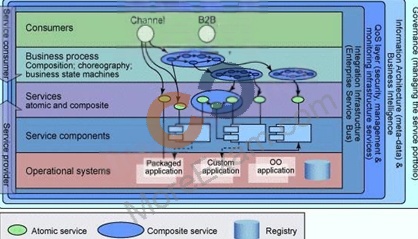
Question3: Which statement is true about the illustrated SOA domain shown in the Exhibit?
Question4: An SOA Solution Designer's recommendation for a financial institution is to use a separate gateway and Enterprise Service Bus (ESB) component. The decision considered a number of factors including the organizations current IT environment, staff skills, and non-functional requirements. However, the client has investigated using a more powerful single SOA appliance as a gateway and ESB to save money. Which action should be taken?
Question5: A company is evaluating how to implement single sign-on authentication in an HTTP-based environment.The goal is to allow them as service provider A to redirect to an outside service provider B and pass along information that proves the user is already authenticated. Which specification most accurately addresses the requirement?
Question6: Which statement is true when designing services within SOA guidelines?
Question7: An organization with a strong background in J2EE development and excellent IT governance is starting its first SOA project. Using the Service Integration Maturity Model (SIMM) as a guide, which action should they take to extend their object oriented modeling capability to increase their chance of success with this SOA project?
Question8: A customer wants to build an executive dashboard using information stored in a CICS application with data in legacy files, as well as customer profiles from a third party service. The IT department wants to build a data warehouse, but management is concerned about the expense and duration of this approach. Which is a viable, service-enabled alternative?
Question9: An SOA project implementation is underway in a large government organization. The development, testing, staging, and production environments have been installed and configured. Each environment consists of an Enterprise Service Bus (ESB), a registry and repository, a Web server, application servers, and Business Process Engine (BPEL). With only weeks before the project goes live with a business critical application, what should be recommended?
Question10: A bank has decided to rewrite their payment system from CICS/VSAM to SOA/J2EE/DB2 to easily adapt to a rapidly changing market, improve reporting capability and comply with a corporate edict to migrate off CICS/VSAM. The payment process is large and complex and includes three major sub-processes (Validation, Sanctions, and Disbursement) as well as additional supporting processes (e.g. Advising, Printing, and Reporting.) The Solution Architect has determined the entire project will take more than two years. The customer requires initial results within six months. What is the first step in the roadmap that should be suggested to the client?
Question11: A rapidly growing retail company recently outsourced their package delivery to a very reputable package delivery company. The two companies are integrated using SOA and Web services. However, the retail company is having customer satisfaction issues as the call center is not reliably calculating delivery dates.Which portion of the SOA Foundation is the focus to resolve this issue?
Question12: Which statement about SOA service design is true?
Question13: An organization has a large investment in legacy technologies (such as CICS and IMS) supporting applications that provide their core business transactions and data access. The Solution Architect believes significant value exists in providing interoperable or open standard, service-based access to those transactions (e.g., transactions that query account balance, create orders, schedule or track deliveries, query stock levels.) Which solution pattern should be considered by an Architect for providing service-based access to legacy systems?
Question14: A retail online commerce company uses SOA to create internal applications for its call centers, partners, and customers. As they matured, they began to look at establishing SOA governance and enlisted the services of an SOA Designer. After an audit of the current environment, it was found that they were achieving very low reuse of services and data entities. Further investigation revealed that duplicate services and data entities were being created. In which phase of the SOA Governance and Management Method should this problem have been initially addressed and which action should have been taken?
Question15: A telecom company has a Service Level Agreement (SLA) that requires Customer Service Representatives (CSRs) to respond to customer inquiries within 10 minutes. Often the CSR has to access nine independent legacy applications to respond to customers' inquiries. CSRs are consistently exceeding the 10 minute SLA. What is the quickest way to satisfy the SLA using an interaction and collaboration scenario based on an SOA approach?
Question16: A large multi-national bank is using SOA to transform their payment system to support new business models such as cross border treasury functions. The current system is a complex mix of payment types and rules used in each country, interacting with a variety of services to complete a payment. Which portion of the SOA Foundation is central to the transformation of this system?
Question17: An SOA project consists of services deployed in a heterogeneous distributed environment that includes an Enterprise Service Bus (ESB). When adding a requirement for routing management, how should it be implemented?
Question18: A manufacturing company can receive many customer orders at once. When an order is received, the OrderProcessing business process allocates a unique order number, updates the Customer service and invokes the Credit service. The process does not continue until the Credit service notifies it that the customer's details are valid, and this can take some time. Since multiple instances of the OrderProcessing process can exist at runtime, how can a specific instance be selected when the Credit service is ready to send notification?
Question19: As part of an SOA initiative, a utility company is re-writing a 2-tier call center application used for reporting power outages. Customers call in to report power outages and in some cases ask to be notified when the problem is fixed. The call center application is tightly coupled with a vendordeveloped power management application which dispatches workers for repairs. The current call center application is difficult to maintain since it implements a very large and complex framework to manage the calls and the relationship with the power management system. Which design approach should the SOA Designer use?
Question20: The IBM SOA Foundation includes services that support business innovation and optimization. What should be found in an SOA solution compliant with the SOA Foundation?
Question21: A company is implementing a new Web service within an SOA. The service will provide the ability to access customer details as part of a number of high-volume business processes. Which key quality assurance activity is needed as part of the Deploy phase of the SOA lifecycle?
Question22: A group of SOA Architects is discussing strategies to improve re-use without impacting the existing project deadlines. Which action is most likely to achieve the stated objective?
Question23: A service owner has developed a new version of an address validation service at a travel company. How is the service registry and repository used to govern the new version release?
Question24: A retail bank executive wants the IT department to re-implement current bank teller applications as an SOA. The executive wants to be in production in one year and asks an SOA Designer to instruct IT on how to accomplish this. What should the SOA Designer recommend to the executive?
Question25: An SOA Designer is collecting requirements for a global banking company's SOA project and discovers that various countries have different security encryption and privacy requirements. How should the SOA Designer handle this situation?
Question26: A large bank has a paper-based process for transferring funds between regional centers that takes days to complete. They want to use SOA to automate this process.As an SOA Designer, what is a likely reason to also include Partner Services?
Question27: During the planning phase of SOA governance, which task should be one of an SOA Designer's first priorities?
Question28: A delivery company currently has a process where office staff must update a number of legacy systems with the status of deliveries from paper-based forms. The company wants to deploy new wireless handheld devices to their drivers so they can report on the progress of daily deliveries in real-time. What should be the initial approach for this scenario?
Question29: When dealing with the security implications of providing a service to a different business unit or organization, what is the Enterprise Service Bus (ESB) Gateway used to accomplish?
Question30: A government department is expecting a higher load on their online loan system because of an upcoming deadline. The assigned Solution Architect plans to use mediation logic to identify and route crucial loan applications to the correct department. Which key business process design factor is being addressed using this SOA solution?
Question31: A company has been experiencing a substantially higher load on their online ordering system over the holidays. The assigned Solution Architect has recommended the use of selectors in routing the incoming requests based on market factors. Which important design consideration is being addressed when evaluating the business process aspect of an SOA solution?
Question32: A company is using the IBM SOA Solution Stack to create a new composite application to keep up with the changing marketplace. Functions and data from several existing Enterprise Information Systems (EIS) will be aggregated into the new application using a top-down approach. See the information in the Exhibit.Which solution is the most appropriate for implementation?
Question33: A municipal utility company, with a well-managed IT environment, created a Customer Query Service as a general purpose customer lookup service to provide one or more customer records associated with a variety of search criteria. The service is now used by both the call center and self-service Web application supporting power outage management. In the past, each application used different technologies to retrieve the information. Which additional management is required when introducing this service?
Question34: An Architect is developing the security architecture for an organization where there are currently two security registries - RACF for CICS applications and LDAP for Web applications. The CICS applications are currently being accessed internally via MQ with user credentials in the MQ header. As part of an SOA initiative, the legacy applications are being exposed to partners via Web services on WebSphere Application Server using JCA to access the CICS applications.At which point in the architecture is the credential mapping performed?
Question35: An organization is adding composite services to the environment. The services are running across different environments and operating systems. When considering secure access, what is one of the additional challenges that must be considered?
Question36: A university is receiving complaints that students can't receive grades reliably due to improper mailing addresses yet they can receive their bills on time at their correct address. During the assessment and analysis, what is the most likely business objective that can resolve this situation?
Question37: A financial services company manages retirement accounts for its corporate clients. The company has developed Web services for account and portfolio management and has deployed an Enterprise Service Bus (ESB) to mediate access to the services from various internal applications. Recently, the company has been getting pressure from some of its clients to expose its account and portfolio Web services externally so that clients can consume and integrate these services within their own internal Web applications. The company wants to ensure that access to the services by its clients is secure and controlled so that accounts are not compromised and also wants to minimize impact to its current IT infrastructure. The company consults an SOA Designer for guidance on the solution design.Which approach should the SOA Designer suggest to handle this requirement?
Question38: A music production company wants to develop a new way of creating and producing music. Their intent is to make it possible for musicians and technicians to collaborate remotely on new compositions. They want to explore an SOA approach. Where should the SOA Designer begin?
Question39: Existing applications running on CICS are identified as having the functionality required to implement a service interface. The decision has been made to use WebSphere Message Broker to implement the aggregation and transformation logic necessary to fulfill the service contract using the CICS application's APIs. The developers intend to expose the service using the SOAP/HTTP Web services features of WebSphere Message Broker. What needs to be done first to expose this service implementation?
Question40: A company has multiple services with each having a different requirement for availability and response time. Which environment should the Architect recommend?
Question41: An organization in the utilities sector has used WebSphere MQ for several years. Over time, the staff has developed expertise in WebSphere MQ and they are most comfortable solving problems using messaging- based technology. They plan to take advantage of SOA but are concerned about the risk of moving to new technology. Which technical solution should be suggested for this client?
Question42: A photo printing business has a central headquarters and approximately 5000 store fronts. Their latest project involves a website where customers can print their photos at the store location of their choice. The plan is to use a service hosted at each store front and route requests to the correct store. Which patterns should be considered when designing this solution?
Question43: The Chief Architect at a large company requested an audit of SOA projects to ensure no design aspects had been overlooked. A key finding was that management of services was not present in any of the designs reviewed. What should an SOA Designer suggest?
Question44: Two existing applications share common data with each having their own database. Since the data is replicated between the two of them every night, it leads to problems during the day when either application works with potentially outdated data. The customer is considering SOA as a solution. Which SOA approach can most effectively solve this problem?
Question45: A bank has extended their corporate investment banking division to include individual consumer investment accounts. For a variety of reasons there was not a tight coupling of the bank's retail banking division to the new individual investment accounts. Therefore, each division has different schemas for consumers and accounts. As part of an SOA initiative around customer insight, the bank now wants to cross-sell accounts across these two divisions. Which approach should the SOA Designer use to provide a single, unified and trusted view of customer data across these divisions?
Question46: A large company has decided to migrate to SOA for integrating business partners with their core transaction systems. This is in preparation for establishing new partnerships that could double their revenue. An SOA Designer has been hired to provide guidance and lead the project. Which approach should the SOA Designer use to get started?
Question47: A large bank has decided to use an SOA as the technical foundation of their customer insight initiative. The SOA Designer has selected the IBM SOA Solution Stack (Logical Reference Model) to support this initiative as shown in the Exhibit.How does the SOA Designer rationalize this choice?
Question48: A mobile phone company is losing money on the process for deactivating a phone when it is reported stolen or lost due to lag time between notification and deactivation. In the current SOA solution, call center staff disable the phone via a portlet that invokes a deactivation service which calls a mainframe application.The mainframe application notifies the telecom provider to deactivate the phone. What is a likely cause of the issue and which aspect of the solution makes the problem worse?
Question49: A new business process is being written that will call a number of new or existing Web services. As part of the SOA quality management process, which activity is the most appropriate?
Question50: A large corporation would like to utilize an SOA reference architecture for its various solutions. The need is for a flexible layered SOA model that can be used in a variety of application-related situations. The SOA Architect is assigned to find such a model. The Architect decides that the SOA Solution Stack fits the need and explains the selection to the Chief Architect. Which statement supports the selection of the SOA Solution Stack?
Question51: The agents of a financial clearing house use several applications that reside in CICS, an application server and a customer management system developed in-house. These applications all provide their own interaction services using different protocols and UIs. Which pattern is the most appropriate for an SOA implementation?
Question52: A retail company is faced with the challenge of quickly introducing new products involving components from multiple lines-of-business. How can adopting SOA help this company meet this challenge?
Question53: A manufacturing company has completed an SOA proof of concept using ten services to integrate several existing internal applications. The solution includes failover for the various services. During a power outage, three of the five application servers were non-operational. While the system never totally failed, IT operations notified the business analyst of the failure and recovery. In looking at the performance measurement metric trends during the outage, the business analyst noticed that one of the ten services was negatively impacted and could have violated potential Service Level Agreements (SLAs).How should the SOA Designer address this architectural issue(s) during assessment and analysis for the final production system?
Question54: A manufacturing company can receive many customer orders at once. When an order is received, the OrderProcessing business process allocates a unique order number, updates the Customer service and invokes the Credit service. The process does not continue until the Credit service notifies it that the customer's details are valid, and this can take some time. Since multiple instances of the OrderProcessing process can exist at runtime, how can a specific instance be selected when the Credit service is ready to send notification?
Question55: At an organization, some standards-based technologies have been adopted around a J2EE application server. There is now a need to provide multi-channel access to existing service providers. Which product should be used for service connectivity in this design?
Question56: A large medical practice is receiving complaints from patients that when they make data changes. Some correspondence is being properly updated but other correspondence is not. The medical practice is implementing an SOA assessment and analysis. Which approach will most likely resolve this situation?
Question57: A company has started an ambitious SOA project as part of an enterprise modernization initiative. The SOA Designer has determined that their mainframe-based portfolio is a tightly coupled set of applications owned by different IT organizations. In addition, the SOA executive sponsor is concerned that their mainframe portfolio and skill base will make the transition to SOA difficult. What should the SOA Designer do?
Question58: Service enabling a mainframe application can be non-invasive or invasive. Which scenario is a justification for invasive service enablement?
Question59: A photo printing business has a central headquarters and approximately 5000 store fronts. They offer an existing service which allows customers to physically enter a store and print their pictures. The latest project involves enabling a website where customers can upload photos to print at the store location of their choice for pickup. The plan is to use the existing service hosted at each store front to do the printing.Which patterns should be considered when designing this solution?
Question60: It has been determined that an application running on a mainframe needs to be service-enabled to allow it to be invoked asynchronously via an Enterprise Service Bus (ESB). The application interface is already capable of accepting WebSphere MQ messages, and the SOA designer does not wish to modify the current application code. What is an appropriate method of service-enabling the application that would also offer a high level of reuse of the resulting service in a business process?
Question61: A retail company is faced with the challenge of quickly introducing new products involving components from multiple lines-of-business. How can adopting SOA help this company meet this challenge?
Question62: A Fortune 100 company is migrating its Enterprise Application Integration (EAI) architecture to SO A The intent is to begin exposing its capabilities to business partners. The CIO is thinking about building a high speed, custom messaging solution so there is capacity for future growth.What should the SOA Designer say about the long-term implications of that direction?