EMT Practice Test

1. Question Content...


Question List

Question1: Organization wants to achieve high availability goal for Mule applications in customer hosted runtime plane.
Due to the complexity involved, data cannot be shared among of different instances of same Mule application.
What option best suits to this requirement considering high availability is very much critical to the organization?

Question2: A team would like to create a project skeleton that developers can use as a starting point when creating API Implementations with Anypoint Studio. This skeleton should help drive consistent use of best practices within the team.
What type of Anypoint Exchange artifact(s) should be added to Anypoint Exchange to publish the project skeleton?

Question3: An XA transaction Is being configured that involves a JMS connector listening for Incoming JMS messages.
What is the meaning of the timeout attribute of the XA transaction, and what happens after the timeout expires?

Question4: An API implementation is being designed that must invoke an Order API which is known to repeatedly experience downtime. For this reason a fallback API is to be called when the Order API is unavailable. What approach to designing invocation of the fallback API provides the best resilience?

Question5: An organization is creating a Mule application that will be deployed to CloudHub. The Mule application has a property named dbPassword that stores a database user's password.
The organization's security standards indicate that the dbPassword property must be hidden from every Anypoint Platform user after the value is set in the Runtime Manager Properties tab.
What configuration in the Mule application helps hide the dbPassword property value in Runtime Manager?

Question6: A mule application must periodically process a large dataset which varies from 6 GB lo 8 GB from a back-end database and write transform data lo an FTPS server using a properly configured bad job scope.
The performance requirements of an application are approved to run in the cloud hub 0.2 vCore with 8 GB storage capacity and currency requirements are met.
How can the high rate of records be effectively managed in this application?

Question7: Refer to the exhibit.

One of the backend systems invoked by an API implementation enforces rate limits on the number of requests a particular client can make. Both the backend system and the API implementation are deployed to several non-production environments in addition to production.
Rate limiting of the backend system applies to all non-production environments. The production environment, however, does NOT have any rate limiting.
What is the most effective approach to conduct performance tests of the API implementation in a staging (non-production) environment?

Question8: A stock trading company handles millions of trades a day and requires excellent performance and reliability within its stock trading system. The company operates a number of event-driven APIs Implemented as Mule applications that are hosted on various customer-hosted Mule clusters and needs to enable message exchanges between the APIs within their internal network using shared message queues.
What is an effective way to meet the cross-cluster messaging requirements of its event-driven APIs?

Question9: A company is designing an integration Mule application to process orders by submitting them to a back-end system for offline processing. Each order will be received by the Mule application through an HTTP5 POST and must be acknowledged immediately.
Once acknowledged the order will be submitted to a back-end system. Orders that cannot be successfully submitted due to the rejections from the back-end system will need to be processed manually (outside the banking system).
The mule application will be deployed to a customer hosted runtime and will be able to use an existing ActiveMQ broker if needed. The ActiveMQ broker is located inside the organization's firewall. The back-end system has a track record of unreliability due to both minor network connectivity issues and longer outages.
Which combination of Mule application components and ActiveMQ queues are required to ensure automatic submission of orders to the back-end system while supporting but minimizing manual order processing?

Question10: A REST API is being designed to implement a Mule application.
What standard interface definition language can be used to define REST APIs?

Question11: An organization has various integrations implemented as Mule applications. Some of these Mule applications are deployed to custom hosted Mule runtimes (on-premises) while others execute in the MuleSoft-hosted runtime plane (CloudHub). To perform the Integra functionality, these Mule applications connect to various backend systems, with multiple applications typically needing to access the backend systems.
How can the organization most effectively avoid creating duplicates in each Mule application of the credentials required to access the backend systems?

Question12: The company's FTPS server login username and password
Question13: Refer to the exhibit.

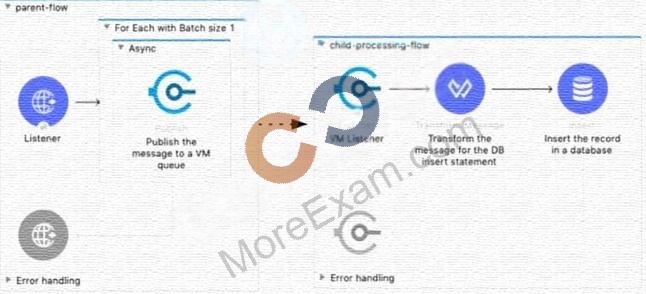
A Mule 4 application has a parent flow that breaks up a JSON array payload into 200 separate items, then sends each item one at a time inside an Async scope to a VM queue.
A second flow to process orders has a VM Listener on the same VM queue. The rest of this flow processes each received item by writing the item to a database.
This Mule application is deployed to four CloudHub workers with persistent queues enabled.
What message processing guarantees are provided by the VM queue and the CloudHub workers, and how are VM messages routed among the CloudHub workers for each invocation of the parent flow under normal operating conditions where all the CloudHub workers remain online?

Question14: Which productivity advantage does Anypoint Platform have to both implement and manage an AP?

Question15: What are two reasons why a typical MuleSoft customer favors a MuleSoft-hosted Anypoint Platform runtime plane over a customer-hosted runtime for its Mule application deployments? (Choose two.)

Question16: An API client is implemented as a Mule application that includes an HTTP Request operation using a default configuration. The HTTP Request operation invokes an external API that follows standard HTTP status code conventions, which causes the HTTP Request operation to return a 4xx status code.
What is a possible cause of this status code response?

Question17: An organization is successfully using API led connectivity, however, as the application network grows, all the manually performed tasks to publish share and discover, register, apply policies to, and deploy an API are becoming repetitive pictures driving the organization to automate this process using efficient CI/'CD pipeline.
Considering Anypoint platforms capabilities how should the organization approach automating is API lifecycle?

Question18: To implement predictive maintenance on its machinery equipment, ACME Tractors has installed thousands of IoT sensors that will send data for each machinery asset as sequences of JMS messages, in near real-time, to a JMS queue named SENSOR_DATA on a JMS server. The Mule application contains a JMS Listener operation configured to receive incoming messages from the JMS servers SENSOR_DATA JMS queue. The Mule application persists each received JMS message, then sends a transformed version of the corresponding Mule event to the machinery equipment back-end systems.
The Mule application will be deployed to a multi-node, customer-hosted Mule runtime cluster. Under normal conditions, each JMS message should be processed exactly once.
How should the JMS Listener be configured to maximize performance and concurrent message processing of the JMS queue?

Question19: A trading company handles millions of requests a day. Due to nature of its business, it requires excellent performance and reliability within its application.
For this purpose, company uses a number of event-based API's hosted on various mule clusters that communicate across a shared message queue sitting within its network.
Which method should be used to meet the company's requirement for its system?

Question20: An organization plans to migrate its deployment environment from an onpremises cluster to a Runtime Fabric (RTF) cluster. The on-premises Mule applications are currently configured with persistent object stores.
There is a requirement to enable Mule applications deployed to the RTF cluster to store and share data across application replicas and through restarts of the entire RTF cluster, How can these reliability requirements be met?

Question21: Mule applications need to be deployed to CloudHub so they can access on-premises database systems. These systems store sensitive and hence tightly protected data, so are not accessible over the internet.
What network architecture supports this requirement?

Question22: An application deployed to a runtime fabric environment with two cluster replicas is designed to periodically trigger of flow for processing a high-volume set of records from the source system and synchronize with the SaaS system using the Batch job scope After processing 1000 records in a periodic synchronization of 1 lakh records, the replicas in which batch job instance was started went down due to unexpected failure in the runtime fabric environment What is the consequence of losing the replicas that run the Batch job instance?

Question23: An insurance company is using a CIoudHub runtime plane. As a part of requirement, email alert should be sent to internal operations team every time of policy applied to an API instance is deleted As an integration architect suggest on how this requirement be met?

Question24: An integration Mule application is deployed to a customer-hosted multi-node Mule 4 runtime duster. The Mule application uses a Listener operation of a JMS connector to receive incoming messages from a JMS queue.
How are the messages consumed by the Mule application?

Question25: As a part of design , Mule application is required call the Google Maps API to perform a distance computation. The application is deployed to cloudhub.
At the minimum what should be configured in the TLS context of the HTTP request configuration to meet these requirements?

Question26: A manufacturing company is planning to deploy Mule applications to its own Azure Kubernetes Service infrastructure.
The organization wants to make the Mule applications more available and robust by deploying each Mule application to an isolated Mule runtime in a Docker container while managing all the Mule applications from the MuleSoft-hosted control plane.
What is the most idiomatic (used for its intended purpose) choice of runtime plane to meet these organizational requirements?

Question27: What is required before an API implemented using the components of Anypoint Platform can be managed and governed (by applying API policies) on Anypoint Platform?

Question28: Refer to the exhibit.

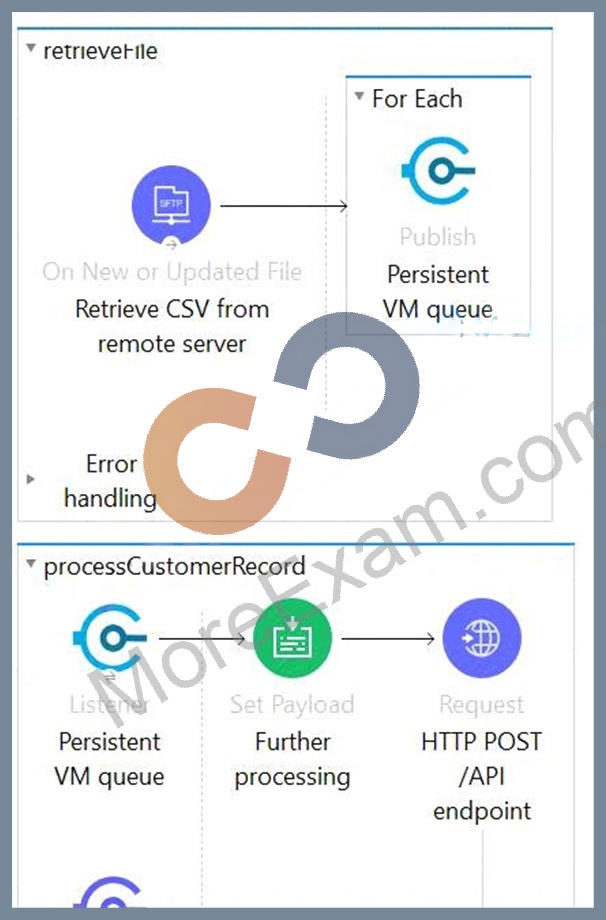
This Mule application is deployed to multiple Cloudhub workers with persistent queue enabled. The retrievefile flow event source reads a CSV file from a remote SFTP server and then publishes each record in the CSV file to a VM queue. The processCustomerRecords flow's VM Listner receives messages from the same VM queue and then processes each message separately.
How are messages routed to the cloudhub workers as messages are received by the VM Listener?

Question29: A stock broking company makes use of CloudHub VPC to deploy Mule applications. Mule application needs to connect to a database application in the customers on-premises corporate data center and also to a Kafka cluster running in AWS VPC.
How is access enabled for the API to connect to the database application and Kafka cluster securely?

Question30: An integration team uses Anypoint Platform and follows MuleSoft's recommended approach to full lifecycle API development.
Which step should the team's API designer take before the API developers implement the AP! Specification?

Question31: According to the National Institute of Standards and Technology (NIST), which cloud computing deployment model describes a composition of two or more distinct clouds that support data and application portability?

Question32: An organization's security policies mandate complete control of the login credentials used to log in to Anypoint Platform. What feature of Anypoint Platform should be used to meet this requirement?

Question33: A Mule application is being designed To receive nightly a CSV file containing millions of records from an external vendor over SFTP, The records from the file need to be validated, transformed. And then written to a database. Records can be inserted into the database in any order.
In this use case, what combination of Mule components provides the most effective and performant way to write these records to the database?

Question34: An organization has chosen Mulesoft for their integration and API platform.
According to the Mulesoft catalyst framework, what would an integration architect do to create achievement goals as part of their business outcomes?

Question35: A Mule application contains a Batch Job with two Batch Steps (Batch_Step_l and Batch_Step_2). A payload with 1000 records is received by the Batch Job.
How many threads are used by the Batch Job to process records, and how does each Batch Step process records within the Batch Job?

Question36: A mule application is being designed to perform product orchestration. The Mule application needs to join together the responses from an inventory API and a Product Sales History API with the least latency.
To minimize the overall latency. What is the most idiomatic (used for its intended purpose) design to call each API request in the Mule application?

Question37: A rale limiting policy has been applied to a soap VI.2 API published in Clondhub. The API implementation catches errors in a global error handler on error propagate in the main flow for HTTP: RETRY_EXHAUSTED with HTTP status set to 429 and any with the HTTP status set to 500.
What is the expected H1TP status when the client exceeds the quota of the API calls?

Question38: A set of integration Mule applications, some of which expose APIs, are being created to enable a new business process. Various stakeholders may be impacted by this. These stakeholders are a combination of semi-technical users (who understand basic integration terminology and concepts such as JSON and XML) and technically skilled potential consumers of the Mule applications and APIs.
What Is an effective way for the project team responsible for the Mule applications and APIs being built to communicate with these stakeholders using Anypoint Platform and its supplied toolset?

Question39: A Mule application is built to support a local transaction for a series of operations on a single database. The Mule application has a Scatter-Gather that participates in the local transaction.
What is the behavior of the Scatter-Gather when running within this local transaction?

Question40: Which Salesforce API is invoked to deploy, retrieve, create or delete customization information such as custom object definitions using a Mule Salesforce connector in a Mule application?

Question41: Anypoint Exchange is required to maintain the source code of some of the assets committed to it, such as Connectors, Templates, and API specifications.
What is the best way to use an organization's source-code management (SCM) system in this context?

Question42: What is a defining characteristic of an integration-Platform-as-a-Service (iPaaS)?

Question43: An organization plans to use the Anypoint Platform audit logging service to log Anypoint MQ actions.
What consideration must be kept in mind when leveraging Anypoint MQ Audit Logs?

Question44: An organization is creating a set of new services that are critical for their business. The project team prefers using REST for all services but is willing to use SOAP with common WS-" standards if a particular service requires it.
What requirement would drive the team to use SOAP/WS-* for a particular service?

Question45: One of the backend systems involved by the API implementation enforces rate limits on the number of request a particle client can make.
Both the back-end system and API implementation are deployed to several non-production environments including the staging environment and to a particular production environment. Rate limiting of the back-end system applies to all non-production environments.
The production environment however does not have any rate limiting.
What is the cost-effective approach to conduct performance test of the API implementation in the non-production staging environment?

Question46: Following MuleSoft best practices, what MuleSoft runtime deployment option best meets the company's goals to begin its digital transformation journey?

Question47: A global, high-volume shopping Mule application is being built and will be deployed to CloudHub. To improve performance, the Mule application uses a Cache scope that maintains cache state in a CloudHub object store. Web clients will access the Mule application over HTTP from all around the world, with peak volume coinciding with business hours in the web client's geographic location. To achieve optimal performance, what Anypoint Platform region should be chosen for the CloudHub object store?

Question48: An organization is designing an integration solution to replicate financial transaction data from a legacy system into a data warehouse (DWH).
The DWH must contain a daily snapshot of financial transactions, to be delivered as a CSV file. Daily transaction volume exceeds tens of millions of records, with significant spikes in volume during popular shopping periods.
What is the most appropriate integration style for an integration solution that meets the organization's current requirements?

Question49: A high-volume eCommerce retailer receives thousands of orders per hour and requires notification of its order management, warehouse, and billing system for subsequent processing within 15 minutes of order submission through its website.
Which integration technology, when used for its typical and intended purpose, meets the retailer's requirements for this use case?

Question50: An organization is designing a mule application to support an all or nothing transaction between serval database operations and some other connectors so that they all roll back if there is a problem with any of the connectors Besides the database connector , what other connector can be used in the transaction.

Question51: As a part of project requirement, client will send a stream of data to mule application. Payload size can vary between 10mb to 5GB. Mule application is required to transform the data and send across multiple sftp servers. Due to the cost cuttings in the organization, mule application can only be allocated one worker with size of 0.2 vCore.
As an integration architect , which streaming strategy you would suggest to handle this scenario?

Question52: A Mule application is being designed for deployment to a single CloudHub worker. The Mule application will have a flow that connects to a SaaS system to perform some operations each time the flow is invoked.
The SaaS system connector has operations that can be configured to request a short-lived token (fifteen minutes) that can be reused for subsequent connections within the fifteen minute time window. After the token expires, a new token must be requested and stored.
What is the most performant and idiomatic (used for its intended purpose) Anypoint Platform component or service to use to support persisting and reusing tokens in the Mule application to help speed up reconnecting the Mule application to the SaaS application?

Question53: An organization is building a test suite for their applications using m-unit. The integration architect has recommended using test recorder in studio to record the processing flows and then configure unit tests based on the capture events What are the two considerations that must be kept in mind while using test recorder (Choose two answers)

Question54: As a part of project requirement, Java Invoke static connector in a mule 4 application needs to invoke a static method in a dependency jar file. What are two ways to add the dependency to be visible by the connectors class loader?
(Choose two answers)

Question55: An airline is architecting an API connectivity project to integrate its flight data into an online aggregation website. The interface must allow for secure communication high-performance and asynchronous message exchange.
What are suitable interface technologies for this integration assuming that Mulesoft fully supports these technologies and that Anypoint connectors exist for these interfaces?

Question56: An organization has strict unit test requirement that mandate every mule application must have an MUnit test suit with a test case defined for each flow and a minimum test coverage of 80%.
A developer is building Munit test suit for a newly developed mule application that sends API request to an external rest API.
What is the effective approach for successfully executing the Munit tests of this new application while still achieving the required test coverage for the Munit tests?

Question57: A global organization operates datacenters in many countries. There are private network links between these datacenters because all business data (but NOT metadata) must be exchanged over these private network connections.
The organization does not currently use AWS in any way.
The strategic decision has Just been made to rigorously minimize IT operations effort and investment going forward.
What combination of deployment options of the Anypoint Platform control plane and runtime plane(s) best serves this organization at the start of this strategic journey?

Question58: Which of the below requirements prevent the usage of Anypoint MQ in a company's network? (Choose two answers)

Question59: An organization plans to migrate all its Mule applications to Runtime Fabric (RTF). Currently, all Mule applications have been deployed to CloudHub using automated CI/CD scripts.
What steps should be taken to properly migrate the applications from CloudHub to RTF, while keeping the same automated CI/CD deployment strategy?

Question60: What approach configures an API gateway to hide sensitive data exchanged between API consumers and API implementations, but can convert tokenized fields back to their original value for other API requests or responses, without having to recode the API implementations?

Question61: A team has completed the build and test activities for a Mule application that implements a System API for its application network.
Which Anypoint Platform component should the team now use to both deploy and monitor the System AP\ implementation?

Question62: In one of the critical payment related mule application, transaction is being used . As an enhancement to implementation , scatter gather route is introduced which is also the part of transaction group. Scatter gather route has 4 routes.
What will be the behavior of the Mule application in case of error occurs in 4th route of the scatter-gather router and transaction needs to be rolled back?

Question63: The retrieveBalances flow in the Mule application is designed to use an operation in a connector to the Finance system (the Finance operation) that can only look up one account record at a time, and a operation from a different connector to the Audit system (the Audit operation) that can only insert one account record at a time.
To best meet the performance-related requirements, what scope or scopes should be used and how should they be used to incorporate the Finance operation and Audit operation into the retrieveBalances flow?

Question64: How does timeout attribute help inform design decisions while using JMS connector listening for incoming messages in an extended architecture (XA) transaction?

Question65: An organization is sizing an Anypoint VPC to extend their internal network to Cloudhub.
For this sizing calculation, the organization assumes 150 Mule applications will be deployed among three(3) production environments and will use Cloudhub's default zero-downtime feature. Each Mule application is expected to be configured with two(2) Cloudhub workers.This is expected to result in several Mule application deployments per hour.

Question66: An organization has an HTTPS-enabled Mule application named Orders API that receives requests from another Mule application named Process Orders.
The communication between these two Mule applications must be secured by TLS mutual authentication (two-way TLS).
At a minimum, what must be stored in each truststore and keystore of these two Mule applications to properly support two-way TLS between the two Mule applications while properly protecting each Mule application's keys?

Question67: Which Exchange asset type represents a complete API specification in RAML or OAS format?

Question68: A project team uses RAML specifications to document API functional requirements and deliver API definitions. As per the current legal requirement, all designed API definitions to be augmented with an additional non-functional requirement to protect the services from a high rate of requests according to define service level agreements.
Assuming that the project is following Mulesoft API governance and policies, how should the project team convey the necessary non-functional requirement to stakeholders?

Question69: What Anypoint Connectors support transactions?

Question70: A payment processing company has implemented a Payment Processing API Mule application to process credit card and debit card transactions, Because the Payment Processing API handles highly sensitive information, the payment processing company requires that data must be encrypted both In-transit and at-rest.
To meet these security requirements, consumers of the Payment Processing API must create request message payloads in a JSON format specified by the API, and the message payload values must be encrypted.
How can the Payment Processing API validate requests received from API consumers?

Question71: When designing an upstream API and its implementation, the development team has been advised to not set timeouts when invoking downstream API. Because the downstream API has no SLA that can be relied upon.
This is the only donwstream API dependency of that upstream API. Assume the downstream API runs uninterrupted without crashing. What is the impact of this advice?

Question72: What requirement prevents using Anypoint MQ as the messaging broker for a Mule application?

Question73: According to MuleSoft, what Action should an IT organization take regarding its technology assets in order to close the IT delivery.

Question74: An organization has implemented a continuous integration (CI) lifecycle that promotes Mule applications through code, build, and test stages. To standardize the organization's CI journey, a new dependency control approach is being designed to store artifacts that include information such as dependencies, versioning, and build promotions.
To implement these process improvements, the organization will now require developers to maintain all dependencies related to Mule application code in a shared location.
What is the most idiomatic (used for its intended purpose) type of system the organization should use in a shared location to standardize all dependencies related to Mule application code?

Question75: An organization is using Mulesoft cloudhub and develops API's in the latest version. As a part of requirements for one of the API's, third party API needs to be called. The security team has made it clear that calling any external API needs to have include listing As an integration architect please suggest the best way to accomplish the design plan to support these requirements?

Question76: An organization is migrating all its Mule applications to Runtime Fabric (RTF). None of the Mule applications use Mule domain projects.
Currently, all the Mule applications have been manually deployed to a server group among several customer hosted Mule runtimes.
Port conflicts between these Mule application deployments are currently managed by the DevOps team who carefully manage Mule application properties files.
When the Mule applications are migrated from the current customer-hosted server group to Runtime Fabric (RTF), fo the Mule applications need to be rewritten and what DevOps port configuration responsibilities change or stay the same?

Question77: A project team is working on an API implementation using the RAML definition as a starting point. The team has updated the definition to include new operations and has published a new version to exchange. Meanwhile another team is working on a mule application consuming the same API implementation.
During the development what has to be performed by the mule application team to take advantage of the newly added operations?

Question78: A mule application is required to periodically process large data set from a back-end database to Salesforce CRM using batch job scope configured properly process the higher rate of records.
The application is deployed to two cloudhub workers with no persistence queues enabled.
What is the consequence if the worker crashes during records processing?

Question79: An organization will deploy Mule applications to Cloudhub, Business requirements mandate that all application logs be stored ONLY in an external splunk consolidated logging service and NOT in Cloudhub.
In order to most easily store Mule application logs ONLY in Splunk, how must Mule application logging be configured in Runtime Manager, and where should the log4j2 splunk appender be defined?

Question80: A mule application designed to fulfil two requirements
a) Processing files are synchronously from an FTPS server to a back-end database using VM intermediary queues for load balancing VM events b) Processing a medium rate of records from a source to a target system using batch job scope Considering the processing reliability requirements for FTPS files, how should VM queues be configured for processing files as well as for the batch job scope if the application is deployed to Cloudhub workers?

Question81: An organization plans to extend its Mule APIs to the EU (Frankfurt) region.
Currently, all Mule applications are deployed to CloudHub 1.0 in the default North American region, from the North America control plane, following this naming convention: {API-name}-{environment} (for example, Orderssapi-dev, Orders-sapi--qa, Orders-sapi--prod, etc.).
There is no network restriction to block communications between APIs.
What strategy should be implemented in order to deploy the same Mule APIs to the CloudHub 1.0 EU region from the North America control plane, as well as to minimize latency between APIs and target users and systems in Europe?

Question82: An organization is designing multiple new applications to run on CloudHub in a single Anypoint VPC and that must share data using a common persistent Anypoint object store V2 (OSv2).
Which design gives these mule applications access to the same object store instance?

Question83: An organization heeds to procure an enterprise software system to increase cross-selling opportunities and better rack prospect data.
Which category of enterprise software has these core capabilities, when used for its typical and intended purpose?

Question84: Refer to the exhibit.

What is the type data format shown in the exhibit?

Question85: A leading bank implementing new mule API.
The purpose of API to fetch the customer account balances from the backend application and display them on the online platform the online banking platform. The online banking platform will send an array of accounts to Mule API get the account balances.
As a part of the processing the Mule API needs to insert the data into the database for auditing purposes and this process should not have any performance related implications on the account balance retrieval flow How should this requirement be implemented to achieve better throughput?

Question86: When the mule application using VM is deployed to a customer-hosted cluster or multiple cloudhub workers, how are messages consumed by the Mule engine?

Question87: Which Mulesoft feature helps users to delegate their access without sharing sensitive credentials or giving full control of accounts to 3rd parties?

Question88: What operation can be performed through a JMX agent enabled in a Mule application?

Question89: What is a core pillar of the MuleSoft Catalyst delivery approach?

Question90: Which component of Anypoint platform belongs to the platform control plane?

Question91: An automation engineer needs to write scripts to automate the steps of the API lifecycle, including steps to create, publish, deploy and manage APIs and their implementations in Anypoint Platform.
What Anypoint Platform feature can be used to automate the execution of all these actions in scripts in the easiest way without needing to directly invoke the Anypoint Platform REST APIs?

Question92: A marketing organization is designing a Mule application to process campaign dat a. The Mule application will periodically check for a file in a SFTP location and process the records in the file. The size of the file can vary from 10MB to 5GB. Due to the limited availabiltty of vCores, the Mule application is deployed to a single CloudHub worker configured with vCore size 0.2.
The application must transform and send different formats of this file to three different downstream SFTP locations.
What is the most idiomatic (used for its intended purpose) and performant way to configure the SFTP operations or event sources to process the large files to support these deployment requirements?

Question93: A Mule application uses the Database connector.
What condition can the Mule application automatically adjust to or recover from without needing to restart or redeploy the Mule application?

Question94: An organization if struggling frequent plugin version upgrades and external plugin project dependencies. The team wants to minimize the impact on applications by creating best practices that will define a set of default dependencies across all new and in progress projects.
How can these best practices be achieved with the applications having the least amount of responsibility?

Question95: A retail company is implementing a MuleSoft API to get inventory details from two vendors by Invoking each vendor's online applications. Due to network issues, the invocations to the vendor applications are timing out intermittently, but the requests are successful after re-invoking each vendor application.
What is the most performant way of implementing the API to invoke each vendor application and to retry invocations that generate timeout errors?

Question96: What is true about automating interactions with Anypoint Platform using tools such as Anypoint Platform REST API's, Anypoint CLI or the Mule Maven plugin?

Question97: Refer to the exhibit.
An organization is designing a Mule application to receive data from one external business partner. The two companies currently have no shared IT infrastructure and do not want to establish one. Instead, all communication should be over the public internet (with no VPN).
What Anypoint Connector can be used in the organization's Mule application to securely receive data from this external business partner?

Question98: An organization is evaluating using the CloudHub shared Load Balancer (SLB) vs creating a CloudHub dedicated load balancer (DLB). They are evaluating how this choice affects the various types of certificates used by CloudHub deplpoyed Mule applications, including MuleSoft-provided, customer-provided, or Mule application-provided certificates.
What type of restrictions exist on the types of certificates that can be exposed by the CloudHub Shared Load Balancer (SLB) to external web clients over the public internet?

Question99: An organization is designing an integration Mule application to process orders by submitting them to a back-end system for offline processing. Each order will be received by the Mule application through an HTTPS POST and must be acknowledged immediately. Once acknowledged, the order will be submitted to a back-end system. Orders that cannot be successfully submitted due to rejections from the back-end system will need to be processed manually (outside the back-end system).
The Mule application will be deployed to a customer-hosted runtime and is able to use an existing ActiveMQ broker if needed. The ActiveMQ broker is located inside the organization's firewall. The back-end system has a track record of unreliability due to both minor network connectivity issues and longer outages.
What idiomatic (used for their intended purposes) combination of Mule application components and ActiveMQ queues are required to ensure automatic submission of orders to the back-end system while supporting but minimizing manual order processing?

Question100: Customer has deployed mule applications to different customer hosted mule run times. Mule applications are managed from Anypoint platform.
What needs to be configured to monitor these Mule applications from Anypoint monitoring and what sends monitoring data to Anypoint monitoring?

Question101: An organization's IT team must secure all of the internal APIs within an integration solution by using an API proxy to apply required authentication and authorization policies.
Which integration technology, when used for its intended purpose, should the team choose to meet these requirements if all other relevant factors are equal?

Question102: Refer to the exhibit.

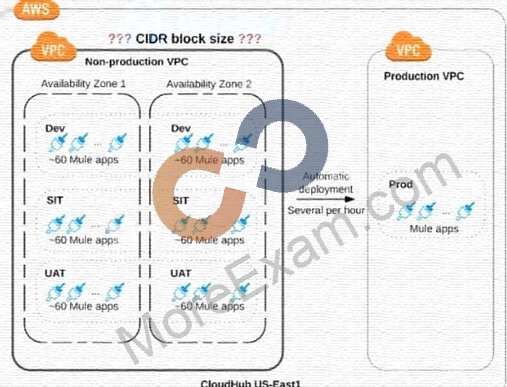
An organization is sizing an Anypoint VPC for the non-production deployments of those Mule applications that connect to the organization's on-premises systems. This applies to approx. 60 Mule applications. Each application is deployed to two CloudHub i workers. The organization currently has three non-production environments (DEV, SIT and UAT) that share this VPC. The AWS region of the VPC has two AZs.
The organization has a very mature DevOps approach which automatically progresses each application through all non-production environments before automatically deploying to production. This process results in several Mule application deployments per hour, using CloudHub's normal zero-downtime deployment feature.
What is a CIDR block for this VPC that results in the smallest usable private IP address range?

Question103: A leading eCommerce giant will use MuleSoft APIs on Runtime Fabric (RTF) to process customer orders.
Some customer-sensitive information, such as credit card information, is required in request payloads or is included in response payloads in some of the APIs. Other API requests and responses are not authorized to access some of this customer-sensitive information but have been implemented to validate and transform based on the structure and format of this customer-sensitive information (such as account IDs, phone numbers, and postal codes).
What approach configures an API gateway to hide sensitive data exchanged between API consumers and API implementations, but can convert tokenized fields back to their original value for other API requests or responses, without having to recode the API implementations?
Later, the project team requires all API specifications to be augmented with an additional non-functional requirement (NFR) to protect the backend services from a high rate of requests, according to defined service-level agreements (SLAs). The NFR's SLAs are based on a new tiered subscription level "Gold", "Silver", or
"Platinum" that must be tied to a new parameter that is being added to the Accounts object in their enterprise data model.
Following MuleSoft's recommended best practices, how should the project team now convey the necessary non-functional requirement to stakeholders?

Question104: What aspects of a CI/CD pipeline for Mule applications can be automated using MuleSoft-provided Maven plugins?

Question105: A MuteSoft developer must implement an API as a Mule application, run the application locally, and execute unit tests against the Running application.
Which Anypoint Platform component can the developer use to full all of these requirements?

Question106: Refer to the exhibit.

A Mule application is deployed to a multi-node Mule runtime cluster. The Mule application uses the competing consumer pattern among its cluster replicas to receive JMS messages from a JMS queue. To process each received JMS message, the following steps are performed in a flow:
Step l: The JMS Correlation ID header is read from the received JMS message.
Step 2: The Mule application invokes an idempotent SOAP webservice over HTTPS, passing the JMS Correlation ID as one parameter in the SOAP request.
Step 3: The response from the SOAP webservice also returns the same JMS Correlation ID.
Step 4: The JMS Correlation ID received from the SOAP webservice is validated to be identical to the JMS Correlation ID received in Step 1.
Step 5: The Mule application creates a response JMS message, setting the JMS Correlation ID message header to the validated JMS Correlation ID and publishes that message to a response JMS queue.
Where should the Mule application store the JMS Correlation ID values received in Step 1 and Step 3 so that the validation in Step 4 can be performed, while also making the overall Mule application highly available, fault-tolerant, performant, and maintainable?

Question107: The AnyAirline organization's passenger reservations center is designing an integration solution that combines invocations of three different System APIs (bookFlight, bookHotel, and bookCar) in a business transaction.
Each System API makes calls to a single database.
The entire business transaction must be rolled back when at least one of the APIs fails.
What is the most idiomatic (used for its intended purpose) way to integrate these APIs in near real-time that provides the best balance of consistency, performance, and reliability?

Question108: According to MuleSoft, what is a major distinguishing characteristic of an application network in relation to the integration of systems, data, and devices?

Question109: A Mule application contains a Batch Job scope with several Batch Step scopes. The Batch Job scope is configured with a batch block size of 25.
A payload with 4,000 records is received by the Batch Job scope.
When there are no errors, how does the Batch Job scope process records within and between the Batch Step scopes?

Question110: As an enterprise architect, what are the two reasons for which you would use a canonical data model in the new integration project using Mulesoft Anypoint platform ( choose two answers )

Question111: A Mule application currently writes to two separate SQL Server database instances across the internet using a single XA transaction. It is 58. proposed to split this one transaction into two separate non-XA transactions with no other changes to the Mule application.
What non-functional requirement can be expected to be negatively affected when implementing this change?

Question112: What aspect of logging is only possible for Mule applications deployed to customer-hosted Mule runtimes, but NOT for Mule applications deployed to CloudHub?

Question113: An API has been unit tested and is ready for integration testing. The API is governed by a Client ID Enforcement policy in all environments.
What must the testing team do before they can start integration testing the API in the Staging environment?

Question114: Refer to the exhibit.

An organization deploys multiple Mule applications to the same customer -hosted Mule runtime. Many of these Mule applications must expose an HTTPS endpoint on the same port using a server-side certificate that rotates often.
What is the most effective way to package the HTTP Listener and package or store the server-side certificate when deploying these Mule applications, so the disruption caused by certificate rotation is minimized?

Question115: 49 of A popular retailer is designing a public API for its numerous business partners. Each business partner will invoke the API at the URL 58. https://api.acme.com/partnefs/vl. The API implementation is estimated to require deployment to 5 CloudHub workers.
The retailer has obtained a public X.509 certificate for the name apl.acme.com, signed by a reputable CA, to be used as the server certificate.
Where and how should the X.509 certificate and Mule applications be used to configure load balancing among the 5 CloudHub workers, and what DNS entries should be configured in order for the retailer to support its numerous business partners?

Question116: What is not true about Mule Domain Project?

Question117: A company is building an application network and has deployed four Mule APIs: one experience API, one process API, and two system APIs. The logs from all the APIs are aggregated in an external log aggregation tool. The company wants to trace messages that are exchanged between multiple API implementations. What is the most idiomatic (based on its intended use) identifier that should be used to implement Mule event tracing across the multiple API implementations?

Question118: What metrics about API invocations are available for visualization in custom charts using Anypoint Analytics?

Question119: Mule application is deployed to Customer Hosted Runtime. Asynchronous logging was implemented to improved throughput of the system. But it was observed over the period of time that few of the important exception log messages which were used to rollback transactions are not working as expected causing huge loss to the Organization. Organization wants to avoid these losses. Application also has constraints due to which they cant compromise on throughput much. What is the possible option in this case?

Question120: The implementation of a Process API must change. What is a valid approach that minimizes the impact of this change on API clients?