MoreExam
1. Question Content...
EXPLANATION
Answer: X - EXPLANATION Content.
Question1: An API implementation is updated. When must the RAML definition of the API also be updated?
Question2: What is a typical result of using a fine-grained rather than a coarse-grained API deployment model to implement a given business process?
Question3: What CANNOT be effectively enforced using an API policy in Anypoint Platform?
Question4: Version 3.0.1 of a REST API implementation represents time values in PST time using ISO 8601 hh:mm:ss format. The API implementation needs to be changed to instead represent time values in CEST time using ISO 8601 hh:mm:ss format. When following the semver.org semantic versioning specification, what version should be assigned to the updated API implementation?
Question5: What is typically NOT a function of the APIs created within the framework called API-led connectivity?
Question6: How can the application of a rate limiting API policy be accurately reflected in the RAML definition of an API?
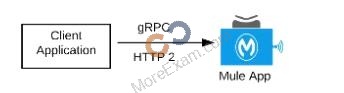
Question7: What Mule application can have API policies applied byAnypoint Platform to the endpoint exposed by that Mule application?A) A Mule application that accepts requests over HTTP/1.xB) A Mule application that accepts JSON requests over TCP but is NOT required to provide a responseC) A Mute application that accepts JSON requests over WebSocketD) A Mule application that accepts gRPC requests over HTTP/2
Question8: An API client calls one method from an existing API implementation. The API implementation is later updated. What change to the API implementation would require the API client's invocation logic to also be updated?
Question9: What do the API invocation metrics provided by Anypoint Platform provide?
Question10: An organization has several APIs that accept JSON data over HTTP POST. The APIs are all publicly available and are associated with several mobile applications and web applications.The organization does NOT want to use any authentication or compliance policies for these APIs, but at the same time, is worried that some bad actor could send payloads that could somehow compromise the applications or servers running the API implementations.What out-of-the-box Anypoint Platform policy can address exposure to this threat?
Question11: Refer to the exhibit.A developer is building a client application to invoke an API deployed to the STAGING environment that is governed by a client ID enforcement policy.What is required to successfully invoke the API?
Question12: What is the main change to the IT operating model that MuleSoft recommends to organizations to improve innovation and clock speed?
Question13: A Mule application exposes an HTTPS endpoint and is deployed to three CloudHub workers that do not use static IP addresses. The Mule application expects a high volume of client requests in short time periods. What is the most cost-effective infrastructure component that should be used to serve the high volume of client requests?
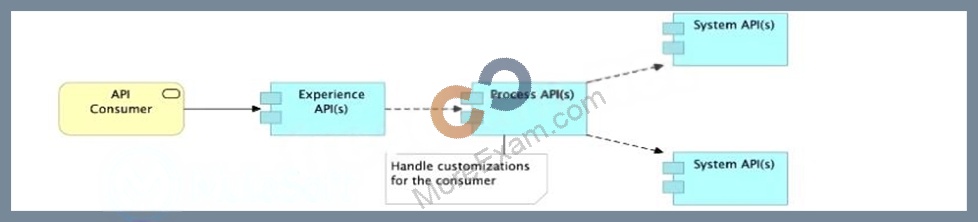
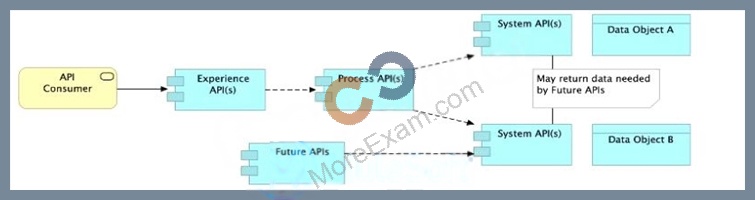
Question14: Refer to the exhibit.What is the best way to decompose one end-to-end business process into a collaboration of Experience, Process, and System APIs?A) Handle customizations for the end-user application at the Process API level rather than the Experience API levelB) Allow System APIs to return data that is NOT currently required by the identified Process or Experience APIsC) Always use a tiered approach by creating exactly one API for each of the 3 layers (Experience, Process and System APIs)D) Use a Process API to orchestrate calls to multiple System APIs, but NOT to other Process APIs
Question15: An API has been updated in Anypoint Exchange by its API producer from version 3.1.1 to 3.2.0 following accepted semantic versioning practices and the changes have been communicated via the API's public portal.The API endpoint does NOT change in the new version.How should the developer of an API client respond to this change?
Question16: A REST API is being designed to implement a Mule application.What standard interface definition language can be used to define REST APIs?
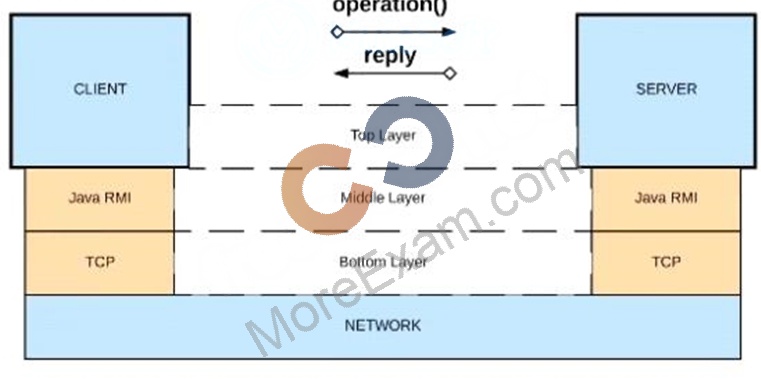
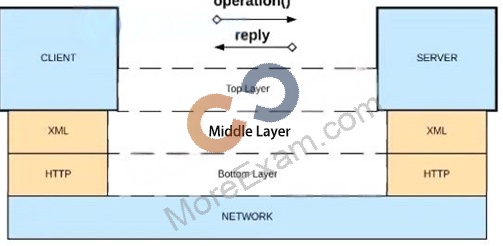
Question17: Refer to the exhibit.What is a valid API in the sense of API-led connectivity and application networks?A) Java RMI over TCPB) Java RMI over TCPC) CORBA over HOPD) XML over UDP
Question18: The implementation of a Process API must change.What is a valid approach that minimizes the impact of this change on API clients?
Question19: An organization is deploying their new implementation of the OrderStatus System API to multiple workers in CloudHub. This API fronts the organization's on-premises Order Management System, which is accessed by the API implementation over an IPsec tunnel.What type of error typically does NOT result in a service outage of the OrderStatus System API?
Question20: An organization wants MuleSoft-hosted runtime plane features (such as HTTP load balancing, zero downtime, and horizontal and vertical scaling) in its Azure environment. What runtime plane minimizes the organization's effort to achieve these features?
Question21: When designing an upstream API and its implementation, the development team has been advised to NOT set timeouts when invoking a downstream API, because that downstream API has no SLA that can be relied upon. This is the only downstream API dependency of that upstream API.Assume the downstream API runs uninterrupted without crashing. What is the impact of this advice?
Question22: An API experiences a high rate of client requests (TPS) vwth small message paytoads. How can usage limits be imposed on the API based on the type of client application?
Question23: Which layer in the API-led connectivity focuses on unlocking key systems, legacy systems, data sources etc and exposes the functionality?
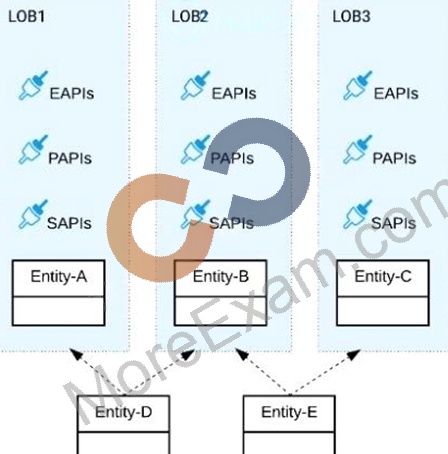
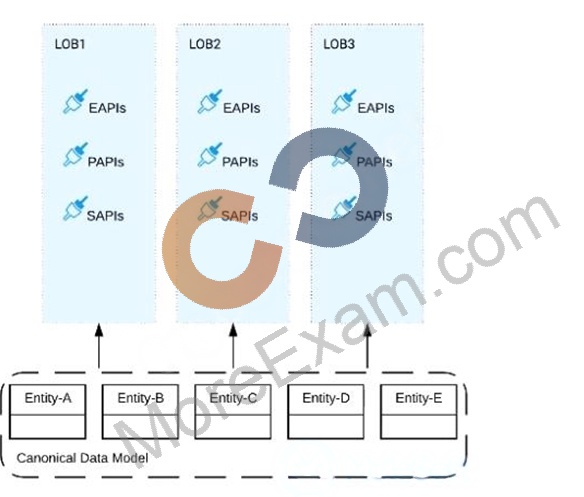
Question24: Refer to the exhibit.Three business processes need to be implemented, and the implementations need to communicate with several different SaaS applications.These processes are owned by separate (siloed) LOBs and are mainly independent of each other, but do share a few business entities. Each LOB has one development team and their own budget In this organizational context, what is the most effective approach to choose the API data models for the APIs that will implement these business processes with minimal redundancy of the data models?A) Build several Bounded Context Data Models that align with coherent parts of the business processes and the definitions of associated business entitiesB) Build distinct data models for each API to follow established micro-services and Agile API-centric practicesC) Build all API data models using XML schema to drive consistency and reuse across the organizationD) Build one centralized Canonical Data Model (Enterprise Data Model) that unifies all the data types from all three business processes, ensuring the data model is consistent and non-redundant
Question25: What are the major benefits of MuleSoft proposed IT Operating Model?
Question26: A set of tests must be performed prior to deploying API implementations to a staging environment. Due to data security and access restrictions, untested APIs cannot be granted access to the backend systems, so instead mocked data must be used for these tests. The amount of available mocked data and its contents is sufficient to entirely test the API implementations with no active connections to the backend systems. What type of tests should be used to incorporate this mocked data?
Question27: What API policy would be LEAST LIKELY used when designing an Experience API that is intended to work with a consumer mobile phone or tablet application?
Question28: How are an API implementation, API client, and API consumer combined to invoke and process an API?
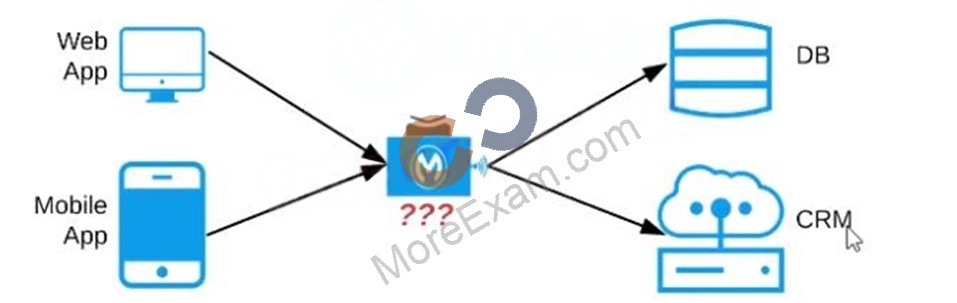
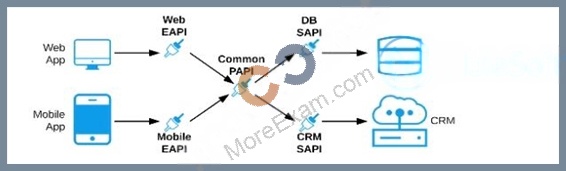
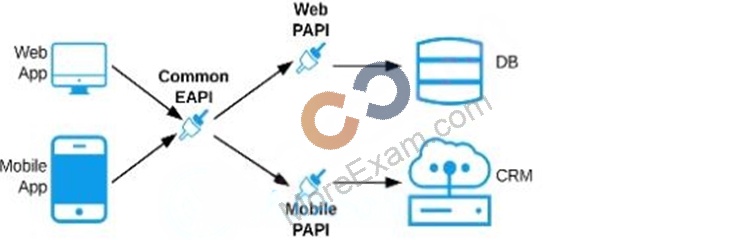
Question29: Refer to the exhibit. An organization needs to enable access to their customer data from both a mobile app and a web application, which each need access to common fields as well as certain unique fields.The data is available partially in a database and partially in a 3rd-party CRM system.What APIs should be created to best fit these design requirements?A) A Process API that contains the data required by both the web and mobile apps, allowing these applications to invoke it directly and access the data they need thereby providing the flexibility to add more fields in the future without needing API changesB) One set of APIs (Experience API, Process API, and System API) for the web app, and another set for the mobile appC) Separate Experience APIs for the mobile and web app, but a common Process API that invokes separate System APIs created for the database and CRM systemD) A common Experience API used by both the web and mobile apps, but separate Process APIs for the web and mobile apps that interact with the database and the CRM System
Question30: Say, there is a legacy CRM system called CRM-Z which is offering below functions:1. Customer creation2. Amend details of an existing customer3. Retrieve details of a customer4. Suspend a customer
Question31: When could the API data model of a System API reasonably mimic the data model exposed by the corresponding backend system, with minimal improvements over the backend system's data model?
Question32: A Mule application exposes an HTTPS endpoint and is deployed to the CloudHub Shared Worker Cloud. All traffic to that Mule application must stay inside the AWS VPC.To what TCP port do API invocations to that Mule application need to be sent?
Question33: What Anypoint Platform Capabilities listed below fall under APIs and API Invocations/Consumers category? Select TWO.