EMT Practice Test

1. Question Content...


Question List

Question1: A TemperatureSensors API instance is defined in API Manager in the PROD environment of the CAR_FACTORY business group. An AcmelemperatureSensors Mule application implements this API instance and is deployed from Runtime Manager to the PROD environment of the CAR_FACTORY business group. A policy that requires a valid client ID and client secret is applied in API Manager to the API instance.
Where can an API consumer obtain a valid client ID and client secret to call the AcmeTemperatureSensors Mule application?

Question2: What is a typical result of using a fine-grained rather than a coarse-grained API deployment model to implement a given business process?

Question3: A company deployed an API to a single worker/replica in the shared cloud in the U.S. West Region.
What happens when the Availability Zone experiences an outage?

Question4: An API with multiple API implementations (Mule applications) is deployed to both CloudHub and customer- hosted Mule runtimes. All the deployments are managed by the MuleSoft-hosted control plane. An alert needs to be triggered whenever an API implementation stops responding to API requests, even if no API clients have called the API implementation for some time.
What is the most effective out-of-the-box solution to create these alerts to monitor the API implementations?

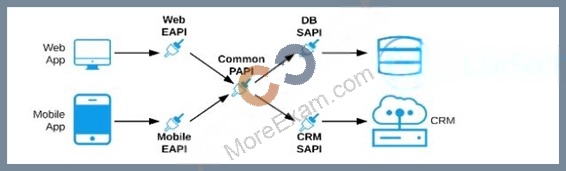
Question5: An established communications company is beginning its API-led connectivity journey, The company has been using a successful Enterprise Data Model for many years. The company has identified a self-service account management app as the first effort for API-led, and it has identified the following APIs.
Experience layer: Mobile Account Management EAPI, Browser Account Management EAPI Process layer: Customer Lookup PAPI, Service Lookup PAPI, Account Lookup PAPI System layer: Customer SAPI, Account SAPI, Product SAPI, Service SAPI According to MuleSoft's API-led connectivity approach, which API would not be served by the Enterprise Data Model?

Question6: When can CloudHub Object Store v2 be used?

Question7: What is true about the technology architecture of Anypoint VPCs?

Question8: Which component monitors APIs and endpoints at scheduled intervals, receives reports about whether tests pass or fail, and displays statistics about API and endpoint performance?

Question9: An Order API must be designed that contains significant amounts of integration logic and involves the invocation of the Product API.
The power relationship between Order API and Product API is one of "Customer/Supplier", because the Product API is used heavily throughout the organization and is developed by a dedicated development team located in the office of the CTO.
What strategy should be used to deal with the API data model of the Product API within the Order API?

Question10: An organization is implementing a Quote of the Day API that caches today's quote.
What scenario can use the GoudHub Object Store via the Object Store connector to persist the cache's state?

Question11: Refer to the exhibit.
Three business processes need to be implemented, and the implementations need to communicate with several different SaaS applications.
These processes are owned by separate (siloed) LOBs and are mainly independent of each other, but do share a few business entities. Each LOB has one development team and their own budget In this organizational context, what is the most effective approach to choose the API data models for the APIs that will implement these business processes with minimal redundancy of the data models?
A) Build several Bounded Context Data Models that align with coherent parts of the business processes and the definitions of associated business entities

B) Build distinct data models for each API to follow established micro-services and Agile API-centric practices C) Build all API data models using XML schema to drive consistency and reuse across the organization D) Build one centralized Canonical Data Model (Enterprise Data Model) that unifies all the data types from all three business processes, ensuring the data model is consistent and non-redundant

Question12: An API experiences a high rate of client requests (TPS) vwth small message paytoads. How can usage limits be imposed on the API based on the type of client application?

Question13: A circuit breaker strategy is planned in order to meet the goal of improved response time and demand on a downstream API.
* Circuit Open: More than 10 errors per minute for three minutes
* Circuit Half-Open: One error per minute
* Circuit Closed: Less than one error per minute for five minutes
Out of several proposals from the engineering team, which option will meet this goal?

Question14: Refer to the exhibit.
What is a valid API in the sense of API-led connectivity and application networks?
A) Java RMI over TCP
B) Java RMI over TCP

C) CORBA over HOP
D) XML over UDP

Question15: Mule applications that implement a number of REST APIs are deployed to their own subnet that is inaccessible from outside the organization.
External business-partners need to access these APIs, which are only allowed to be invoked from a separate subnet dedicated to partners - called Partner-subnet. This subnet is accessible from the public internet, which allows these external partners to reach it.
Anypoint Platform and Mule runtimes are already deployed in Partner-subnet. These Mule runtimes can already access the APIs.
What is the most resource-efficient solution to comply with these requirements, while having the least impact on other applications that are currently using the APIs?

Question16: An organization makes a strategic decision to move towards an IT operating model that emphasizes consumption of reusable IT assets using modern APIs (as defined by MuleSoft).
What best describes each modern API in relation to this new IT operating model?

Question17: A business process is being implemented within an organization's application network. The architecture group proposes using a more coarse-grained application network design with relatively fewer APIs deployed to the application network compared to a more fine- grained design.
Overall, which factor typically increases with a more coarse-grained design for this business process implementation and deployment compared with using a more fine-grained design?

Question18: A company stores financial transaction data in two legacy systems. For each legacy system, a separate, dedicated System API (SAPI) exposes data for that legacy system. A Process API (PAPI) merges the data retrieved from ail of the System APIs into a common format. Several API clients call the PAPI through its public domain name.
The company now wants to expose a subset of financial data to a newly developed mobile application that uses a different Bounded Context Data Model. The company wants to follow MuleSoft's best practices for building out an effective application network.
Following MuleSoft's best practices, how can the company expose financial data needed by the mobile application in a way that minimizes the impact on the currently running API clients, API implementations, and support asset reuse?

Question19: What best explains the use of auto-discovery in API implementations?

Question20: What is a key performance indicator (KPI) that measures the success of a typical C4E that is immediately apparent in responses from the Anypoint Platform APIs?

Question21: How can the application of a rate limiting API policy be accurately reflected in the RAML definition of an API?

Question22: A Platinum customer uses the U.S. control plane and deploys applications to CloudHub in Singapore with a default log configuration.
The compliance officer asks where the logs and monitoring data reside?

Question23: A Rate Limiting policy is applied to an API implementation to protect the back-end system. Recently, there have been surges in demand that cause some API client POST requests to the API implementation to be rejected with policy-related errors, causing delays and complications to the API clients.
How should the API policies that are applied to the API implementation be changed to reduce the frequency of errors returned to API clients, while still protecting the back-end system?

Question24: Several times a week, an API implementation shows several thousand requests per minute in an Anypoint Monitoring dashboard, Between these bursts, the dashboard shows between two and five requests per minute. The API implementation is running on Anypoint Runtime Fabric with two non-clustered replicas, reserved vCPU 1.0 and vCPU Limit 2.0.
An API consumer has complained about slow response time, and the dashboard shows the 99 percentile is greater than 120 seconds at the time of the complaint. It also shows greater than 90% CPU usage during these time periods.
In manual tests in the QA environment, the API consumer has consistently reproduced the slow response time and high CPU usage, and there were no other API requests at this time. In a brainstorming session, the engineering team has created several proposals to reduce the response time for requests.
Which proposal should be pursued first?

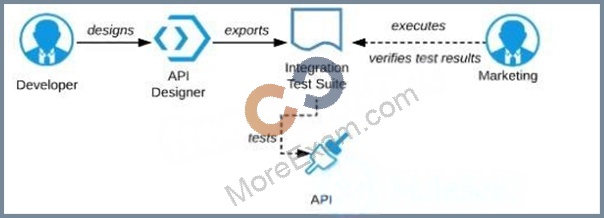
Question25: Refer to the exhibit.

A RAML definition has been proposed for a new Promotions Process API, and has been published to Anypoint Exchange.
The Marketing Department, who will be an important consumer of the Promotions API, has important requirements and expectations that must be met.
What is the most effective way to use Anypoint Platform features to involve the Marketing Department in this early API design phase?
A) Ask the Marketing Department to interact with a mocking implementation of the API using the automatically generated API Console

B) Organize a design workshop with the DBAs of the Marketing Department in which the database schema of the Marketing IT systems is translated into RAML C) Use Anypoint Studio to Implement the API as a Mule application, then deploy that API implementation to CloudHub and ask the Marketing Department to interact with it D) Export an integration test suite from API designer and have the Marketing Department execute the tests In that suite to ensure they pass

Question26: A Mule 4 API has been deployed to CloudHub and a Basic Authentication - Simple policy has been applied to all API methods and resources. However, the API is still accessible by clients without using authentication.
How is this possible?

Question27: An organization is deploying their new implementation of the OrderStatus System API to multiple workers in CloudHub. This API fronts the organization's on-premises Order Management System, which is accessed by the API implementation over an IPsec tunnel.
What type of error typically does NOT result in a service outage of the OrderStatus System API?

Question28: Which of the below, when used together, makes the IT Operational Model effective?

Question29: When must an API implementation be deployed to an Anypoint VPC?

Question30: Which scenario is suited for MUnit tests instead of integration tests?

Question31: What is typically NOT a function of the APIs created within the framework called API-led connectivity?

Question32: What do the API invocation metrics provided by Anypoint Platform provide?
Question33: An API implementation is being designed that must invoke an Order API, which is known to repeatedly experience downtime.
For this reason, a fallback API is to be called when the Order API is unavailable.
What approach to designing the invocation of the fallback API provides the best resilience?

Question34: In an organization, the InfoSec team is investigating Anypoint Platform related data traffic.
From where does most of the data available to Anypoint Platform for monitoring and alerting originate?

Question35: What is true about API implementations when dealing with legal regulations that require all data processing to be performed within a certain jurisdiction (such as in the USA or the EU)?

Question36: An API is protected with a Client ID Enforcement policy and uses the default configuration. Access is requested for the client application to the API, and an approved contract now exists between the client application and the API How can a consumer of this API avoid a 401 error "Unauthorized or invalid client application credentials"?

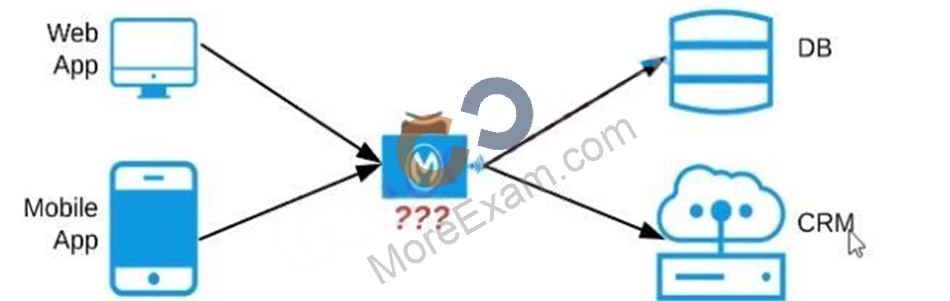
Question37: Refer to the exhibit. An organization needs to enable access to their customer data from both a mobile app and a web application, which each need access to common fields as well as certain unique fields.
The data is available partially in a database and partially in a 3rd-party CRM system.
What APIs should be created to best fit these design requirements?

A) A Process API that contains the data required by both the web and mobile apps, allowing these applications to invoke it directly and access the data they need thereby providing the flexibility to add more fields in the future without needing API changes B) One set of APIs (Experience API, Process API, and System API) for the web app, and another set for the mobile app C) Separate Experience APIs for the mobile and web app, but a common Process API that invokes separate System APIs created for the database and CRM system

D) A common Experience API used by both the web and mobile apps, but separate Process APIs for the web and mobile apps that interact with the database and the CRM System

Question38: Due to a limitation in the backend system, a system API can only handle up to 500 requests per second. What is the best type of API policy to apply to the system API to avoid overloading the backend system?

Question39: What is most likely NOT a characteristic of an integration test for a REST API implementation?

Question40: A company is building an application network using MuleSoft's recommendations for various API layers.
What is the main (default) role of a process API in an application network?

Question41: When could the API data model of a System API reasonably mimic the data model exposed by the corresponding backend system, with minimal improvements over the backend system's data model?

Question42: Refer to the exhibit.

what is true when using customer-hosted Mule runtimes with the MuleSoft-hosted Anypoint Platform control plane (hybrid deployment)?

Question43: When should idempotency be taken into account?

Question44: 4A developer for a transportation organization is implementing exactly one processing functionality in a Reservation Mule application to process and store passenger records. This Reservation application will be deployed to multiple CloudHub workers/replicas. It is possible that several external systems could send duplicate passenger records to the Reservation application.
An appropriate storage mechanism must be selected to help the Reservation application process each passenger record exactly once as much as possible. The selected storage mechanism must be shared by all the CloudHub workers/replicas in order to synchronize the state information to assist attempting exactly once processing of each passenger record by the deployed Reservation Mule application.
Which type of simple storage mechanism in Anypoint Platform allows the Reservation Mule application to update and share data between the CloudHub workers/replicas exactly once, with minimal development effort?

Question45: A code-centric API documentation environment should allow API consumers to investigate and execute API client source code that demonstrates invoking one or more APIs as part of representative scenarios.
What is the most effective way to provide this type of code-centric API documentation environment using Anypoint Platform?

Question46: A company is using an on-prem cluster in the data center as a runtime plane and MuleSoft-hosted control plane.
How can the company monitor the detailed performance metrics on the Mule applications deployed to the cluster from the control plane?

Question47: What should be ensured before sharing an API through a public Anypoint Exchange portal?

Question48: An enterprise is embarking on the API-led digital transformation journey, and the central IT team has started to define System APIs. Currently there is no Enterprise Data Model being defined within the enterprise, and the definition of a clean Bounded Context Data Model requires too much effort.
According to MuleSoft's recommended guidelines, how should the System API data model be defined?

Question49: Which out-of-the-box key performance indicator measures the success of a typical Center for Enablement and is immediately available in responses from Anypoint Platform APIs?

Question50: What CANNOT be effectively enforced using an API policy in Anypoint Platform?

Question51: The application network is recomposable: it is built for change because it "bends but does not break"

Question52: An API implementation is updated. When must the RAML definition of the API also be updated?

Question53: An application updates an inventory running only one process at any given time to keep the inventory consistent. This process takes 200 milliseconds (.2 seconds) to execute; therefore, the scalability threshold of the application is five requests per second.
What is the impact on the application if horizontal scaling is applied, thereby increasing the number of Mule workers?

Question54: An eCommerce company is adding a new Product Details feature to their website, A customer will launch the product catalog page, a new Product Details link will appear by product where they can click to retrieve the product detail description. Product detail data is updated with product update releases, once or twice a year, Presently the database response time has been very slow due to high volume.
What action retrieves the product details with the lowest response time, fault tolerant, and consistent data?

Question55: 4 Production environment is running on a dedicated Virtual Private Cloud (VPC) on CloudHub 1,0, and the security team guidelines clearly state no traffic on HTTP.
Which two options support these security guidelines?
Choose 2 answers

Question56: A developer from the Central IT team has created an initial version of the RAML definition in Design Center for an OAuth 2.0-protected System API and published it to Exchange. Another developer from LoB IT discovered the System API in Exchange and would like to leverage it in the Process API.
What is the MuleSoft-recommended approach for Process API to invoke the System API?

Question57: A new upstream API Is being designed to offer an SLA of 500 ms median and 800 ms maximum (99th percentile) response time. The corresponding API implementation needs to sequentially invoke 3 downstream APIs of very similar complexity.
The first of these downstream APIs offers the following SLA for its response time: median: 100 ms, 80th percentile: 500 ms, 95th percentile: 1000 ms.
If possible, how can a timeout be set in the upstream API for the invocation of the first downstream API to meet the new upstream API's desired SLA?

Question58: A System API is designed to retrieve data from a backend system that has scalability challenges. What API policy can best safeguard the backend system?

Question59: An API implementation is deployed to CloudHub.
What conditions can be alerted on using the default Anypoint Platform functionality, where the alert conditions depend on the API invocations to an API implementation?

Question60: What is the most performant out-of-the-box solution in Anypoint Platform to track transaction state in an asynchronously executing long-running process implemented as a Mule application deployed to multiple CloudHub workers?

Question61: A European company has customers all across Europe, and the IT department is migrating from an older platform to MuleSoft. The main requirements are that the new platform should allow redeployments with zero downtime and deployment of applications to multiple runtime versions, provide security and speed, and utilize Anypoint MQ as the message service.
Which runtime plane should the company select based on the requirements without additional network configuration?

Question62: What Mule application can have API policies applied by
Anypoint Platform to the endpoint exposed by that Mule application?
A) A Mule application that accepts requests over HTTP/1.x

B) A Mule application that accepts JSON requests over TCP but is NOT required to provide a response C) A Mute application that accepts JSON requests over WebSocket D) A Mule application that accepts gRPC requests over HTTP/2

Question63: A customer wants to monitor and gain insights about the number of requests coming in a given time period as well as to measure key performance indicators (response times, CPU utilization, number of active APIs).
Which tool provides these data insights?

Question64: What best describes the Fully Qualified Domain Names (FQDNs), also known as DNS entries, created when a Mule application is deployed to the CloudHub Shared Worker Cloud?

Question65: The asset version 2.0.0 of the Order API is successfully published in Exchange and configured in API Manager with the Autodiscovery API ID correctly linked to the API implementation, A new GET method is added to the existing API specification, and after updates, the asset version of the Order API is 2.0.1, What happens to the Autodiscovery API ID when the new asset version is updated in API Manager?

Question66: A manufacturing company has deployed an API implementation to CloudHub and has not configured it to be automatically restarted by CloudHub when the worker is not responding.
Which statement is true when no API Client invokes that API implementation?

Question67: To minimize operation costs, a customer wants to use a CloudHub 1.0 solution. The customer's requirements are:
* Separate resources with two Business groups
* High-availability (HA) for all APIs
* Route traffic via Dedicated load balancer (DLBs)
* Separate environments into production and non-production
Which solution meets the customer's needs?

Question68: A set of tests must be performed prior to deploying API implementations to a staging environment. Due to data security and access restrictions, untested APIs cannot be granted access to the backend systems, so instead mocked data must be used for these tests. The amount of available mocked data and its contents is sufficient to entirely test the API implementations with no active connections to the backend systems. What type of tests should be used to incorporate this mocked data?

Question69: An IT Security Compliance Auditor is assessing which nonfunctional requirements (NFRs) are already being implemented to meet security measures.
* The Web API has Rate-Limiting SLA
* Basic Authentication - LDAP
* JSON Threat Protection
* TP Allowlist policies applied
Which two NFRs-are enforced?