MoreExam
1. Question Content...
EXPLANATION
Answer: X - EXPLANATION Content.
Question1: You are designing a cloud storage solution for a customer in Microsoft Azure with strict security requirements. They want to use Azure NetApp Files and they require "krb5p" for all NFS traffic. The workload is highly concurrent and mostly sequential.In this scenario, how will throughput be affected?
Question2: One volume on your NetApp Cloud Volumes ONTAP Hlgh-Availablllty (HA) cluster has reached a capacity limit.Which two actions would address this issue? (Choose two.)
Question3: You are designing an automation solution that you will use across both on-premises and cloud-based NetApp ONTAP systems. You want a single automation solution for both locations to reduce the administrative overhead.In this scenario, which two automation tools would you use? (Choose two.)
Question4: You are migrating your on-premises Microsoft SQL Server to Microsoft Azure VMs and Azure NetApp Files. You want to avoid connectivity interruptions during scheduled maintenance operations.Which Azure NetApp Files feature satisfies this requirement?
Question5: You want to protect your data against ransomware attacks In Cloud Volumes ONTAP In this scenario, which two policies should be enabled? (Choose two.)
Question6: You are designing a new hybrid cloud solution. The nonfunctional requirements state that you must be able to integrate identity management for SSO authentication.In this scenario, what are two supported identity management providers? (Choose two.)
Question7: A customer wants to migrate workloads to Cloud Volumes ONTAP.In this scenario, which two test cases would you design in your proof of concept to demonstrate the solution? (Choose two.)
Question8: A customer has an on-premises data center with NetApp ONTAP storage. They have a Snapshot policy set up for their volumes to create periodic Snapshot copies so that they can recover from those in case they lose their dat a. However, their IT architect wants to implement a solution that will enable them to restore volumes or individual files to their storage on-premises or in the cloud.In this scenario, which NetApp cloud service should be used to satisfy the requirement?
Question9: You are designing a new deployment of Cloud Volumes ONTAP in Azure using a highly available configuration.In this scenario, which two statements are true? (Choose two.)
Question10: You are designing a multicloud architecture using Microsoft Azure and Amazon Web Services (AWS) The objective is to deploy NetApp Cloud Volumes ONTAP in both clouds and use SnapMlrror for replication. You already deployed NetApp Cloud Manager and an associated Connector in Microsoft Azure. To connect your Cloud Manager to AWS, you are instructed to establish a site-to-site VPN between Microsoft Azure and AWS.In this scenario, which two components are required to provision the AWS endpoint for the VPN connection? (Choose two.)
Question11: You need to set up a data resilient configuration for Cloud Volumes ONTAP In AWS. In this scenario, which action will accomplish this task?
Question12: Your manager asks you to include steps In your NetApp Hybrid cloud deployment to reduce the risk of a developer accidentally interfering with your mission-critical applications that are in production.In this scenario, which step would you perform?
Question13: You are designing for StorageGRID deployment.In this scenario, what are two rules for the nodes? (Choose two.)
Question14: You are designing a disaster-recovery solution for a customer who is running a critical workload on Azure NetApp Files. You suggest cross-region replication In this scenario, which two statements are true? (Choose two.)
Question15: You are using Windows Virtual Desktops and storing user profiles on Azure NetApp Files by using the Premium storage service level. There will be 1000 contractors coming onboard for a short duration to assist with project work, and each one of them requires virtual desktop access.In this scenario, which three actions address the short term performance demand without affecting the latency of existing users? (Choose three.)
Question16: Your customer needs assistance developing a cloud storage solution that allows access from both NFSv3 and SMBv3 clients. You recommend Azure NetApp Files.In this scenario, which two satisfy the requirements? (Choose two.)
Question17: You must consolidate your branch office Microsoft Windows file servers Into the cloud with the objective to centralize ail Microsoft Windows file shares (SMB) into your Active Directory domain.After analyzing your unstructured data set, you find that 10% of the data Is active and 90% of your data is archive dat a. You deploy NetApp Cloud Volumes ONTAP in Microsoft Azure and enable data tiering to tier off data to object storage, leaving all the defaults for the capacity tier.In this scenario, by default, which storage class is used for your archive data?
Question18: Your customer wants to move from hosting all workloads in a public cloud to infrastructure-as-a- service (IaaS) on-premises.In this scenario, which two benefits would you present to the customer? (Choose two.)
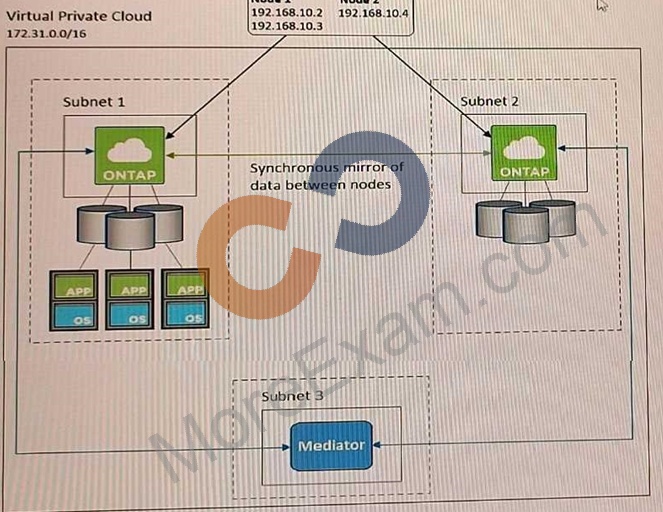
Question19: Exhibit.Which deployment model for NetApp Cloud Volumes ONTAP in AWS would use the networking topology as shown in the exhibit?
Question20: An IT organization transformed from an asset-based management approach into a service-provider approach by implementing adaptive QoS and multiple points of automation. Now, performance and cost of the system are predictable.Which two metrics would the organization start to report after such a transition? (Choose two.)
Question21: You are sizing a new Azure NetApp Flies deployment and are documenting the throughput limit calculations within the design.In this scenario, which two factors are used to accomplish this task? (Choose two.)
Question22: You want to deploy NetApp Cloud Volumes ONTAP In AWS using NetApp Cloud Manager.In this scenario, which two network protocols need to be specified in the security group rules to initiate a connection with your AWS tenant? (Choose two.)
Question23: You are designing for StorageGRID deployment.In this scenario, what are two rules for the nodes? (Choose two.)
Question24: Your organization requires you to consolidate your branch office Microsoft Windows file servers into the cloud with the objective to centralize all Microsoft Windows file shares (SMB) into your Active Directory domain. Your organization requires you to extend file shares from your Azure NetApp Files central data sources to your branch office workforce with support for file locking.In this scenario, which NetApp cloud service provides the desired outcome?
Question25: Your organization is implementing an automation-first policy, requiring all code to be checked into a version-controlled repository. You are planning to deploy NetApp Cloud Volumes ONTAP for storage services in AWS.In this scenario, how do you ensure that the NetApp solution satisfies your organization's requirements?
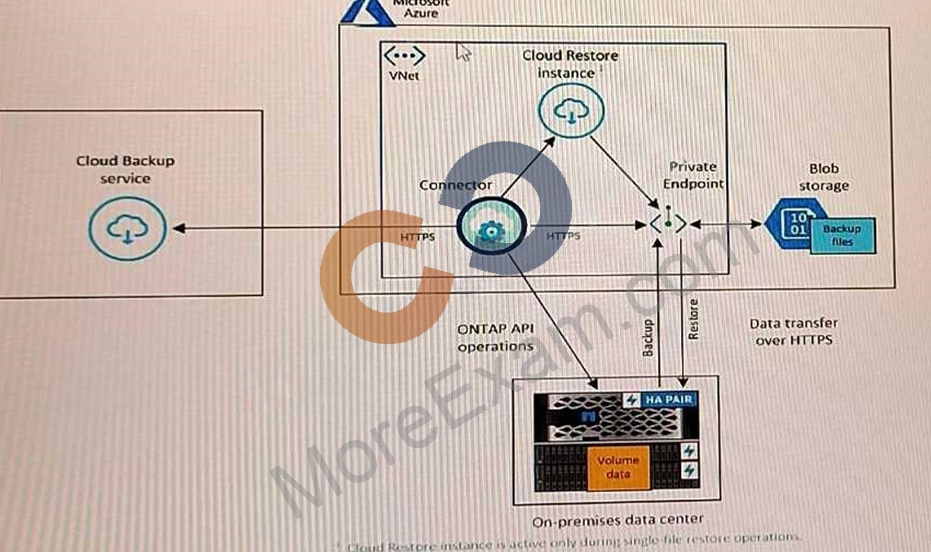
Question26: Exhibit.You are designing a NetApp Cloud Backup solution for your on-premises ONTAP clusters to Azure Blob storage.Referring to the exhibit, which two statements are true? (Choose two.)
Question27: You are asked to deploy NetApp Cloud Volumes ONTAP In a Google Cloud environment. You set up a NetApp Cloud Central account. You want the storage administrator to be able to log in to the NetApp Cloud Central account and deploy a connector from the SaaS Cloud Manager before deploying NetApp Cloud Volumes ONTAP.In this scenario, what are two requirements to accomplish this task? (Choose two.)
Question28: You are asked to develop a migration strategy for your customer that is migrating several SMB and NFS workloads from on-premises to Azure NetApp Files.In this scenario, which three technologies should you consider? (Choose three.)
Question29: You deployed a custom application on AWS that uses MongoDB as the backend. The database files of MongoDB reside on an iSCSI volume hosted on NetApp Cloud Volumes ONTAP in high availability mode.In this scenario, what is required to provide fault tolerance for applications when one of the storage nodes fails?