MoreExam
1. Question Content...
EXPLANATION
Answer: X - EXPLANATION Content.
Question1: Select the word that best completes the sentence:
Question2: Select the term which best describes the quality management system process of modifying a non-conforming product to bring it within acceptance criteria.
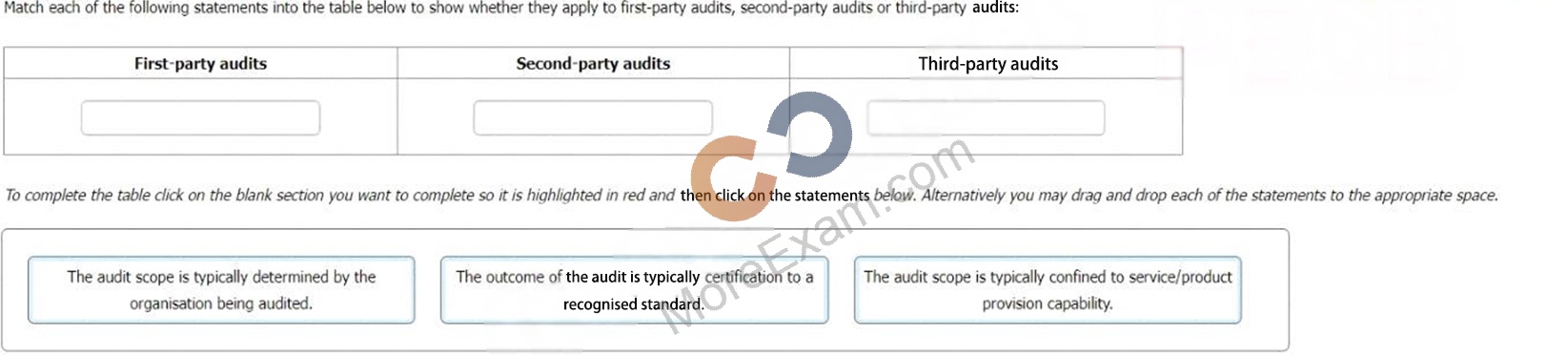
Question3: Match each of the following statements into the table below to show whether they apply to first-party audits, second-party audits or third-party audits:
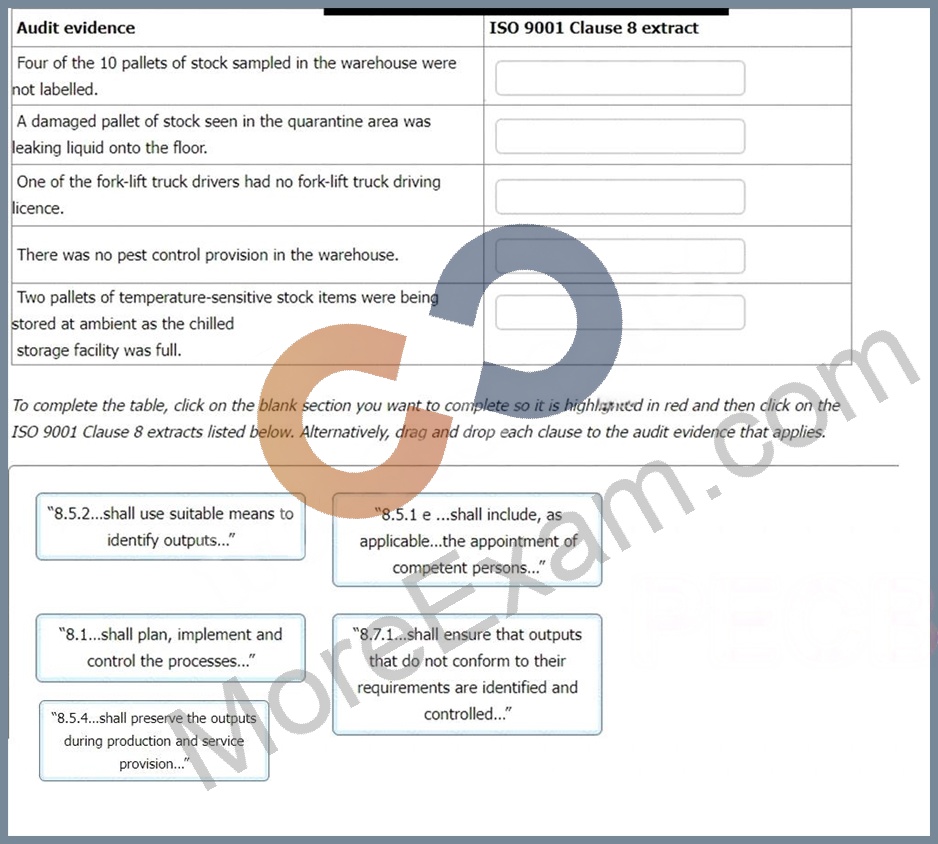
Question4: You are carrying out an audit at a single-site organisation seeking certification to ISO 9001 for the first time.The organisation offers warehousing and export services to customers. Customers are invoiced for the time stock items are stored in the warehouse. Transport to and from the warehouse is controlled by the organisation and approved subcontract transport services are used. The organization does not have its own transport vehicles. Stock items are not purchased by the organisation.You have gathered audit evidence as outlined in the table. Match the ISO 9001 Clause 8 extract to the audit evidence.
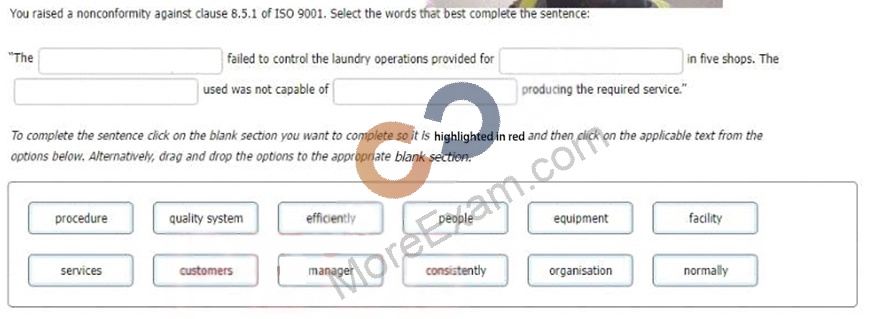
Question5: Whistlekleen is a national dry cleaning and laundry company with 50 shops. You are conducting a surveillance audit of the Head Office and are sampling customer complaints. You find that 80% of complaints originate from five shops in the same region. Most of these complaints relate to damage to customer laundry. The Quality Manager tells you that these are the oldest shops in the company. The cleaning equipment needs replacing but the company cannot afford it at the moment. You learn that the shop managers were told to dismiss most of the claims on the basis of the poor quality of the laundered materials.On raising the matter with senior management, you are told that there are plans to replace the equipment in these shops over the next five years.
Question6: An audit team leader arrives at a printing organisation to carry out a Stage 2 audit for a certification body. At a meeting with the Quality Manager, she is told that they have won their biggest contract from a computer manufacturer to print and compile computer documentation packages. They have leased the unit next door for space reasons but have never worked in this sector before. The Quality Manager wants the ISO 9001 certificate to cover the new contract.During the audit, a team member finds that a number of print jobs have been rejected by several clients over a number of months due to spelling errors in the print run. The Print Manager blames the new employees they had to take on because of a big contract. The auditor raises a nonconformance against clause 10.2.1.b of ISO9001.Which one of the evidence statements would support this finding?
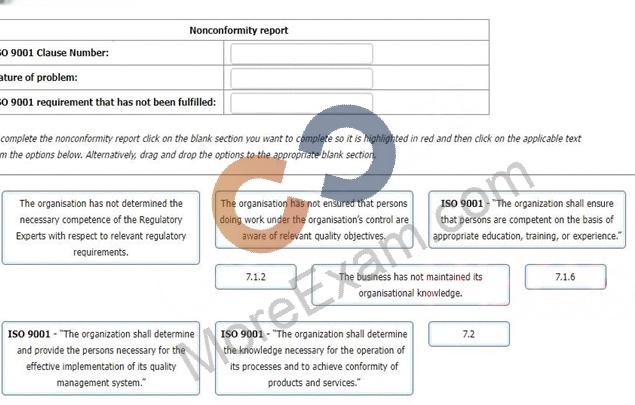
Question7: You are carrying out an audit to ISO 9001 at an organisation which offers regulatory consultancy services to manufacturers of cosmetics.You are interviewing the Technical Director (TD), who manages a team of regulatory experts responsible for providing regulatory services to customers.You: "How do you ensure your regulatory team's competence concerning regulatory requirements is maintained?" TD: "The two Regulatory Experts we employ full-time have years of experience of working in the cosmetics industry." You: "How is their regulatory competence maintained?" TD: "They are dedicated individuals with lots of contacts in the sector." You: "How does the business enable them to maintain their understanding of current regulatory requirements?" TD: "We leave that up to them."
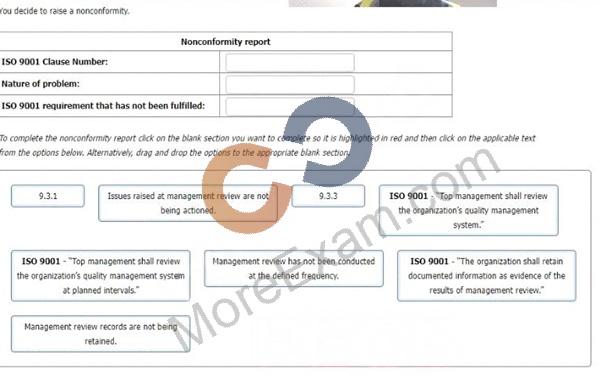
Question8: You are carrying out an annual audit at an organisation that offers home security services. You are interviewing the Quality Manager (QM) You: "Would you tell me about your management review process?" QM: "The senior management team plans to review the management system every six months. The review follows a set agenda and records are maintained." You: "May I see the records from the last two management reviews?" Narrative: The Quality Manager gives you the latest record, which shows the last management review took place nine months ago.The Quality Manager then gives you the previous management review record, which took place one year before the latest review.You: "Are there any other review reports in the last two years?QM: "No, these are the only ones."
Question9: You work for an organisation, 'A', which provides packaged food to the public. You are asked to lead a team (you as the leader and two other auditors) to audit a supplier, 'B', which provides packaging materials to your organisation. It is 4 p.m. and the audit is close to an end; you are having an internal meeting with the team to decide what will be presented to the auditee during the Closing meeting.The Closing meeting was scheduledfor 5 p.m.You, as audit team leader, audited top management, the laboratory, and the storage of raw materials.Auditor 1 audited the two manufacturing lines and dispatch areas.You to Auditor 1: "What findings would you report?"Auditor 1: "When reviewing the Dispatch records, I noticed that during the morning two different trucks (Number 011 and 025) delivered the same batch number of the product (Batch 33555). Truck 011 left the plant at 9.15 am and Truck 025 left the plant at11.30 am. Procedure P-02 Rev.3 saysthat trucks should carry a complete batch. The batch number, once on the truck, is captured using a QR device." You: "OK, what do you think?" Auditor 2: "I think that this is a nonconformity." You: "OK. How would you describe the evidence on which the nonconformity will be based"?Identify which one of the following statements best describes the identified nonconformity.
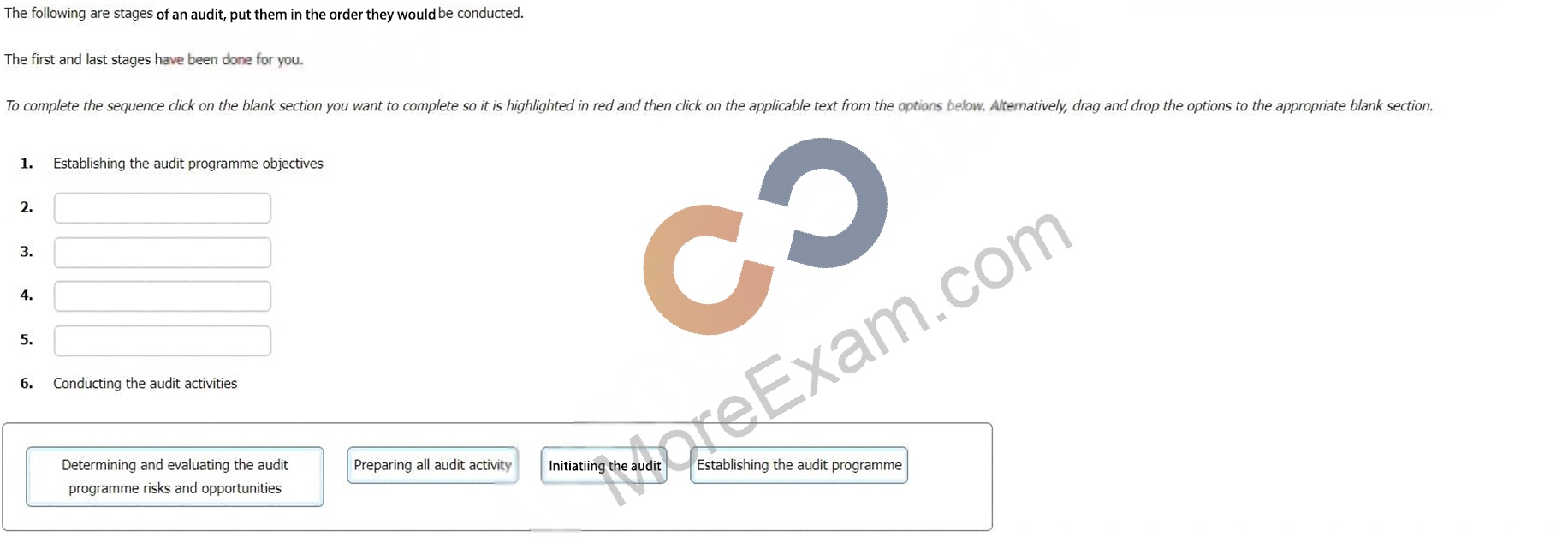
Question10: The following are stages of an audit, put them in the order they would be conducted.
Question11: You work as an external quality consultant for an organisation, 'A', which provides packaged food to the public. You are asked to lead a team (you as the leader and two other auditors) to audit a supplier, 'B', to ISO9001 which provides packaging materials to your organisation. It is 4 pm and the audit is close to an end; you are having an internal meeting with the team to decide what will be presented to the auditee during the Closing meeting. The Closing meeting was scheduled at 5 pm.You, as Audit Team Leader, audited top management. You explain to the audit team that you identified two nonconformities:a. There is no documented information on Top Management Reviews, as required in clause 9.3 of ISO9001:2015.b. There is no evidence of Top Management Commitment as required in clause 5.1 of ISO 9001:2015. (e.g., not ensuring the availability of resources to operate the QMS, not ensuring the establishment of objectives, no promotion of improvement, no promotion of the process approach).All agreed to present these two nonconformities. They went to meet the Top Management of 'B' and noticed that the General Manager and three other managers (Production, Human Resources, and Sales) were present in the meeting room.Considering the seriousness of the two nonconformities to Top Management, as audit team leader, from the following select the best option:
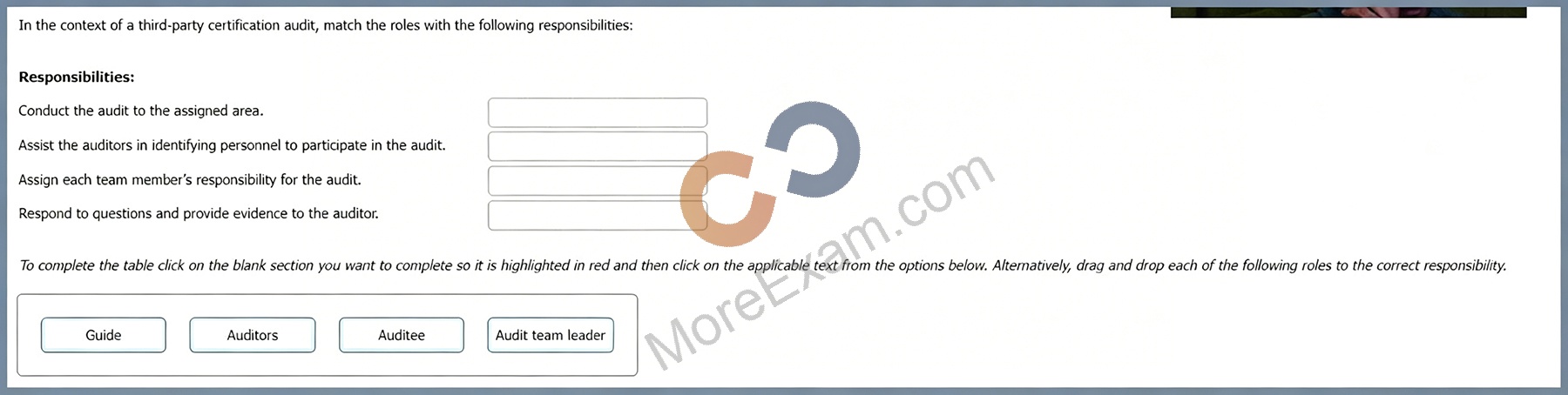
Question12: In the context of a third-party certification audit, match the roles with the following responsibilities:
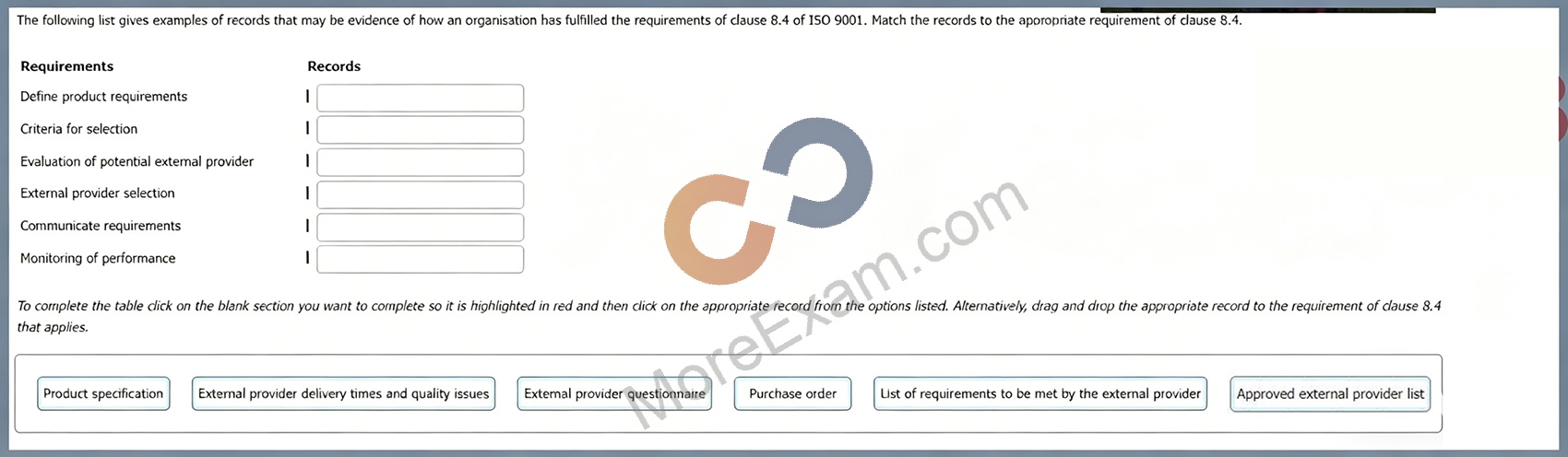
Question13: The following list gives examples of records that may be evidence of how an organisation has fulfilled the requirements of clause 8.4 of ISO 9001. Match the records to the appropriate requirement of clause 8.4.
Question14: You will lead a third-party audit next Monday on ABC, an organisation that provides services for cleaning windows from the outside of tall buildings. They work on demand, and usually have 4-5 orders per week. All documented information on these activities is kept at the central office.On Friday evening, before the audit, you are informed by mail that customers cancelled all orders for the next week; therefore, the auditors will not have the chance to see them working at the customer's premises, but the field supervisors will be available at the ABC offices.You have prepared the audit plan and the checklist. Choose the best action you would take:
Question15: Select the words that best complete the sentence:
Question16: Which one of the following options best describes the purpose of a Stage 1 third-party audit?
Question17: Select one option that must be considered when determining the scope of a QMS to ISO 9001.