EMT Practice Test

1. Question Content...


Question List

Question1: In respect of operational risk capital calculations, the Basel II accord recommends a confidence leveland time horizon of:

Question2: Which of the following does not affect the credit risk facing a lender institution?

Question3: A Bank Holding Company (BHC) is invested in an investment bank and a retail bank. The BHC defaults for certain if either the investment bank or the retail bank defaults. However, the BHC can also default on its own without either the investment bank or the retail bank defaulting. The investment bank and the retail bank's defaults are independent of each other, with a probability of default of 0.05 each. The BHC's probability of default is 0.11.
What is the probabilityof default of both the BHC and the investment bank? What is the probability of the BHC's default provided both the investment bank and the retail bank survive?

Question4: The CDS rate on a defaultable bond is approximated by which of the following expressions:

Question5: Which loss event type is the failure to timely deliver collateral classified as under the Basel II framework?

Question6: The VaR of a portfolio at the 99% confidence level is $250,000 when mean return is assumed to be zero. If the assumption of zero returns is changed to an assumption of returns of $10,000, what is the revised VaR?

Question7: Which of the following decisions need to be made as part of laying down a system for calculating VaR:
I. How returns are calculated, eg absoluted returns, log returns or relative/percentage returns II. Whether VaR is calculated based on historical simulation, Monte Carlo, or is computed parametrically III. Whether binary/digital options are included in the portfolio positions IV. How volatility is estimated

Question8: Which of the following credit risk models includes a consideration of macro economic variables such asunemployment, balance of payments etc to assess credit risk?

Question9: If two bonds with identical credit ratings, coupon and maturity but from different issuers trade at different spreads to treasury rates, which of the following is a possible explanation:
I. The bonds differ in liquidity
II. Events have happened that have changed investor perceptions but these are not yet reflected in the ratings III. The bonds carry different market risk IV. The bonds differ in their convexity

Question10: Which of the following belong in a credit risk report?

Question11: If A and B be two debt securities, which of the following is true?

Question12: A long position in a creditsensitive bond can be synthetically replicated using:

Question13: There are two bonds in a portfolio, each with a marketvalue of $50m. The probability of default of the two bonds over a one year horizon are 0.03 and 0.08 respectively. If the default correlation is zero, what is the one year expected loss on this portfolio?

Question14: When building a operational loss distribution by combining a loss frequency distribution and a loss severity distribution, it is assumed that:
I. The severity of losses is conditional upon the numberof loss events
II. The frequency of losses is independent from the severity of the losses III. Both the frequency and severity of loss events are dependent upon the state of internal controls in the bank

Question15: Under the contingent claims approach to measuring credit risk, which of the following factors does NOT affect credit risk:

Question16: All else remaining the same, an increase in the joint probability of default between two obligors causes the default correlation between the two to:

Question17: If the full notional value of a debt portfolio is $100m, its expected value in a year is $85m, and the worst value of the portfolio in one year's time at 99% confidence level is $60m, then what is the credit VaR?

Question18: The loss severity distribution for operational risk loss events is generally modeled by which of the following distributions:
I. the lognormal distribution
II. The gamma density function
III. Generalized hyperbolic distributions
IV. Lognormal mixtures

Question19: Which of the following credit risk models relies upon theanalysis of credit rating migrations to assess credit risk?

Question20: Which of the following is not a permitted approach under Basel II for calculating operational riskcapital

Question21: Which of the following statements is true:
I. Confidence levels for economic capital calculations are driven by desired credit ratings II. Loss distributions for operational risk are affected more by theseverity distribution than the frequency distribution III. The Advanced Measurement Approach (AMA) referred to in the Basel II standard is a type of a Loss Distribution Approach (LDA) IV. The loss distribution for operational risk under the LDA (Loss Distribution Approach) is estimated by separately estimating the frequency and severity distributions.

Question22: For a 10 year interest rate swap, what would be the worst time for a counterparty to default (in terms of the maximum likely credit exposure)

Question23: Which of the following is not a limitation of the univariate Gaussian model to capture the codependence structure between risk factros used for VaR calculations?

Question24: Which of the following statements are correct in relation to the financial system just prior to the current financial crisis:
I. The system was robustagainst small random shocks, but not against large scale disturbances to key hubs in the network II. Financial innovation helped reduce the complexity of the financial network III. Knightian uncertainty refers to risk that can be quantified and measured IV. Feedback effects under stress accentuated liquidity problems

Question25: The 99% 10-day VaR for a bank is $200mm. The average VaR for the past 60 days is $250mm, and the bank specific regulatory multiplier is 3. What is the bank's basic VaR based market risk capital charge?

Question26: The probability of default of a security during the first year after issuance is 3%, that during the second and third years is 4%, and during the fourth year is 5%. What is the probability that it would not have defaulted at the end of four years from now?

Question27: A stock that follows the Weiner process has its future price determined by:

Question28: If the cumulative default probabilities of default for years 1 and 2 for a portfolio of credit risky assets is 5% and 15% respectively, what is the marginal probability of default in year 2 alone?

Question29: What would be the consequences of a model of economic risk capital calculation that weighs all loans equallyregardless of the credit rating of the counterparty?
I. Create an incentive to lend to the riskiest borrowers
II. Create an incentive to lend to the safest borrowers
III. Overstate economic capital requirements
IV. Understate economic capitalrequirements

Question30: If the odds of default are 1:5, what is the probability of default?

Question31: If the marginal probabilities of default for a corporate bond for years 1, 2 and 3 are 2%, 3% and 4% respectively, what is the cumulative probability of default at the end of year 3?

Question32: Which of the following statements are true:
I. The set of UoMs used for frequency and severity modeling should be identical II. UoMs can be grouped together into larger combined UoMs using judgment based on the knowledge of the business III. UoMs can be grouped together into combined UoMs using statistical techniques IV. One may use separate sets of UoMs for frequency and severity modeling

Question33: Which of the following situations are not suitable for applying parametric VaR:
I. Where the portfolio's valuation is linearlydependent upon risk factors II. Where the portfolio consists of non-linear products such as options and large moves are involved III. Where the returns of risk factors are known to be not normally distributed

Question34: A key problem with return on equity as a measure of comparative performance is:
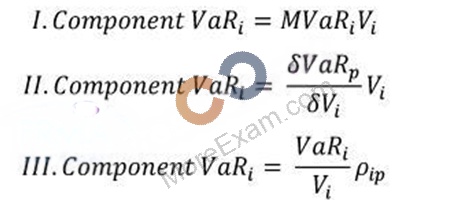
Question35: Which of the following formulae correctly describes Component VaR. (p refers to the portfolio, and i is the i-th constituent of the portfolio. MVaR means Marginal VaR, and other symbols have their usual meanings.)

Question36: Which of the following are valid criticisms of value at risk:
I. There are many risks that a VaR framework cannot model
II. VaR does not considerliquidity risk
III. VaR does not account for historical market movements
IV. VaR does not consider the risk of contagion

Question37: If E denotes the expected value of a loan portfolio at the end on one year and U the value of the portfolio in the worst case scenario at the 99% confidence level, which of the following expressions correctly describes economic capital requiredin respect of credit risk?

Question38: Which of the following is not a credit event under ISDA definitions?

Question39: CreditRisk+, the actuarial model for calculating portfolio credit risk, is based upon:

Question40: If X represents a matrix with ratings transition probabilities for one year, the transition probabilities for 3 years are given by the matrix:

Question41: A bank extends a loan of $1m to a home buyer to buy a house currently worth $1.5m, with the house serving as the collateral. The volatility of returns (assumed normally distributed) on house prices in that neighborhood is assessed at 10% annually. The expected probability of default of the home buyer is 5%.
What is the probability that the bank will recover less than the principal advanced on this loan; assuming the probability of the home buyer's default is independent of the value of the house?

Question42: The generalized Pareto distribution, when used in the context of operational risk, is used to model:

Question43: Which of the following should be included when calculating the Gross Income indicator used to calculate operational risk capital under the basic indicator and standardized approaches underBasel II?

Question44: If the default hazard rate for a company is 10%, and the spread on its bondsover the risk free rate is 800 bps, what is the expected recovery rate?

Question45: CreditRisk+, the actuarial model for calculating portfolio credit risk, is based upon:

Question46: Which of the following is not one of the 'three pillars' specified in the Basel accord:

Question47: For a given mean, which distribution would you prefer for frequency modeling where operational risk events are considered dependent, or in other words are seen as clustering together (as opposed to being independent)?

Question48: For a given notional amount, which of the following carries the greatest counterparty exposure (assuming the same counterparty credit rating for each):

Question49: Which of the following is not a tool available to financial institutions for managing credit risk:

Question50: Credit exposure for derivatives is measured using

Question51: A cumulative accuracy plot:

Question52: Calculate the 1-year 99% credit VaR of a portfolio of two bonds, each with a value of $1m, and the probability of default of 1% each over the next year. Assume the recovery rate to be zero, and the defaults of the two bonds to be uncorrelated to each other.

Question53: Which of the following statements is NOT true in relation to the recent financial crisis of 2007-08?

Question54: When pricing credit risk for an exposure, which of the following is a better measure than the others:

Question55: Which of the following can be used to reduce credit exposures to a counterparty:
I. Netting arrangements
II. Collateral requirements
III. Offsetting tradeswith other counterparties
IV. Credit default swaps

Question56: Which of the following steps are required for computing the total loss distribution for a bank for operational risk once individual UoM level loss distributions have been computed from the underlhying frequency and severity curves:
I. Simulate number of losses based onthe frequency distribution
II. Simulate the dollar value of the losses from the severity distribution III. Simulate random number from the copula used to model dependence between the UoMs IV. Compute dependent losses from aggregate distribution curves

Question57: Under the KMV Moody's approach to credit risk measurement, how is the distance to default converted to expected default frequencies?

Question58: Which of the following statements are correct?
I. A reliance upon conditional probabilities and a-priori views of probabilities is called the 'frequentist' view II. Knightian uncertainty refers to thingsthat might happen but for which probabilities cannot be evaluated III. Risk mitigation and risk elimination are approaches to reacting to identified risks IV. Confidence accounting is a reference to the accounting frauds that were seen in the past decadeas a reflection of failed governance processes

Question59: Under the credit migration approach to assessing portfolio credit risk, which of the following are needed to generate adistribution of future portfolio values?

Question60: When fitting a distribution in excess of a threshold as part of the body-tail distribution method described by the equation below, how is the parameter 'p' calculated.

Here, F(x) is the severity distribution. F(Tail) and F(Body) are the parametric distributions selected for the tail and the body, and T is the threshold in excess of which the tail is considered to begin.

Question61: Under the internal ratings based approach for risk weighted assets, for which of the following parameters must each institution make internal estimates (as opposed to relying upon values determined by a national supervisor):

Question62: There are two bonds in a portfolio, each with a market value of $50m. The probability of default of the two bonds are 0.03 and 0.08 respectively, over a one year horizon. If the probability of the two bonds defaulting simultaneously is 1.4%, what is the default correlation between the two?

Question63: When modeling operational risk using separate distributions for loss frequency and loss severity, whichof the following is true?

Question64: Which of the following techniques is used to generate multivariate normal random numbers that are correlated?

Question65: Which of the following carry greater counterparty risk: a forward contract on a 10 year note, or a commercial paper carrying a AA credit rating with identicalmaturity and notional?

Question66: Aderivative contract has a negative current replacement value. Which of the following statements is true about its loan equivalent value for credit risk calculations over a 2-year horizon?

Question67: Which of the following represents a riskier exposure for a bank: A LIBOR based loan, or an Overnight Indexed Swap? Which of the two rates is expected to be higher?
Assume the same counterparty and the same notional.

Question68: When considering a request for a loan from a retail customer, which of the following factors is relevant for a bank to consider:

Question69: What ensures that firms are not able to selectively default on some obligations without being considered in default on the others?

Question70: Which of the following need to be assumed to convert a transition probability matrix for a given time period to the transition probability matrix for another length of time:
I. Time invariance
II. Markov property
III. Normal distribution
IV. Zero skewness

Question71: A loan portfolio's full notional value is $100, and its value in a worst case scenario at the 99% level of confidence is $65. Expected losses on the portfolio are estimated at 10%. What is the level of economic capital required to cushion unexpected losses?

Question72: Under the CreditPortfolio View approach to credit risk modeling, which of the following best describes the conditional transition matrix:

Question73: Which of the following is not an event of default covered in the ISDA Master Agreement?
I. failure to pay or deliver
II. credit support default
III. merger without assumption
IV. Bankruptcy

Question74: Which of the following statements is true:

Question75: Financial institutions need to take volatility clustering into account:
I. To avoid taking on an undesirable level of risk
II. To know the right level of capital they need to hold
III. To meet regulatory requirements
IV. To account for mean reversion in returns

Question76: Which of the following statements is true
I. If no loss data is available, good quality scenarios can be used to model operational risk II. Scenario data can be mixed with observed loss data for modeling severity and frequency estimates III. Severity estimates should not be created by fitting models to scenario generated loss data points alone IV. Scenario assessments should only be used as modifiers to ILD or ELD severity models.

Question77: Which of the following will be a loss not covered by operational risk as defined under Basel II?

Question78: Loss provisioning is intended to cover:

Question79: For a loan portfolio, unexpected losses are charged against:

Question80: For a hypotherical UoM, the number of losses in two non-overlapping datasets is 24 and 32 respectively. The Pareto tail parameters for the two datasets calculated using the maximum likelihood estimation method are 2 and 3. What is an estimate of the tail parameter of the combined dataset?

Question81: The standalone economic capital estimates for the three uncorrelated business units of a bank are $100, $200 and $150 respectively. Whatis the combined economic capital for the bank?

Question82: The key difference between 'top down models' and 'bottom up models' foroperational risk assessment is:

Question83: According to Basel II's definition of operational loss event types, losses due to acts by third parties intended to defraud, misappropriate property or circumvent the law are classified as:

Question84: An operational loss severity distribution is estimated using 4 data points from a scenario. The management institutes additional controls to reduce the severity of the loss if the risk is realized, and as a result the estimated losses from a 1-in-10-year losses are halved. The 1-in-100 loss estimate however remains the same.
What would be the impact on the 99.9th percentile capital required for this risk as a result of the improvement in controls?

Question85: According to the Basel II framework, subordinated term debt that was originally issued 4 years ago with amaturity of 6 years is considered a part of:

Question86: A bank holds a portfolio ofcorporate bonds. Corporate bond spreads widen, resulting in a loss of value for the portfolio. This loss arises due to:

Question87: A portfolio has two loans, A and B, each worth $1m. The probability of default of loan A is 10% and that of loan B is 15%. Theprobability of both loans defaulting together is 1%. Calculate the expected loss on the portfolio.