Question1: Suppose the current release will be complete after 6 two-week iterations. A team member is insisting that the Product Owner write the acceptance test cases for the entire release. How should the Scrum Master respond?
Question2: Spike solutions are small standalone programs that demonstrate what you've learned. Which of the following types of spike will you use if you need to test an approach to your production code?
Question3: Who is NOT part of the Scrum Team?
Question4: Project managers use velocity to determine:
Question5: Pick the THREE statements that are true about Agile Analysis. (Choose three.)
Question6: The cost estimation techniques used on Agile projects are:
Question7: An agile team notices that the same problems continue to occur during multiple iterations.
Several team members have suggestions to fix the problem.
What is the proper agile approach to handle this?
Question8: What is the definition of velocity?
Question9: What Agile concept expresses delivering value in slices rather than in layers/stages?
Question10: When working with a globally distributed team, the most useful approach would be to:
Question11: Risk exposure is the:
Question12: The term "last responsible moment" refers to the moment at which:
Question13: When we practice active listening, what are the levels through which our listening skills progress?
Question14: On a risk map or a risk heat map, the vertical and horizontal axes represent:
Question15: A project manager is concerned that the team has misaligned expectations with some stakeholders, and that user stories were written only from a generic user's perspective. This may lead the team to miss stories for non-generic users.
What agile tools can help the team address these issues?
Question16: Testing that often occurs between "Done" and "Done, Done" is:
Question17: The following is a picture of which of the following Information Radiators?

Question18: Following a successful product release, senior management asks an agile team how to improve the value of the product for the next release.
What should the team do?
Question19: Which of the following tests verify that units and combinations of units work together to perform the desired operations?
Question20: During a project meeting, a team is faced with a difficult decision. After discussion and deliberation, the project leader makes the final decision and ends the discussion. This causes a team member to withdraw from future collaboration.
How could the project leader have avoided this?
Question21: Drag and Drop Question
Sequence the core practices of Kanban in order of execution.

Question22: During a planning session, four out five team members vote to include eight story points in a particular story, while the fifth member votes for five story points.
How should this be handled?
Question23: The purpose of a project burndown chart is to:
Question24: In an Agile approach, at which meeting does a team examine the effectiveness of risk responses by conducting a risk audit?
Question25: An agile team is working on a new product. To ensure that all unknown issues are clarified before committing to the scope, the team plans to work only on spike user stories for the next three sprints.
What should the agile coach do in this situation?
Question26: The Project Leader's primary responsibilities are to "move boulders and carry water". What is this an example of?
Question27: In Scrum, Sprints are never longer than a calendar month.
Question28: Which Agile method promotes the practice of risk-based Spike or Spike solutions?
Question29: Which type of estimation refers to splitting a story into smaller and easier to manage pieces?
Question30: A development team and product owner disagree on a user story in the product backlog.
What should the agile practitioner do?
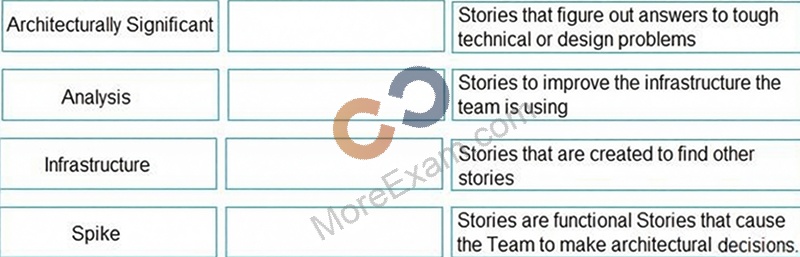
Question31: Drag and Drop Question
Match the story types on the left to their definition on the right:
Question32: A new agile team member notices that the team's current process involves excessive documentation.
What should the new team member do?
Question33: Which of the following best represents both a principle of the Agile manifesto and a Lean method of simplicity?
Question34: Retrospectives provide an opportunity for the team to:
Question35: In reference to Scrum, each sprint should produce:
Question36: Which of the following is NOT recognized as a "unit" that can be used for estimating the size of the requirements on your Agile project?
Question37: A team is delivering work as per the sprint plan, and team velocity is stabilized. However, at the end of the release, the customer is dissatisfied with project quality.
What should the agile project manager have done to avoid this?
Question38: What is the purpose of practicing asking the "5 Why's"?
Question39: Which of the following documents defines the functional and non-functional requirements that the system should meet to deliver the vision, prioritized and estimated?
Question40: What type of time estimation excludes non-programming time?
Question41: During a six-week iteration, an issue is identified by a team member. After analysis, the team member determines that it will take at least two weeks to resolve.
What should the team member do?
Question42: An agile team is unable to complete all its planned sprint user stories, which results in a decrease of its planned sprint velocity.
What should the team do?
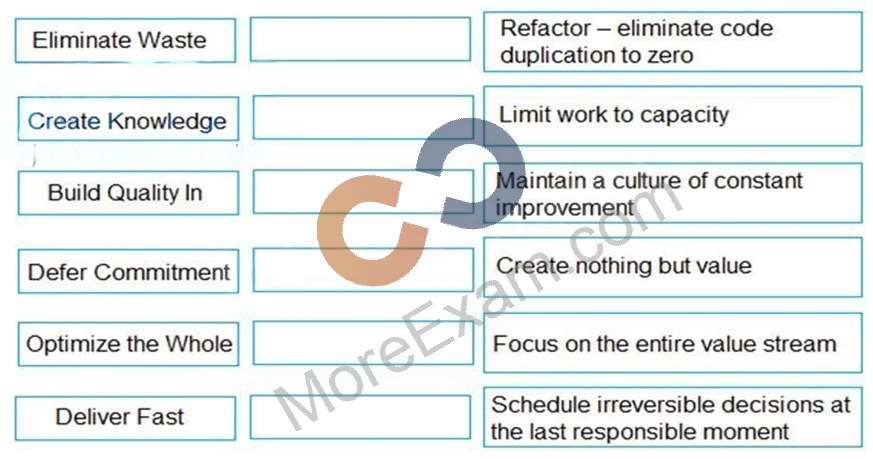
Question43: Drag and Drop Question
Match a definition (on the right) to a Lean principle (on the left).
Question44: For a "caves and commonroom arrangement, the most appropriate prerequisite is that the people in the room must be working on:
Question45: How long is the Sprint Planning meeting?
Question46: Drag and Drop Question
Order the 5 focusing steps of the Theory of Constraints.

Question47: This artifact contains release names with expected dates and includes major features, client-side impacts, server-side applications, platform support and markets served:
Question48: After three iterations, the problems impeding an Agile team appear to be similar in nature to problems faced in earlier iterations.
Inspection of the retrospectives for past iterations reveals information organized into columns entitled "What worked for us" and "What did not work for us. " Based on this information, one can infer that the team did not capture:
Question49: Kanban means________in Japanese?
Question50: Which of the following is NOT true about Retrospective?
Question51: A team is transitioning from a predictive approach to an agile approach. Historically, the team has delivered work products that did not meet customer expectations.
What agile practice can help the team to alleviate this?
Question52: Kanban cards should always be written using User Stories.
Question53: When does Adaptation occur in Scrum?
Question54: Sometimes stories are too small. A good approach for tiny stories, common among Extreme Programming teams, is to combine them into larger stories that represent from about a half-day to several days of work. The combined story is given a name and is then scheduled and worked on just like any other story. Which of the following are NOT examples of small stories?
Question55: Which one is NOT a reason to perform a Spike?
Question56: Drag and Drop Question
Pick which 3 activities are the responsibilities of the Scrum Master in Scrum.

Question57: Having problems does not indicate a problem in itself, so welcome problems because they bring with them the chance for the team to overcome, grow, and become stronger together." As an Agile Coach, which are the multiple perspectives to analyse to detect the symptoms for the problem?
Question58: A team identifies the number of threats and lists them in the order in which they were identified.
After analyzing a cause-and-effect diagram, the ownership of the threats and their treatment is assigned, and a number of risk cards are placed on the Kanban board.
What approach should be used to manage these threats?
Question59: Which one is NOT a level of need in the Kano Model?
Question60: During the review session, the product owner discovers that the user interface has a response time of 10 seconds. The non-functional requirements state that it should respond in less than two seconds. The team complains that this requirement was not communicated to them.
What should have been done to avoid this?
Question61: Scrum is a software development methodology.
Question62: On what should Agile estimates be based?
Question63: What are three processes used to begin an Agile project?
Question64: An agile project leader is delivering a team kick-off session. The first exercise is a "Life Timeline" - a story-telling exercise where each team member tells their life story, explains how they experienced the highs and lows of their journey, and identifies their fears and hopes.
What is the project leader trying to create?
Question65: During a retrospective, team members suggest process improvement ideas. The agile team lead knows that, while many of these ideas are different from standard practices, a few of them are good.
What should the agile team lead do?
Question66: Which of the following is NOT a reason to use a Feature Breakdown Structure (FBS) instead of a Work Breakdown Structure (WBS)?
Question67: A business analyst has identified a new risk in an Agile project.
What is the best first step the business analyst should take regarding this risk?
Question68: What is used to provide a simple medium for gathering basic information about stories, recording high-level requirements, developing work estimates, and defining acceptance tests?
Question69: A new product owner needs to manage the backlog of a high-visibility, fast-moving project that is consuming a considerable amount of time.
What should the product owner do?
Question70: Your project management office (PMO) has suggested your project could benefit from self- assessment work at the next retrospective.
Which of the following benefits would they most likely be looking to achieve from a self- assessment?
Question71: The customer needs assistance in determining the efficiency of a set of process activities within the solution.
What should the agile team do?
Question72: Backlog Grooming and Backlog Refinement are the same thing.
Question73: The Project Manager plays the following role in Scrum:
Question74: A key component of Agile software development is:
Question75: It is not possible to have a fixed price contract in Agile.
Question76: The feedback from the Sprint Review impacts the next Sprint planning meeting.
Question77: Senior management is frustrated at the lack of a detailed implementation plan that shows exactly when the project will end and when all requirements will be met. The team has been using a rolling wave planning approach so far on the project.
How should the agile practitioner explain to senior management the benefits of this approach?
Question78: A senior team member feels underutilized.
What should the agile practitioner do?
Question79: A product owner for two highly visible projects spends a great deal of time meeting with and reporting to senior stakeholders. The product owner is overwhelmed because both project teams request clarification on the requirements and the overall priorities.
What should the agile project manager do?
Question80: During product development, changes in technology and regulations require the team to reassess product architecture.
How should this technical debt be captured?
Question81: A product owner, new to the role, is very enthusiastic about an agile project with an energetic team.
What should be done first to ensure successful delivery of the product?
Question82: Which of the following is a STORY?
Question83: Midway through a project, the product owner learns from the sponsor that a major component, which is already 20 percent complete, is unimportant to users. The component was part of the approved scope and a key selling point for the project.
What should the product owner do next?
Question84: The product owner should spend at least 3 hours per day with the development team?
Question85: An Agile team best ensures product quality through:
Question86: During project inception, an agile practitioner engages the stakeholder to ensure alignment on the project's strategy and vision. The stakeholder asks for detailed requirements, design, and delivery plans.
What should the agile practitioner do?
Question87: "Fail Sooner" is a benefit of Incremental Development.
Question88: Who tracks work remaining in the Product Backlog?
Question89: Which should NOT take place at the daily Scrum?
Question90: According to DeMarco, Fragmented knowledge workers may look busy but a lot of their business is just thrashing. The minimum cost penalty is :
Question91: While developing a story during the iteration, team discovered new tasks that were not identified earlier. A newly discovered task is such that the User Story cannot be completed during the iterations. What are the most appropriate actions for the team to perform?
Question92: Personas are used in Agile requirements to depict which type of user?
Question93: All of the following are TRUE about communicating on distributed teams EXCEPT:
Question94: Which chart shows the total number of story points completed through the end of each iteration?
Question95: The purpose of Work in Progress (WIP) limits is to prevent the unintentional accumulation of work, so there isn't a bottleneck.
Question96: During backlog refinement meeting, the new developer on the team asks the product owner to discuss a new performance threshold requirement and how it impacts the stories in the backlog.
What should the team do?
Question97: A project's first iteration contains item A, and its second iteration contains item B.
The first iteration is behind schedule, which will impact the second iteration. Since items A and B are similar, a team member suggests beginning the design of item B.
What should the agile practitioner do?
Question98: Agile development prevents technical debt.
Question99: What is a high-level representation of the features or themes that are to be delivered in each release?
Question100: All of the following are metrics used in Agile except:
Question101: Non-functional requirements should be written as user stories whenever possible.
Question102: An agile team is under pressure to deliver an application. The product owner anticipates many change requests from customers once the product is released?
What should the agile team do?
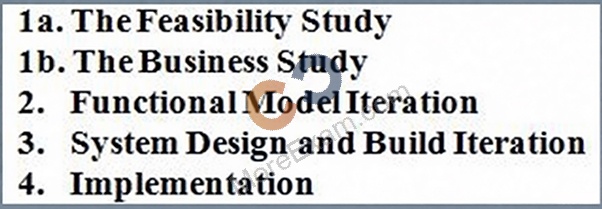
Question103: Which Agile method goes through the following stages:
Question104: Which of the following are 2 attributes of Exploratory testing? (Choose two.)
Question105: Refactoring is a key way of preventing technical debt.
Question106: Which is a report of all the work that is "done"?
Question107: Traditional Project Management uses the Work Breakdown Structure to develop requirements in terms of activities. What type of breakdown structure is used in Agile for this purpose?
Question108: Which of the following is NOT a principle of the Agile Manifesto?
Question109: While attending a conference, an agile practitioner learns of a new user interface (UI) framework that could benefit the team.
What should the agile practitioner do next?
Question110: Which of the following is an Agile Manifesto principle?
Question111: A development team, new to scrum, questions the need to collect metrics on team performance.
While team members understand velocity and burn down, they feel that once velocity becomes settled it is needless to keep track.
What should the agile coach tell the team?
Question112: After completing the release plan, the team realizes that the project is very likely to have a negative ROI.
What should the team do?
Question113: Continuous integration ensures that a product is:
Question114: The PMO has asked you to generate some financial information to summarize the business benefits of your project. To best describe how much money you hope the project will return, you should show an estimate of:
Question115: What are the three pillars of Scrum?
Question116: What is the reason to develop personas as part of User Story creation?
Question117: A client states that a product is not being built as requested. How should the agile team address this?
Question118: What is a product roadmap?
Question119: When maintaining the product backlog, this role represents the interests of the stakeholders, and ensures the value of the work completed:
Question120: An organization adopts Agile practices and implements an incremental delivery strategy.
If implemented correctly, the company should recognize improved:
Question121: Which of the following is NOT an attribute of a Good Story?
Question122: One of your stakeholder wants more detail than the vision statement provides, but not the overwhelming detail of the release and iteration plans. Which of the following progress report will you share with this stakeholder?
Question123: A project team estimates that they should complete 30 story points in the current iteration.
Partway through the iteration they realize that they will complete 50 story points at their current rate.
The team should:
Question124: This role would be responsible for determining when a release can occur:
Question125: What Agile planning artifact is updated minimally once a year by the Product Owner?
Question126: An agile project manager notices that the product owner manages team members' day-to-day tasks in a way that distracts them from their core responsibilities. In addition, the team believes that their questions on product backlog prioritization are not being answered on time.
What should the agile project manager do?
Question127: Traditional project management uses requirement decomposition. This can be comparable to____________ of Agile User Stories.
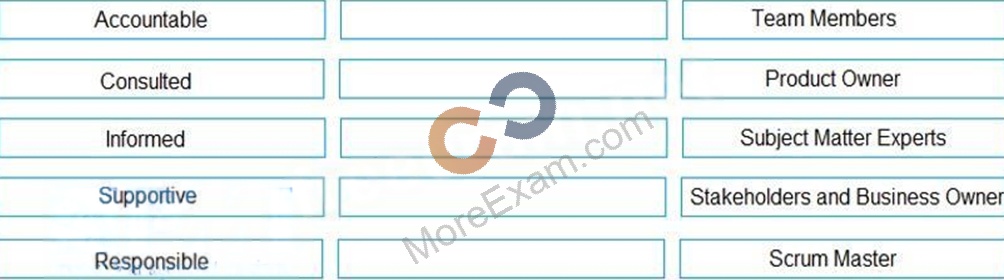
Question128: Drag and Drop Question
Match the following roles on the right to the RASCI on the left:
Question129: How is the Retrospective meeting BEST conducted?
Question130: The amount of information captured in the project's defects is varying within the development team. Team members are becoming frustrated with the defect quality inconsistencies and the frequent clarification required.
What should be done to address the issue?
Question131: Which of these statements is NOT correct about Ideal time and Calendar time?
Question132: The risk profile of a project has increased beyond the upper threshold of tolerance. The product owner and project leader meet to discuss an approach for dealing with this.
What should the team do next?
Question133: What is the best description of the relationship between Scrum and extremeProgramming(XP)?
Question134: When was Scrum first introduced?
Question135: Typically calculated in story points, this is the rate at which the team converts "Done" items in a single Sprint:
Question136: Select the statements that are TRUE about the Product Owner. (Choose two.)
Question137: Which of the following is NOT considered an enterprise Agile method?
Question138: An agile practitioner becomes a Scrum Master on an established Scrum team.
After introductions, what should the agile practitioner do?
Question139: In eXtreme Programming (XP), analysis, design, coding, and testing phases are done:
Question140: A story point is the:
Question141: Which is the first step in setting up Kanban?
Question142: This role champions the products, provides the budget and supports the Scrum Master in removing impediments
Question143: Affinity Estimating is a technique many teams use to quickly and easily estimate a large number of user stories. What should be the minimum size for the items in the Product Backlog?
Question144: The executive leadership wants to understand ways to better deliver on time and on budget.
What can the project team do to assist in achieving the organizational goal?
Question145: Which of the following defines the splitting of a story or a feature into smaller, easier-to- estimate pieces?
Question146: Which of the following factor will not assist in improving the project velocity?
Question147: Technical debt is the total amount of less-than perfect __________ in your project.
Question148: Setting up development work in a way that the team can figure out what to do next is called:
Question149: What Agile planning artifact is created by the Product Owner and the development team?
Question150: Midway through a sprint, a scrum team member advises the team of a new requirement that may change the initial scope.
What should the team do?
Question151: In Pair Programming, one programmer is responsible for all the coding in an iteration then the programmer switch for the next iteration?
Question152: In Scrum, the definition of "done" is created by everyone EXCEPT:
Question153: Spike solutions are appropriate when:
Question154: A term used to describe the work that can be delivered which meets the business requirements without exceeding them. (Choose two.)
Question155: Midway through a sprint, a team member discovers that the product design fails to adhere to the organization's enterprise architecture standards. Since this required escalation to the architecture team for further analysis and resolution, the team was unable to deliver its sprint goal and the sprint was cancelled.
What should the team have done to avoid this?
Question156: eXtreme Programming (XP) teams strive to avoid:
Question157: Based on the following information, determine the number weeks until the next release.

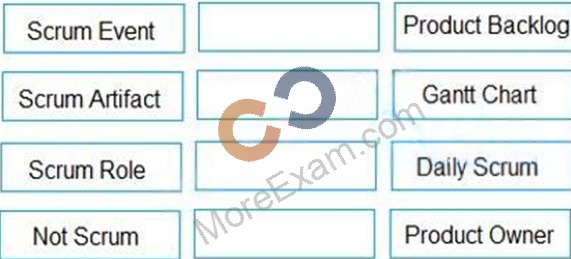
Question158: Drag and Drop Question
Match the following:
Question159: During a retrospective meeting, a team develops a large list of initiatives. All will have a positive impact and improve team performance.
What should the agile coach do next?
Question160: What is a Japanese term used in Lean software development is an activity that is wasteful, unproductive, and doesn't add value?
Question161: Team A is working on the second sprint of a product release. Team B, which is an interdependent team located on the same floor, requires extensive and frequent information to complete its sprint goal.
What should the agile team lead do?
Question162: An agile project leader notices that the team's velocity has decreased. In examining data provided by team members, the project leader discovers that one team member has been slow to enter story statuses.
What can happen as a result?
Question163: Scrum dictates the use of User Stories.
Question164: During a current sprint, a team member asks permission from the scrum master to investigate an alternative design approach.
What should the scrum master do?
Question165: An agile coach is assigned to help a project team that was recently co-located close to a very popular business. Many team members visit this business during working hours which affects team performance.
What should the agile coach do to mitigate this issue?
Question166: An agile team's client has been asked to expedite the delivery of the next release. By delivering one month early, the company can generate US$40,000 more than expected for the quarter.
What should the agile team do?
Question167: Midway through an iteration, an agile team learns that a team member will be unavailable for the next two iterations.
As a high-performance team, what should the team do?
Question168: What can an agile team use to prioritize stories?
Question169: The Scrum Master's job is to work with the Scrum Team and the organization to increase the awareness of the artifacts. Which pillar of Scrum does this represent?
Question170: What is the normal time estimate for a research story?
Question171: This Agile methodology's properties include Focus, Osmotic Communication and Project Safety.
Question172: Of the listed options, which BEST describes User Stories?
Question173: What is the responsibility of an extreme Programming (XP) customer role?
Question174: During a sprint review, the product owner identifies a required improvement for a feature's user interface (UI) delivered during the sprint.
What should the product owner do next?
Question175: 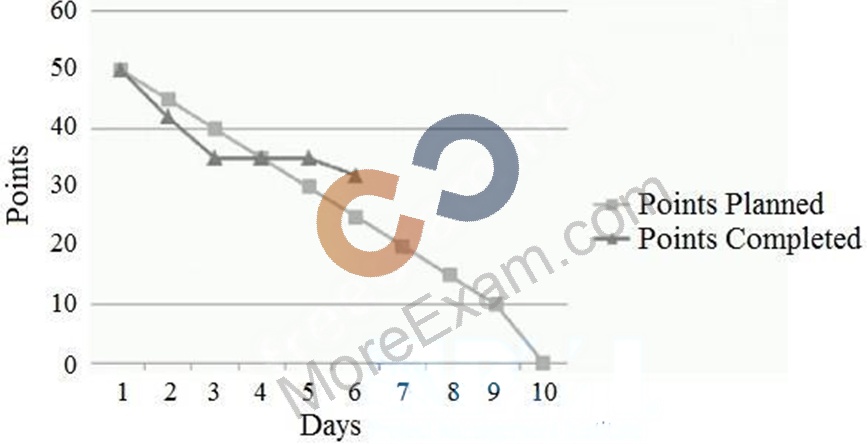
Based on the chart, what is the current status of the iteration when comparing story points planned versus completed?
Question176: When a team member encounters an issue in an agile environment, what should they do?
Question177: What can a team use to prioritize stories?
Question178: Drag and Drop Question
Match each activity (on the left) to its definition (on the right).

Question179: What is the name of this facilitated process? One or more team members sequence the product backlog from smallest to largest User Story. The rest of the team validates the sequence. The whole team uses a sizing method such as T-shirt size or Fibonacci sequence to group the user stories.
Question180: _____________ an estimate refers to estimating a story based on its relationship to one or more other stories.
Question181: An executive requests information regarding a sprint status.
What action should the product owner take?
Question182: After seeing the planned features for an upcoming release, a customer notes that a vitally important and complex one is missing. The team estimates that this feature significantly exceeds its average velocity.
How can this issue be resolved?
Question183: Which development mastery model of skill acquisition lies in helping the teacher understand how to assist the learner in advancing to the next level?
Question184: A company is moving into a new space and is determining the best configuration for offices. The management team is also considering moving to an agile process.
What advice should an agilist give?
Question185: Which of the following BEST describes error-feedback ratio?
Question186: A product's scope and acceptance criteria have been defined, and the product is planned for release at the end of the next quarter.
What should the project team do next?
Question187: At minimum, all Kanban boards should have the following columns:
Question188: A team's technical lead believes that manual testing tasks should be conducted by junior team members below their level. The junior team members think it is unfair and refuse the tasks.
What should the scrum master do?
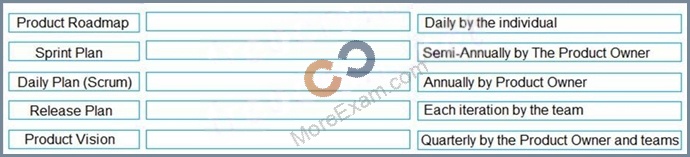
Question189: Drag and Drop Question
While managing the Agile Product Lifecycle, Match the frequency with which you update the five Agile plans.
Question190: During sprint retrospectives, some team members are very vocal and tend to dominate the conversation, while others are more reserved and less likely to participate.
What should the scrum master do?
Question191: Assuming one-week iterations and a team of four developers, how many iterations will it take the team to complete a project with 27 story points if they have a velocity of 4?
Question192: An agile team delivered a feature in the last iteration. The product owner, who missed the planning and review meetings, was dissatisfied with the feature. The team conducted a retrospective and reviewed the user stories related it.
What should the agile team do next?
Question193: A cross-functional team in Scrum consists of which types of team members?
Question194: In agile approaches, negotiation is viewed as:
Question195: Midway through a sprint, the scrum master identifies that reassigning a certain task could help the team meet its sprint goals.
What should the scrum master do next?
Question196: During a daily stand up meeting, a developer expresses concerns that the selected technology limits the number of concurrent users.
What should the agile team lead do?
Question197: A scrum team has conducted regular retrospectives to discuss immediate concerns and the implementation of improvement actions. Despite this, after a few iterations, the same concerns resurface.
What should the team have done to improve retrospective outcomes?
Question198: A project team realizes that an important task on the iteration backlog will take more time than originally estimated.
What should the project team do?
Question199: Suppose 8 new members joined the development team, and the team size is now 15. The daily Scrum is getting noisy and exceeding the 15 minutes time-box. What is the most effective way to address this situation?
Question200: If there are multiple Scrum teams working on a product, each needs its own definition of Done.
Question201: The purpose of a Sprint retrospective is for the Scrum team to:
Question202: The backlog is ordered by:
Question203: An agile team has been given a complex project with a basic set of requirements which need further elaboration and review.
How should the team iteratively build out the backlog of requirements with the stakeholders?
Question204: To ensure the success of our project, in what order should we execute the work, taking into account the necessary dependencies and risk mitigation tasks?
Question205: Scrum practices are facilitated by the:
Question206: The team is refining user stories during the backlog grooming session and confused on the acceptance criteria and level of details.
What should the agile practitioner do?
Question207: During a project review, the team discovers customer feedback that would add scope. The project leader is concerned that the team will be unable to incorporate this feedback and still meet the product launch date.
What should the project leader do?
Question208: Self-organizing teams are characterized by their ability to:
Question209: Triple Nickels is a technique used in what kind of meeting?
Question210: When prioritizing features to be delivered in an iteration, on what features should an agile team defer work?
Question211: What should a Scrum Master do when one team member falls behind in their tasks?
Question212: Which of the following is an Agile improvement technique to address issues continuously, e.g.
after daily stand-up?
Question213: 80% of the value comes from 20% of the work. Which law is this referring to?
Question214: Which of the following techniques best encourages osmotic communication?
Question215: An agile practitioner wants to communicate the effect of technical debt on the project.
What should the practitioner do?
Question216: The smallest amount of functionality that delivers customer value is best described as a:
Question217: Which of the following is the hierarchy of User Story creation?
Question218: The ultimate goal of __________ is to deploy all but the last few hours of work at any time.
Question219: Which Agile framework adopts and tailors methods such as Scrum, Extreme Programming (XP), Agile Modeling (AM), Unified Process (UP), Kanban and Agile Data (AD) in order to support scaling.
Question220: Which of the following statements is an accurate value statement of the Agile Manifesto?
Question221: A product owner adds a 21-point, high-priority story to a sprint backlog. The team is concerned that it cannot be completed during the current sprint.
What should the team do?
Question222: Project X has an IRR of 12%, and Project Y has an IRR of 10%. Which project should be chosen as a better investment for the organization?
Question223: At the end of a product development phase, an agile project team confirms that all tests have passed. The product is released, but the customer complains that it is deficient.
What should the project team have done prior to product release?
Question224: The way that we calculate the number of years it takes to break even from undertaking a project which also takes into account the time value of money is the:
Question225: Product Backlog Items (PBI) described as emergent, are expected to:
Question226: An agile team is beginning a new release. Things are progressing a little slower than they initially estimated. The project manager is taking a servant leadership approach. Which of the following actions is the project manager most likely to do?
Question227: Due to its complexity, a new team member struggles with developing a concise user story.
What advice should the agile practitioner give to assist with developing the story?
Question228: When can a plan be changed in Agile Management?
Question229: Which of the following is NOT one of the 12 core practices of XP:
Question230: A product owner concludes that the majority of a project's value can be delivered by completing only the first half of the prioritized backlog.
What should the product owner do next?
Question231: No one but the Scrum Team attends the Sprint Planning meeting.
Question232: Drag and Drop Question
How do you read a burndown bar chart? Match the phrases below to create instructions.

Question233: During a daily stand up, the tester engages the developer in a discussion about what will be tested during unit testing versus regression testing.
What should the scrum master do?
Question234: When we use the term "container" in Scrum what are we referring to?
Question235: A seven-member agile team's composition varies considerably in age, gender, culture, personality type, and professional background.
When planning a team-building event, what type of interpersonal skills should the project leader use?
Question236: Which of the following is NOT true about the Iteration Demos?
Question237: In which meeting do you capture lessons learned?
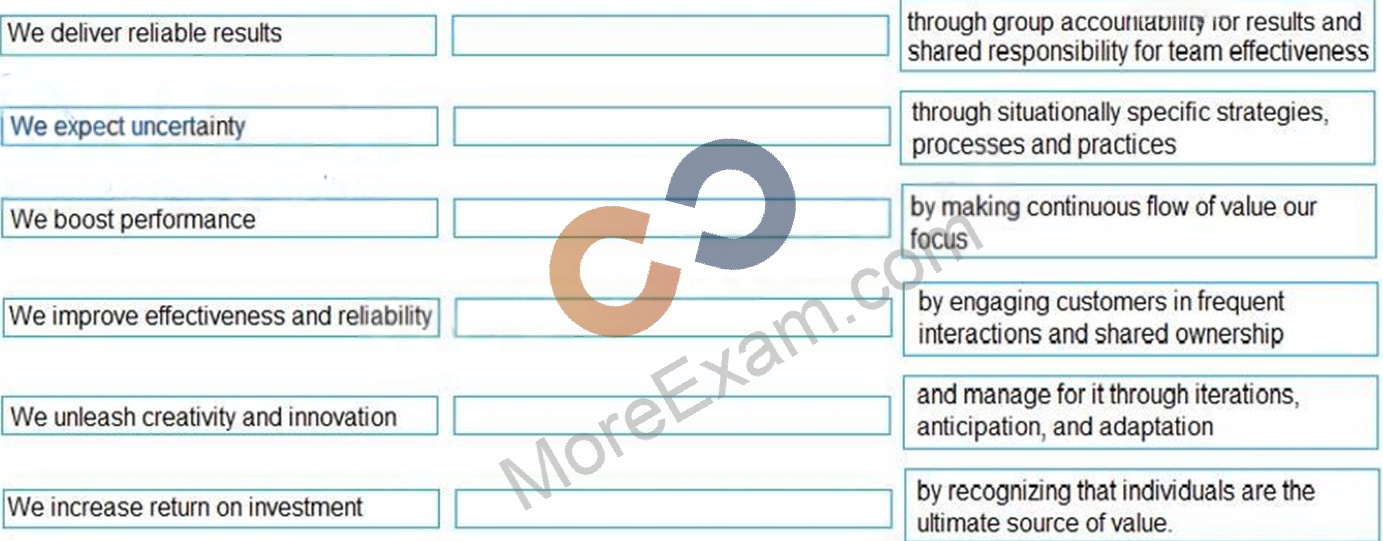
Question238: Drag and Drop Question
The PM Declaration of Interdependence is a set of six management principle initially intended for project managers of Agile software development projects. Match the items below to identify the principles.
Question239: Who specifies Acceptance Tests in an Agile Project?
Question240: A high-performance Agile team:
Question241: Throughout the project, an agile practitioner notices that one team member is becoming an emergent leader.
What should an agile practitioner do?
Question242: Every Project Management Life Cycle (PMLC) has a sequence of processes that include these phases:

Question243: What does acronym DRY stand for?
Question244: The acronym for a good product backlog is DEEP. What does it stand for?
Question245: Agile project management and product development use several types of documents specific to each iteration; they are known as "artifacts". All of the following documents are Agile iteration artifacts except:
Question246: When is the ideal time to hold a retrospective?
Question247: Drag and Drop Question
When reading a burn-down chart, what does each status measurement say about project performance? Match the items below.

Question248: What does Scrum mean by Transparency?
Question249: An agile team identifies that their velocity is lower than predicted, and that their previous forecasts in the product roadmap are wrong. The team is worried that they will be unable to meet a critical release date without corrective action.
What should the team do?
Question250: In Agile development, what is the term for the internal things that you choose not to do now, knowing they will impede future development if left undone?
Question251: The most powerful capability of Scrum teams is that they:
Question252: All of the following occur in the second half of the Sprint planning meeting EXCEPT:
Question253: Why should an agile coach model agile principles and behaviors, become self-aware, and be present?
Question254: Team A is producing 61 points per iteration and Team B is producing 20 points per iteration.
Team A has more senior engineers.
A manager demands that Team B match Team A's points in the next iteration.
Based on this information, it is reasonable to tell the manager that:
Question255: Which list below includes the attributes of a good User Story?
Question256: What should a team do when they complete all sprint goals earlier than expected?
Question257: Choose the correct combination of XP practice names from the following options:
Question258: Suppose your team velocity is 8 story points, and the product backlog items are ordered by priority as shown below. If you are in a Sprint Planning meeting and need to commit to the User Stories for the next iteration, which ones will you select?

Question259: Wideband Delphi is a repeatable process that can be used :
Question260: Which of the following charts shows the total number of story points completed through the end of each iteration?
Question261: When interacting with team members, the Agile project manager should:
Question262: In the Lean process, the focus is on:
Question263: An event management team is following an agile approach to prepare for an upcoming conference. The regional sales manager, from where the conference is to be held, contacts the team with a number of questions about the company's booth.
What should the team do?
Question264: This Emertxe Project Management (MPx) approach is when neither a goal nor solution is clearly defined.
Question265: What is the role in an eXtreme Programming (XP) project that ensures the right project processes are applied?
Question266: Frequent verification and validation is key in Agile but each approach produces a very different result. Verification determines ________________ whereas validation determines
_____________.
Question267: An iteration takes place in a time frame with specific start and end dates, called a time-box.
Which of the following is NOT an advantage of time-boxing?
Question268: Which of the following sets of tools is least likely to be utilized by an Agile team?
Question269: Which of the following frameworks has the following practices?
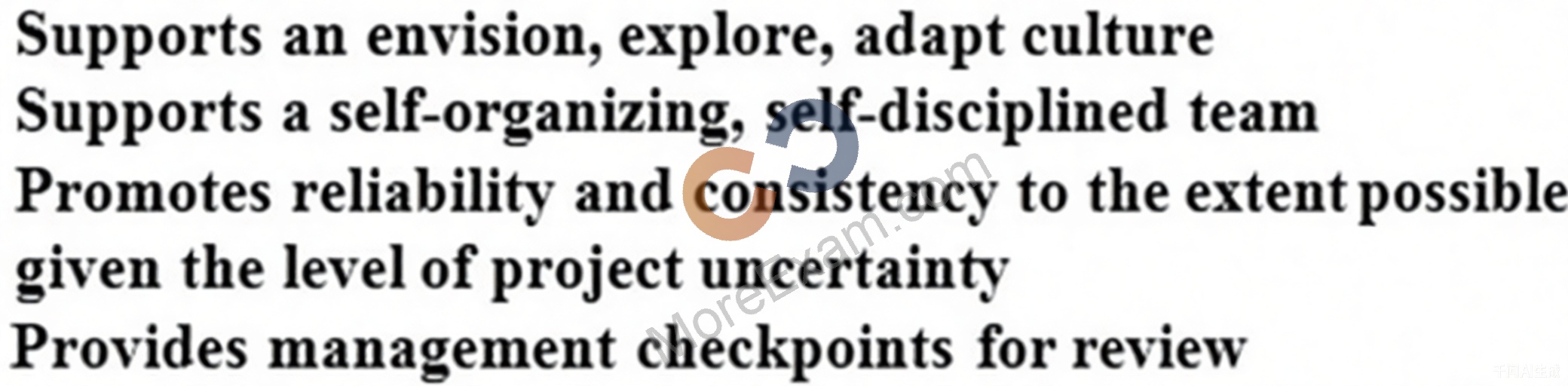
Question270: Team members who are part-time on your project will see at least a 15% reduction in their productivity per hour. The type of resource model in Agile is called:
Question271: The purpose of the iteration retrospective is to:
Question272: Who is responsible for ordering the Product Backlog?
Question273: On an agile project, some of the development team is struggling to understand how the tasks and user stories fit into the overall product.
How should this be addressed?
Question274: During the daily standup meeting, a team member states that an issue has been encountered.
This leads to the team members getting into a problem-solving discussion.
How should the ScrumMaster respond?
Question275: In Agile projects, the technique in which planning is done at three distinct horizons is known as:
Question276: The best reason for extreme character personas in writing user stories is to:
Question277: The Agile artifact that describes the incremental nature of how a product will be built and delivered over time, along with the important factors that drive each individual release is called:
Question278: Which of the following is not part of Agile Discovery?
Question279: Well-written User Stories that follow the INVEST model include which attributes?
Question280: When does a Sprint get canceled or end early?
Question281: A 4-hour Sprint Planning meeting is typical for a Sprint or Iteration that is how long?
Question282: How can an agile team working on a new product ensure alignment with external stakeholders?
Question283: Acronym describing the attributes of a product backlog:
Question284: On what should an agile team work to achieve predictable flow?
Question285: Toward the end of a project, the product owner discovers that the project has a high probability of failure due to a critical feature not functioning as expected.
What should the product owner do?
Question286: What is the name of this facilitated process? One or more team members sequence the product backlog from smallest to largest User Story. The rest of the team validates the sequence. The whole team uses a sizing method such as T-shirt size or Fibonacci sequence to group the user stories.
Question287: Business stakeholders of an agile project frequently skip the review meetings.
What should the agile practitioner do?
Question288: Which 2 are goals of Lean Software Development? (Choose two.)
Question289: Prior to a retrospective, discussions among team members indicate conflict. An agile practitioner wants to ensure an open and safe environment during the retrospective.
What should the agile practitioner do?
Question290: Which role is external to the Scrum Team but provides a skill that does not exist on the Team?
Question291: What can be described as "one or two written sentences; a series of conversations about the desired functionality."
Question292: Scrum is both an iterative and incremental Agile process.
Question293: An agile team has been in place for five years and the customer is satisfied with the team's performance and deliverables. Now that the product is built and delivered, the customer is considering the future role of the Scrum Master.
What should the customer do?
Question294: Drag and Drop Question
Sequence the steps to User Story Mapping.

Question295: Stakeholders have conflicting requirements, and the product owner is struggling to decide which user stories to write.
What should the product owner do?
Question296: Which best describes the attributes of the IN VEST criteria in a user story?
Question297: Incremental delivery means that:
Question298: More details for a story are required before the upcoming sprint planning meeting.
What should the scrum master do?
Question299: Drag and Drop Question
Match each Agile requirement type (on the left) to its definition (on the right).

Question300: What should a team consider when calculating the effort needed to complete a product backlog?
Question301: Extreme Programming (XP) includes which of the following practices? (Choose three.)
Question302: Which of the following is a weakness of an Adaptive PMLC Model?
Question303: Who is responsible for maximizing the value of the product?
Question304: If the Development Team does not have all the skills to accomplish the Sprint Goal, the Scrum Master should:
Question305: Which of the following will NOT assist in Critical Problem solving during the project?
Question306: Suppose your team is working to create a commercial website and is in the process of developing User Stories by role. One team member suggests rather than only thinking about the target user, we should also think of some exceptional users who use the system very differently. What type of user is this team member referring to?
Question307: Which of the following is NOT one of the 12 core practices of XP?
Question308: Which of the following is part of the 12 practices defined in eXtreme Programming (XP)?
Question309: In Scrum, who is responsible for managing the team?
Question310: A ScrumMaster:
Question311: For a one month Sprint, what is the recommended duration of the Sprint Planning meeting?
Question312: What type of process control is Scrum?
Question313: One of your stakeholder is interested in viewing the project progress but he is not interested in details. Which of the following report can you share with this stakeholder?
Question314: After a successful product deployment, a key stakeholder informs an agile team member that an implemented feature is failing to deliver its expected business value. The team member replies that the requirement was provided by the customer, and that the scope was clearly met.
If the problem were an issue of requirement elicitation rather than delivery, what should have been done to avoid this situation?
Question315: Pick the two PMLC models that are based upon the Agile Project Management (APM) approach:
Question316: The agile practitioner has determined that two different team members are working on addressing the same major issue on the project.
How should the agile practitioner address this?
Question317: An agile team lead is assigned to a project that must ensure data security.
What should the team lead do to guarantee that security, as a non-functional requirement, is managed throughout the project?
Question318: What is the ideal approach for an Agile project manager to take when considering fractional assignments?
Question319: The following chart lists stories for a release of an Agile project:
If the velocity of the team is 10, how many iterations will be needed to complete all of the stories?

Question320: A technique in which a team collaboratively discusses acceptance criteria and then distills them into a set of concrete tests before development begins is called:
Question321: A technical problem arises that will likely impact the stories planned for delivery in the current sprint.
What should the scrum master do?
Question322: The scrum master for a large project must provide an estimate of what can be delivered in six months.
What should the scrum master do?
Question323: The 3 items are required for an Agile, adaptive environment: (Choose three.)
Question324: A company is considering developing a new, complex application that will require a large initial investment.
However, if successful, the profit potential is high.
When preparing an analysis, what should be used to encourage stakeholders who are concerned about project failure to authorize the initial investment?
Question325: The Kaizen philosophy is change:
Question326: Which of the following 2 statements are TRUE about Product Refinement? (Choose two.)
Question327: Applying the Pareto rule when prioritizing the Product Backlog means that:
Question328: A product owner asks a newly formed scrum team how many story points will be completed in a sprint.
What should the scrum master do?
Question329: Process Tailoring is the iterative approach implementing your SDLC process.
Question330: Pareto Analysis is the exercise of determining what 40% of functionality can be delivered with
60% of the effort.
Question331: What are the 5 values of Agile Modeling?
Question332: The Japanese terms for an Agile developmental mastery model is:
Question333: Which of the following technique of Scrum requires that every slice of functionality created by the developers be complete?
Question334: Which of the following would be most likely to assist when a customer has difficulty prioritizing stories?
Question335: A meeting where a team looks back on a past period of work so that they can learn from their experience and apply this learning to future projects is popularly known as?
Question336: The Agile Manifesto value "customer collaboration over contract negotiation" means that:
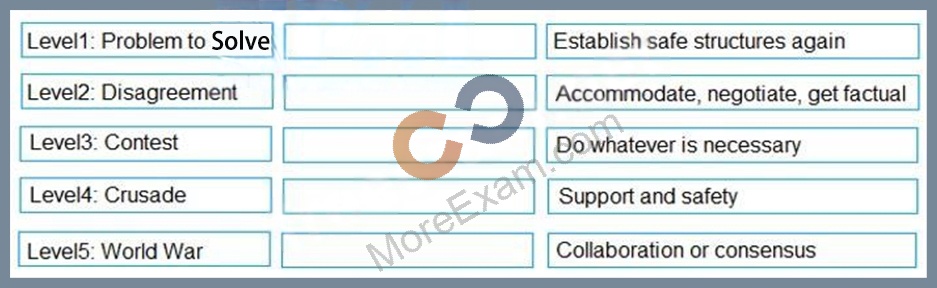
Question337: Drag and Drop Question
Match the response options to each level of conflict.
Question338: Refactoring, as it applies to the practice of extreme Programming (XP), refers to:
Question339: Which are some of the most important benefits of an Agile team sitting together in a co-located, open environment?