EMT Practice Test

1. Question Content...


Question List

Question1: In an Access Control Object, which clauses are used? Note: There are 3 correct answers to this question.

Question2: In a program you find this source code
AUTHORITY-CHECK OBJECT '/DWO/TRVL ( ID 'CNTRY' FIELD 'DE*
ID ACTVT FIELD '03".
Which of the following apply? Note: There are 2 correct answers to this question.

Question3: For the assignment, gv_target = gv_source.
which of the following data declarations will always work without truncation or rounding? Note: There are 2 correct answers to this question.

Question4: Which ABAP SQL clause allows the use of inline declarations?
Question5: For what kind of applications would you consider using on-stack developer extensions? Note: There are 2 correct answers to this question.

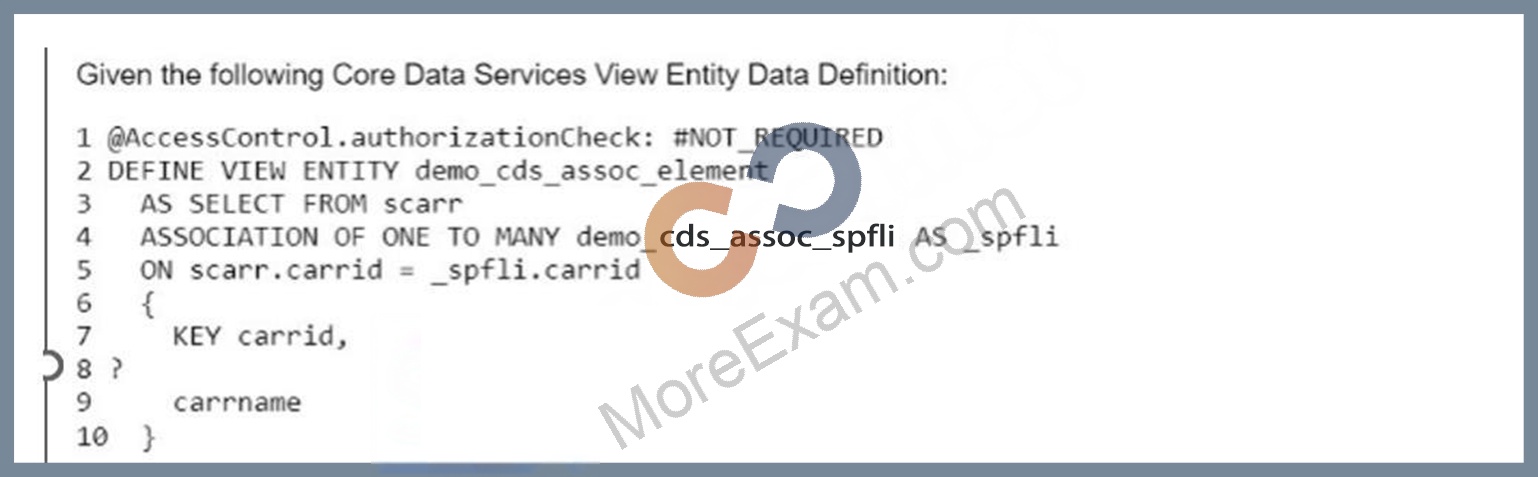
Question6:
The "demo_ods_assoc_spfi data source referenced in line #4 contains a field "connid" which you would like to expose in the element list.
Which of the following statements would do this if inserted on line #8?

Question7: Why would you use Access Controls with CDS Views? Note: There are 2 correct answers to this question.

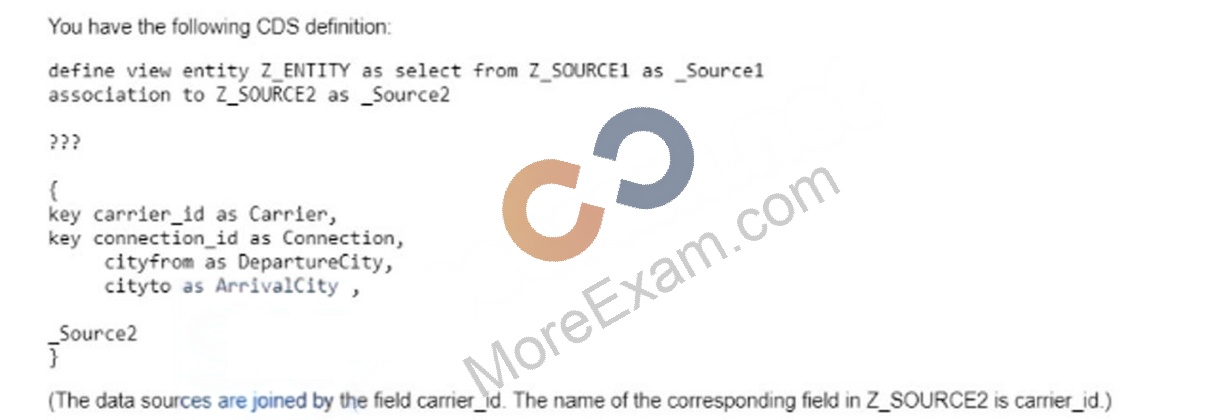
Question8:
Which of the following ON conditions must you insert in place of "???"?
Question9: After you created a database table in the RESTful Application Programming model, what do you create next?

Question10: Which of the following integration frameworks have been released for ABAP cloud development? Note:
There are 3 correct answers to this question.

Question11: What would be the correct expression to change a given string value 'mr joe doe' into 'JOE' in an ABAP SQL field list?

Question12: Exhibit

Which of the following ABAP SQL snippets are syntactically correct ways to provide a value for the parameter on line #4? Note: There are 2 correct answers to this question

Question13: What is the purpose of a foreign key relationship between two tables in the ABAP Dictionary?

Question14: In this nested join below in which way is the join evaluated?


Question15: You are given the following information:
1.
The data source "spfli" on line #2 is an SAP HANA
database table
2.
"spfli" will be a large table with over one million rows.
3.
This program is the only one in the system that accesses
the table.
4.
This program will run rarely.
Based on this information, which of the following general
settings should you set for the spfli database table? Note:
There are 2 correct answers to this question.

Question16: You have two internal tables itab1 and itab2.What is true for using the expression itab1 = corresponding #( itab2 )? Note: There are 2 correct answers to this question.

Question17: /DMO/I_Connection is a CDS view.
What variable type is connection full based on the following code? DATA connection full TYPE
/DMD/I_Connection.

Question18: Which of the following string functions are predicate functions? Note: There are 2 correct answers to this question.

Question19: What are some of the reasons that Core Data Services are preferable to the classical approach to data modeling? Note: There are 2 correct answers to this question.

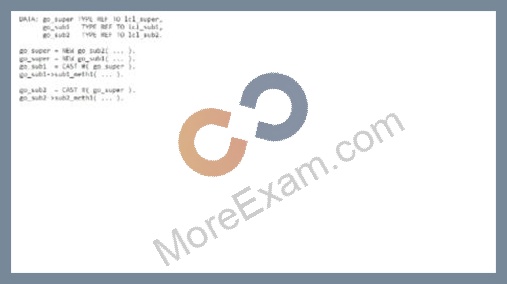
Question20: Exhibit:

With Icl_super being superclass for Icl_subl and Icl_sub2 and with methods subl_methl and sub2_methl being subclass-specific methods of Id_subl or Icl_sub2, respectivel. What will happen when executing these casts?
Note:
There are 2 correct answers to this question

Question21: Given the following Core Data Service View Entity Data Definition:
1 @AccessControl.authorizationCheck: #NOT_REQUIRED
2 DEFINE VIEW ENTITY demo_flight_info_join
3 AS SELECT
4 FROM scarr AS a
5 LEFT OUTER JOIN scounter AS c
6 LEFT OUTER JOIN sairport AS p
7 ON p.id = c.airport
8 ON a.carrid = c.carrid
9 {
10 a.carridAS carrier_id,
11 p.idAS airport_id,
12 c.countnumAS counter_number
13 }
In what order will the join statements be executed?

Question22: As a consultant you are posed the following question from a client who is using SAP S/4HANA Cloud, public edition and also SAP BTP, ABAP environment.
"We are currently using an SAP Fiori app based on SAP Fiori elements that analyzes open orders. We have determined that it should be extended via a new button on the UI which will perform an on- the-fly calculation and display the result in a quick popup for the enduser. We have been informed by SAP that all underlying stack layers for the SAP Fiori app have been extensibility enabled." Based on this which of the following extension types would you recommend to the customer to add the new button?

Question23: In RESTful Application Programming, which EML statement retrieves an object?
Question24: Which of the following are valid sort operations for internal tables? Note: There are 3 correct answers to this question.

Question25: What are some features of a unique secondary key? Note: There are 2 correct answers to this question.

Question26: Which statement can you use to change the contents of a row of data in an internal table?

Question27: When processing an internal table with the statement LOOP AT itab... ENDLOOP, what system variable contains the current row number?

Question28: Which type of legacy code does SAP recommend you eliminate when you review modifications as part of an SAP S/4HANA system conversion? Note: There are 2 correct answers to this question.

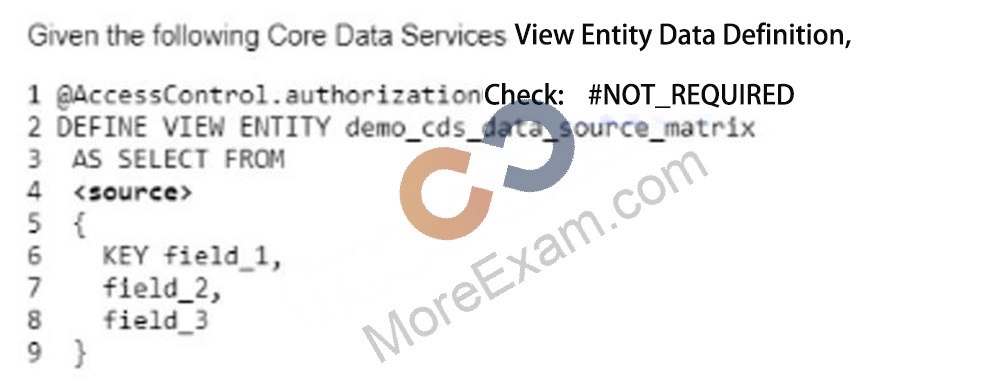
Question29:
Which of the following types are permitted to be used for <source> on line #4? Note: There are 2 correct answers to this question.

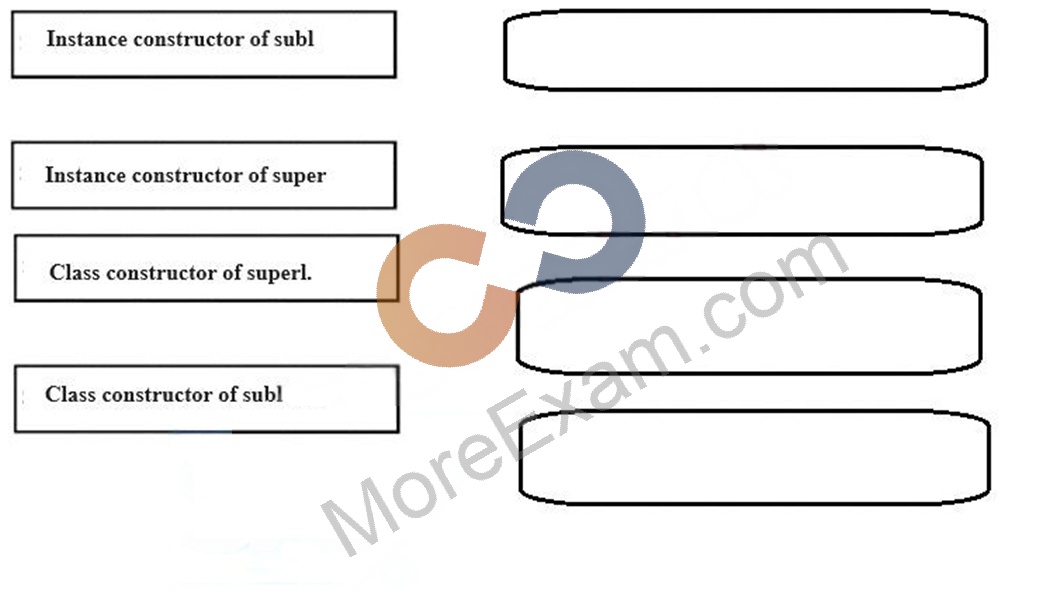
Question30: You have a superclass superl and a subclass subl of superl. Each class has an instance constructor and a static constructor. The first statement of your program creates an instance of subl. In which sequence will the constructors be executed?

Question31: What are some characteristics of secondary keys for internal tables? Note: There are 3 correct answers to this question.

Question32: In the assignment, data (gv_result) = 1/8. what will be the data type of gv_result?

Question33:
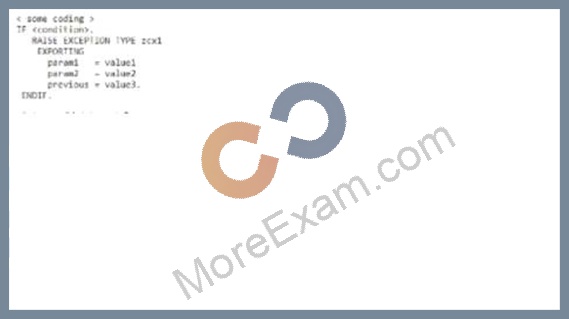
What are valid statements? Note: There are 2 correct answers to this question.

Question34: What RESTful Application Programming feature is used to ensure the uniqueness of a semantic key?