MoreExam
1. Question Content...
EXPLANATION
Answer: X - EXPLANATION Content.
Question1: While discussing the Smart Battery initiative in greater detail with the appropriate stakeholder, as Chief Enterprise Architect of Wanderlust, you discover that several key areas such as value proposition, cost structure, revenue streams, partners, and channels have been worked upon in isolation and therefore do not tally with each other. Which artifact would you recommend to bring all the above key dimensions together in a single window, to have a unified, consistent, holistic view of the Smart Battery initiative?
Question2: What kind of applications can you develop with SAP Business Application Studio?
Question3: What are important factors of the SAP BTP. Cloud Foundry environment during runtime that you need to consider?
Question4: Why is it useful to create Transition Architectures in the Application Architecture domain?
Question5: Which of the following are the best architectural decisions for an extension application in S/4HANA?
Question6: As the Chief Enterprise Architect of your company you have been asked by the CIO to apply agile principles instead of following the sequential phases of TOGAFS ADM. How do you respond?
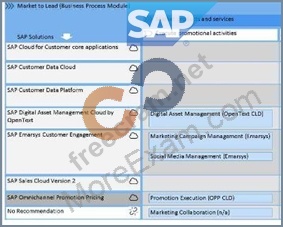
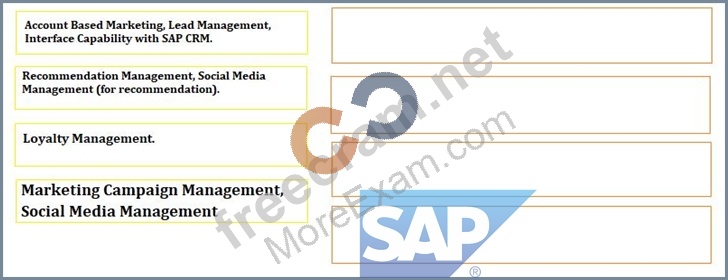
Question7: With the lead to cash Business capabilities identified, as chief Enterprise Architect the Wanderlust CIO has asked your capabilities.See Image,The SAP enterprise Architect has shared the snapshot for your reference. What is the pertinent SAP Solution in the market to Lead Business Process module of the Lead to cash E2E Process
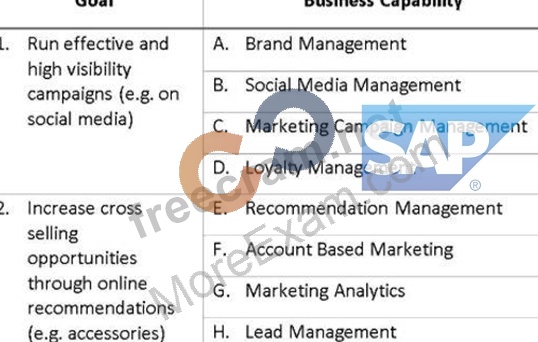
Question8: Having identified the appropriate sel of Business Activities, as the Chief Enterprise Architect of Wanderlust, assisted by the sap Enterprise Architects. you have been trying to relate to Lead to Cash Business Capabilities in the SAP Reference Business Architecture content repository. In light of the two key goals outlined by the Wanderlust CIO, what are the most appropriate Business Capabilities? Note: There are 3 correct answers to this question.
Question9: As the Chief Enterprise Architect of Wanderlust GmbH, you know that there is very little process documentation available on online marketing processes within Wanderlust. You also know that SAP has a rich End-to-End (E2E) Business Processes content repository. To take advantage of that, you have engaged an SAP Enterprise Architect. The SAP Enterprise Architect is using SAP's Business Process Model (BPM) and the Business Capability Model (BCM) while mapping processes to capabilities, how are the two models connected? Note: There are 2 correct answers to this question.
Question10: The CIO of Wanderlust strongly feels that the seldom-used legacy Marketing application cannot be the platform to rejuvenate their online marketing business. As Chief Enterprise Architect, the CIO has entrusted you with the responsibility of finding a suitable replacement that can support all current processes and also address the issues plaguing the existing application. Which of the following should you do to conclusively shortlist possible applications to replace the existing one? Note: There are 2 correct answers to this question.
Question11: Which of the following roles are missing from Wanderlust's current Enterprise Architecture practice structure? Note: There are 2 correct answers to this question.
Question12: As part of the mapping of a Business Architecture to the Solution Architecture, an Environment & Location Diagram must be developed in the Technology Architecture phase. In this context, numerous architecture decisions have to be made. Among other things, you must check which SAP BTP services and which SAP SaaS solutions are available as part of the Solution Architecture in which data center of the desired hyperscaler. How do you go about this validation?
Question13: As Chief Enterprise Architect, you want to select an extension option that follows SAP's clean-core strategy. What are your recommendations to implement the clean-core strategy best?
Question14: Which artifact from the SAP Reference Solution Architecture shows which data objects are exchanged between SAP application components in a given end-to-end scenario?
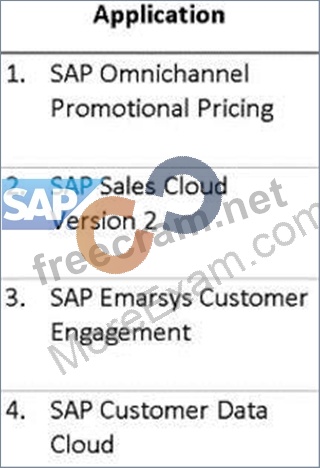
Question15: The Wanderlust CIO, along with you, the Chief Enterprise Architect, are in the process of deciding on the application that can potentially replace your existing online marketing application, and you are trying to create the artifact Business Footprint Diagram for decision support ( See table below) Which of the following combinations of goals, business capabilities, and applications would you recommend? Note: There are 2 correct answers to this question,
Question16: As an Enterprise Architect, you must ensure that future extensions to the Digital Core of the enterprise guarantee stable and reliable operations. The architecture guideline demands to follow the clean-core strategy. What does this demand ensure and entail?
Question17: A custom web application developed with SAPUI5 and running on SAP Business Technology Platform uses large custom data objects deployed in a central data store (SAP HANA Cloud). The solution architect of the application is unsure about which tools to use for integration of this data from different SAP Sources into the central data store and asks you as the Enterprise Architect for guidance. Under which conditions is a data-oriented integration approach (Data Integration) preferable to other integration styles?
Question18: As Chief Enterprise Architect, you are asked to select an Enterprise Architecture toolset for Wanderlust GmbH' Enterprise Architecture activities. What are the most critical selection criteria you should consider? Note: There are 3 correct answers to this question.
Question19: For the next Architecture Board meeting, you need to determine the next steps required after the business, application/data and technology architecture designs have been created. What do you recommend?
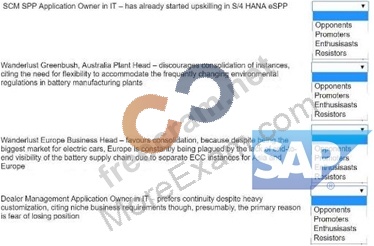
Question20: While trying to identify and map key stakeholders in Wanderlust, you, as the Chief Enterprise Architect, have been evangelizing the strategic business and IT objectives with business and IT departments across regions and taking in their views on the upcoming business transformation, Match the feedback from stakeholders (shown on the left) to the categorization and to some of the actions in the dropdown lists.
Question21: Green Elk & Company is the world's leading manufacturer of agricultural and forestry machinery. The former company slogan "Eik always runs has recently been changed to "Eik feeds the world" One of Green Elk's strategic goals is to increase its revenue in the emerging markets of China, India, and other parts of Asia by 80 % within three years. This requires a new business model that caters to significantly smaller farms with limited budgets You are the Chief Enterprise Architect and the decision was taken to implement regional S/4HANA productive systems while ensuring a high degree of standardization. Which of the following implementation approach would you consider best in this case?
Question22: Select the most appropriate sequence of critical Business Capabilities for the Business Architecture Roadmap.
Question23: Wanderlust's numbers for order booking have been on a free-fall, ever since a recent economic downturn reduced showroom footfall to near zero. To counter the drop in in-person bookings, the CEO and CIO have been looking to revive their online channel, which was started six years ago. However, this channel was seldom used before the pandemic, which has led to a complete breakdown of Wanderlust's online marketing business ecosystem. Also of major concern, is their existing Non-SAP Marketing application, which lays unused due to poor integration with SAP CRM. As Chief Enterprise Architect, you have been approached by the CEO to document the online marketing business ecosystem first. Which of the following actions would you do to meet your CEO's request? Note: There are 2 correct answers to this question