EMT Practice Test

1. Question Content...

Question List

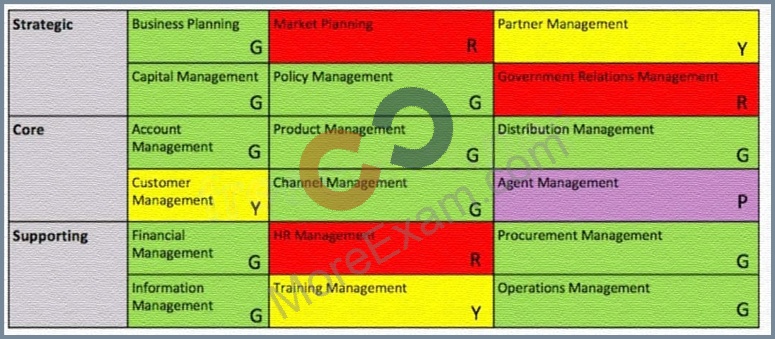
Question1: Consider the following business capability map. where cells of a model are given different colors to represent maturity levels (note the letters G, R. Y. P also denote the colors used = Green, Red. Yellow and Purple):

Which of the following best describes this technique?

Question2: Which of the following best describes the relationship between business models and business architecture?

Question3: Which statement best describes iteration and the ADM?

Question4: Complete the sentence. A key principle of value streams is that value is always defined from the perspective of the_____________

Question5: Which of the following best describes a business capability?

Question6: Consider the following statements:
A whole corporation or a division of a corporation
A government agency or a single government department
Partnerships and alliances of businesses working together, such as a consortium or supply chain What are those examples of according to the TOGAF Standard?

Question7: What information does the Architecture Requirements Repository within the Architecture Repository hold?

Question8: Consider the following example using the Business Model Canvas:

What are the segments labeled A, D and I?

Question9: Exhibit.

Consider the diagram of an architecture development cycle.
Select the correct phase names corresponding to the labels 1, 2 and 3?

Question10: Which of the following Business Architecture concepts should the architect examine and search for when developing the Architecture Vision?

Question11: What Is presented as striking a balance between positive and negative outcomes resulting from the realization of either opportunities or threats"?

Question12: Which of the following is a purpose of mapping capabilities to value stream stages?

Question13: Complete the sentence. The architecture domains that are considered by the TOGAF standard as subsets of an overall enterprise architecture are Business, Technology,

Question14: Which of the following is a benefit of Value Stream Mapping?

Question15: Which of the following best describes where business scenarios are used in the TOGAF ADM?

Question16: Which of the following describes how the Enterprise Continuum is used when developing an enterprise architecture?

Question17: What is presented as "striking a balance between positive and negative outcomes resulting from the realization of either opportunities or threats"?

Question18: Which approach to model, measure, and analyze business value is primarily concerned with identifying the participants involved in creating and delivering value?

Question19: In what TOGAF ADM phase should the architect locate existing architecture descriptions to create an information map?

Question20: Which of the following best describes information mapping?

Question21: What process turns a set of business capabilities into a structure that communicates the right amount of detail to different stakeholder groups?

Question22: Which of the following can be used to help define information concepts in an information map?

Question23: Consider the following:
You need to analyze a new value stream within the scope of a project.
Which of the following would you use?

Question24: Which of the following is a difference between an organization map and an organization chart?

Question25: Which of the following is the element of a value stream stage that describes the end state condition denoting the completion of the value stream stage?

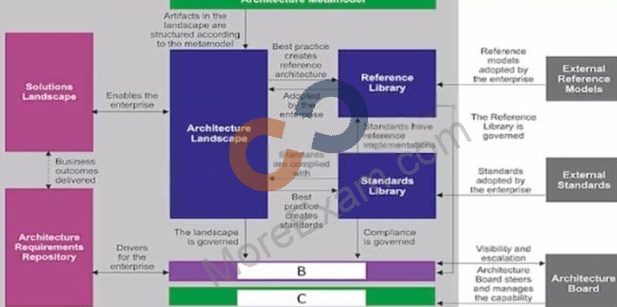
Question26: In the diagram, what are the items labelled A, B, and C?
Question27: Question: Which of the following best describes a business capability map?

Question28: Which of the following is the element of a value stream stage that describes the end state condition denoting the completion of the value stream stage?

Question29: When developing a Business Architecture, which of the following best describes the approach to take If no Architecture Descriptions exist?

Question30: Consider the following chart:

Which important concept for Enterprise Architecture Practitioners does it illustrate?

Question31: Which of the following is an analysis technique which is used to show a range of different perspectives on the same set of business capabilities?

Question32: Which of the following is a benefit of organization mapping?

Question33: Which of the following lists the components of a business capability?

Question34: In business capability mapping, when you have documented all of the business capabilities, what should you do next?

Question35: Which statement best describes iteration and the ADM?

Question36: Refer to the table below:
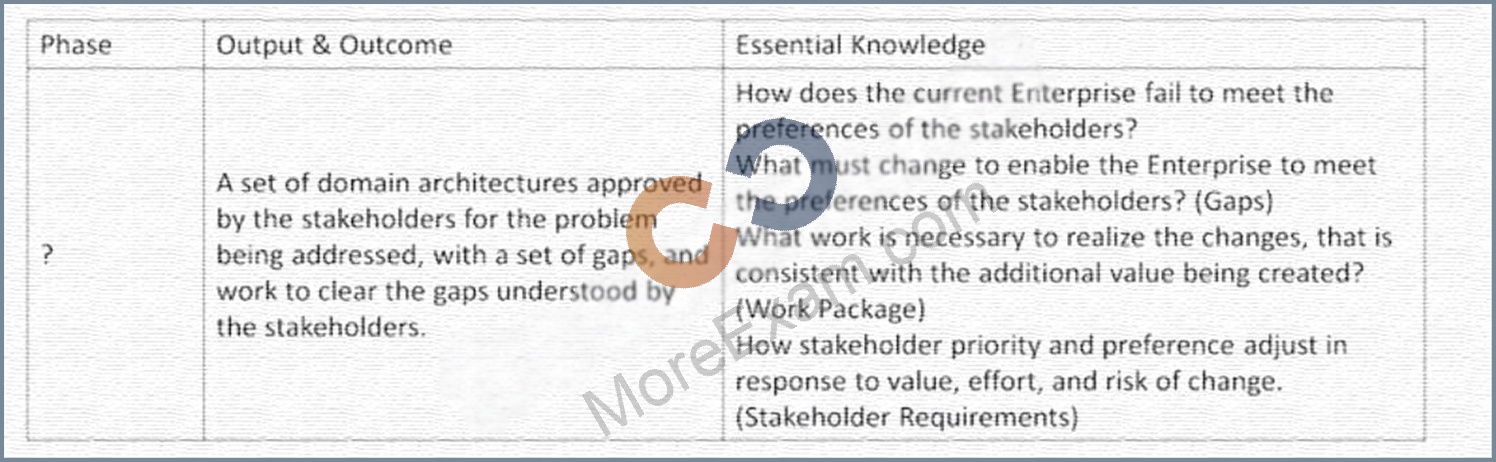
Which ADM Phase(s) does this describe?

Question37: In business capability mapping, when you have documented all of the business capabilities, what should you do next?

Question38: Which of the following is the element of a value stream stage that describes the state change that triggers the value stream stage?

Question39: Consider the following modeling example, relating business capabilities to organization units so as to highlight duplication and redundancy:

(Note in this example the cells colored green, yellow, and red, are also marked G. Y, and R, respectively) Which of the following best describes this technique?

Question40: Which of the following supports the need to govern Enterprise Architecture?

Question41: Which of the following is a difference between an organization map and an organization chart?

Question42: Which of the following is a benefit of information mapping?