EMT Practice Test

1. Question Content...


Question List

Question1: An administrator is tasked with configuring remote direct memory access (RDMA) over Converged Ethernet v2 (RoCE v2).
Which two types of adapters must the administrator configure? (Choose two.)

Question2: An administrator is tasked with migrating a single virtual machine (VM) from an existing VMware vCenter to a secure environment where corporate security policy requires that all VMs be encrypted. The secure environment consists of a dedicated vCenter instance with a 4-node vSphere cluster and already contains a number of encrypted VMs.
Which two steps must the administrator take to ensure the migration is a success? (Choose two.)

Question3: An administrator is configuring vSphere Lifecycle Manager to install patches to a vSphere cluster. The cluster runs workload virtual machines (VMs) that are incompatible with vSphere vMotion, and therefore cannot be live migrated between hosts during the installation of the patches.
Which configuration in vSphere Lifecycle Manager will allow the administrator to reduce the downtime associated with the patching operation without migrating the VMs?

Question4: An administrator decides to restore VMware vCenter from a file-based backup following a failed upgrade. Which interface should the administrator use to complete the restore?

Question5: What are two uses cases for VMware Tools? (Choose two.)

Question6: An administrator is completing the configuration of a new vSphere cluster and has enabled vSphere High Availability (HA) and vSphere Distributed Resource Scheduler (DRS).
After adding the ESXi hosts to the cluster, which networking information will the administrator be prompted to provide when using the Cluster Quickstart workflow?

Question7: Refer to Exhibit:

An environment has the following configuration:
* Resource Pool "RP-MOM? has a reservation of 6GHz and one running virtual machine (VM) "VM-M1? with 1 GHz reserved
* Resource Pool ^RP-KID? has a reservation of 2GHz, and expandable reservations is activated The administrator creates two VMs, "VM-K1? and 'VM-K2?, in the ''RP-KID? resource pool with 2GHz reserved for each, and turns on "VM-M1 ?
Given this scenario, which statement is true?

Question8: An administrator is tasked with installing VMware vCenter. The vCenter Server Appliance must support an environment of:
* 400 hosts
* 4000 virtual machines
Which two resources must be allocated, at a minimum, to meet the requirements? (Choose two.)

Question9: After a recent unexplained peak in virtual machine (VM) CPU usage, an administrator is asked to monitor the VM performance for a recurrence of the issue.
Which two tools can the administrator use? (Choose two.)

Question10: An administrator is planning to upgrade a VMware vCenter instance to version 8. It is currently integrated with the following solutions:
* VMware Aria Automation
* VMware Cloud Director
Which tool can the administrator use to run Interoperability reports before the upgrade process?

Question11: An administrator needs to consolidate a number of physical servers by migrating the workloads to a software-defined data center solution.
Which VMware solution should the administrator recommend?

Question12: A vSphere environment is experiencing intermittent short bursts of CPU contention, causing brief production outages for some of the virtual machines (VMs). To understand the cause of the issue, the administrator wants to observe near real-time statistics for all VMs.
Which two vSphere reporting tools could the administrator use? (Choose two.)

Question13: An administrator is attempting to configure Storage I/O Control (SIOC) on five datastores within a vSphere environment. The administrator is being asked to determine why SIOC configuration completed successfully on only four of the datastores.
What are two possible reasons why the configuration was not successful? (Choose two.)

Question14: An administrator notices a performance issue in VMvvare vCenter To try and understand more about the performance issue, the administrator needs to gather more information about the vCenter database to eliminate a potential disk space issue.
Which two tools can the administrator use? (Choose two.)

Question15: An administrator plans to bring VMware vCenter offline in order to perform hardware mainte-nance on the host where the vCenter Server Appliance is running.
Which vSphere feature must be configured to ensure that vCenter users experience minimal downtime?

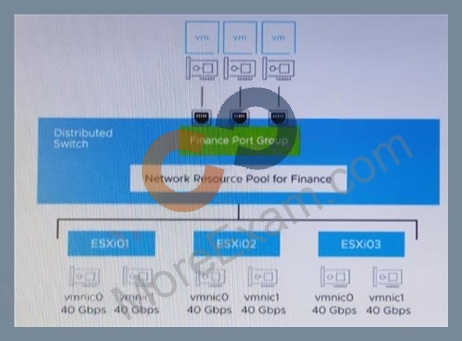
Question16: Refer to the exhibit.

An administrator set up the following configuration:
* The distributed switch has three ESXi hosts, and each host has two 40 Gbps NICs.
* The amount of bandwidth reserved for virtual machine (VM) traffic is 6 Gbps.
The administrator wants to guarantee that VMs in the Finance distributed port group can access 50 percent of the available reserved bandwidth for VM traffic. k Given this scenario, what should the size (in Gbps) of the Finance network resource pool be?

Question17: An administrator is tasked with looking into the disaster recovery (DR) options for a software-defined data center (SDDC).
The following requirements must be met:
* All virtual machines (VMs) must be protected to a secondary site.
* The source VMs must remain online until the failover.
* When failing over to the secondary site, application downtime is allowed
* The DR failover must be managed from the vSphere Client.
* Costs must remain as low as possible.
How can the administrator accomplish this task?

Question18: Which two tasks can be completed using vSphere LifeCycle Manager? (Choose two.)

Question19: An administrator Is performing maintenance activities and discovers that a Virtual Machine File System (VMFS) datastore has a lot more used capacity than expected. The datastore contains 10 virtual machines (VMs) and, when the administrator reviews the contents of the associated datastore, discovers that five- virtual machines have a snapshot file (-delta.vmdk flies) that has not been modified In over 12 months. The administrator chei kfl the Snapshot Manager within the vSphere Client and confirms that there are no snapshots visible.
Which task should the administrator complete on the virtual machines to free up datastore space?

Question20: An administrator has mapped three vSphere zones to three vSphere clusters.
Which two statements are true for this vSphere with Tanzu zonal Supervisor enablement? (Choose two.)

Question21: An administrator is tasked with configuring vSphere Trust Authority. The administrator has completed the following steps:
* Set up the workstation
* Enabled the Trust Authority Administrator
* Enabled the Trust Authority State
* Collected information about the ESXi hosts and vCenter to be trusted
Which step does the administrator need to complete next?

Question22: Which step is completed during Stage 1 of the vCenter Server Appliance deployment?
Question23: An administrator is investigating reports of users experiencing difficulties logging into a VMware vCenter instance using LDAP accounts.
Which service should the administrator check as part of troubleshooting?

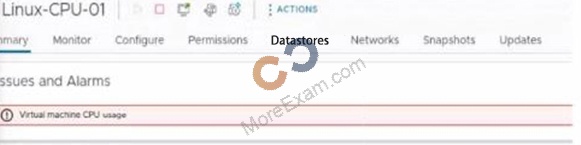
Question24: Refer to the exhibit.

After removing an ESXi host from a cluster for maintenance, a number of virtual machines have encountered the warning seen in the exhibit. After re-adding the ESXi, the issue is resolved. Which step should the administrator take to move the triggered alarm to its normal state?

Question25: An administrator is tasked with implementing a backup solution capable of backing up the Supervisor cluster, vSphere Pods, and persistent volumes.
Which two solutions must be used to meet this requirement? (Choose two.)

Question26: What is the minimum network throughput in Gb/s for vSAN using the Express Storage Architecture (ESA)?

Question27: After a number of outages within a production VMware software-defined data center, an administrator is tasked with identifying a solution to meet the following requirements:
* Reduce the risk of outages by proactively identifying issues with the environment and resolving them.
* Reduce the complexity of uploading log bundles when raising support tickets.
Which solution should the administrator recommend to meet these requirements?

Question28: Following a merger with another company, an administrator is tasked with configuring an identity source for VMware vCenter so that all vSphere administrators can authenticate using their existing Active Directory accounts. Each company has user accounts in their own Active Directory forests.
The following additional information has been provided:
* The corporate policy states that only Windows-based machine accounts are allowed in Active Directory. Which action should the administrator take to configure vCenter Single Sign-On (SSO) to meet this requirement?

Question29: Which two datastore types store the components of a virtual machine as a set of objects? (Choose two.)

Question30: Refer to the exhibit.

Given the configuration shown in the exhibit, what should the administrator do if the latest VM template contains changes that are no longer needed?

Question31: An administrator has a requirement to revert a running virtual machine to a previous snapshot after a failed attempt to upgrade an application. When the administrator originally took the snapshot, the following choices in the Take Snapshot dialog were made:
* Snapshot the virtual machine's memory = false
* Quiesce guest file system = false
What will be the result of the administrator selecting the 'Revert to Latest Snapshot? option to return the virtual machine to a previous snapshot? (Choose two.)

Question32: An administrator needs to update a VMware vCenter instance to a newer minor release version. Due to restrictions within the environment, the vCenter instance does not have access to the Internet As a first step, the administrator downloads the required update on another machine.
What are the next steps the administrator must perform to complete the update?
A Place the update ISO file in a Virtual Machine File System (VMFS) datastore.
' Use the vSphere Client to select the update ISO file as the source for the update.

Question33: After adding a new vSphere ESXi host with identical hardware configuration to an existing vSphere cluster, which task would an administrator complete prior to checking the compliance with an existing host profile?

Question34: An administrator needs better performance and near-zero CPU utilization from the ESXI hosts for networking functions and processing. The administrator creates a new vSphere Distributed Switch and enables network offloads compatibility.
Which solution would help achieve this goal?

Question35: An administrator is tasked with applying updates to a vSphere cluster running vSAN using vSphere Lifecycle Manager.
Downtime to the ESXI hosts must be minimal while the work Is completed.
The administrator has already completed the following steps and no errors have been returned:
* Downloaded all applicable software and created a new Image
* Attached the new Image to the cluster and run a compliance check against the Image for the cluster
* Ran a remediation pre-check for the cluster
Which two series of steps should the administrator perform to start the remediation of the cluster using the new image? (Choose two.)

Question36: What are two use cases for VMware vSphere+? (Choose two.)

Question37: An administrator has Windows virtual machines (VMs) and VMware Tools is installed in each VM. The administrator performs a status check of VMware Tools using vSphere Lifecycle Manager.
What is the VMware Tools status for the Windows VMs if the version of VMware Tools has a known problem and must be immediately upgraded?

Question38: A vSphere cluster hosts a three-tier application The cluster has 50% resources available. If a host in the cluster fails, the database server must be online before the application server, and the application server must be online before the Web server.
Which feature can be used to meet these requirements?

Question39: A combination of which two components of the software-defined data center (SDDC) are responsible for the initial abstraction of CPU, memory, disk, and network resources and their subsequent management? (Choose two.)

Question40: An administrator is tasked with adding two additional hosts into an existing production vSphere cluster to support the need for additional capacity.
The vSphere cluster currently has four identically configured ESXi hosts (esxOT esx02. esx03 and esx04) that utilize Intel Skylake-based CPUs. The two new hosts (esx05 and esx06) are configured identically in terms of memory and storage to the existing hosts: but utilize Intel Ice Lake-based CPUs.
The administrator must ensure that:
* Any virtual machine migrates to any of the six ESXi hosts running in the cluster.
* There is no virtual machine downtime during the process of adding the new hosts.
Which step should the administrator take to meet these requirements?

Question41: An administrator Is looking to deploy a new VMware vCenter Instance. The current environment consists of 75 hosts and is expected to grow up to 100 hosts over the next three years.
Which deployment size should the administrator select?

Question42: Which feature would allow for the non-disruptive migration of a virtual machine between two clusters in a single VMware vCenter instance?

Question43: Refer to the exhibit.

An administrator set up the following configuration:
* The distributed switch has four ESXi hosts, and each host has two 10 Gbps NICs.
* In the Network I/O Control configuration, the amount of bandwidth reserved for virtual machine (VM) traffic if 4 Gbps.
The administrator wants to guarantee that VMs in the Retail distributed port group can access 50 percent of the available reserved bandwidth for VM traffic.
Given this scenario, what should the size (in Gbps) of the Retail network resource pool be?

Question44: During the staging of a patch on a vCenter Server Appliance, an error was encountered and the process stopped. An administrator resolved the root cause and is ready to continue with the staging of the patch.
From the vCenter Management Interface, which action should the administrator take to continue the process from the point at which the error occurred?