EMT Practice Test

1. Question Content...


Question List

Question1: What may be a cause for failure to unmount an NFS datastore?

Question2: Users of an application are reporting performance issues.
The following performance values are observed in the vSphere Web Client:
Host CPU utilization is 90%

Virtual Machine memory utilization is consistently greater than 90%

CPU Ready values are higher than 20%

What could be the cause of the application performance issue?

Question3: A virtual machine has been renamed and an administrator is unable to find files with the new virtual machine name in the datastore.
What is the reason for this?

Question4: What is the VMware recommended way to distribute storage I/O loads across multiple paths to minimize downtime and remove potential bottlenecks?

Question5: What component must be installed prior to deploying a vCenter Server in vSphere 6.x?
Question6: A vSphere Administrator notices that one of the virtual machines has been configured for VMDirectPath I/ O, and a physical NIC has been assigned to the VM.
What feature is not available to this VM?

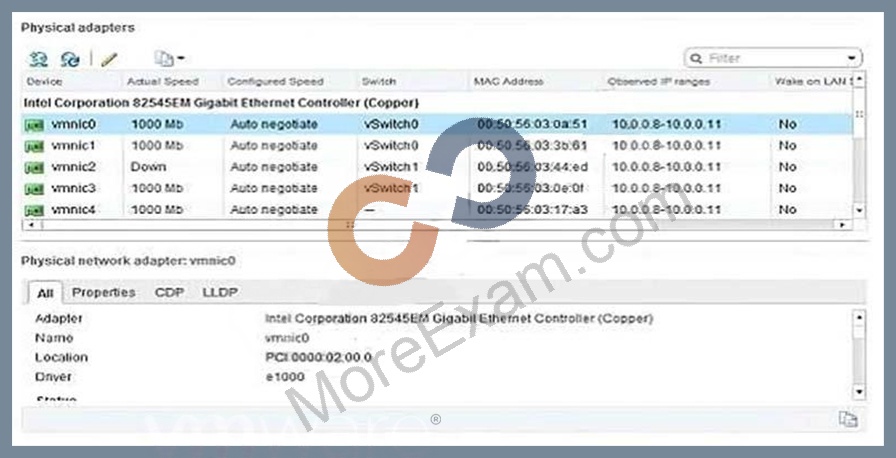
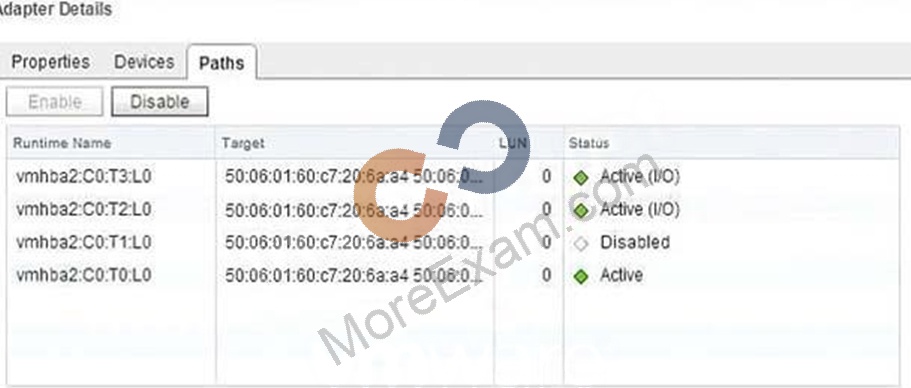
Question7: Refer to the Exhibit. A storage administrator is not seeing full utilization of all bandwidth from an ESXi host.
The vSphere administrator observes the adapter details, as shown in the Exhibit.

What is the probable cause of this issue?

Question8: What two utilities provide a VMware vSphere 6.x Administrator a detailed look at how ESXi uses resources in real time? (Choose two.)

Question9: How many Link Aggregation Groups (LAGs) can be configured on a vSphere 6.x Distributed Switch?

Question10: An administrator creates an ESXi cluster using vSphere Auto Deploy. The ESXi hosts are configured to get a management IP address from a DHCP server. The administrator needs to troubleshoot the management network on one of the hosts. Which DCUI option should the administrator use to renew the DHCP lease?

Question11: Your manager has given you a bash script that retrieves data for ESXi 6.x host configurations.
This data needs to be collected right after the installation of a host and must be run directly on the host.
Which two actions can be used to run this script on an ESXi host? (Choose two.)

Question12: What are three goals of resource management within a cluster? (Choose three.)

Question13: What are two valid states for Compliance Status in VM Storage Policy? (Choose two.)

Question14: An administrator is attempting to migrate a large Hadoop virtual machine using vMotion.
The administrator notices a delay when the machine is quiesced. The Hadoop virtual machine is processing many transactions a second to an in-memory database.
Which two actions would help reduce the amount of time needed to perform a vMotion on this virtual machine? (Choose two.)

Question15: A vSphere Administrator notices that sometimes they receive poor network throughput for multiple port groups that reside on a vSwitch with multiple physical uplinks (vmnics). The configuration on the ESXi host is identical to other hosts that are working properly in the same cluster.
What should be done next?

Question16: A Fault Tolerance (FT) virtual machine with four vCPUs is experiencing high latency when performing ICMP and Application tests.
What are three potential causes that may be attributing to this latency? (Choose three.)

Question17: What is the maximum supporter number of vCPU per VM in VMware vSphere 6.5?

Question18: When using vSAN, all the storage characteristics are specified by Storage Policies. Which parameter in vSAN Storage Policies can increase performance in a cache miss situation? (Choose the best answer.)

Question19: What is true regarding datastores on ESXi 6.x?

Question20: When is it possible to place a VMFS5 datastore in maintenance mode?

Question21: An organization has a number of virtual machines that would benefit from Fault Tolerance.
These include:
A single vCPU Apache Server
A dual vCPU vCenter Server
A quad vCPU SQL Server
An eight vCPU Hadoop Server
Which two virtual machines can be configured to use VMware Fault Tolerance? (Choose two.)

Question22: Which two actions are required when enabling vFlash Read Cache for a virtual machine's virtual disk?
(Choose two.)

Question23: An administrator is tasked with performing a vMotion migration of a virtual machine.
The virtual machine is configured as follows:
vSphere Flash Read Cache (vFRC) enabled

Is part of a Distributed Resource Cluster (DRS) Cluster

Which two statements are true? (Choose two.)

Question24: You are editing the management network configuration of an ESXi 6.x Host from the vSphere Web Client.
You mistakenly put the incorrect VLAN in place for the management network.
What action do you need to take to correct this?

Question25: A vSphere Administrator is required to apply security hardening policies following the VMware vSphere Hardening Guide recommendations.
Which tool enables native compliance reporting for these guidelines?

Question26: Which two statements are Datastore Cluster requirements? (Choose two.)
Question27: Which three factors should an Administrator take into account when determining the required VDP appliance size and number of appliances? (Choose three.)

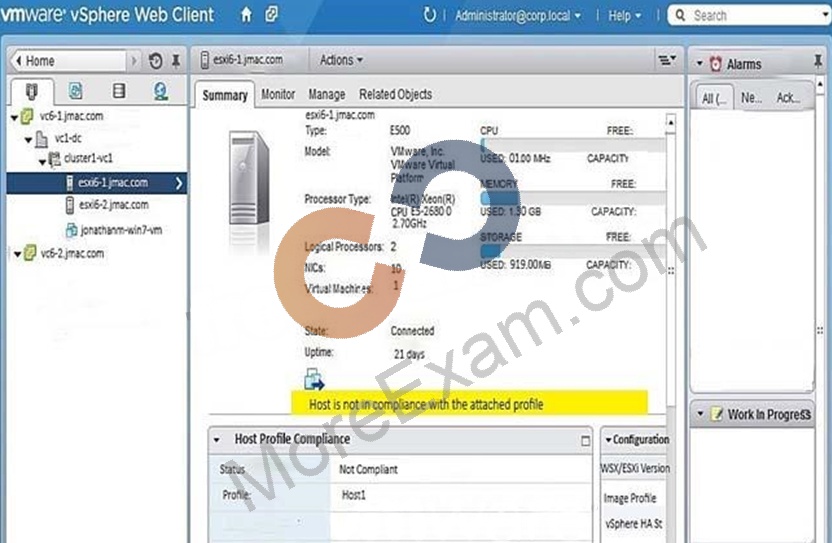
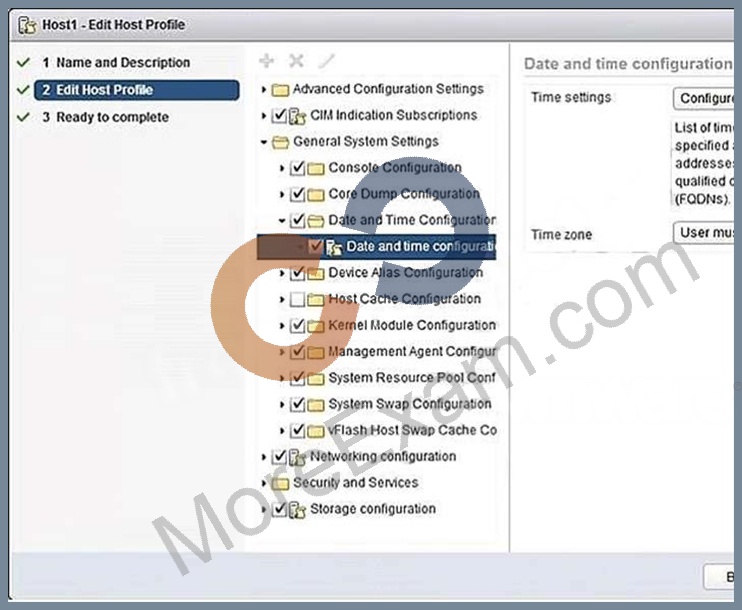
Question28: Refer to the Exhibit. An administrator has configured a host profile so that ESXi 6.x hosts will point to the corporate NTP server for time synchronization. The NTP server is located at 10.0.30.213, but time has not been synchronized properly across the ESXi hosts.

The administrator reviews Host Profile settings as shown in the Exhibit.
Which two steps are required to resolve the issue? (Choose two.)

Question29: VM Components Protection (VMCP) can provide automated recovery for which two virtual machine failures? (Choose two.)

Question30: You need to add an object to an existing vApp using the vSphere Web Client. How is this accomplished?

Question31: An administrator has just completed performing an interactive installation of ESXi 6.x and is booting the host.
How is the network initially configured?

Question32: What is the maximum supported number of vCPU per VM in VMware vSphere 6.5?

Question33: Which scenario shows a reason for VMware Tools failing to install?

Question34: After selecting an object in vRealize Operations, how can a user compare the badge values of related child objects?

Question35: What is the effective vSphere licensing level during the 60 day evaluation period?

Question36: Which three limits can restrict the maximum number of simultaneous migrations that can occur in a vSphere environment? (Choose three.)

Question37: An administrator is attempting to restore a number of files in a directory within the Operating System of a virtual machine.
How can the administrator restore the files from a previous backup?

Question38: Which three are architecture components of vRealize Operations? (Choose three.)

Question39: Which two Identity Sources are available to add for vCenter Single Sign-On authentication? (Choose two.)

Question40: An administrator has recently installed a new ESXi 6.x Host, and during the configuration notices sporadic network problems. To check whether the issue occurred sometime during the configuration, the administrator would like to reset the system.
How can this be accomplished in the shortest amount of time?

Question41: Which password meets the default password requirements in ESXi 6.x?

Question42: A VMware vSphere 6.x Administrator is implementing a new eight-node cluster for business critical applications. Each server will be configured with two 10 GbE network adapters and will utilize iSCSI for storage on one subnet.
Which feature is required to implement this solution?

Question43: What two virtual hardware devices can be added to a powered on VM? (Choose two.)
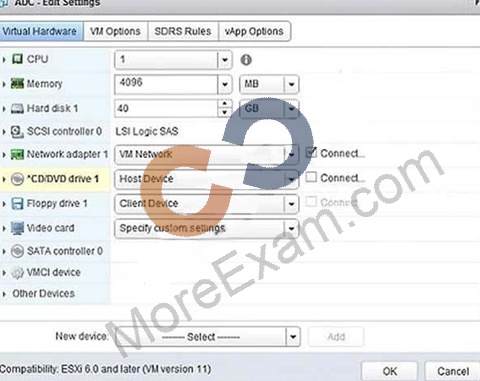
Question44: Refer to the Exhibit. An administrator is installing Windows into a virtual machine. The DVD has been mounted on the Host and configured for the virtual machine as shown in the Exhibit.

Based on the exhibit, when the virtual machine is booted, why would it attempt to search for a PXE server?

Question45: By default, how many login attempts will an ESXi host allow before locking out the account?

Question46: A vSphere Administrator attempts to remove a host from a vSphere distributed switch, and fails. There is a notification that resources are still in use.
What are two possible causes? (Choose two.)

Question47: An administrator enables High Availability (HA) on a Virtual SAN cluster.
Which network is used for HA Network Heatbeat configuration?

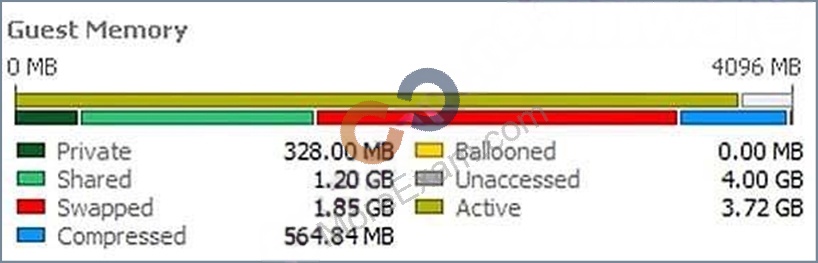
Question48: Refer to the Exhibit. A 4 GB Memory virtual machine is experiencing extended memory issues, as shown in the Exhibit.

What potential issues could be attributed to this memory pressure?

Question49: Which key combination will let a vSphere Administrator revert to the previous version or build of ESXi?

Question50: Which three features are not supported when using Fault Tolerance in vSphere 6.x? (Choose three.)

Question51: As part of a multisite Single Sign-On (SSO) deployment what two steps are required to ensure that a change to one Single Sign-On instance is propagated to the other instances? (Choose two.)

Question52: A VMware vSphere 6.x Administrator is tasked with configuring vRealize Log Insight.
What three ports can be used for syslog? (Choose three.)

Question53: Which option is true during a virtual machine cold migration?

Question54: What must be enabled to ensure that VM Component Protection (VMCP) works in a High Availability cluster?

Question55: When managing search queries in vRealize Log Insight, what three actions can be performed? (Choose three.)

Question56: A vApp named Sales has a Memory Limit of 32 GB and a CPU Limit of 12,000 MHz.
There are three virtual machines within the vApp:
Sales-DB -- Has a memory reservation of 20 GB.
Sales-DC -- Has a memory reservation of 8 GB.
Sales-Web -- Has a memory reservation of 8 GB.
Which statement is correct?

Question57: Which three connection types are available when configuring a vSwitch in the vSphere Web Client?
(Choose three.)

Question58: An administrator creates a DRS cluster of eight ESXi 6.x hosts. There are 10 virtual machines balanced across the hosts. An attempt to place the first host into maintenance mode fails.
What are two reasons that the host failed to enter maintenance mode? (Choose two.)

Question59: An administrator wants to add a web server to an existing multi-tier application consisting of three virtual machines:
A web server
A database server
An application server
The web server should be added to the application when the primary web server reaches:
7 0% vCPU utilization
5 5% active memory
Which option will achieve this result?

Question60: What two files are created when the Take snapshot operation is executed? (Choose two.)
Question61: An administrator must determine an appropriate backup solution, given these conditions:
- 50 of the virtual machines are in a resource pool named Finance.
- 50 of the virtual machines are in a resource pool named QA.
Which solution allows an administrator the ability to backup 100 virtual machines?

Question62: Which two statements about virtual switches in vSphere 6.x virtual networking are true? (Choose two.)

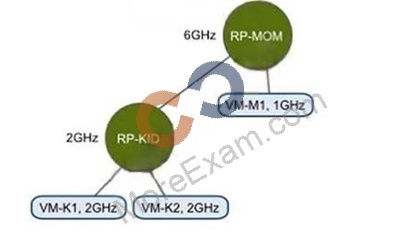
Question63: Refer to the Exhibit. An administrator has created the resource pool configuration shown in the Exhibit.

Based on the exhibit, which virtual machine(s) can be successfully powered on?

Question64: A vSphere Administrator notices that the newly deployed ESXi hosts cannot stay in a connected state in vCenter Server for more than 60 seconds at a time. The Administrator knows that the hardware is in good health and that the ESXi hypervisors are properly configured.
What is the source of the problem?

Question65: An ESXi host has limited network connectivity.
What three troubleshooting steps can a vSphere Administrator take? (Choose three.)

Question66: Which three object types can be stored in the Content Library? (Choose three.)

Question67: What is true about a virtual machine with (orphaned) appended to the display name?

Question68: An administrator is attempting to remove an ESXi 6.x host from a vSphere Distributed Switch (vDS). When the administrator attempts to remove the host, the following error is observed:
The resource '16' is still in use.
What three steps are needed to successfully remove the host from the switch? (Choose three.)

Question69: Which three options are available when applying a Customization Specification to an existing virtual machine? (Choose three.)

Question70: Which three options are required to use vSphere DRS features successfully? (Choose three.)

Question71: ESXi 6.x can be installed upon which three supported hardware configurations? (Choose three.)

Question72: During an upgrade, the ESXi 6.x installer finds an existing version of ESXi and a VMFS3 volume.
No virtual machines exist on the host or VMFS3 volume. The requirement is to upgrade to VMFS5.
Which option should be chosen to meet this requirement?

Question73: A High Availability (HA) cluster is configured to respond to a given number of host failures.
The cluster contains virtual machines configured with these settings:
- VM1 has a 1GHz CPU reservation and no Memory reservation
- VM2 has a 2GHz CPU reservation and no Memory reservation
- VM3 has no CPU reservation and no Memory reservation
Given this information, what is the correct slot size for the cluster?

Question74: An administrator has configured an alarm to be notified when a virtual machine meets two conditions:
high virtual CPU
high active memory consumption
The alarm is malfunctioning and triggering when either condition is met instead of both.
What can be done to correct the issue?

Question75: Which virtual SCSI controller would be recommended when deploying a Windows Server 2012 R2 VM that will host a database server which is expected to generate high I/O?

Question76: A physical Windows 2008 R2 Server is converted to a virtual machine using VMware vCenter Converter.
Upon completion of the conversion and subsequent power on operation, the virtual machine fails to boot and the message below is observed in the Console of the virtual machine:
STOP 0x0000007B INACCESSIBLE_BOOT_DEVICE
Which two potential issues may be causing this boot failure? (Choose two.)

Question77: Which feature of vSphere 6.x enables organizations to move virtual machines across data centers?

Question78: A virtual machine template is accidentally removed from the vCenter Server Inventory.
Which method would be used to recover the template back into the environment?

Question79: What is a valid plug-in status for a plug-in that has been added to a vSphere client?

Question80: What information is required as part of an interactive ESXi 6.x installation?

Question81: A mission-critical virtual machine built on vSphere 4.1 needs to be moved to an ESXi 6.x host.
Which virtual hardware version is needed to move the virtual machine without upgrading?

Question82: You are creating a virtual machine in the Web Client using the New Virtual Machine wizard.
Which two steps are required? (Choose two.)

Question83: What are three valid disk configurations for the vSphere Data Protection 6.x Appliance? (Choose three.)

Question84: Which vSphere 6.x feature will allow an organization to utilize native snapshots?

Question85: vMotion can be performed between which three physical boundaries? (Choose three.)

Question86: An organization has configured Distributed Power Management (DPM) on a vSphere 6 cluster.
The organization wants to be alerted when an ESXi host has been powered down by DPM.
Which two options represent the type and name of the alarm that would accomplish this? (Choose two.)

Question87: Which actions take place when DRS Automation is set to Partially Automated?

Question88: Which two options can change the thin provisioned disk to thick provisioned? (Choose two.)

Question89: Which type of Adapter does not require vmkernel networking?

Question90: Which statement is true regarding the licensing of vCenter Server?

Question91: What is required when changing a virtual machine name using the vSphere Web Client?

Question92: An organization has an ESXi 6.x host that contains two resource pools.
The host is being relocated to a DRS cluster.
What two actions can be taken to integrate the host into the cluster, and what would happen to the existing ESXi resource pool hierarchy as a result? (Choose two.)

Question93: What is a benefit of using Enhanced vMotion Compatibility for an environment?

Question94: When modifying a vApp, which two vSphere entities can be added? (Choose two.)

Question95: The vSphere administrator is configuring directory services for an ESXi host:

What should the vSphere administrator do to configure the host to use CAM services?

Question96: Which two SMTP Notification Event Details are specific to alarms triggered by events? (Choose two.)

Question97: A vSphere Administrator wants to migrate a virtual machine from a host with an AMD Opteron CPU to an intel Xeon CPU.
Which method should be used?

Question98: A vApp template recently added to a Content Library is not displayed.
Which two actions could correct this problem? (Choose two.)

Question99: What are the two minimum configurations of a disk group in a vSAN host? (Choose two.)

Question100: An administrator is upgrading a vSphere Distributed Switch. The existing switch is version 5.0 and the administrator wants to upgrade to the latest version possible. The environment contains several ESXi 5.1 hosts.
Which two options are available to ensure that the upgraded switch will be compatible with these hosts?
(Choose two.)

Question101: An administrator creates an ESXi cluster using vSphere Auto Deploy.
The ESXi hosts are configured to get a management IP address from a DHCP server.
The administrator needs to troubleshoot the management network on one of the hosts.
Which DCUI option should the administrator use to renew the DHCP lease?

Question102: Which three VLAN Tagging modes are available in vSphere 6.x? (Choose three.)

Question103: What is the maximum supported RAM per virtual machine (VM) in vSphere 6.5?
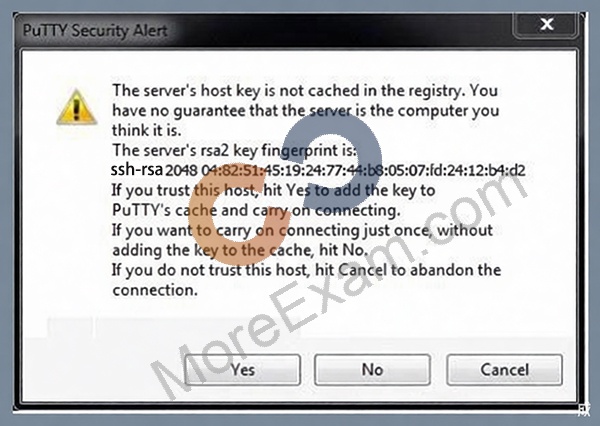
Question104: The vSphere administrator attempts to connect to an ESXi host via an SSH client and receives the following security alert:

The vSphere administrator needs to determine whether the RSA key fingerprint shown in the security alert is the fingerprint of the intended ESXi host.
Which tool should the vSphere administrator use?

Question105: A vSphere administrator wants to migrate a virtual machine with vMotion from one node to another in the same cluster, but when the destination server is specified, an error message is displayed.
What might be wrong? (Choose two.)

Question106: You have just installed an ESXi 6.x Host. As part of your company security regulations, a security banner must be presented on the console of the host.
How can this action be accomplished?

Question107: An administrator deploys vRealize Operations into a vSphere 6.x environment.
After the deployment, the administrator notices that badges are not appearing.
What is a likely cause of this behavior?

Question108: An administrator has configured an alarm to be notified when a virtual machine meets either of these conditions:
High virtual CPU
High active memory consumption.
The alarm is only triggering when both of the conditions are met.
What can be done to correct the alarm behavior?

Question109: What are two benefits of using NFS 4.1 with vSphere 6.x as compared to NFS 3? (Choose two.)

Question110: An attempt to enable vSphere Fault Tolerance for a powered-on virtual machine fails.
Which two scenarios would result in this failure? (Choose two.)

Question111: An administrator needs to verify that vMotion operations can be performed in a vSphere data center.
What round trip time (RTT) latency is the maximum value that will allow vMotion operations to succeed?

Question112: An administrator has an application that requires connection directly to PCI devices through a virtual machine.
What is a limitation of this configuration?

Question113: Which two statements are true about VMFS5 datastores on ESXi 6.x? (Choose two.)

Question114: What are two valid iSCSI discovery methods? (Choose two.)
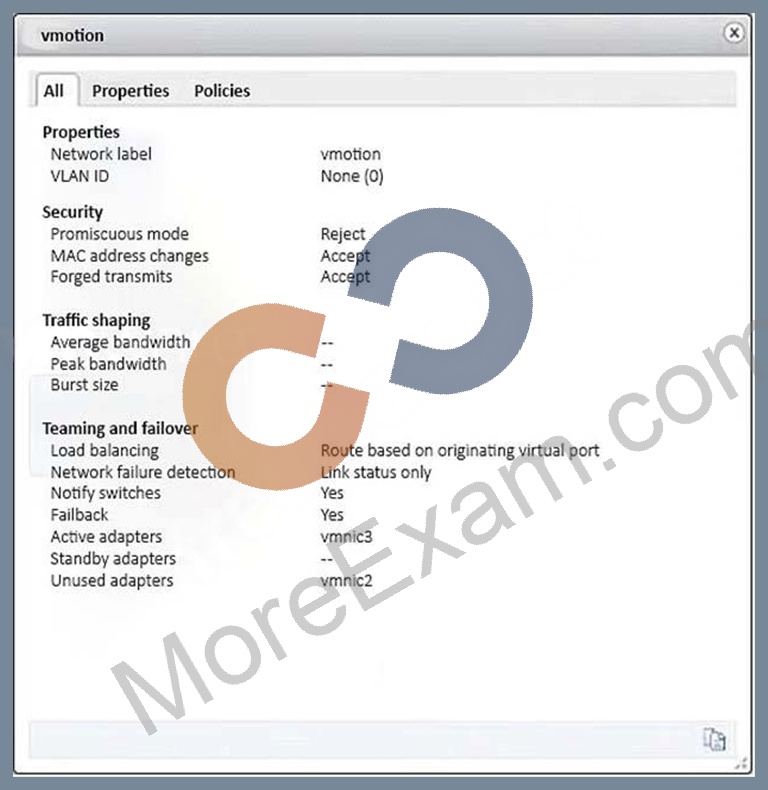
Question115: What happens to the status of users already logged into ESXi Shell when a vSphere administrator enables lockdown mode?

Question116: A vSphere Administrator uses vMotion to migrate a virtual machine between two ESXi hosts and notices that they can no longer ping the VM.
What is the cause?

Question117: An administrator reports that the System Event log data is only available for 24 hours when reviewing the Hardware Status tab.
Which condition could be responsible for the loss of data?

Question118: Refer to the Exhibit. A storage administrator has reported that full utilization of all bandwidth from an ESXi
6.x host is not being seen. In troubleshooting the issue, the Adapter details are shown in the Exhibit.

Based on the exhibit, what is cause of the issue?

Question119: An administrator is migrating a virtual machine from a Test cluster to a Production cluster.
The two environments do not have any shared storage.
What is the easiest way to accomplish this task?

Question120: An administrator is evaluating whether to deploy vCenter Server on a Windows server or on a vCenter Server appliance. The administrator has the following requirements:
- A web browser will be utilized to manage the vSphere environment.
- 16 ESXi hosts will be deployed.
- Licenses must be shared with a vCenter Server at another site.
- An external Oracle 10g database server will be used to host the vCenter Server database.
Why will the administrator need to deploy vCenter Server on a Windows server?

Question121: Refer to the Exhibit.
An administrator has been given requirements to configure vMotion for a new virtual machine. The configuration should:
Provide Network Redundancy
Use VLAN 550
Be secured against anyone trying to spoof communication
The vSwitch1 configuration is shown in the Exhibit.

Which three changes should be made to meet the stated requirements? (Choose three.)

Question122: In order for a company to meet regulatory requirements, all ESXi 6.x Hosts must be configured to direct logs to a syslog server.
What are two ways ESXi hosts can configured for this action? (Choose two)

Question123: Refer to the Exhibit. An administrator logs into the vSphere Web Client and sees the warning shown in the Exhibit.

During a change control window, the warning was addressed.
What should be done to verify that the host is no longer showing the warning?

Question124: Which two actions are prerequisites to adding ESXi 6.x hosts to a vSphere Distributed Switch? (Choose two.)

Question125: An administrator has just configured the IP address on an ESXi host from the Direct Console User Interface.
How can the configuration be validated as correct without any additional tools?

Question126: An administrator has unsuccessfully attempted several times to install an Operating System inside a virtual machine. The administrator finds that the installation fails at random intervals.
Which two actions can be taken to resolve this issue? (Choose two.)

Question127: An administrator deploys vCenter Server using the embedded Platform Services Controller.
After testing the deployment for a couple of months, it is determined that the environment would be better served with an external Platform Services Controller.
What should the administrator do to meet this new requirement?

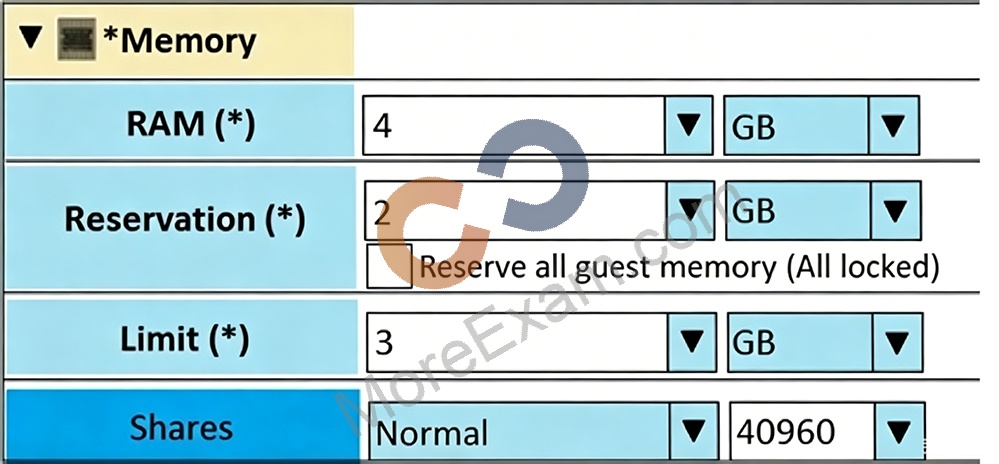
Question128: When a vSphere Administrator powers on a VM with the following configuration, what will be the resulting swap file size?

Question129: Which two statements are true about LACP support with the vSphere Distributed Switch? (Choose two.)

Question130: vSphere Update Manager allows which two virtual machine attributes to be upgraded? (Choose two.)

Question131: An administrator logs into the vSphere Web Client, but is unable to see any hosts and clusters.
Which two options could fix the problem? (Choose two.)

Question132: Which two configurable options apply to both virtual machine CPU and memory allocation? (Choose two.)

Question133: An administrator has just completed installing an ESXi 6.x host, but doesn't know what address has been configured.
Where is the ESXi host IP address configured?

Question134: An ESXi 6.x host consists of 24 logical cores. Hyperthreading is enabled on the host.
What is the maximum number of vCPUs that can be assigned to a virtual machine on this host?

Question135: ESXi supports which three iSCSI adapters? (Choose three.)

Question136: A vSphere Administrator just finished installing new software on the Windows vCenter Server and notices that vCenter Server services no longer start properly.
What two tasks should be done next? (Choose two.)

Question137: One of your virtual machines (VM) has performance issues and sometimes in unresponsive.
Which VM file must be checked in order to find the root cause?

Question138: Which virtual switch load balancing method should be used when teaming network interfaces with EtherChannel?

Question139: Which type of network traffic is used for vSphere High Availability (HA) by default?

Question140: Which three IP addresses may be pinged by the Test Management Network feature in the ESXi hosts DCUI? (Choose three.)

Question141: Which three options are available for remediation with Proactive HA? (Choose three.)

Question142: Which two options can be monitored when creating a new Alarm Definition? (Choose two.)
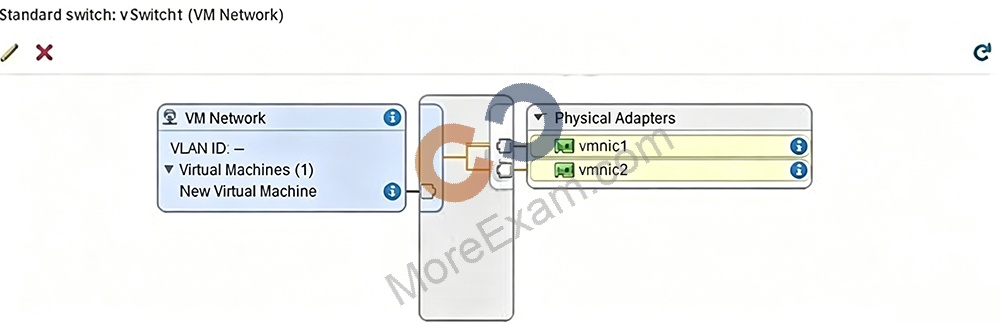
Question143: Which three actions are available in Troubleshooting Mode in the ESXi Direct Console User Interface (DCUI)? (Choose three.)

Question144: An administrator is monitoring a High Availability (HA) and Distributed Resource Scheduler (DRS) enabled cluster and has noticed that virtual machines in the cluster are being migrated without user intervention.
Why is this happening?

Question145: An administrator is re-provisioning an ESXi host and moving it to another datacenter.
Which DCUI option should the administrator use to revert the system configuration to the default settings?

Question146: Which two Virtual SAN related actions might start resynchronization of virtual machine objects?
(Choose two.)

Question147: An administrator is unable to login to vCenter Server when using the vSphere web client.
The administrator successfully accessed vCenter Server using the client earlier the same day.
What is the most appropriate first step the administrator should take to resolve this issue?

Question148: When adding a new VLAN to an existing virtual distributed switch, which three steps are necessary?
(Choose three.)

Question149: Virtual machines do not power on after completing the clone or deploy from template workflow in the vSphere Web Client.
What two solutions will fix this problem? (Choose two.)

Question150: After enabling iSCSI port binding on ESXi hosts, a vSphere Administrator can no longer reach an iSCSI Array Target from the configured software iSCSI initiators. Which can be the root cause for the failure?

Question151: Refer to the Exhibit. An administrator has configured network connectivity for a new virtual machine, as shown in the Exhibit.

What will occur with the network traffic of this virtual machine when communicating externally from vSwitch1?

Question152: VMware vRealize Log Insight can be configured to send notification events to which endpoint?

Question153: Which load balancing policy, previously limited to vSphere Distributed Switches, is now available on vSphere Standard Switches with vSphere 6.x?

Question154: During a new vSphere Distributed Switch configuration, where does the Maximum Transmission Unit (MTU) value get modified?

Question155: How are ports scaled on vSphere Standard Switches (vSS)?

Question156: Which two statements are true regarding VMware vSphere Flash Read Cache (vFRC)? (Choose two.)

Question157: Which two statements are true when configuring a virtual flash resources (vFlash)? (Choose two.)

Question158: A Primary Fault Tolerant VM is performing poorly despite its ESXi host having adequate resources and CPUs are idle. Other hosts in the cluster are much more heavily utilized.
What is the cause?

Question159: What are two possible causes of Storage Distributed Resource Scheduler (SDRS) being disabled on one or more virtual machine disks in a datastore cluster? (Choose two.)

Question160: A user wants to monitor a business-critical virtual machine to ensure that it doesn't run out of resources.
What metric could be monitored in vRealize Operations to address this concern?

Question161: VMware tools is failing to install on a Microsoft Windows virtual machine.
What are two possible situations that would prevent the installation? (Choose two.)

Question162: Which Single Sign-On deployment mode should an administrator use for two 6.x vCenter Servers configured with linked mode?

Question163: VMware vSphere 6.x provides which three capabilities? (Choose three.)

Question164: An administrator is planning a vSphere infrastructure with the following specific networking requirements:
- The ability to shape inbound (RX) traffic
- Support for Private VLANs (PVLANs)
- Support for LLDP (Link Layer Discovery Protocol)
What is the minimum vSphere Edition that will support these requirements?

Question165: What are two uses of the vRealize Log Insight Agents for Windows and Linux? (Choose two.)

Question166: Which three features can be enabled for a new host cluster? (Choose three.)

Question167: An administrator enables vSphere High Availability (HA) on an existing cluster with a large number of hosts and virtual machines.
The administrator notices that the setup of vSphere HA on some of the hosts is failing.
What step, if taken, might resolve this issue?

Question168: What two object types can be created inside of vApp? (Choose two.)

Question169: Which two choices are VMware-recommended ESXi syslog configurations? (Choose two.)

Question170: An administrator needs to monitor traffic on vSwitches in a vSphere 6.x environment.
Which option, if configured, would accomplish this task?

Question171: Which two badges are major badges in vRealize Operations? (Choose two.)
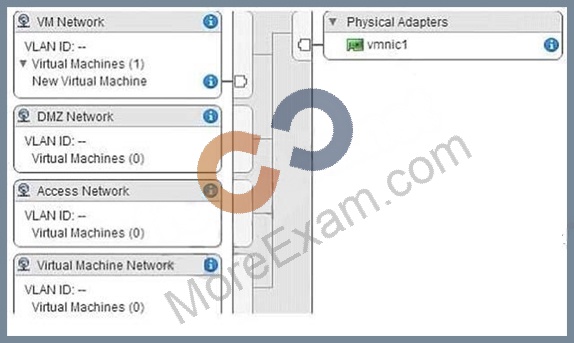
Question172: A vCenter Server displays this error for a single host:
Virtual machine creation may fail because agent is unable to retrieve VM creation options from the host Which action will allow a vSphere Administrator to resolve the issue?

Question173: Refer to the Exhibit. A vSphere 6.x Standard Switch is configured with 4 virtual machine portgroups, as shown in the exhibit.

Which portgroup would be utilized by default when creating a new virtual machine?

Question174: Refer to the Exhibit. An administrator is configuring an ESXi 6.x host to use multiple NICs to resolve a management network redundancy error. After configuring a second NIC, the server is not able to communicate when the primary connection is taken down.
The administrator analyzes the Exhibit shown here.

Based on the exhibit, what is the likely cause of the issue?

Question175: After installation of a host in your test environment, you need to move it to production.
The only major change that needs to be made is that the hostname of the server needs to change.
What are two ways that an administrator can change the host name without editing configuration files on the host directly? (Choose two.)

Question176: What is the optimal configuration when building a virtual machine for a single-threaded Windows application?

Question177: When you add an ESXi 6.x host to a new Cluster, which vSphere object owns the CPU and Memory resources of the hosts?

Question178: An administrator is troubleshooting basic network connectivity issues.
Which two scenarios are potential issues that this administrator might face? (Choose two.)

Question179: What are two valid methods to deploy an OVF template which consists of two or more VMs? (Choose two.)

Question180: What are two ways to identify TCP/IP stack information? (Choose two.)
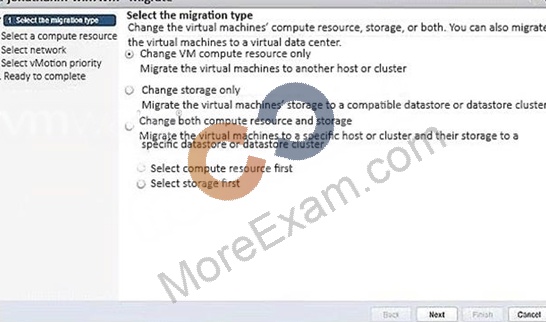
Question181: What two scenarios will prevent extending a VMDK that is attached to a powered on VM? (Choose two.)

Question182: Refer to the Exhibit. An administrator is migrating a powered-on virtual machine, as shown in the exhibit.

Which option should be selected to perform a Storage vMotion of the VM?

Question183: A new vApp was built and tested in the corporate headquarters datacenter running vSphere 6.x.
What condition would explain why the virtual machine is failing to boot in an offsite datacenter running on vSphere 5.5?

Question184: An administrator is deploying multiple Windows 2003 Virtual Machines from the same template.
What two steps should be taken to avoid network conflicts? (Choose two.)

Question185: What is a requirement when enabling a Virtual SAN cluster in an existing High Availability (HA) and Distributed Resource Scheduler (DRS) Cluster?

Question186: Why are some virtual machines orphaned after rebooting a High Availability (HA) enabled host?

Question187: Which two NFS Protocol versions does vSphere 6 support? (Choose two.)

Question188: What two IT infrastructure components are virtualized by vSphere Essentials? (Choose two.)

Question189: From which two locations in the inventory hierarchy can you deploy a virtual machine using a template?
(Choose two.)

Question190: Which of the following options are configurable in a Resource Pool? (Choose two.)

Question191: A vSphere Administrator notices that upgrading VMware Tools on a single VM fails. Upon closer inspection, the summary tab shows that the VMware Tools status is unmanaged.
What is true about this virtual machine?

Question192: A VMware vSphere 6.x Administrator has been tasked with enabling the Integrated Load Balancer for the new vRealize Log Insight cluster.
What three options are required before the Integrated Load Balancer can be used? (Choose three.)

Question193: An administrator is attempting to enable Storage I/O Control on a datastore, but it is failing.
What is the likely reason for this failure?

Question194: A vSphere Administrator wants to enable Storage I/O Control. There is a mix of VMFS and NFS datastores. All of the VMFS datastores have hardware acceleration enabled. The Administrator attempts to create a new datastore cluster but is unable to add all of the datastores to the cluster.
What is the problem?

Question195: Which vSphere 6 Standard Edition feature will allow an organization to ensure that critical multi-threaded applications have the maximum possible uptime?

Question196: An administrator is unable to create the first group in a new vRealize Operations environment.
What is the likely cause of the problem?

Question197: Refer to the Exhibit. An administrator is adding an NFS datastore as shown in the Exhibit.

What is the purpose of the Servers to be added list?

Question198: An administrator is moving a virtual machine into a resource pool. The VM and resource pool are configured as shown:
VM configuration:
2 GHz CPU reservation
1 GB Memory limit
Resource Pool configuration:
6 GHz CPU reservation
1 GB Memory reservation
No limit to memory
What happens to the virtual machine's resource settings when it is moved into the pool?

Question199: What is a benefit of using VMware Data Protection (VDP)?

Question200: Which is a valid requirement for deploying the vCenter Server Appliance 6.x to a DRS cluster?

Question201: An administrator is performing a scripted installation of ESXi 6.x.
In which three locations does the script need to be? (Choose three.)

Question202: A vSphere administrator has been using vSphere in evaluation mode and now wants to deploy an environment that provides the same features.
Which edition of vSphere provides similar functionality to evaluation mode?

Question203: What three types of widgets can be added to a vRealize Log Insight Custom Dashboard? (Choose three.)

Question204: Which are two requirements for vMotion without shared storage? (Choose two.)

Question205: Which three items should be validated prior to installing ESXi 6.x? (Choose three.)
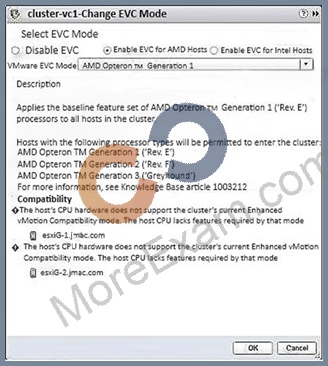
Question206: Which two statements are true about deploying and using vSphere Replication? (Choose two.)

Question207: What condition would prevent an administrator from creating a new VMFS3 datastore on an ESXi 6.x host using the vSphere Web Client?

Question208: Refer to the Exhibit. An administrator attempts to enable Enhanced vMotion Compatibility (EVC) on a cluster.
The operation results in a compatibility error, as shown in the exhibit.

What is the likely cause of this error?

Question209: Which three are requirements when using vMotion to move a virtual machine across vCenter Server systems? (Choose three.)

Question210: A virtual machine is experiencing performance issues.
The following performance metrics are observed:
CPU usage value for the virtual machine is above 90%

CPU ready value for the virtual machine is above 20%

Which two activities will likely resolve the performance issues? (Choose two.)

Question211: A vSphere Administrator sees the alarm:
vSphere HA virtual machine failed to failover
This occurred for a number of virtual machines on a particular ESXi host in a cluster with vSphere High Availability (HA) enabled. The virtual machines guest operating systems never reported a power event.
What happened?

Question212: An administrator is performing an interactive installation of ESXi 6.x.
Which three options are available for installation? (Choose three.)

Question213: An administrator attempts to migrate a suspended virtual machine to a newly deployed vSphere 6.x cluster. The compatibility check fails.
What condition could cause this behavior?

Question214: When attempting to access a virtual machine, an administrator is unable to login using the vSphere credentials.
What two options are probable causes of the authentication failure? (Choose two.)

Question215: An application running in a virtual machine is experiencing performance issues. When utilizing performance monitoring utilities, it is noted that the CPU Utilization of the application is at 100%.
Which two scenarios are probable causes of the CPU contention for the application? (Choose two.)

Question216: What is the minimum version of ESXi required to support VMFS6? (Choose the best answer.)

Question217: An administrator attempts to install vCenter Single Sign-On Server. The installer returns an error message indicating that the installation failed. Prior to the installation, all setup prerequisites were met. The administrator has generated a vCenter Server Single Sign-On support bundle.
Which two files should the administrator analyze to determine the cause of the failure? (Choose two.)

Question218: A company has decided to implement Virtual SAN within their vSphere 6.x environment.
The Virtual SAN cluster will be composed of three ESXi 6.x hosts that are on the Virtual SAN Ready Node list.
Each ESXi host includes:
Two SAS Controllers that support Passthrough Mode

Four Solid State Drives (SSDs) 1TB in size each

20 SAS Magnetic Disks (MDs) 1TB in size each

The SSDs and MDs are evenly split between the two SAS controllers

The company will pilot a Virtual SAN cluster utilizing VMware best practices while maximizing storage capacity. The Virtual SAN cluster will use Manual Mode.
Which two Disk Group configurations would meet the stated configuration requirements? (Choose two.)

Question219: A vApp is running out of compute resources when overall activity is high within the resource pool. At other times, everything is fine.
What should be done to resolve this issue?

Question220: Which two parameters are required when adding an iSCSI target to an iSCSI Software Adapter using Dynamic Discovery? (Choose two.)

Question221: Which vSphere 6 Enterprise Edition feature will allow an organization to ensure that critical multi-threaded applications have the maximum possible uptime?

Question222: A VMware vSphere 6.x Administrator is looking at the following output from esxtop on an ESXi host:

What does DAVG/cmd represent?

Question223: Which three steps must be taken to use vSphere Update Manager 6.x to upgrade an ESXi 5.5 host to vSphere 6.x? (Choose three.)

Question224: Immediately after installing ESXi, an administrator observes that the Configure Lockdown Mode option is grayed out in the Direct Console User Interface (DCUI).
What is the most likely explanation?

Question225: Which two statements are correct when licensing an ESXi 6.x host? (Choose two.)

Question226: A user is trying to retrieve objects from a SharePoint server and finds the request is taking an excessive amount of time. An administrator tries to isolate the issue and notes the following:
- Application performance is poor when compared to virtual machines on other hosts.
- Performance improves when the virtual machine is moved to another host.
The virtual machine encounters higher than expected CPU %Ready times.
What conclusion can be reached regarding the performance issues for this virtual machine?

Question227: In the vSphere Web Client, what are the records of user actions or system actions that occur on objects in vCenter Server or on a host? (Choose the best answer.)

Question228: A vSphere Administrator has stated that currently Private VLAN is utilized to prevent cross-talk on the dedicated backup network.
What two actions are required to implement Private VLAN in VMware vSphere? (Choose two.)