MoreExam
1. Question Content...
EXPLANATION
Answer: X - EXPLANATION Content.
Question1: Which two resources can be used by an NSX architect during the Assessment Phase? (Choose two.)
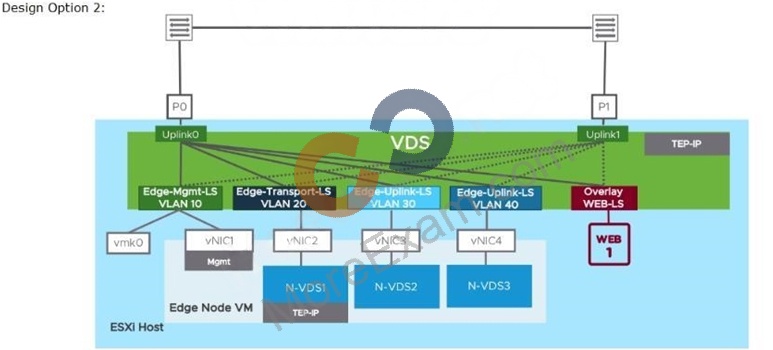
Question2: Refer to the exhibits.An architect is helping an organization with the Logical Design of an NSX-T Data Center solution. This information was gathered during the Assessment Phase:* Existing network hardware must be used.* Existing ESXi hosts with 2 pNICS must be used.* One vCenter must be used for virtual environment management.* Customer is concerned NSX-T will use too many resources.Which design option should the architect propose to the customer?
Question3: Which two benefits can be achieved using in-band management of an NSX Bare Metal Edge Node? (Choose two.)
Question4: An architect is helping an organization with the Physical Design of an NSX-T Data Center solution and resolving a network throughput bottleneck. This information was gathered during a workshop:* A VM running a business critical application Is peaking at ~5Gbps* Current host uplink is configured as Active/Standby with two 10Gb NICs.* The installed server NIC model does not support GENEVE offload.* All VM traffic is East/West.* The business critical application VM communicates with multiple client VMs.Which should the architect recommend to improve vSphere VM throughput?
Question5: Which NSX-T feature is used to allocate the network bandwidth to business-critical applications and to resolve situations where several types of traffic compete for common resources?
Question6: Which is associated with the Discover Task of the Engagement Lifecycle?
Question7: An architect is helping an organization with the Logical Design of an NSX-T Data Center solution. This information was gathered during the Assessment Phase:* Data between two networks connected over a public network needs to be encrypted.* Certificate authentication is required.* Dynamic route learning is preferred.Which should the architect include in their design?
Question8: An architect is helping an organization with the Logical Design of an NSX-T Data Center solution. This information was gathered during the Assessment Phase:1. Any solution should add more value to current and future customers engagements.2. The solution should improve the company's operational efficiency.3. The design should offer agility and freedom for application phases.4. There should be improvement in application life cycle SLAs.5. Current physical solution is composed of many vendors taking care of many layers of security, but it is getting complex. A reduction in complexity will be something expected from any solution.6. Current business continuity and disaster recovery plans are based on tape technology. A public cloud class of service should be party of any new solution.7. Scripts are used for repeatable tasks in combination with many open source tools.8. Delays are Incurred with new marketing campaigns because an external IT services company must be hired.Campaigns must be accelerated with any new solution.9. All application servers have hardcoded IP addresses.10. Different vendors are used for our storage solution.11. The time line before an upcoming freeze period is soon.Which two statements should the architect consider as non technical requirements? (Choose two.)
Question9: An architect is helping an organization with the Logical Design of a Layer 2 bridging solution. This information was gathered during the Assessment Phase:* Workloads are running on ESXI hosts.* Workloads are running on KVM hosts.* Workloads on both type of hypervisors should use bridging services.* VLAN 50 is used for Tier-0 uplink connectivity.Which should the architect include in their design?
Question10: An architect is helping an organization with the Physical Design of an NSX-T Data Center solution. This information was gathered during a workshop about ESXi Host networking:* A total of 50 ESXI hosts to be configured as Transport Nodes.* All ESXi hosts have a dedicated 2 x Intel 10Gbps Physical Network adapter for the Overlay Traffic.To achieve low latency, high throughput, redundancy, and performance, which two NIC teaming policies should the architect recommend? (Choose two.)
Question11: According to the Discover Task of the Engagement Lifecycle, which statement would be classified as a risk?
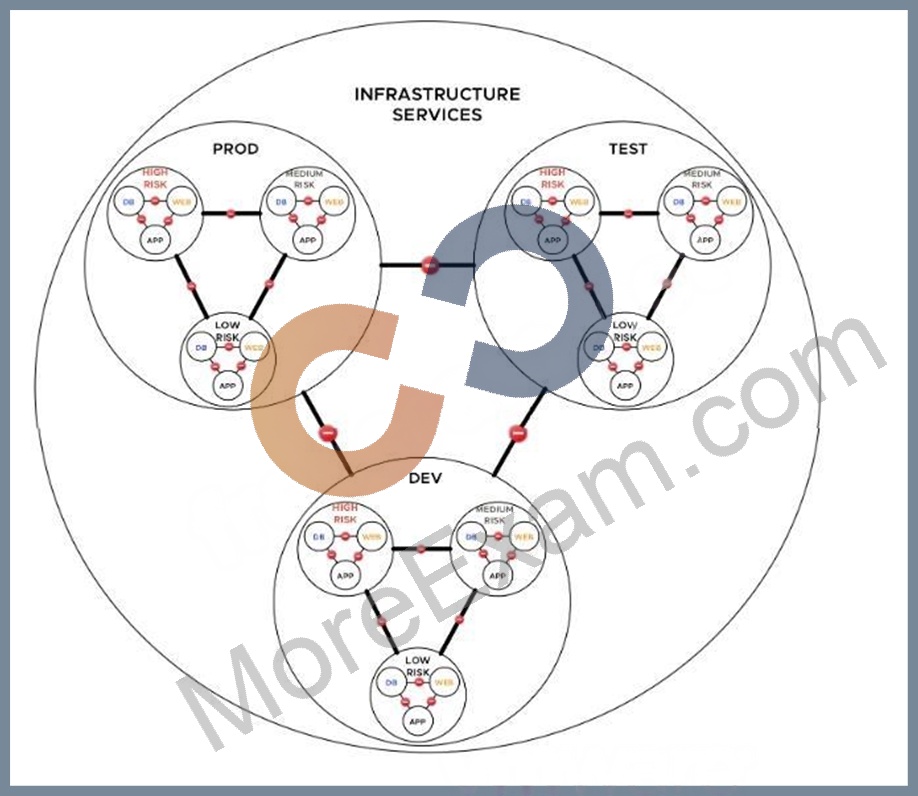
Question12: Refer to the exhibit.A financial company is adopting micro-services with the intent of simplifying network security. An NSX-T architect is proposing a NSX-T Data Center micro-segmentation logical design. The architect has created a diagram to share with the customer.How many security levels will be implemented according to this Logical Design?