EMT Practice Test

1. Question Content...


Question List

Question1: What are the design considerations for virtual switch design in NSX?

Question2: What is a key advantage of using the NSX Distributed Firewall?

Question3: Which of the following should be taken into account when designing the uplink profile and transport node profile?

Question4: A company is planning to deploy NSX to provide a multi-tenant environment for their customers. The solutions architect is responsible for designing the network services to ensure that each tenant's traffic is isolated and secure.
Which of the following NSX features should the solutions architect use to achieve this goal?

Question5: A Solutions Architect working with a multinational corporation has several branch offices located across different geographical regions. The organization is looking for a secure and reliable way to connect these branch offices to the corporate data center and ensure secure communication between them.
What NSX feature should be recommended by the architect?

Question6: Choosing NSX security features should be guided by?

Question7: Which three VMware guidelines are recommended when designing VLANs and subnets for a single region and single availability zone?(Choose three.)

Question8: Failover detection mechanisms in NSX are designed to?

Question9: The stretched networking capability in Federation allows for?

Question10: In NSX, stateful services on edge clusters can enhance?

Question11: When designing top-of-rack (ToR) switches, which guideline is crucial?

Question12: The use of NSX Gateway Firewall as an inter-tenant firewall enables?

Question13: What should growth patterns for edge clusters consider? (Choose two)

Question14: Physical design in a VMware environment is concerned with?

Question15: Which of the following is a requirement for using NSX Federation for disaster recovery?

Question16: Multitier architectures in NSX provide control over stateful service location by:

Question17: A Solutions Architect is working with a customer who wants to extend their traditional Telco IP/MPLS core network to an NFV cloud.
Which NSX feature can be recommended by the architect?

Question18: What is the function of the data plane in NSX?

Question19: Which of the following would be an example of a customer requirement that a solutions architect must consider in the design of an NSX solution?

Question20: A solutions architect is designing an NSX solution for a customer who has a rapidly growing environment and expects to add more workloads over time. The customer wants to ensure that their NSX Edge clusters can accommodate this growth.
Which two of the following growth patterns for NSX Edge clusters should the solutions architect consider when designing this solution?(Choose two.)

Question21: A Solutions Architect is designing an NSX solution for a customer. Which of the following would be an example of a logical design for this project?

Question22: A customer has an application running on multiple VMs and requires a high-performance network with low latency.
Which NSX feature can provide the desired performance boost for this use case?

Question23: What does Geneve Offload primarily aim to improve?

Question24: Which of the following describes the role of the NSX Gateway Firewall as an inter-tenantfirewall within a VMware NSX solution?

Question25: How do enterprise and service provider NSX designs typically differ?

Question26: Identifying customers' requirements is crucial for?

Question27: Which three of the following are components of switch fabric design?(Choose three.)

Question28: Which combination of stateful services are available in an NSX Gateway?

Question29: Differentiating between dedicated and collapsed cluster approaches involves understanding?

Question30: NSX Distributed Firewall supports which of the following capabilities? (Choose two)

Question31: A Solutions Architect is designing an NSX solution for a customer who needs to extend their on- premises VLANs to a public cloud environment. The customer wants to use L2 bridging to extend the VLANs across the environments.
Which of the following design considerations should the Solutions Architect keep in mind when using L2 bridging solutions in NSX for this use case?

Question32: What is a key scale consideration in an NSX multisite design?

Question33: What does the term "High Availability" refer to in design terms?

Question34: Guidelines for designing top-of-rack switches often emphasize? (Choose two)

Question35: How do Federation disaster recovery designs differ?

Question36: VMware Cloud Foundation designs are primarily focused on providing?
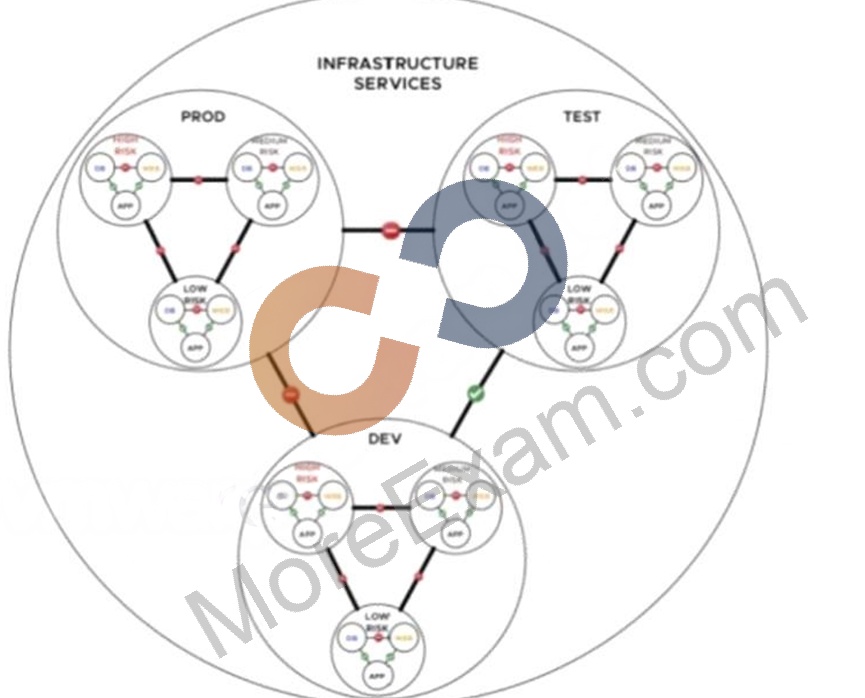
Question37: Refer to the exhibit.

A financial company is adopting micro-services with the intent of simplifying network security. An NSX architect is proposing a NSX segmentation logical design. The architect has created a diagram to share with the customer.
Which design choice provides less management overhead?

Question38: The NSX management cluster primarily functions to?

Question39: The benefits of using SSL Offload include?

Question40: Enhanced Datapath modes are designed for? (Choose two)

Question41: Which are features of the NSX Gateway Firewall? (Choose two)

Question42: A typical scalable architecture in NSX would feature:

Question43: What is the primary focus of NSX Edge VM reference designs?

Question44: The NSX Gateway Firewall can be used as?

Question45: When designing for growth in edge clusters, what is important?

Question46: What is the function of the control plane in NSX?

Question47: DPU-Based Acceleration is primarily used to?

Question48: When determining a security policy methodology, what is crucial?

Question49: A company is planning to use NSX to provide network services for a highly distributed application that spans multiple data centers and cloud environments. A Solutions Architect is responsible for designing the network services to ensure that the application is highly available and performs well.
Which of the following NSX features should the Solutions Architect use to achieve this goal?

Question50: Which feature is an advantage of using OSPF in an NSX environment?

Question51: What is required to deploy a virtual machine (VM) using a template in VMware?

Question52: Enhanced Datapath modes are best suited for use cases that require?

Question53: Which of the following would be an example of an assumption that a solutions architect needs to consider in the design of an NSX solution?

Question54: A Solutions Architect has been tasked with designing an NSX architecture that meets these customer requirements:
* Need fornetwork segmentation and security
* Need forload balancing for high availability and performance
* Integration withexisting and future VMware and non-VMware workloads
* Solution should allow forfuture scalability
The architect has decided to leverage the NSX Tier-0 and Tier-1 Gateways for the architecture design to manage North-South and East-West traffic.
How should the architect design the gateway deployment to ensure high availability, effective traffic management, and scalability?

Question55: Which of the following is considered an NSX security leading practice?

Question56: When selecting a routing topology in NSX, what guideline is crucial?

Question57: The primary purpose of the NSX management plane is to?

Question58: Assessing Layer 3 switch fabric design implications is important for understanding?

Question59: What are the benefits of a centralized gateway architecture in NSX?

Question60: Logical design includes which of the following components? (Choose two)

Question61: What is a benefit of using a multi-tier architecture for providing control over stateful service location in NSX?

Question62: What do leading practices for NSX Edge cluster design aim to ensure?

Question63: What is a critical design consideration when using L2 bridging services?

Question64: What does SOA stand for in IT standards?

Question65: A security policy methodology should primarily focus on?

Question66: Which of the following are considered when identifying assumptions in a design concept? (Choose two)